第10章液体と固体
10.1 Intermolecular Forces10.1 分子間力
Learning Objectives学習目標
By the end of this section, you will be able to:
この節を終えると、次のことができるようになる。
- Describe the types of intermolecular forces possible between atoms or molecules in condensed phases (dispersion forces, dipole-dipole attractions, and hydrogen bonding)凝縮相の原子や分子の間に働きうる分子間力(分散力、双極子間引力、水素結合)の種類を説明する。
- Identify the types of intermolecular forces experienced by specific molecules based on their structures具体的な分子の構造に基づいて、それが受ける分子間力の種類を見分ける。
- Explain the relation between the intermolecular forces present within a substance and the temperatures associated with changes in its physical state物質内に存在する分子間力と、その物理的状態が変わる温度との関係を説明する。
As was the case for gaseous substances, the kinetic molecular theory may be used to explain the behavior of solids and liquids. In the following description, the term particle will be used to refer to an atom, molecule, or ion. Note that we will use the popular phrase “intermolecular attraction” to refer to attractive forces between the particles of a substance, regardless of whether these particles are molecules, atoms, or ions.
英語のヒント
気体物質の場合と同様に、固体や液体の振る舞いも気体分子運動論で説明できる。以下の説明では、原子、分子、イオンを指して「粒子」という語を用いる。また、物質の粒子間に働く引力については、その粒子が分子、原子、イオンのいずれであるかを問わず、一般的な「分子間引力」という表現を用いることに注意しよう。
Consider these two aspects of the molecular-level environments in solid, liquid, and gaseous matter:
固体、液体、気体の分子レベルでの環境について、次の二つの側面を考えよう。
- Particles in a solid are tightly packed together and often arranged in a regular pattern; in a liquid, they are close together with no regular arrangement; in a gas, they are far apart with no regular arrangement.固体中の粒子は密に詰まり、多くの場合は規則的に並んでいる。液体中では、粒子は互いに近くにあるが、規則的な配列を持たない。気体中では、粒子は互いに遠く離れ、規則的な配列を持たない。
- Particles in a solid vibrate about fixed positions and do not generally move in relation to one another; in a liquid, they move past each other but remain in essentially constant contact; in a gas, they move independently of one another except when they collide.
英語のヒント
固体中の粒子は固定された位置のまわりで振動し、通常は互いの位置関係を変えない。液体中では粒子は互いのそばを通り抜けて動くが、基本的に接触を保っている。気体中では、衝突するときを除き、粒子は互いに独立して動く。
The differences in the properties of a solid, liquid, or gas reflect the strengths of the attractive forces between the atoms, molecules, or ions that make up each phase. The phase in which a substance exists depends on the relative extents of its intermolecular forces (IMFs) and the kinetic energies (KE) of its molecules. IMFs are the various forces of attraction that may exist between the atoms and molecules of a substance due to electrostatic phenomena, as will be detailed in this module. These forces serve to hold particles close together, whereas the particles’ KE provides the energy required to overcome the attractive forces and thus increase the distance between particles. Figure 10.2 illustrates how changes in physical state may be induced by changing the temperature, hence, the average KE, of a given substance.
英語のヒント
固体、液体、気体の性質の違いは、各相を構成する原子、分子、イオンの間の引力の強さを反映している。物質がどの相で存在するかは、分子間力(IMF)と分子の運動エネルギー(KE)の相対的な大きさに依存する。分子間力とは、静電的な現象によって物質の原子や分子の間に存在しうる、さまざまな引力である。この節で詳しく説明する。これらの力は粒子を近くに保つように働く。一方、粒子の運動エネルギーは、引力に打ち勝って粒子間の距離を大きくするために必要なエネルギーを与える。図10.2は、物質の温度、したがって平均運動エネルギーを変えることで、物理的状態の変化をどのように引き起こせるかを示している。
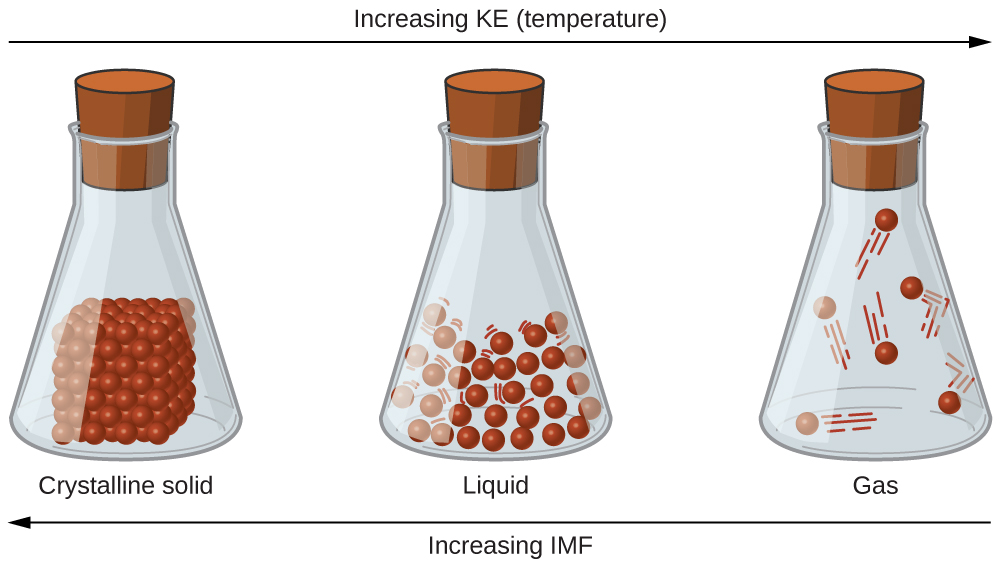

Figure 10.2図 10.2
Transitions between solid, liquid, and gaseous states of a substance occur when conditions of temperature or pressure favor the associated changes in intermolecular forces. (Note: The space between particles in the gas phase is much greater than shown.)
物質の固体、液体、気体の間の転移は、それに伴う分子間力の変化が起こりやすい温度や圧力の条件で生じる。(注:気相の粒子間の距離は、図示したものよりはるかに大きい。)
As an example of the processes depicted in this figure, consider a sample of water. When gaseous water is cooled sufficiently, the attractions between H2O molecules will be capable of holding them together when they come into contact with each other; the gas condenses, forming liquid H2O. For example, liquid water forms on the outside of a cold glass as the water vapor in the air is cooled by the cold glass, as seen in Figure 10.3.
英語のヒント
この図で示した過程の例として、水を考えよう。気体の水を十分に冷やすと、H2O分子同士が接触した際に、分子間引力によって一緒にとどまれるようになる。つまり、気体が凝縮して液体のH2Oになる。例えば図10.3のように、空気中の水蒸気が冷たいコップによって冷やされると、コップの外側に液体の水が生じる。
Image omitted because its reuse rights could not be verified.権利の確認ができないため画像を割愛。
Figure 10.3図 10.3
Condensation forms when water vapor in the air is cooled enough to form liquid water, such as (a) on the outside of a cold beverage glass or (b) in the form of fog. (credit a: modification of work by Jenny Downing; credit b: modification of work by Cory Zanker)
空気中の水蒸気が液体の水になるほど十分に冷やされると、凝縮が起こる。例えば、(a) 冷たい飲み物のコップの外側や、(b) 霧として見られる。(クレジットa:Jenny Downingの作品を改変;b:Cory Zankerの作品を改変)
We can also liquefy many gases by compressing them, if the temperature is not too high. The increased pressure brings the molecules of a gas closer together, such that the attractions between the molecules become strong relative to their KE. Consequently, they form liquids. Butane, C4H10, is the fuel used in disposable lighters and is a gas at standard temperature and pressure. Inside the lighter’s fuel compartment, the butane is compressed to a pressure that results in its condensation to the liquid state, as shown in Figure 10.4.
英語のヒント
温度が高すぎなければ、多くの気体は圧縮しても液化できる。圧力を上げると気体分子が近づき、その運動エネルギーに比べて分子間引力が強くなる。その結果、液体になる。使い捨てライターの燃料であるブタンC4H10は、標準温度・標準圧力では気体である。ライターの燃料室では、ブタンは凝縮して液体になる圧力まで圧縮されている(図10.4)。
Image omitted because its reuse rights could not be verified.権利の確認ができないため画像を割愛。
Figure 10.4図 10.4
Gaseous butane is compressed within the storage compartment of a disposable lighter, resulting in its condensation to the liquid state. (credit: modification of work by “Sam-Cat”/Flickr)
使い捨てライターの貯蔵室内では、気体のブタンが圧縮され、凝縮して液体になっている。(クレジット:「Sam-Cat」/Flickrの作品を改変)
Finally, if the temperature of a liquid becomes sufficiently low, or the pressure on the liquid becomes sufficiently high, the molecules of the liquid no longer have enough KE to overcome the IMF between them, and a solid forms. A more thorough discussion of these and other changes of state, or phase transitions, is provided in a later module of this chapter.
英語のヒント
最後に、液体の温度が十分に低くなるか、液体にかかる圧力が十分に高くなると、液体分子は分子間力に打ち勝つだけの運動エネルギーを持たなくなり、固体ができる。これらを含む状態変化、つまり相転移については、この章の後の節でさらに詳しく説明する。