第10章液体と固体
Calculation of Ionic Radiiイオン半径の計算
If we know the edge length of a unit cell of an ionic compound and the position of the ions in the cell, we can calculate ionic radii for the ions in the compound if we make assumptions about individual ionic shapes and contacts.
イオン化合物の単位格子の辺の長さとイオンの位置がわかれば、個々のイオンの形と接し方を仮定することによって、その化合物中のイオン半径を計算できる。
Example 10.18例題 10.18
Calculation of Ionic Radiiイオン半径の計算
The edge length of the unit cell of LiCl (NaCl-like structure, FCC) is 0.514 nm or 5.14 Å. Assuming that the lithium ion is small enough so that the chloride ions are in contact, as in Figure 10.61, calculate the ionic radius for the chloride ion.
LiCl(NaCl型のFCC構造)の単位格子の辺の長さは0.514 nm、すなわち5.14 Åである。リチウムイオンは十分に小さく、図10.61のように塩化物イオンどうしが接していると仮定して、塩化物イオンの半径を計算しなさい。
Note: The length unit angstrom, Å, is often used to represent atomic-scale dimensions and is equivalent to 10−10 m.
注:長さの単位オングストロームÅは、原子規模の寸法を表すのによく用いられ、10−10 mに等しい。
Solution解法
On the face of a LiCl unit cell, chloride ions contact each other across the diagonal of the face:
LiClの単位格子の面では、塩化物イオンどうしが面対角線上で接している。
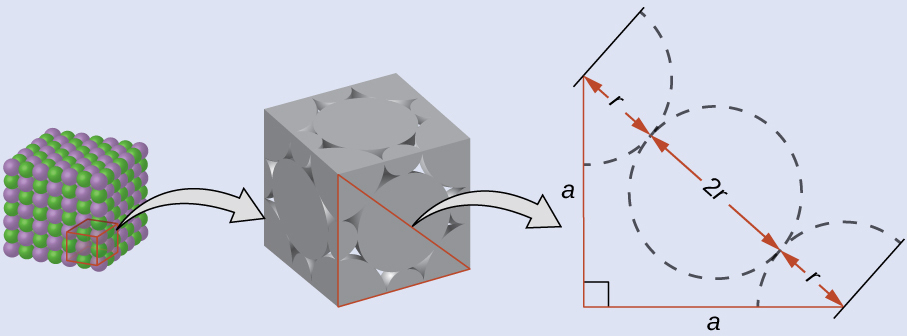
Drawing a right triangle on the face of the unit cell, we see that the length of the diagonal is equal to four chloride radii (one radius from each corner chloride and one diameter—which equals two radii—from the chloride ion in the center of the face), so d = 4r. From the Pythagorean theorem, we have:
単位格子の面に直角三角形を描くと、対角線の長さは塩化物イオンの半径4個分に等しいとわかる。両端の頂点の塩化物イオンから半径一つ分ずつ、面の中心の塩化物イオンから直径一つ分、すなわち半径二つ分が寄与するためである。したがって、d=4r。ピタゴラスの定理から、次の式が得られる。
which yields:
これより、次のようになる。
Solving this gives:
これを解くと、次の値が得られる。
Check Your Learning理解を確かめよう
The edge length of the unit cell of KCl (NaCl-like structure, FCC) is 6.28 Å. Assuming anion-cation contact along the cell edge, calculate the radius of the potassium ion. The radius of the chloride ion is 1.82 Å.
KCl(NaCl型のFCC構造)の単位格子の辺の長さは6.28 Åである。陰イオンと陽イオンが辺に沿って接していると仮定し、カリウムイオンの半径を求めなさい。塩化物イオンの半径は1.82 Åである。
It is important to realize that values for ionic radii calculated from the edge lengths of unit cells depend on numerous assumptions, such as a perfect spherical shape for ions, which are approximations at best. Hence, such calculated values are themselves approximate and comparisons cannot be pushed too far. Nevertheless, this method has proved useful for calculating ionic radii from experimental measurements such as X-ray crystallographic determinations.
英語のヒント
単位格子の辺の長さから計算したイオン半径は、イオンが完全な球形であることなど、多くの仮定に依存する。これらの仮定は、よくても近似にすぎないと理解しておくことが重要である。したがって、計算値自体も近似値であり、比較をあまり細かいところまで押し進めることはできない。それでも、X線結晶構造解析などの実験測定からイオン半径を計算する方法として、有用であることがわかっている。
X-Ray CrystallographyX線結晶構造解析
The size of the unit cell and the arrangement of atoms in a crystal may be determined from measurements of the diffraction of X-rays by the crystal, termed X-ray crystallography. Diffraction is the change in the direction of travel experienced by an electromagnetic wave when it encounters a physical barrier whose dimensions are comparable to those of the wavelength of the light. X-rays are electromagnetic radiation with wavelengths about as long as the distance between neighboring atoms in crystals (on the order of a few Å).
英語のヒント
結晶の単位格子の大きさと原子の配列は、結晶によるX線の回折を測定することで決定できる。この方法をX線結晶構造解析という。回折とは、電磁波が、その波長と同程度の大きさを持つ障害物に出会ったときに進行方向を変える現象である。X線は、結晶中の隣接原子間の距離と同程度の波長、数Å程度の波長を持つ電磁波である。
When a beam of monochromatic X-rays strikes a crystal, its rays are scattered in all directions by the atoms within the crystal. When scattered waves traveling in the same direction encounter one another, they undergo interference, a process by which the waves combine to yield either an increase or a decrease in amplitude (intensity) depending upon the extent to which the combining waves’ maxima are separated (see Figure 10.64).
英語のヒント
単色X線のビームが結晶に当たると、X線は結晶中の原子によってあらゆる方向へ散乱される。同じ方向に進む散乱波が重なり合うと、干渉が起こる。これは波が合成され、その振幅(強度)が増加または減少する現象である。どちらになるかは、重なる波の山どうしのずれの程度によって決まる(図10.64参照)。
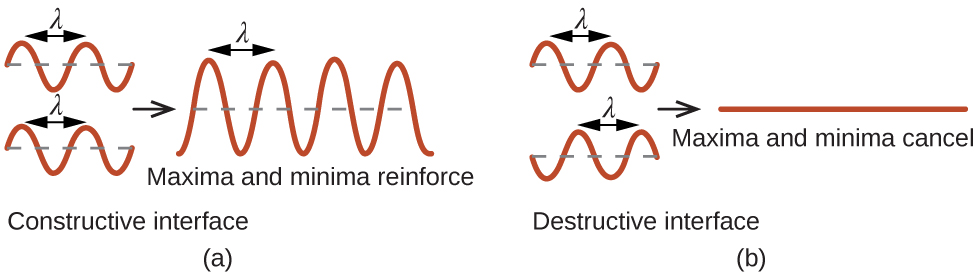
Figure 10.64図 10.64
Light waves occupying the same space experience interference, combining to yield waves of greater (a) or lesser (b) intensity, depending upon the separation of their maxima and minima.
同じ空間を占める光の波は干渉し、山と谷のずれに応じて、強度の大きい波(a)または小さい波(b)へ合成される。
When X-rays of a certain wavelength, λ, are scattered by atoms in adjacent crystal planes separated by a distance, d, they may undergo constructive interference when the difference between the distances traveled by the two waves prior to their combination is an integer factor, n, of the wavelength. This condition is satisfied when the angle of the diffracted beam, θ, is related to the wavelength and interatomic distance by the equation:
英語のヒント
波長λのX線が、距離dだけ離れた隣接結晶面の原子で散乱されるとき、二つの波が合成されるまでに進む距離の差が、波長の整数n倍であれば、強め合う干渉が起こり得る。この条件は、回折ビームの角度θ、波長、原子間距離が次の式の関係を満たすときに成立する。
This relation is known as the Bragg equation in honor of W. H. Bragg, the English physicist who first explained this phenomenon. Figure 10.65 illustrates two examples of diffracted waves from the same two crystal planes. The figure on the top depicts waves diffracted at the Bragg angle, resulting in constructive interference, while that on the bottom shows diffraction and a different angle that does not satisfy the Bragg condition, resulting in destructive interference.
英語のヒント
この関係は、この現象を初めて説明した英国の物理学者W・H・ブラッグにちなみ、ブラッグの式と呼ばれる。図10.65は、同じ二つの結晶面からの回折波の二例を示す。上の図ではブラッグ角で回折が起こり、強め合う干渉が生じる。下の図ではブラッグの条件を満たさない別の角度で回折が起こり、弱め合う干渉が生じる。
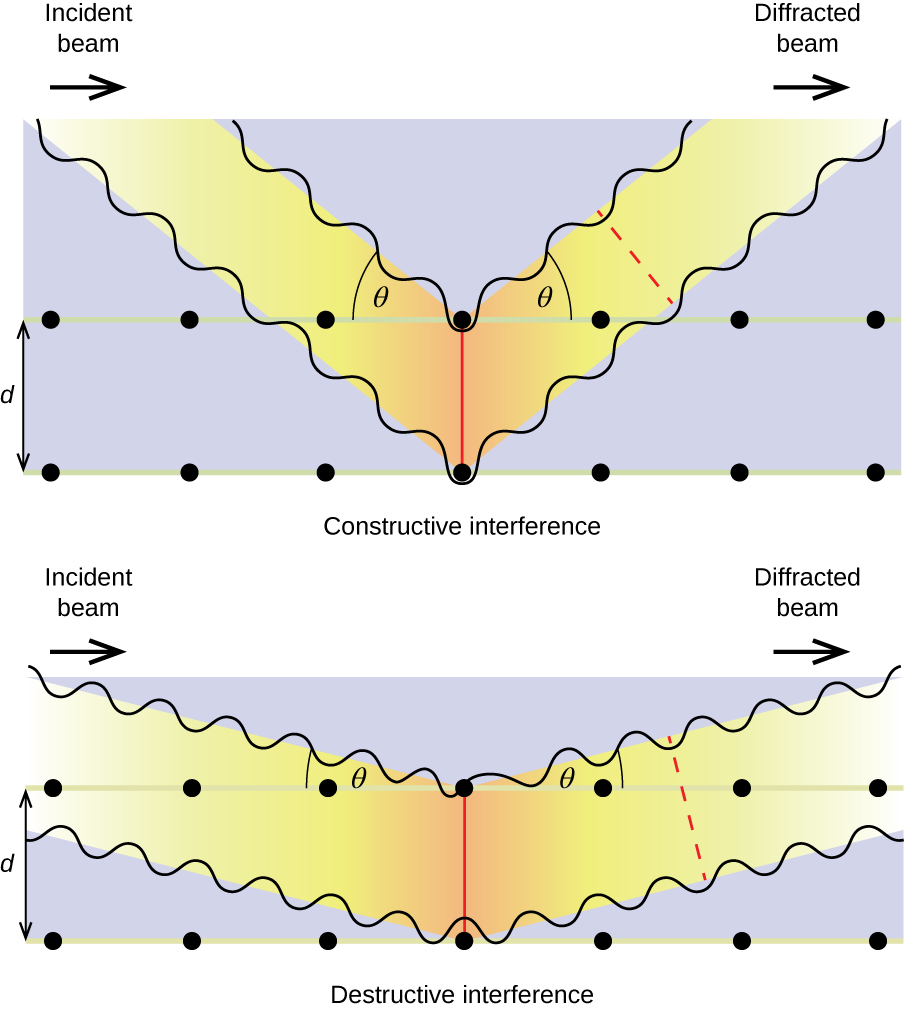
Figure 10.65図 10.65
The diffraction of X-rays scattered by the atoms within a crystal permits the determination of the distance between the atoms. The top image depicts constructive interference between two scattered waves and a resultant diffracted wave of high intensity. The bottom image depicts destructive interference and a low intensity diffracted wave.
結晶中の原子で散乱されたX線の回折から、原子間距離を決定できる。上の図は、二つの散乱波が強め合い、強度の高い回折波を生む様子を示す。下の図は、弱め合う干渉と、強度の低い回折波を示す。
An X-ray diffractometer, such as the one illustrated in Figure 10.66, may be used to measure the angles at which X-rays are diffracted when interacting with a crystal as described earlier. From such measurements, the Bragg equation may be used to compute distances between atoms as demonstrated in the following example exercise.
英語のヒント
図10.66のようなX線回折装置を使うと、先に述べたように、X線が結晶と相互作用して回折する角度を測定できる。この測定値からブラッグの式を使って原子間距離を計算する方法を、次の例題に示す。
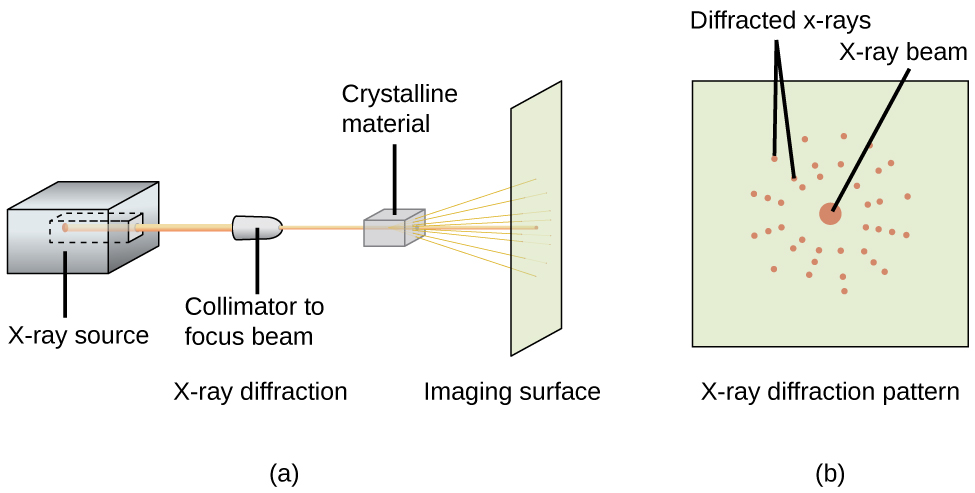


Figure 10.66図 10.66
(a) In a diffractometer, a beam of X-rays strikes a crystalline material, producing (b) an X-ray diffraction pattern that can be analyzed to determine the crystal structure.
(a) 回折装置では、X線ビームを結晶性物質に当て、(b) X線回折パターンを得る。そのパターンを解析して結晶構造を決定できる。
Example 10.19例題 10.19
Using the Bragg Equationブラッグの式を使う
In a diffractometer, X-rays with a wavelength of 0.1315 nm were used to produce a diffraction pattern for copper. The first order diffraction (n = 1) occurred at an angle θ = 25.25°. Determine the spacing between the diffracting planes in copper.
回折装置で、波長0.1315 nmのX線を用いて銅の回折パターンを得た。一次の回折(n=1)は角度θ=25.25°で起こった。銅の回折面間の距離を求めなさい。
Solution解法
The distance between the planes is found by solving the Bragg equation, nλ = 2d sin θ, for d.
面間距離は、ブラッグの式nλ=2d sin θをdについて解くことで求められる。
This gives:
これより、となる。
Check Your Learning理解を確かめよう
A crystal with spacing between planes equal to 0.394 nm diffracts X-rays with a wavelength of 0.147 nm. What is the angle for the first order diffraction?
面間距離が0.394 nmの結晶によって、波長0.147 nmのX線が回折される。一次の回折が起こる角度はいくらか。