第10章液体と固体
Sublimation and Deposition昇華と凝華
Some solids can transition directly into the gaseous state, bypassing the liquid state, via a process known as sublimation. At room temperature and standard pressure, a piece of dry ice (solid CO2) sublimes, appearing to gradually disappear without ever forming any liquid. Snow and ice sublime at temperatures below the melting point of water, a slow process that may be accelerated by winds and the reduced atmospheric pressures at high altitudes. When solid iodine is warmed, the solid sublimes and a vivid purple vapor forms (Figure 10.28). The reverse of sublimation is called deposition, a process in which gaseous substances condense directly into the solid state, bypassing the liquid state. The formation of frost is an example of deposition.
英語のヒント
固体の中には、昇華という過程によって、液体を経由せずに直接気体へ移行するものがある。室温・標準圧力では、ドライアイス(固体CO2)のかけらは昇華し、液体を作ることなく徐々に消えていくように見える。雪や氷も水の融点より低い温度で昇華する。この遅い過程は、風や、高地での低い大気圧によって速められることがある。固体のヨウ素を暖めると昇華し、鮮やかな紫色の蒸気ができる(図10.28)。昇華の逆は凝華といい、気体物質が液体を経ずに直接固体になる過程である。霜のできる現象は凝華の一例である。
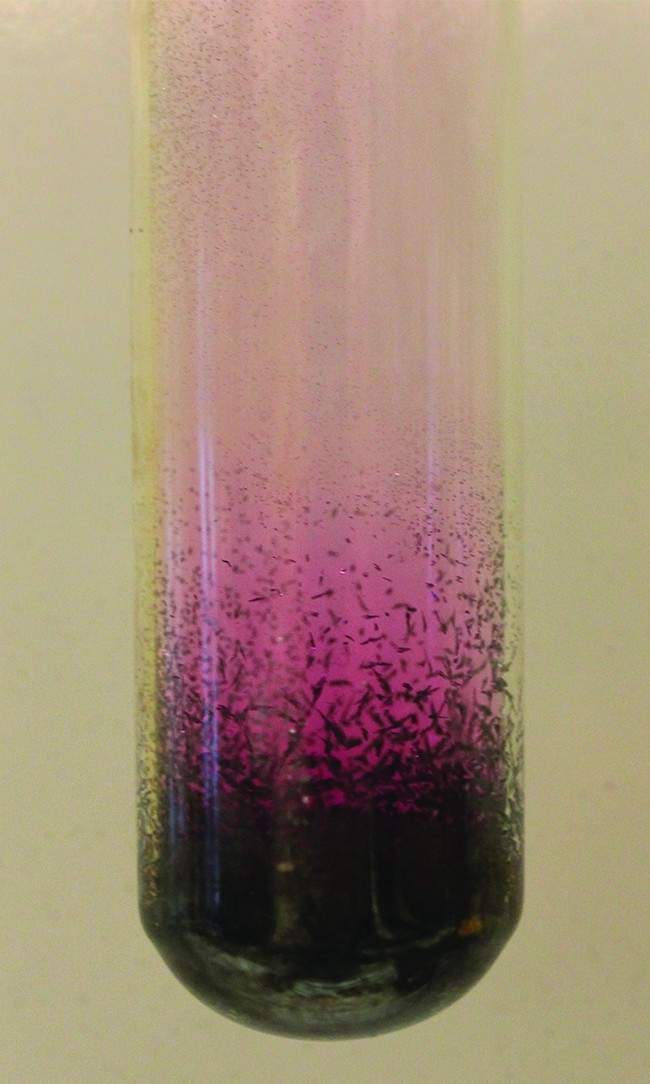
Figure 10.28図 10.28
Sublimation of solid iodine in the bottom of the tube produces a purple gas that subsequently deposits as solid iodine on the colder part of the tube above. (credit: modification of work by Mark Ott)
試験管の底の固体ヨウ素が昇華して紫色の気体を生じ、その後、上方のより冷たい部分に固体のヨウ素として凝華する。(クレジット:Mark Ottの作品を改変)
Like vaporization, the process of sublimation requires an input of energy to overcome intermolecular attractions. The enthalpy of sublimation, ΔHsub, is the energy required to convert one mole of a substance from the solid to the gaseous state. For example, the sublimation of carbon dioxide is represented by:
気化と同じく、昇華には分子間引力に打ち勝つためのエネルギーの供給が必要である。昇華エンタルピーΔHsubは、物質1 molを固体から気体に変えるのに必要なエネルギーである。例えば、二酸化炭素の昇華は次のように表される。
Likewise, the enthalpy change for the reverse process of deposition is equal in magnitude but opposite in sign to that for sublimation:
同様に、逆の過程である凝華のエンタルピー変化は、昇華と大きさが等しく符号が逆である。
Consider the extent to which intermolecular attractions must be overcome to achieve a given phase transition. Converting a solid into a liquid requires that these attractions be only partially overcome; transition to the gaseous state requires that they be completely overcome. As a result, the enthalpy of fusion for a substance is less than its enthalpy of vaporization. This same logic can be used to derive an approximate relation between the enthalpies of all phase changes for a given substance. Though not an entirely accurate description, sublimation may be conveniently modeled as a sequential two-step process of melting followed by vaporization in order to apply Hess’s Law. Viewed in this manner, the enthalpy of sublimation for a substance may be estimated as the sum of its enthalpies of fusion and vaporization, as illustrated in Figure 10.29. For example:
英語のヒント
ある相転移を起こすために、分子間引力にどの程度打ち勝つ必要があるか考えよう。固体を液体に変えるには、引力に部分的に打ち勝つだけでよいが、気体への移行では完全に打ち勝つ必要がある。そのため、物質の融解エンタルピーは蒸発エンタルピーより小さい。同じ考え方で、ある物質のすべての相変化のエンタルピーの間に、近似的な関係を導ける。完全に正確な記述ではないものの、ヘスの法則を適用するため、昇華を、融解に続いて気化する2段階の過程として扱うと便利である。この見方では、図10.29のように、物質の昇華エンタルピーを融解エンタルピーと蒸発エンタルピーの和として見積もれる。例えば、
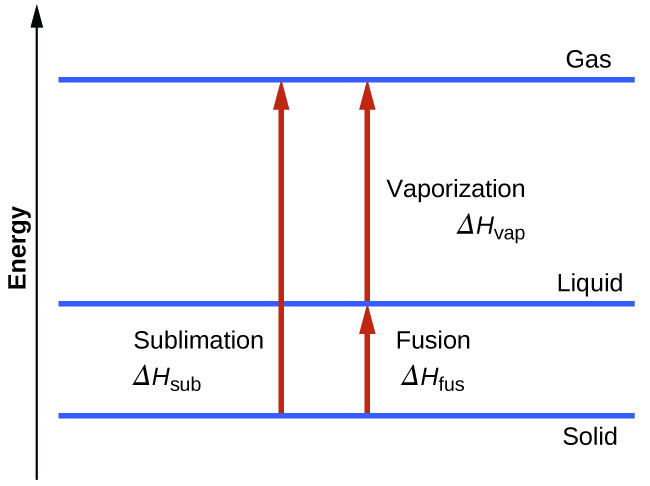
Figure 10.29図 10.29
For a given substance, the sum of its enthalpy of fusion and enthalpy of vaporization is approximately equal to its enthalpy of sublimation.
ある物質の融解エンタルピーと蒸発エンタルピーの和は、昇華エンタルピーにほぼ等しい。
Heating and Cooling Curves加熱曲線と冷却曲線
In the chapter on thermochemistry, the relation between the amount of heat absorbed or released by a substance, q, and its accompanying temperature change, ΔT, was introduced:
熱化学の章では、物質が吸収または放出する熱量qと、それに伴う温度変化ΔTの関係を紹介した。
where m is the mass of the substance and c is its specific heat. The relation applies to matter being heated or cooled, but not undergoing a change in state. When a substance being heated or cooled reaches a temperature corresponding to one of its phase transitions, further gain or loss of heat is a result of diminishing or enhancing intermolecular attractions, instead of increasing or decreasing molecular kinetic energies. While a substance is undergoing a change in state, its temperature remains constant. Figure 10.30 shows a typical heating curve.
英語のヒント
ここで、mは物質の質量、cは比熱である。この関係は、加熱または冷却されるが状態変化は起こしていない物質に当てはまる。加熱や冷却によって相転移の温度に達すると、その後の熱の出入りは、分子の運動エネルギーの増減ではなく、分子間引力を弱めたり強めたりすることによるものとなる。物質が状態変化を起こしている間、温度は一定である。典型的な加熱曲線を図10.30に示す。
Consider the example of heating a pot of water to boiling. A stove burner will supply heat at a roughly constant rate; initially, this heat serves to increase the water’s temperature. When the water reaches its boiling point, the temperature remains constant despite the continued input of heat from the stove burner. This same temperature is maintained by the water as long as it is boiling. If the burner setting is increased to provide heat at a greater rate, the water temperature does not rise, but instead the boiling becomes more vigorous (rapid). This behavior is observed for other phase transitions as well: For example, temperature remains constant while the change of state is in progress.
英語のヒント
鍋の水を沸騰するまで加熱する例を考えよう。コンロはほぼ一定の速さで熱を供給し、最初はその熱によって水温が上がる。沸点に達すると、コンロから熱が供給され続けても温度は一定になる。水は沸騰しているかぎり、この温度を保つ。火力を上げて熱の供給を速めても、水温は上がらず、代わりに沸騰が激しく、速くなる。この振る舞いはほかの相転移でも見られ、例えば状態変化が進行している間は温度が一定に保たれる。
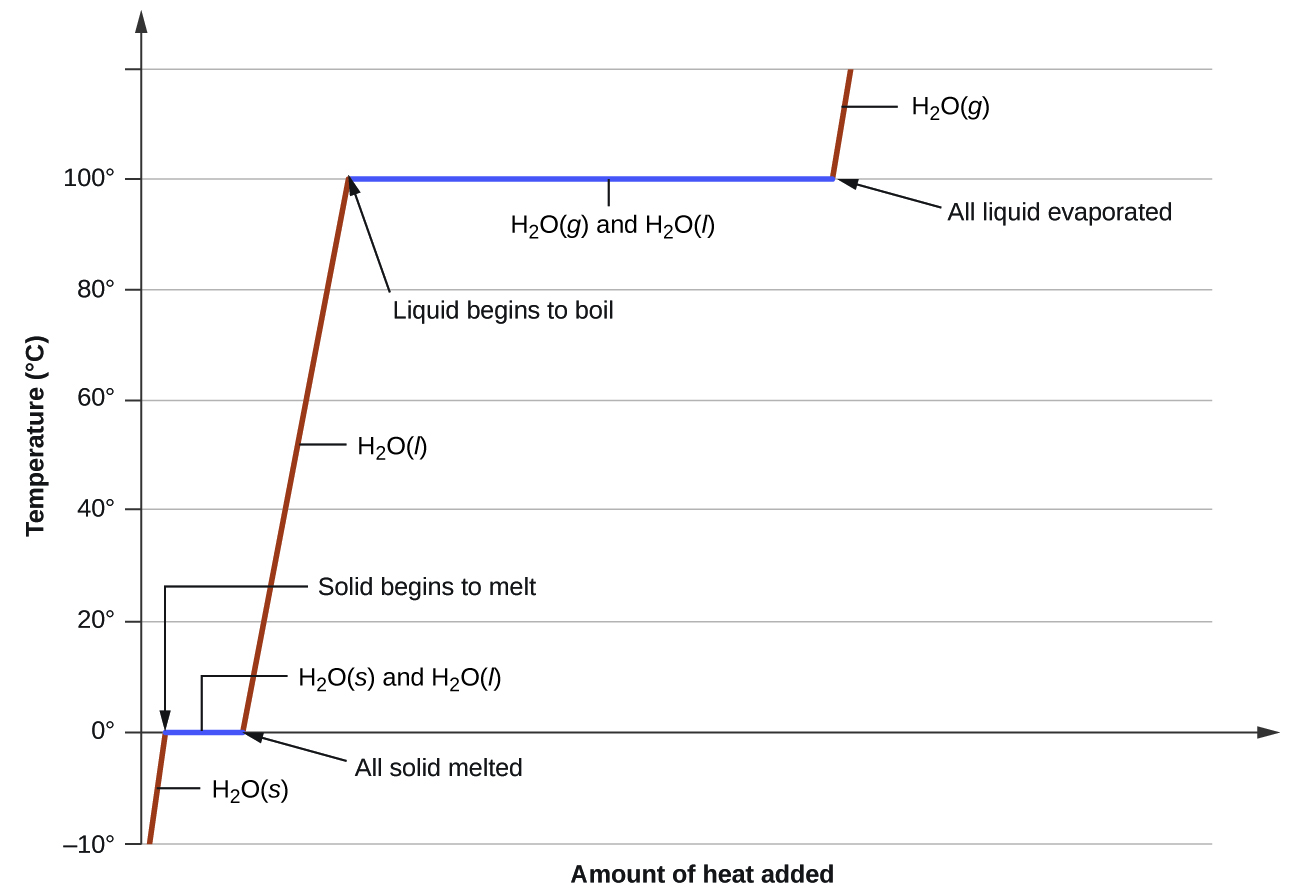


Figure 10.30図 10.30
A typical heating curve for a substance depicts changes in temperature that result as the substance absorbs increasing amounts of heat. Plateaus in the curve (regions of constant temperature) are exhibited when the substance undergoes phase transitions.
英語のヒント
典型的な加熱曲線は、物質が吸収した熱量が増えるにつれ、温度がどう変わるかを示す。相転移を起こすときには、曲線に平坦部、すなわち温度が一定の区間が現れる。
Example 10.10例題 10.10
Total Heat Needed to Change Temperature and Phase for a Substance物質の温度と相を変えるのに必要な総熱量
How much heat is required to convert 135 g of ice at −15 °C into water vapor at 120 °C?
−15 °Cの氷135 gを、120 °Cの水蒸気に変えるには、どれだけの熱が必要か。
Solution解法
The transition described involves the following steps:
この変化は、次の段階からなる。
- Heat ice from −15 °C to 0 °C氷を−15 °Cから0 °Cまで加熱する。
- Melt ice氷を融かす。
- Heat water from 0 °C to 100 °C水を0 °Cから100 °Cまで加熱する。
- Boil water水を沸騰させる。
- Heat steam from 100 °C to 120 °C水蒸気を100 °Cから120 °Cまで加熱する。
The heat needed to change the temperature of a given substance (with no change in phase) is: q = m c ΔT (see previous chapter on thermochemistry). The heat needed to induce a given change in phase is given by q = n ΔH.
相を変えずに物質の温度を変えるための熱量は、q = m c ΔTである(前の熱化学の章を参照)。相変化を起こすための熱量は、q = n ΔHで与えられる。
Using these equations with the appropriate values for specific heat of ice, water, and steam, and enthalpies of fusion and vaporization, we have:
これらの式に、氷、水、水蒸気の比熱、および融解・蒸発エンタルピーの適切な値を用いると、次のようになる。
Converting the quantities in J to kJ permits them to be summed, yielding the total heat required:
Jで表された量をkJに換算すると足し合わせられ、必要な総熱量が得られる。
NOTE: The value of ΔHvap at the boiling point of water (40.67 kJ/mol) is used here instead of the value at standard temperature (44.01 kJ/mol).
注:ここではΔHvapとして、標準温度での値44.01 kJ/molではなく、水の沸点での値40.67 kJ/molを用いる。
Check Your Learning理解度の確認
What is the total amount of heat released when 94.0 g water at 80.0 °C cools to form ice at −30.0 °C?
80.0 °Cの水94.0 gが冷えて−30.0 °Cの氷になるとき、放出される熱の総量はいくらか。