第10章液体と固体
Molecular Solid分子結晶
Molecular solids, such as ice, sucrose (table sugar), and iodine, as shown in Figure 10.43, are composed of neutral molecules. The strengths of the attractive forces between the units present in different crystals vary widely, as indicated by the melting points of the crystals. Small symmetrical molecules (nonpolar molecules), such as H2, N2, O2, and F2, have weak attractive forces and form molecular solids with very low melting points (below −200 °C). Substances consisting of larger, nonpolar molecules have larger attractive forces and melt at higher temperatures. Molecular solids composed of molecules with permanent dipole moments (polar molecules) melt at still higher temperatures. Examples include ice (melting point, 0 °C) and table sugar (melting point, 185 °C).
英語のヒント
氷、スクロース(砂糖)、ヨウ素などの分子結晶は、図10.43のように、中性の分子からできている。異なる結晶で構成単位間に働く引力の強さは、融点の違いが示すように、大きく異なる。H2、N2、O2、F2などの小さく対称な分子(無極性分子)では引力が弱く、融点が非常に低い(−200 °C未満)分子結晶を作る。より大きな無極性分子からなる物質では引力が強く、融ける温度も高い。永久双極子モーメントを持つ分子(極性分子)からなる分子結晶は、さらに高い温度で融ける。その例が氷(融点0 °C)や砂糖(融点185 °C)である。
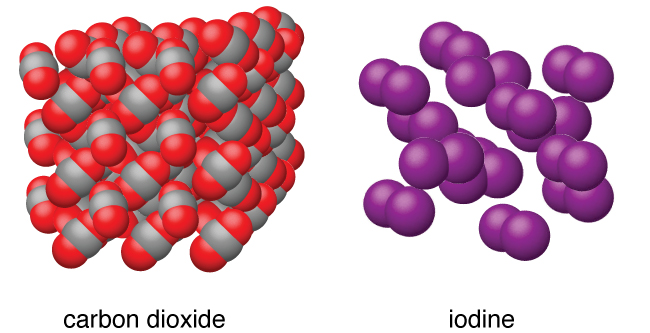

Figure 10.43図 10.43
Carbon dioxide (CO2) consists of small, nonpolar molecules and forms a molecular solid with a melting point of −78 °C. Iodine (I2) consists of larger, nonpolar molecules and forms a molecular solid that melts at 114 °C.
二酸化炭素(CO2)は小さな無極性分子からなり、融点−78 °Cの分子結晶を作る。ヨウ素(I2)はより大きな無極性分子からなり、114 °Cで融ける分子結晶を作る。
Properties of Solids固体の性質
A crystalline solid, like those listed in Table 10.4, has a precise melting temperature because each atom or molecule of the same type is held in place with the same forces or energy. Thus, the attractions between the units that make up the crystal all have the same strength and all require the same amount of energy to be broken. The gradual softening of an amorphous material differs dramatically from the distinct melting of a crystalline solid. This results from the structural nonequivalence of the molecules in the amorphous solid. Some forces are weaker than others, and when an amorphous material is heated, the weakest intermolecular attractions break first. As the temperature is increased further, the stronger attractions are broken. Thus amorphous materials soften over a range of temperatures.
英語のヒント
表10.4に挙げたような結晶性固体は、同じ種類の原子や分子が同じ力、すなわち同じエネルギーでその位置に保たれているため、融ける温度が明確に定まっている。したがって、結晶を作る構成単位間の引力はどれも同じ強さであり、切り離すのに同じ量のエネルギーを要する。非晶質の物質が徐々に軟らかくなる様子は、結晶性固体が明確に融ける様子と大きく異なる。これは、非晶質固体の分子が構造上等価でないためである。力の強さに違いがあり、加熱すると最も弱い分子間引力から先に切れる。さらに温度を上げると、より強い引力が切れる。このため、非晶質の物質はある温度範囲にわたって軟化する。
Types of Crystalline Solids and Their Properties 結晶性固体の種類と性質 |
||||
|---|---|---|---|---|
Type of Solid 固体の種類 |
Type of Particles 粒子の種類 |
Type of Attractions 引力の種類 |
Properties 性質 |
Examples 例 |
ionic イオン結晶 |
ions イオン |
ionic bonds イオン結合 |
hard, brittle, conducts electricity as a liquid but not as a solid, high to very high melting points 硬く、もろい。液体では電気を通すが、固体では通さない。融点は高いか、非常に高い。 |
NaCl, Al2O3 NaCl、Al2O3 |
metallic 金属結晶 |
atoms of electropositive elements 陽性元素の原子 |
metallic bonds 金属結合 |
shiny, malleable, ductile, conducts heat and electricity well, variable hardness and melting temperature 光沢があり、展性と延性を持つ。熱と電気をよく通す。硬さと融点はさまざまである。 |
Cu, Fe, Ti, Pb, U Cu、Fe、Ti、Pb、U |
covalent network 共有結合の網目構造 |
atoms of electronegative elements 陰性元素の原子 |
covalent bonds 共有結合 |
very hard, not conductive, very high melting points 非常に硬く、電気を通さない。融点は非常に高い。 |
C (diamond), SiO2, SiC C(ダイヤモンド)、SiO2、SiC |
molecular 分子結晶 |
molecules (or atoms) 分子(または原子) |
IMFs 分子間力 |
variable hardness, variable brittleness, not conductive, low melting points 硬さともろさはさまざま。電気を通さず、融点は低い。 |
H2O, CO2, I2, C12H22O11 H2O、CO2、I2、C12H22O11 |