第10章液体と固体
Dipole-Dipole Attractions双極子間引力
Recall from the chapter on chemical bonding and molecular geometry that polar molecules have a partial positive charge on one side and a partial negative charge on the other side of the molecule—a separation of charge called a dipole. Consider a polar molecule such as hydrogen chloride, HCl. In the HCl molecule, the more electronegative Cl atom bears the partial negative charge, whereas the less electronegative H atom bears the partial positive charge. An attractive force between HCl molecules results from the attraction between the positive end of one HCl molecule and the negative end of another. This attractive force is called a dipole-dipole attraction—the electrostatic force between the partially positive end of one polar molecule and the partially negative end of another, as illustrated in Figure 10.9.
英語のヒント
化学結合と分子の形の章で、極性分子は片側に部分的な正電荷、反対側に部分的な負電荷を持つことを学んだ。このような電荷の分離を双極子という。極性分子の例として塩化水素HClを考えよう。HCl分子では、電気陰性度の高いCl原子が部分的な負電荷を帯び、電気陰性度の低いH原子が部分的な正電荷を帯びる。一方のHCl分子の正の端と、もう一方の負の端との引き合いによって、分子間に引力が生じる。この引力を双極子間引力という。これは、図10.9に示すように、一つの極性分子の部分的に正の端と、別の極性分子の部分的に負の端との間の静電力である。
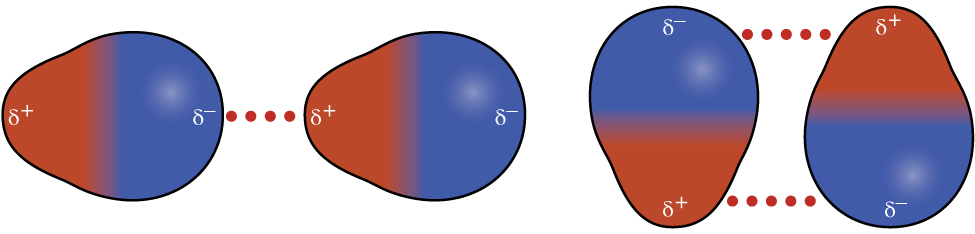
Figure 10.9図 10.9
This image shows two arrangements of polar molecules, such as HCl, that allow an attraction between the partial negative end of one molecule and the partial positive end of another.
HClのような極性分子について、一つの分子の部分的に負の端と別の分子の部分的に正の端との間に引力が働く、二つの配置を示している。
The effect of a dipole-dipole attraction is apparent when we compare the properties of HCl molecules to nonpolar F2 molecules. Both HCl and F2 consist of the same number of atoms and have approximately the same molecular mass. At a temperature of 150 K, molecules of both substances would have the same average KE. However, the dipole-dipole attractions between HCl molecules are sufficient to cause them to “stick together” to form a liquid, whereas the relatively weaker dispersion forces between nonpolar F2 molecules are not, and so this substance is gaseous at this temperature. The higher normal boiling point of HCl (188 K) compared to F2 (85 K) is a reflection of the greater strength of dipole-dipole attractions between HCl molecules, compared to the attractions between nonpolar F2 molecules. We will often use values such as boiling or freezing points, or enthalpies of vaporization or fusion, as indicators of the relative strengths of IMFs of attraction present within different substances.
英語のヒント
HCl分子の性質を、無極性のF2分子と比べると、双極子間引力の効果が明らかになる。HClとF2は原子数が同じで、分子質量もほぼ等しい。150 Kでは、両物質の分子は同じ平均運動エネルギーを持つと考えられる。しかし、HCl分子間の双極子間引力は、分子を「くっつけて」液体にするのに十分であるのに対し、無極性F2分子間の比較的弱い分散力にはそれだけの強さがなく、この物質はこの温度で気体になる。HClの標準沸点(188 K)がF2(85 K)より高いことは、HCl分子間の双極子間引力が、無極性F2分子間の引力より強いことを反映している。異なる物質中の分子間引力の相対的な強さを知る指標として、沸点、凝固点、蒸発エンタルピー、融解エンタルピーなどの値を用いることが多い。
Example 10.2例題 10.2
Dipole-Dipole Forces and Their Effects双極子間力とその効果
Predict which will have the higher boiling point: N2 or CO. Explain your reasoning.
N2とCOのどちらの沸点が高いか予測し、その理由を説明しなさい。
Solution解法
CO and N2 are both diatomic molecules with masses of about 28 amu, so they experience similar London dispersion forces. Because CO is a polar molecule, it experiences dipole-dipole attractions. Because N2 is nonpolar, its molecules cannot exhibit dipole-dipole attractions. The dipole-dipole attractions between CO molecules are comparably stronger than the dispersion forces between nonpolar N2 molecules, so CO is expected to have the higher boiling point.
COとN2はともに質量約28 amuの二原子分子なので、同程度のロンドン分散力を受ける。COは極性分子なので、双極子間引力も受ける。一方、N2は無極性なので、その分子間に双極子間引力は生じない。CO分子間の双極子間引力は、無極性N2分子間の分散力より比較的強いので、COの沸点のほうが高いと予想される。
Check Your Learning理解度の確認
Predict which will have the higher boiling point: ICl or Br2. Explain your reasoning.
IClとBr2のどちらの沸点が高いか予測し、その理由を説明しなさい。
Hydrogen Bonding水素結合
Nitrosyl fluoride (ONF, molecular mass 49 amu) is a gas at room temperature. Water (H2O, molecular mass 18 amu) is a liquid, even though it has a lower molecular mass. We clearly cannot attribute this difference between the two compounds to dispersion forces. Both molecules have about the same shape and ONF is the heavier and larger molecule. It is, therefore, expected to experience more significant dispersion forces. Additionally, we cannot attribute this difference in boiling points to differences in the dipole moments of the molecules. Both molecules are polar and exhibit comparable dipole moments. The large difference between the boiling points is due to a particularly strong dipole-dipole attraction that may occur when a molecule contains a hydrogen atom bonded to a fluorine, oxygen, or nitrogen atom (the three most electronegative elements). The very large difference in electronegativity between the H atom (2.1) and the atom to which it is bonded (4.0 for an F atom, 3.5 for an O atom, or 3.0 for a N atom), combined with the very small size of a H atom and the relatively small sizes of F, O, or N atoms, leads to highly concentrated partial charges with these atoms. Molecules with F-H, O-H, or N-H moieties are very strongly attracted to similar moieties in nearby molecules, a particularly strong type of dipole-dipole attraction called hydrogen bonding. Examples of hydrogen bonds include HF⋯HF, H2O⋯HOH, and H3N⋯HNH2, in which the hydrogen bonds are denoted by dots. Figure 10.10 illustrates hydrogen bonding between water molecules.
英語のヒント
フッ化ニトロシル(ONF、分子質量49 amu)は室温で気体である。水(H2O、分子質量18 amu)は、分子質量が小さいにもかかわらず液体である。この違いを分散力のせいにすることは明らかにできない。両分子はほぼ同じ形で、ONFのほうが重く大きい。したがって、ONFにはより大きな分散力が働くと予想される。また、沸点の違いを双極子モーメントの違いに帰することもできない。どちらの分子も極性を持ち、双極子モーメントは同程度である。沸点の大きな差は、分子内に、電気陰性度が最も高い三つの元素であるフッ素、酸素、窒素のいずれかに結合した水素原子があるときに生じうる、特に強い双極子間引力による。H原子(2.1)と、その結合相手の原子(Fは4.0、Oは3.5、Nは3.0)との電気陰性度の差は非常に大きい。このことと、H原子が非常に小さく、F、O、N原子も比較的小さいことが組み合わさり、これらの原子に部分電荷が強く集中する。F−H、O−H、N−Hの部分構造を持つ分子は、近くの分子にある同じような部分構造に非常に強く引き付けられる。この特に強い双極子間引力を水素結合という。水素結合の例には、HF⋯HF、H2O⋯HOH、H3N⋯HNH2があり、点で水素結合を表している。図10.10に、水分子間の水素結合を示す。
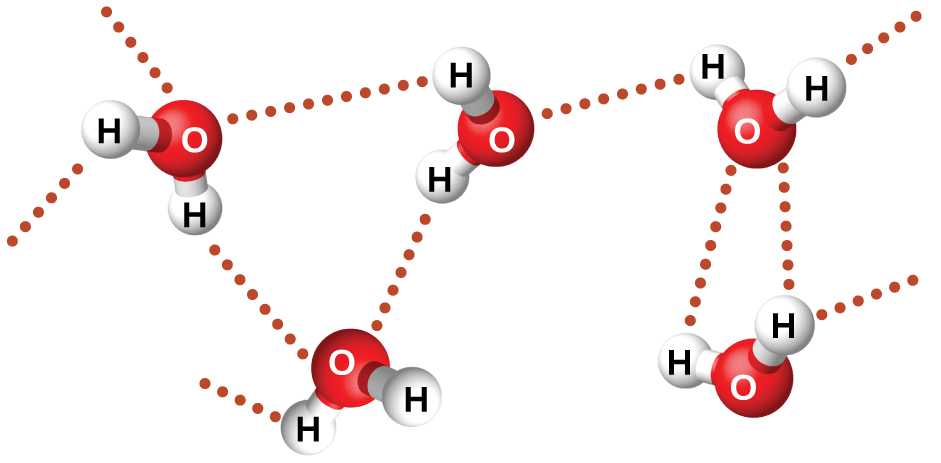
Figure 10.10図 10.10
Water molecules participate in multiple hydrogen-bonding interactions with nearby water molecules.
水分子は、近くの水分子との間で、複数の水素結合による相互作用に関与する。
Despite use of the word “bond,” keep in mind that hydrogen bonds are intermolecular attractive forces, not intramolecular attractive forces (covalent bonds). Hydrogen bonds are much weaker than covalent bonds, only about 5 to 10% as strong, but are generally much stronger than other dipole-dipole attractions and dispersion forces.
英語のヒント
「結合」という語を用いているが、水素結合は分子間の引力であり、分子内の引力(共有結合)ではないことを覚えておこう。水素結合は共有結合よりはるかに弱く、その強さは約5〜10%にすぎないが、一般にはほかの双極子間引力や分散力よりはるかに強い。
Hydrogen bonds have a pronounced effect on the properties of condensed phases (liquids and solids). For example, consider the trends in boiling points for the binary hydrides of group 15 (NH3, PH3, AsH3, and SbH3), group 16 hydrides (H2O, H2S, H2Se, and H2Te), and group 17 hydrides (HF, HCl, HBr, and HI). The boiling points of the heaviest three hydrides for each group are plotted in Figure 10.11. As we progress down any of these groups, the polarities of the molecules decrease slightly, whereas the sizes of the molecules increase substantially. The effect of increasingly stronger dispersion forces dominates that of increasingly weaker dipole-dipole attractions, and the boiling points are observed to increase steadily.
英語のヒント
水素結合は凝縮相(液体と固体)の性質に顕著な影響を及ぼす。例えば、15族の二元水素化物(NH3、PH3、AsH3、SbH3)、16族の水素化物(H2O、H2S、H2Se、H2Te)、17族の水素化物(HF、HCl、HBr、HI)の沸点の傾向を考えよう。各族の重いほうから三つの水素化物の沸点を図10.11に示す。どの族でも下へ進むにつれ、分子の極性は少し弱くなる一方、分子の大きさは大きく増す。次第に強くなる分散力の効果が、次第に弱くなる双極子間引力の効果を上回り、沸点は着実に高くなる。
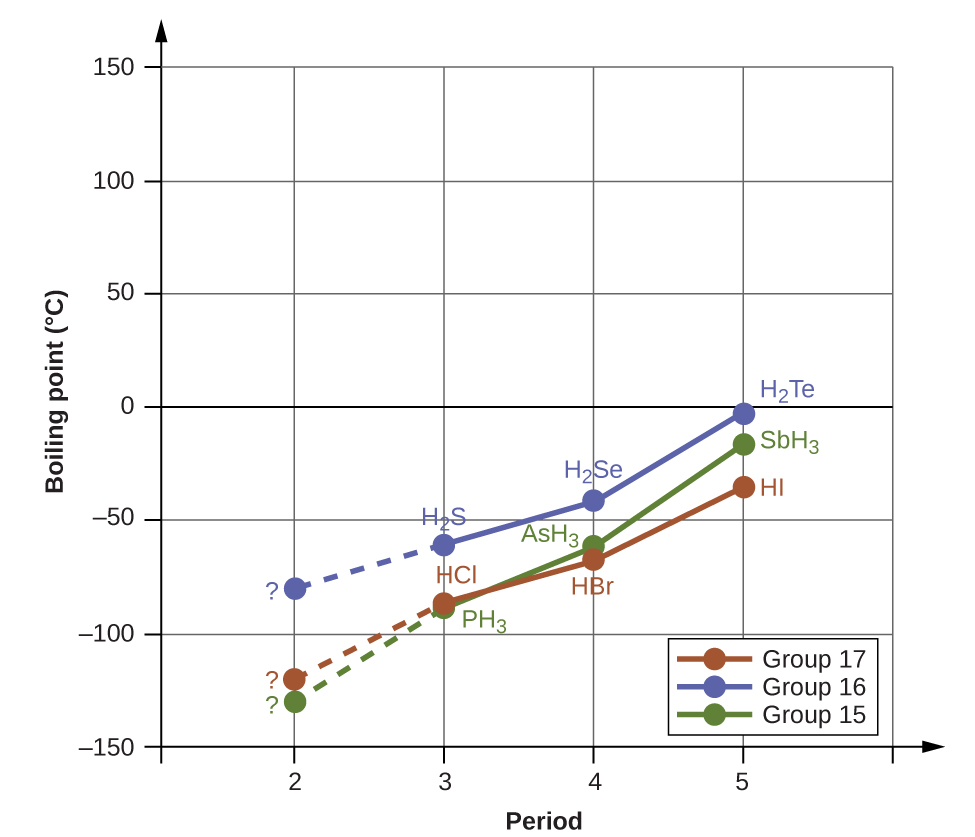
Figure 10.11図 10.11
For the group 15, 16, and 17 hydrides, the boiling points for each class of compounds increase with increasing molecular mass for elements in periods 3, 4, and 5.
15、16、17族の水素化物では、第3、4、5周期の元素からなる各系列の化合物は、分子質量が増すにつれて沸点が高くなる。
If we use this trend to predict the boiling points for the lightest hydride for each group, we would expect NH3 to boil at about −120 °C, H2O to boil at about −80 °C, and HF to boil at about −110 °C. However, when we measure the boiling points for these compounds, we find that they are dramatically higher than the trends would predict, as shown in Figure 10.12. The stark contrast between our naïve predictions and reality provides compelling evidence for the strength of hydrogen bonding.
英語のヒント
この傾向から各族の最も軽い水素化物の沸点を予測すると、NH3は約−120 °C、H2Oは約−80 °C、HFは約−110 °Cで沸騰すると考えられる。しかし実際に測定すると、図10.12のように、いずれの沸点もこの傾向からの予測より大幅に高い。この単純な予測と現実との鮮明な違いは、水素結合の強さを示す説得力のある証拠である。
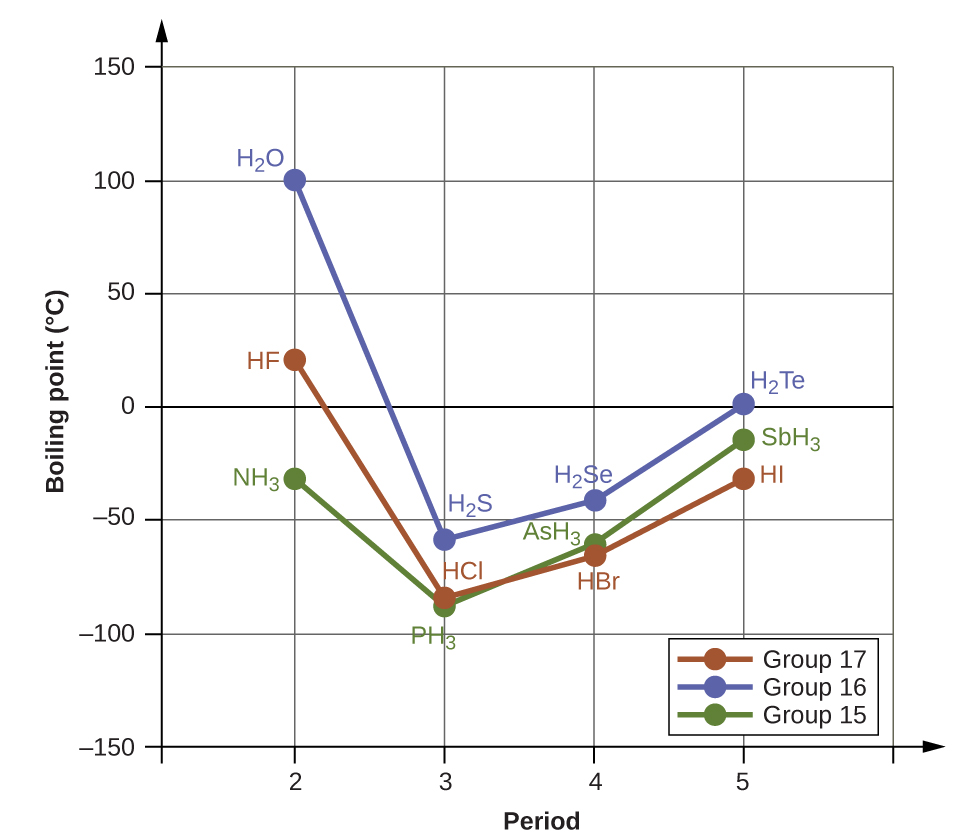


Figure 10.12図 10.12
In comparison to periods 3−5, the binary hydrides of period 2 elements in groups 17, 16 and 15 (F, O and N, respectively) exhibit anomalously high boiling points due to hydrogen bonding.
英語のヒント
第3〜5周期と比べると、17、16、15族の第2周期の元素(それぞれF、O、N)の二元水素化物は、水素結合のために異常に高い沸点を示す。
Example 10.3例題 10.3
Effect of Hydrogen Bonding on Boiling Points水素結合が沸点に及ぼす影響
Consider the compounds dimethylether (CH3OCH3), ethanol (CH3CH2OH), and propane (CH3CH2CH3). Their boiling points, not necessarily in order, are −42.1 °C, −24.8 °C, and 78.4 °C. Match each compound with its boiling point. Explain your reasoning.
ジメチルエーテル(CH3OCH3)、エタノール(CH3CH2OH)、プロパン(CH3CH2CH3)を考えよう。沸点は、必ずしもこの順ではないが、−42.1 °C、−24.8 °C、78.4 °Cである。各化合物と沸点を対応させ、理由を説明しなさい。
Solution解法
The VSEPR-predicted shapes of CH3OCH3, CH3CH2OH, and CH3CH2CH3 are similar, as are their molar masses (46 g/mol, 46 g/mol, and 44 g/mol, respectively), so they will exhibit similar dispersion forces. Since CH3CH2CH3 is nonpolar, it may exhibit only dispersion forces. Because CH3OCH3 is polar, it will also experience dipole-dipole attractions. Finally, CH3CH2OH has an −OH group, and so it will experience the uniquely strong dipole-dipole attraction known as hydrogen bonding. So the ordering in terms of strength of IMFs, and thus boiling points, is CH3CH2CH3 < CH3OCH3 < CH3CH2OH. The boiling point of propane is −42.1 °C, the boiling point of dimethylether is −24.8 °C, and the boiling point of ethanol is 78.5 °C.
VSEPR理論で予測されるCH3OCH3、CH3CH2OH、CH3CH2CH3の形は似ており、モル質量もそれぞれ46 g/mol、46 g/mol、44 g/molと近いので、同程度の分散力を示す。CH3CH2CH3は無極性なので、分散力だけを示す。CH3OCH3は極性があるため、双極子間引力も受ける。CH3CH2OHは−OH基を持つため、水素結合という特に強い双極子間引力を受ける。したがって、分子間力の強さ、ひいては沸点の順は、CH3CH2CH3 < CH3OCH3 < CH3CH2OHとなる。プロパンの沸点は−42.1 °C、ジメチルエーテルは−24.8 °C、エタノールは78.5 °Cである。
Check Your Learning理解度の確認
Ethane (CH3CH3) has a melting point of −183 °C and a boiling point of −89 °C. Predict the melting and boiling points for methylamine (CH3NH2). Explain your reasoning.
エタン(CH3CH3)の融点は−183 °C、沸点は−89 °Cである。メチルアミン(CH3NH2)の融点と沸点を予測し、その理由を説明しなさい。