第10章液体と固体
Unit Cells of Ionic Compoundsイオン化合物の単位格子
Many ionic compounds crystallize with cubic unit cells, and we will use these compounds to describe the general features of ionic structures.
多くのイオン化合物は立方単位格子を持つ結晶を作る。ここでは、それらを使ってイオン結晶構造の一般的な特徴を説明する。
When an ionic compound is composed of cations and anions of similar size in a 1:1 ratio, it typically forms a simple cubic structure. Cesium chloride, CsCl, (illustrated in Figure 10.60) is an example of this, with Cs+ and Cl− having radii of 174 pm and 181 pm, respectively. We can think of this as chloride ions forming a simple cubic unit cell, with a cesium ion in the center; or as cesium ions forming a unit cell with a chloride ion in the center; or as simple cubic unit cells formed by Cs+ ions overlapping unit cells formed by Cl− ions. Cesium ions and chloride ions touch along the body diagonals of the unit cells. One cesium ion and one chloride ion are present per unit cell, giving the 1:1 stoichiometry required by the formula for cesium chloride. Note that there is no lattice point in the center of the cell, and CsCl is not a BCC structure because a cesium ion is not identical to a chloride ion.
英語のヒント
大きさの似た陽イオンと陰イオンが1:1の比でできているイオン化合物は、通常、単純立方構造を作る。図10.60の塩化セシウムCsClがその例で、Cs+とCl−の半径はそれぞれ174 pmと181 pmである。この構造は、塩化物イオンが作る単純立方単位格子の中心にセシウムイオンがあると考えられる。逆に、セシウムイオンが作る単位格子の中心に塩化物イオンがあると考えてもよい。また、Cs+イオンが作る単純立方単位格子と、Cl−イオンが作る単位格子が重なったものとも考えられる。セシウムイオンと塩化物イオンは、単位格子の体対角線に沿って接する。単位格子あたり各イオンが1個ずつ含まれるため、塩化セシウムの化学式が要求する1:1の比になる。単位格子の中心には格子点がなく、CsClはBCC構造ではないことに注意しよう。セシウムイオンは塩化物イオンと同一ではないためである。
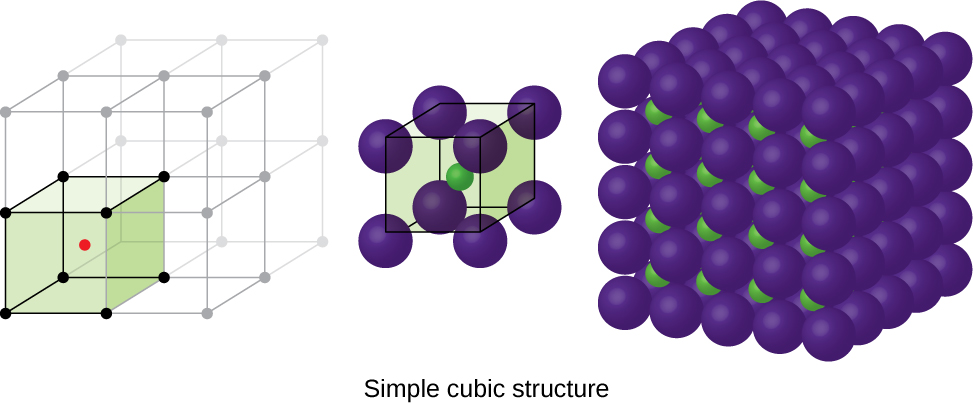
Figure 10.60図 10.60
Ionic compounds with similar-sized cations and anions, such as CsCl, usually form a simple cubic structure. They can be described by unit cells with either cations at the corners or anions at the corners.
CsClのように陽イオンと陰イオンの大きさが似たイオン化合物は、通常、単純立方構造を作る。頂点に陽イオンを置く単位格子でも、陰イオンを置く単位格子でも表せる。
We have said that the location of lattice points is arbitrary. This is illustrated by an alternate description of the CsCl structure in which the lattice points are located in the centers of the cesium ions. In this description, the cesium ions are located on the lattice points at the corners of the cell, and the chloride ion is located at the center of the cell. The two unit cells are different, but they describe identical structures.
英語のヒント
格子点の位置は任意に選べると述べた。CsCl構造で、セシウムイオンの中心に格子点を置く別の表し方が、そのことを示す。この表し方では、単位格子の頂点の格子点にセシウムイオンがあり、単位格子の中心に塩化物イオンがある。二つの単位格子は異なるが、表している構造は同じである。
When an ionic compound is composed of a 1:1 ratio of cations and anions that differ significantly in size, it typically crystallizes with an FCC unit cell, like that shown in Figure 10.61. Sodium chloride, NaCl, is an example of this, with Na+ and Cl− having radii of 102 pm and 181 pm, respectively. We can think of this as chloride ions forming an FCC cell, with sodium ions located in the octahedral holes in the middle of the cell edges and in the center of the cell. The sodium and chloride ions touch each other along the cell edges. The unit cell contains four sodium ions and four chloride ions, giving the 1:1 stoichiometry required by the formula, NaCl.
大きさがかなり異なる陽イオンと陰イオンが1:1の比でできているイオン化合物は、通常、図10.61のようなFCC単位格子を持つ結晶になる。塩化ナトリウムNaClがその例で、Na+とCl−の半径はそれぞれ102 pmと181 pmである。これは、塩化物イオンがFCC単位格子を作り、単位格子の辺の中点と中心にある八面体孔にナトリウムイオンが入ったものと考えられる。ナトリウムイオンと塩化物イオンは辺に沿って接する。単位格子には両イオンが4個ずつ含まれ、化学式NaClが要求する1:1の比になる。
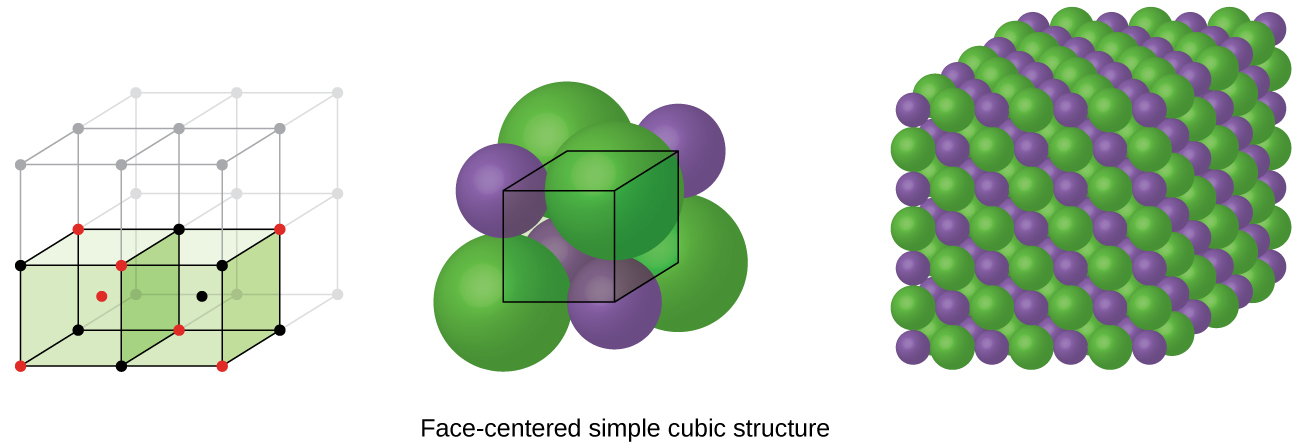
Figure 10.61図 10.61
Ionic compounds with anions that are much larger than cations, such as NaCl, usually form an FCC structure. They can be described by FCC unit cells with cations in the octahedral holes.
NaClのように陰イオンが陽イオンよりはるかに大きいイオン化合物は、通常、FCC構造を作る。八面体孔に陽イオンが入ったFCC単位格子で表すことができる。
The cubic form of zinc sulfide, zinc blende, also crystallizes in an FCC unit cell, as illustrated in Figure 10.62. This structure contains sulfide ions on the lattice points of an FCC lattice. (The arrangement of sulfide ions is identical to the arrangement of chloride ions in sodium chloride.) The radius of a zinc ion is only about 40% of the radius of a sulfide ion, so these small Zn2+ ions are located in alternating tetrahedral holes, that is, in one half of the tetrahedral holes. There are four zinc ions and four sulfide ions in the unit cell, giving the empirical formula ZnS.
英語のヒント
硫化亜鉛の立方晶形である閃亜鉛鉱も、図10.62のように、FCC単位格子で結晶化する。この構造では、FCC格子の格子点に硫化物イオンがある。(硫化物イオンの配列は、塩化ナトリウム中の塩化物イオンの配列と同じである。)亜鉛イオンの半径は硫化物イオンの半径の約40%しかないため、小さなZn2+イオンは四面体孔に一つおきに入る。すなわち、四面体孔の半分を占める。単位格子内には亜鉛イオン4個と硫化物イオン4個があるため、組成式はZnSとなる。
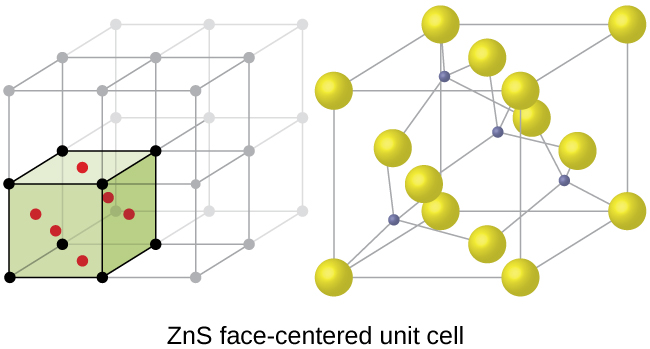
Figure 10.62図 10.62
ZnS, zinc sulfide (or zinc blende) forms an FCC unit cell with sulfide ions at the lattice points and much smaller zinc ions occupying half of the tetrahedral holes in the structure.
ZnS、硫化亜鉛(閃亜鉛鉱)は、格子点に硫化物イオンがあり、はるかに小さい亜鉛イオンが四面体孔の半分を占めるFCC単位格子を作る。
A calcium fluoride unit cell, like that shown in Figure 10.63, is also an FCC unit cell, but in this case, the cations are located on the lattice points; equivalent calcium ions are located on the lattice points of an FCC lattice. All of the tetrahedral sites in the FCC array of calcium ions are occupied by fluoride ions. There are four calcium ions and eight fluoride ions in a unit cell, giving a calcium:fluorine ratio of 1:2, as required by the chemical formula, CaF2. Close examination of Figure 10.63 will reveal a simple cubic array of fluoride ions with calcium ions in one half of the cubic holes. The structure cannot be described in terms of a space lattice of points on the fluoride ions because the fluoride ions do not all have identical environments. The orientation of the four calcium ions about the fluoride ions differs.
英語のヒント
図10.63のようなフッ化カルシウムの単位格子もFCCであるが、この場合は格子点に陽イオンがある。等価なカルシウムイオンがFCC格子の格子点を占める。カルシウムイオンのFCC配列にある四面体位置は、すべてフッ化物イオンで占められる。単位格子内にはカルシウムイオン4個とフッ化物イオン8個があり、カルシウム:フッ素の比は、化学式CaF2が要求する1:2になる。図10.63を詳しく見ると、フッ化物イオンが単純立方配列を作り、立方体孔の半分にカルシウムイオンが入っていることがわかる。この構造を、フッ化物イオン上の点を使った空間格子として表すことはできない。フッ化物イオンがすべて同じ環境を持つわけではないためである。各フッ化物イオンを囲む四つのカルシウムイオンの向きが異なる。
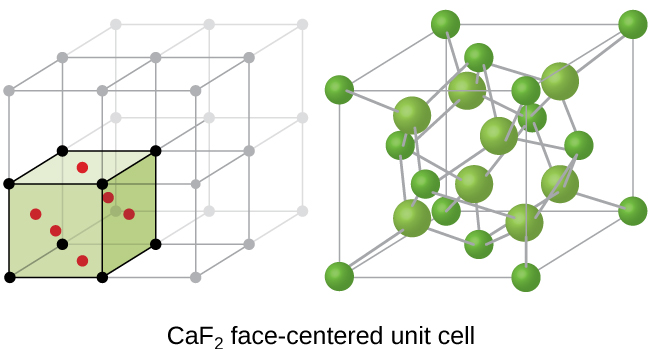


Figure 10.63図 10.63
Calcium fluoride, CaF2, forms an FCC unit cell with calcium ions (green) at the lattice points and fluoride ions (red) occupying all of the tetrahedral sites between them.
フッ化カルシウムCaF2は、格子点にカルシウムイオン(緑)があり、その間のすべての四面体位置をフッ化物イオン(赤)が占めるFCC単位格子を作る。