第10章液体と固体
Boiling Points沸点
When the vapor pressure increases enough to equal the external atmospheric pressure, the liquid reaches its boiling point. The boiling point of a liquid is the temperature at which its equilibrium vapor pressure is equal to the pressure exerted on the liquid by its gaseous surroundings. For liquids in open containers, this pressure is due to the earth’s atmosphere. The normal boiling point of a liquid is defined as its boiling point when surrounding pressure is equal to 1 atm (101.3 kPa). Figure 10.25 shows the variation in vapor pressure with temperature for several different substances. Considering the definition of boiling point, these curves may be seen as depicting the dependence of a liquid’s boiling point on surrounding pressure.
英語のヒント
蒸気圧が外の大気圧に等しくなるまで高まると、液体は沸点に達する。液体の沸点とは、平衡蒸気圧が周囲の気体から液体に加わる圧力に等しくなる温度である。開いた容器の液体では、この圧力は地球の大気による。標準沸点は、周囲の圧力が1 atm(101.3 kPa)に等しいときの沸点と定義される。図10.25には、いくつかの物質について蒸気圧が温度とともに変わる様子を示す。沸点の定義を考えると、これらの曲線は、液体の沸点が周囲の圧力にどう依存するかを表すものとも見なせる。
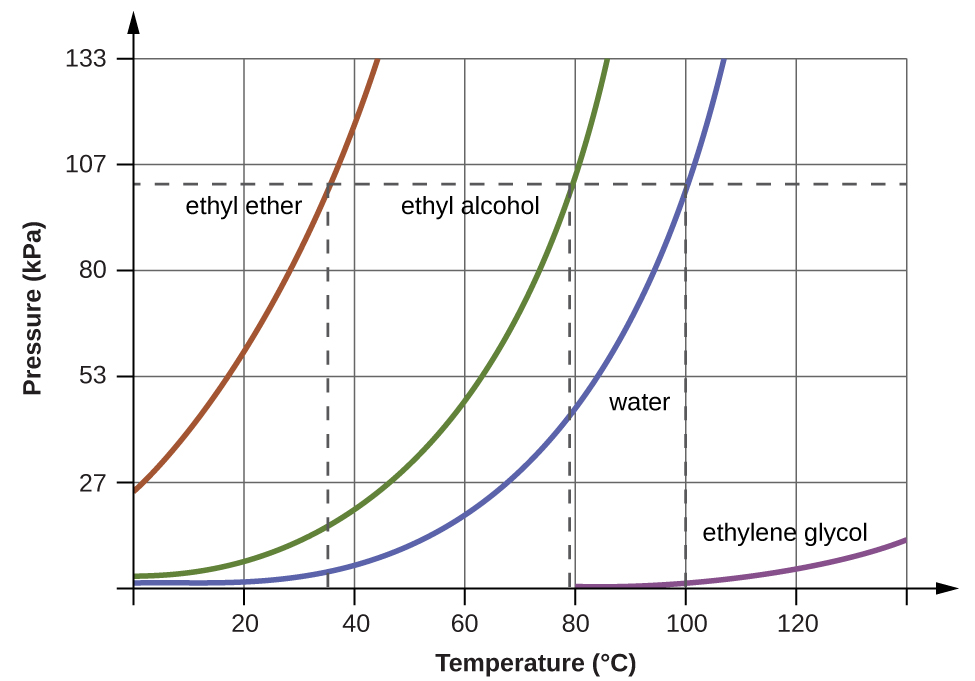

Figure 10.25図 10.25
The boiling points of liquids are the temperatures at which their equilibrium vapor pressures equal the pressure of the surrounding atmosphere. Normal boiling points are those corresponding to a pressure of 1 atm (101.3 kPa.)
液体の沸点は、その平衡蒸気圧が周囲の大気の圧力に等しくなる温度である。標準沸点は、圧力1 atm(101.3 kPa)に対応する沸点である。
Example 10.6例題 10.6
A Boiling Point at Reduced Pressure低い圧力での沸点
A typical atmospheric pressure in Leadville, Colorado (elevation 10,200 feet) is 68 kPa. Use the graph in Figure 10.25 to determine the boiling point of water at this elevation.
コロラド州レッドビル(標高10,200フィート)の典型的な大気圧は68 kPaである。図10.25のグラフを用い、この標高での水の沸点を求めなさい。
Solution解法
The graph of the vapor pressure of water versus temperature in Figure 10.25 indicates that the vapor pressure of water is 68 kPa at about 90 °C. Thus, at about 90 °C, the vapor pressure of water will equal the atmospheric pressure in Leadville, and water will boil.
図10.25の水の蒸気圧と温度のグラフより、約90 °Cで蒸気圧が68 kPaになることがわかる。したがって約90 °Cで水の蒸気圧がレッドビルの大気圧に等しくなり、水は沸騰する。
Check Your Learning理解度の確認
The boiling point of ethyl ether was measured to be 10 °C at a base camp on the slopes of Mount Everest. Use Figure 10.25 to determine the approximate atmospheric pressure at the camp.
エベレスト山の斜面にあるベースキャンプで、エチルエーテルの沸点を測ると10 °Cだった。図10.25を用いて、キャンプのおおよその大気圧を求めなさい。
The quantitative relation between a substance’s vapor pressure and its temperature is described by the Clausius-Clapeyron equation:
物質の蒸気圧と温度の定量的な関係は、クラウジウス=クラペイロンの式で表される。
where ΔHvap is the enthalpy of vaporization for the liquid, R is the gas constant, and A is a constant whose value depends on the chemical identity of the substance. Temperature T must be in Kelvin in this equation. This equation is often rearranged into logarithmic form to yield the linear equation:
英語のヒント
ここで、ΔHvapは液体の蒸発エンタルピー、Rは気体定数、Aは物質の化学的な種類によって値が決まる定数である。この式では、温度Tをケルビンで表さなければならない。この式は、対数を取って次の直線を表す式へ変形されることが多い。
This linear equation may be expressed in a two-point format that is convenient for use in various computations, as demonstrated in the example exercises that follow. If at temperature T1, the vapor pressure is P1, and at temperature T2, the vapor pressure is P2, the corresponding linear equations are:
この直線を表す式は、後の例題で示すように、さまざまな計算に便利な2点を用いる形に表せる。温度T1での蒸気圧をP1、温度T2での蒸気圧をP2とすると、対応する式は次のようになる。
Since the constant, A, is the same, these two equations may be rearranged to isolate ln A and then set them equal to one another:
定数Aは同じなので、この二つの式をln Aについて解き、互いに等しいと置ける。
which can be combined into:
これらをまとめると、
Example 10.7例題 10.7
Estimating Enthalpy of Vaporization蒸発エンタルピーの推定
Isooctane (2,2,4-trimethylpentane) has an octane rating of 100. It is used as one of the standards for the octane-rating system for gasoline. At 34.0 °C, the vapor pressure of isooctane is 10.0 kPa, and at 98.8 °C, its vapor pressure is 100.0 kPa. Use this information to estimate the enthalpy of vaporization for isooctane.
英語のヒント
イソオクタン(2,2,4-トリメチルペンタン)のオクタン価は100であり、ガソリンのオクタン価を決める基準物質の一つとして使われる。イソオクタンの蒸気圧は34.0 °Cで10.0 kPa、98.8 °Cで100.0 kPaである。この情報から、イソオクタンの蒸発エンタルピーを推定しなさい。
Solution解法
The enthalpy of vaporization, ΔHvap, can be determined by using the Clausius-Clapeyron equation:
蒸発エンタルピーΔHvapは、クラウジウス=クラペイロンの式を用いて求められる。
Since we have two vapor pressure-temperature values (T1 = 34.0 °C = 307.2 K, P1 = 10.0 kPa and T2 = 98.8 °C = 372.0 K, P2 = 100 kPa), we can substitute them into this equation and solve for ΔHvap. Rearranging the Clausius-Clapeyron equation and solving for ΔHvap yields:
蒸気圧と温度の組が二つ、T1 = 34.0 °C = 307.2 K、P1 = 10.0 kPa、およびT2 = 98.8 °C = 372.0 K、P2 = 100 kPaとわかっているので、式に代入してΔHvapを求められる。クラウジウス=クラペイロンの式を変形してΔHvapについて解くと、次式を得る。
Note that the pressure can be in any units, so long as they agree for both P values, but the temperature must be in kelvin for the Clausius-Clapeyron equation to be valid.
英語のヒント
圧力の単位は、二つのPの値でそろっていれば何でもよいが、クラウジウス=クラペイロンの式が成り立つためには、温度をケルビンで表す必要があることに注意しよう。
Check Your Learning理解度の確認
At 20.0 °C, the vapor pressure of ethanol is 5.95 kPa, and at 63.5 °C, its vapor pressure is 53.3 kPa. Use this information to estimate the enthalpy of vaporization for ethanol.
エタノールの蒸気圧は20.0 °Cで5.95 kPa、63.5 °Cで53.3 kPaである。この情報から、エタノールの蒸発エンタルピーを推定しなさい。
Example 10.8例題 10.8
Estimating Temperature (or Vapor Pressure)温度または蒸気圧の推定
For benzene (C6H6), the normal boiling point is 80.1 °C and the enthalpy of vaporization is 30.8 kJ/mol. What is the boiling point of benzene in Denver, where atmospheric pressure = 83.4 kPa?
ベンゼン(C6H6)の標準沸点は80.1 °C、蒸発エンタルピーは30.8 kJ/molである。大気圧が83.4 kPaのデンバーでは、ベンゼンの沸点はいくらか。
Solution解法
If the temperature and vapor pressure are known at one point, along with the enthalpy of vaporization, ΔHvap, then the temperature that corresponds to a different vapor pressure (or the vapor pressure that corresponds to a different temperature) can be determined by using the Clausius-Clapeyron equation:
ある1点での温度と蒸気圧、および蒸発エンタルピーΔHvap,がわかれば、クラウジウス=クラペイロンの式を用いて、異なる蒸気圧に対応する温度、または異なる温度に対応する蒸気圧を求められる。
Since the normal boiling point is the temperature at which the vapor pressure equals atmospheric pressure at sea level, we know one vapor pressure-temperature value (T1 = 80.1 °C = 353.3 K, P1 = 101.3 kPa, ΔHvap = 30.8 kJ/mol) and want to find the temperature (T2) that corresponds to vapor pressure P2 = 83.4 kPa. We can substitute these values into the Clausius-Clapeyron equation and then solve for T2. Rearranging the Clausius-Clapeyron equation and solving for T2 yields:
標準沸点は蒸気圧が海面での大気圧に等しくなる温度なので、蒸気圧と温度の組としてT1 = 80.1 °C = 353.3 K、P1 = 101.3 kPa、およびΔHvap = 30.8 kJ/molがわかる。求めたいのは、蒸気圧P2 = 83.4 kPaに対応する温度T2である。これらの値をクラウジウス=クラペイロンの式に代入し、T2について解けばよい。式を整理してT2を求めると、次のようになる。
Check Your Learning理解度の確認
For acetone (CH3)2CO, the normal boiling point is 56.5 °C and the enthalpy of vaporization is 31.3 kJ/mol. What is the vapor pressure of acetone at 25.0 °C?
アセトン(CH3)2COの標準沸点は56.5 °C、蒸発エンタルピーは31.3 kJ/molである。25.0 °Cでのアセトンの蒸気圧はいくらか。