第11章すべての戦争を終わらせるための戦争The War to End All Wars
11.5 The War Ends11.5 戦争の終結
Learning Objectives学習の目標
By the end of this section, you will be able to:
この節を学ぶと、次のことができるようになる。
Describe tsarist autocracy and the challenges to it in pre–World War I Russia
ツァーリ専制と、第一次世界大戦前のロシアでそれに対して起こった挑戦を説明する
Analyze how and why the Bolshevik Revolution began and its effect on Russian participation in World War I
ボリシェヴィキ革命がどのように、なぜ始まったか、またロシアの第一次世界大戦への参加に与えた影響を分析する
Explain why World War I came to an end in November 1918
第一次世界大戦が1918年11月に終結した理由を説明する
World War I spelled the end of an era. The growth of socialist ideology and of the Bolshevik Party turned Russians’ thoughts away from the war and toward revolution, ending both tsarist rule and Russia’s involvement in the war long before the armistice of November 1918. German success early in 1918 was halted by the size of the armies it faced later that year. With the world fighting not only a war but a deadly influenza virus, the last year of conflict saw even more death and set the stage for a rebuilt world to emerge in the aftermath.
英語のヒント
第一次世界大戦は一つの時代の終わりを意味した。社会主義思想とボリシェヴィキ党の成長は、ロシア人の関心を戦争から革命へ向け、1918年11月の休戦よりはるか前に、ツァーリの支配とロシアの参戦をともに終わらせた。1918年初めのドイツの成功は、同年後半に対峙した軍隊の規模によって阻まれた。世界が戦争だけでなく致死的なインフルエンザウイルスとも闘う中、最後の年はさらに多くの死を生み、戦後に再建された世界が現れる土台を作った。
The 1905 Revolution1905年革命
Long-standing problems in Russia such as a stagnant bureaucracy became exacerbated by the war. The Romanov tsars, in control since the 1600s, saw themselves as absolute rulers who governed without being questioned, but more liberal ideologies emerging in Europe in the 1700s and 1800s reached parts of Russian society, inspiring a desire for reform and reducing public tolerance for those in power. Socialist and Marxist ideologies, in particular, took hold among many young Russians, who felt the time had come to overthrow the tsarist state. In the early 1900s, a political faction known as the Bolsheviks appeared that followed these ideologies. Its members believed that violent revolution was necessary to oust the tsar and that the revolution needed a strong leader who could control the working class. Their push for reform and its accompanying violence eventually caused Russia to withdraw from the war.
英語のヒント
停滞した官僚機構など、ロシアの長年の問題は戦争によって悪化した。1600年代から権力を握るロマノフ家のツァーリは、疑問を差し挟まれずに統治する絶対的支配者を自認した。しかし1700年代と1800年代にヨーロッパで現れたより自由主義的な思想がロシア社会の一部にも届き、改革への願望を呼び起こし、権力者への国民の寛容さを減らした。特に社会主義やマルクス主義は多くの若いロシア人に根づき、ツァーリ国家を打倒する時が来たと考えさせた。1900年代初め、これらの思想に従うボリシェヴィキという政治派閥が現れた。党員はツァーリを追い出すには暴力革命が必要であり、革命には労働者階級を統制できる強い指導者が必要だと信じた。その改革への圧力と伴う暴力が、最終的にロシアを戦争から離脱させた。
On January 5, 1905, many workers gathered to protest peacefully outside Tsar Nicholas II’s Winter Palace in St. Petersburg. They were led by a local cleric and appealed to the tsar (who was not in residence) for improvements to their working conditions, as well as a government that would share power with a popularly elected assembly. They made this direct appeal because they saw the tsar as their “Little Father,” someone who would care for his people. Instead, military troops fired on the crowd. Around one thousand people were killed in the melee as blood spilled all over the snow, and the day came to be called “Bloody Sunday.”
英語のヒント
1905年1月5日、多くの労働者がサンクトペテルブルクにあるニコライ2世の冬宮の外へ集まり、平和的に抗議した。地元の聖職者に率いられ、宮殿に不在だったツァーリに対し、労働条件の改善と、公選の議会と権力を分かち合う政府を求めた。ツァーリを人民を気にかける「小さな父」とみなしていたため、直接訴えたのである。しかし軍隊は群衆へ発砲した。混乱の中で約1000人が死亡し、雪の上に血が広がり、この日は「血の日曜日」と呼ばれるようになった。
The backlash against the tsar was brutal. Workers in numerous cities went on strike to protest the bloodshed as part of the Revolution of 1905. Many strikes turned violent as more troops were ordered to put them down. With no end in sight, Nicholas II was forced to concede that he would no longer rule autocratically, and that a national legislature would meet to create a new voice in the government. The legislature was called the Duma and first met in 1906. It was composed of middle-class men and peasants, but it had two houses. One was indirectly chosen by an electoral college whose members were selected by men over age twenty-five. The other house had members appointed by the tsar. This second house dominated the Duma, limiting the legislature’s ability to function as a true representative assembly. While it was a step forward in line with some revolutionary aims, it did not signal a true sharing of power by the tsar.
英語のヒント
ツァーリへの反発は激しかった。1905年革命の一環として、多くの都市の労働者が流血に抗議するストライキを行った。鎮圧のため追加の軍が命じられると、多くは暴力化した。終わりが見えない中、ニコライ2世は専制的な統治をやめ、政府に新たな声を届ける国民議会を開くと認めざるをえなかった。この議会はドゥーマと呼ばれ、1906年に初めて開かれた。中産階級の男性と農民から成ったが、二院制だった。一方の院は25歳を超える男性が選んだ選挙人団によって間接選出され、他方はツァーリが任命した。この第2院がドゥーマを支配し、真の代議機関として機能する力を制限した。革命の目標の一部に沿う前進ではあったが、ツァーリが本当に権力を共有することを意味しなかった。
Peace, Land, and Bread平和、土地、パン
Russia had significant difficulty achieving victories in World War I. Its armies were massive but also suffered enormous casualties, and millions were killed, wounded, or taken prisoner, sometimes thanks to incompetent commanders and lack of supplies. Morale was low, and soldiers were aware that food shortages had caused long lines and even riots in the cities and towns they had left behind. Shortages of guns and other munitions further compromised the effectiveness of the military. The tsarist government did not seem up to the challenge of fighting the war.
英語のヒント
ロシアは第一次世界大戦で勝利を得ることに大きな困難を抱えた。軍は巨大だったが犠牲も膨大で、無能な指揮官や補給不足のために、数百万人が死亡、負傷、捕虜となることもあった。士気は低く、兵士は故郷の都市や町で食糧不足が長い行列や暴動さえ生んでいると知っていた。銃やその他の軍需品の不足も軍の有効性を損なった。ツァーリ政府には、戦争という難題を乗り切る力がないように見えた。
Also undermining popular support for the monarchy was Tsarina Alexandra’s steady reliance on the advice of the monk Rasputin, who appeared able to relieve the suffering of her young son Alexei, who had hemophilia and was heir to the throne. The favor shown to Rasputin, along with rumors of his romantic exploits, made for many questions about his true relationship with Alexandra, who was German and whom the Russian people had never really liked. After the tsar went to the front to direct the fighting in the autumn of 1915, Russia’s losses could be attributed to him, and leaving Alexandra (and her adviser Rasputin) in charge of the country when the tsar was away was an unpopular decision that helped bring about the break between the Russian people and their “Little Father.”
英語のヒント
王政への国民の支持をさらに損なったのは、皇后アレクサンドラが修道士ラスプーチンの助言に頼り続けたことだった。ラスプーチンは、血友病を患う幼い皇位継承者アレクセイの苦痛を和らげられるように見えた。彼への寵愛と恋愛遍歴の噂は、ドイツ人でロシア国民にあまり好かれていなかった皇后との真の関係について、多くの疑問を生んだ。1915年秋、ツァーリが戦闘を指揮するため前線へ行くと、ロシアの敗北の責任を本人に帰せるようになった。不在の間に皇后と助言者ラスプーチンへ国政を任せる決定は不評で、国民と「小さな父」の断絶をもたらす一因となった。
The end of the tsarist government began with the February Revolution in 1917. In March (February under the Julian calendar used in Russia), close to 100,000 people went on strike in the capital of Petrograd (meaning “Peter’s City” in Russian and replacing the German name St. Petersburg after war with Germany began in 1914). The strike spread over the next several days as more workers took to the streets (Figure 11.19). The government tried to repress these protests and called out soldiers to disperse the crowds. While some soldiers fired on the workers, killing them, as the days passed, the soldiers’ sympathy with the workers grew, and they refused to fire. Their defection marked a turning point in the city.
英語のヒント
ツァーリ政府の終わりは、1917年の二月革命から始まった。3月、ロシアが使うユリウス暦では2月、首都ペトログラードで10万人近い人々がストライキを行った。この名はロシア語で「ピョートルの町」を意味し、1914年の対独開戦後、ドイツ語名サンクトペテルブルクから改められたものだった。数日間でさらに多くの労働者が街頭へ出て、ストライキは広がった(図11.19)。政府は抗議を抑えようとし、群衆を散らすため軍を呼んだ。発砲して労働者を殺した兵もいたが、日が経つにつれ労働者への共感が強まり、兵士は発砲を拒否した。その離反は都市の転機となった。
The February Revolution.二月革命。
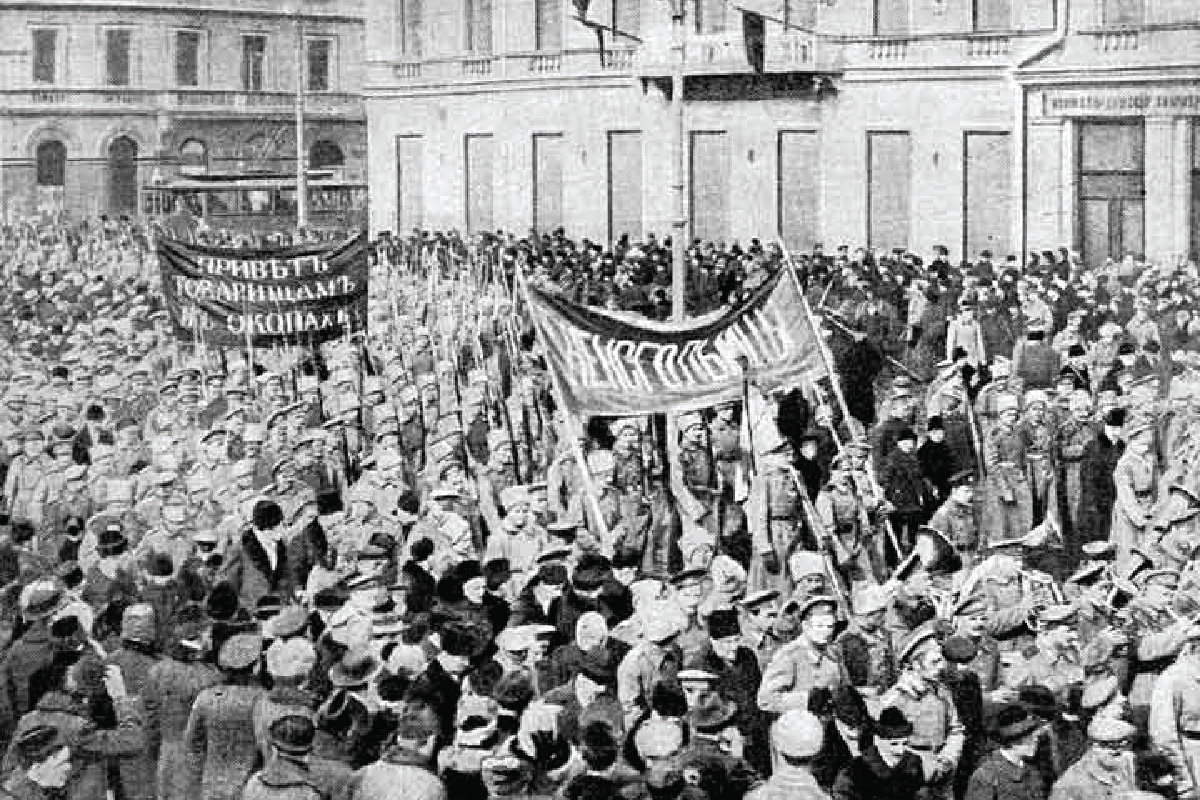
(credit: “Soldiers demonstration. February 1917” by socialist.memo.ru/Wikimedia Commons, Public Domain) · Public Domain
Figure 11.19 This photo shows protesters and soldiers in the February Revolution in Petrograd in 1917. (credit: “Soldiers demonstration. February 1917” by socialist.memo.ru/Wikimedia Commons, Public Domain)
図11.19 1917年、ペトログラードの二月革命における抗議者と兵士。(出典:socialist.memo.ru/ウィキメディア・コモンズの「Soldiers demonstration. February 1917」、パブリックドメイン)
The soldiers formed the Petrograd Soviet (a council representing workers, soldiers, and peasants) to establish power in the city. A group of moderate politicians then established a new government for Russia under the auspices of the Duma. This provisional government was led by Alexander Kerensky, a lawyer who had become popular for assisting revolutionaries in the past. Tsar Nicholas II was forced to abdicate, paving the way for the end of three hundred years of Romanov rule.
英語のヒント
兵士たちは都市で権力を確立するため、労働者・兵士・農民を代表する評議会であるペトログラード・ソヴィエトを作った。その後、穏健な政治家の一団がドゥーマの後援でロシアの新政府を樹立した。この臨時政府を率いたのは、以前革命家を援助して人気を得た弁護士アレクサンドル・ケレンスキーだった。ツァーリのニコライ2世は退位を強いられ、300年に及ぶロマノフ家支配の終焉への道が開かれた。
Kerensky was dedicated to continuing Russia’s participation in World War I, partly because he feared that aid he needed from the West to support Russia’s economy would be lost if he withdrew from the conflict. However, this position became increasingly unpopular with the Russian people. The provisional government and the Petrograd Soviet (which was becoming more anti-war) then vied for power in Russia.
英語のヒント
ケレンスキーはロシアの第一次世界大戦への参加継続に力を注いだ。その理由の一つは、離脱すれば経済を支えるために必要な西側からの援助を失うと恐れたことだった。しかしこの立場は国民にますます不人気となった。臨時政府と、反戦色を強めるペトログラード・ソヴィエトは、ロシアの権力を争うようになった。
Germany saw an opportunity to take advantage of Russia’s disintegrating political situation. A young Russian named Vladimir Ilyich Lenin had supported the cause of revolution in his native country for many years. His older brother had been executed for involvement in an attempt to assassinate Alexander III, Nicholas II’s father. Lenin had then left Russia, branded a radical and forced into exile. Germany helped him return to Russia to energize the revolution there and undermine the tsarist government’s conduct of the war.
英語のヒント
ドイツは、ロシアの政治状況の崩壊を利用する機会を見いだした。ウラジーミル・イリイチ・レーニンという若いロシア人は、長年祖国の革命を支持していた。兄は、ニコライ2世の父アレクサンドル3世の暗殺未遂への関与で処刑されていた。その後レーニンも急進派の烙印を押され、亡命を強いられてロシアを離れた。ドイツは、革命を活気づけてツァーリ政府の戦争遂行を弱めるため、彼の帰国を助けた。
Lenin’s arrival in Russia was like a lightning bolt. He quickly became the leader of the revolutionary cause, and the group he led, the Bolsheviks, challenged Kerensky’s provisional government. In the October Revolution in 1917, Lenin led a coup and seized power from the other political factions in Petrograd. He spoke of creating a government in which the Soviets would hold power. Capitalizing on a campaign of “Peace, Land, Bread,” Lenin’s government moved to end the war with Germany. Germany was only too happy to work out an agreement that would allow it to focus solely on the war on its western front.
英語のヒント
レーニンのロシア到着は稲妻のようだった。すぐに革命運動の指導者となり、率いるボリシェヴィキはケレンスキーの臨時政府に挑戦した。1917年の十月革命でレーニンはクーデターを率い、ペトログラードの他の政治勢力から権力を奪った。ソヴィエトが権力を握る政府の建設を語った。「平和、土地、パン」の運動を利用し、レーニン政府は対独戦争の終結へ動いた。ドイツは、西部戦線の戦争だけに集中できる協定を結ぶことを大いに歓迎した。
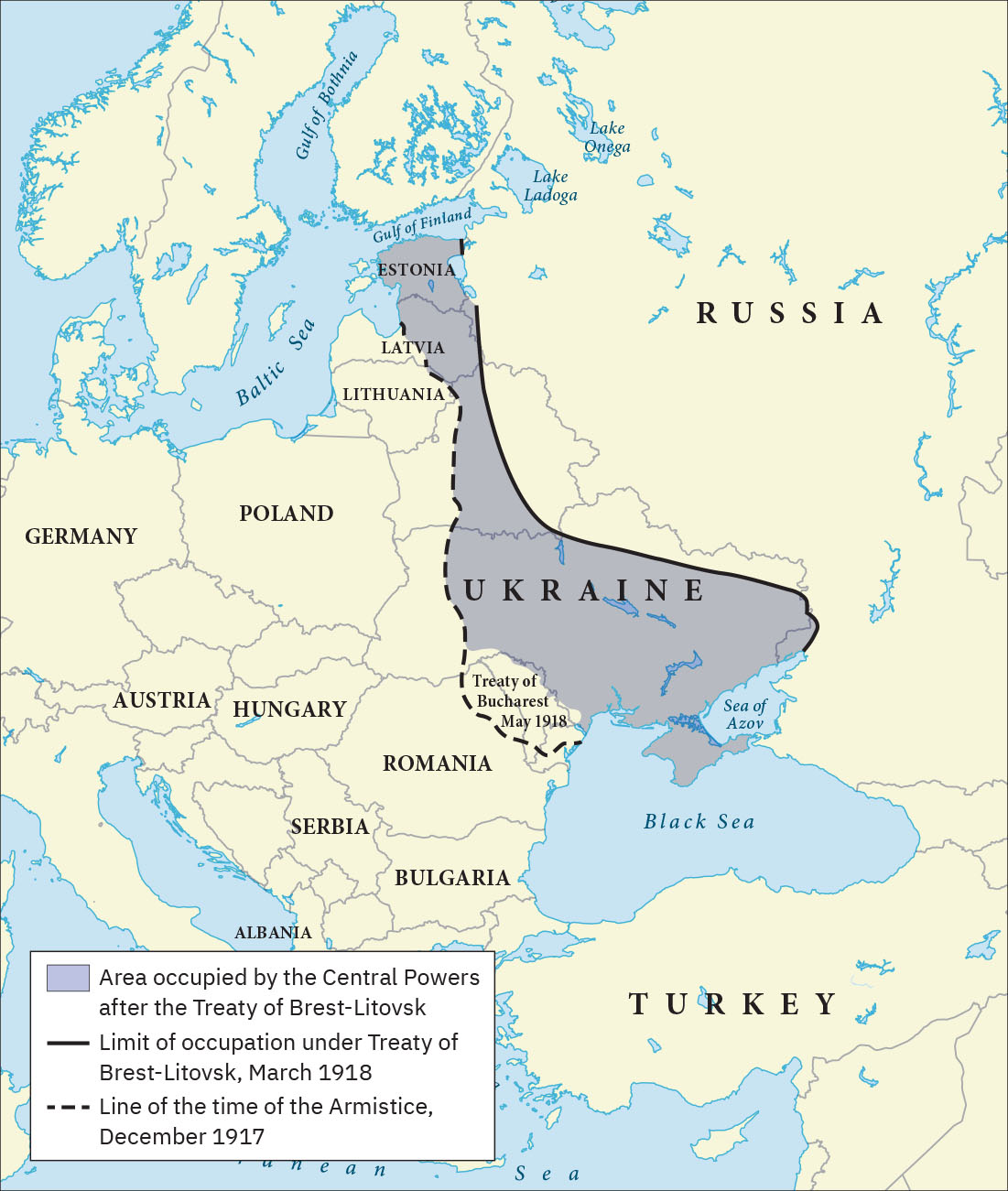
Lenin’s goal was to end the fighting as quickly as possible, so he agreed to terms that were fairly advantageous for Germany and the Central powers. The Treaty of Brest-Litovsk was signed on March 3, 1918. In it, Russia gave up significant territory to the Central powers, including areas of Poland and Ukraine, Finland, and the Baltic states (Lithuania, Latvia, and Estonia), which gave Germany new ports (Figure 11.20). In return, Russia was able to end its participation in the war as Lenin focused on building a Communist state, the Soviet Union.
英語のヒント
レーニンの目標はできるだけ早く戦闘を終わらせることだったため、ドイツと中央同盟国にかなり有利な条件に同意した。ブレスト=リトフスク条約は1918年3月3日に調印された。ロシアはポーランドとウクライナの一部、フィンランド、バルト諸国のリトアニア、ラトヴィア、エストニアを含む重要な領土を中央同盟国に譲り、ドイツは新たな港を得た(図11.20)。その見返りにロシアは参戦を終え、レーニンは共産主義国家ソヴィエト連邦の建設に集中できた。
Treaty of Brest-Litovsk.ブレスト=リトフスク条約。
(credit: modification of work “Europe 1920 simplyfied” by London Geographical Institute/Wikimedia Commons, Public Domain) · Public Domain
Figure 11.20 This map shows the area affected by the 1918 Treaty of Brest-Litovsk, including territory in what are now the states of Estonia, Latvia, Belarus, and Ukraine. Germany gained substantially from Russia, but the concessions were worth it to Lenin to extricate Russia from the war. (credit: modification of work “Europe 1920 simplyfied” by London Geographical Institute/Wikimedia Commons, Public Domain)
図11.20 1918年のブレスト=リトフスク条約が影響した地域を示す地図。現在のエストニア、ラトヴィア、ベラルーシ、ウクライナの領土を含む。ドイツはロシアから大きな利益を得たが、レーニンにはロシアを戦争から抜け出させるために譲歩する価値があった。(出典:ロンドン地理学研究所/ウィキメディア・コモンズの「Europe 1920 simplyfied」を改変、パブリックドメイン)
In 1918, after being held under house arrest for two years, the former tsar, his wife, and their five children were executed. A civil war broke out that year pitting the White Army, which opposed Lenin, against the Red Army, which supported the Bolshevik government. This conflict lasted until 1923, when the Red Army proved victorious.
英語のヒント
1918年、2年間の軟禁の後、元ツァーリ、妻、5人の子どもは処刑された。同年、レーニンに反対する白軍とボリシェヴィキ政府を支持する赤軍の内戦が始まった。この紛争は1923年まで続き、赤軍が勝利した。