第11章すべての戦争を終わらせるための戦争The War to End All Wars
11.1 Alliances, Expansion, and Conflict11.1 同盟、拡張、対立
Learning Objectives学習の目標
By the end of this section, you will be able to:
この節を学ぶと、次のことができるようになる。
Describe political conditions in Europe at the beginning of the twentieth century
20世紀初頭のヨーロッパの政治状況を説明する
Analyze the nature of the alliances made among European powers by 1914
1914年までにヨーロッパ列強が結んだ同盟の性質を分析する
Explain how the desire for colonies destabilized the balance of power in the early twentieth century
植民地獲得への欲求が20世紀初頭の勢力均衡をどのように不安定にしたかを説明する
Describe the competition to build modern navies in the early twentieth century
20世紀初頭の近代海軍建設競争を説明する
By the early twentieth century, Europe had achieved outward stability through a series of alliances. Such accords were a hallmark of nineteenth-century diplomacy and had maintained peace for decades on the continent, compressing the wars that did occur into finite conflicts. In the 1900s, these alliances had solidified two opposed groups, each with major powers that allied with one another and then developed relationships with smaller nations. Germany’s territorial ambitions put it in direct conflict with other imperialistic powers as it sought to expand its colonial holdings. Its desire to be taken more seriously and become a force in global affairs threatened to destabilize the peace when its goals brought it into competition with other countries hungry for land and power, notably Great Britain, and led to military buildups. A specter of war soon hung over Europe.
英語のヒント
20世紀初めまでに、ヨーロッパは一連の同盟によって表面上の安定を達成していた。こうした協定は19世紀外交の特徴であり、大陸の平和を数十年維持し、起こった戦争も限られた紛争にとどめてきた。1900年代には、これらの同盟によって対立する二つの集団が固まり、それぞれ主要な大国同士が同盟し、さらに小国との関係を築いた。ドイツは植民地を拡大しようとしたため、その領土的野心が他の帝国主義列強との直接対立を招いた。より重く扱われ、世界情勢の有力な担い手になりたいという願望は、その目標を通じて、土地と権力を求める他国、とりわけイギリスとの競争を生み、軍備増強を引き起こしたため、平和を不安定にするおそれがあった。ほどなく戦争の影がヨーロッパを覆った。
The Long Peace長い平和
The decades before the world erupted into the Great War, as World War I was known, were generally marked by great stability. The work done in 1815 to create a balance of power among European nations in the wake of the Napoleonic Wars had been quite successful. The Concert of Europe—an informal agreement to maintain the status quo—had been able to absorb some internal conflicts and the growth of more liberal political thoughts without incurring political or territorial instability. There were occasionally military conflicts, but these were usually of short duration and limited in scale.
英語のヒント
第一次世界大戦が「大戦」と呼ばれて世界を巻き込むまでの数十年間は、概して大きな安定に特徴づけられた。ナポレオン戦争の後、1815年にヨーロッパ諸国の勢力均衡を築くために行われた取り組みは、かなり成功していた。現状維持のための非公式な取り決めであるヨーロッパ協調は、政治や領土の不安定化を招くことなく、一部の国内紛争と、より自由主義的な政治思想の成長を吸収できた。軍事衝突は時折起こったが、通常は短期間で、規模も限られていた。
Prussia, however, with its militarized culture, clearly did still see warfare as a means of achieving its own ends, as did other nations such as France. Austria-Hungary and Prussia went to war in 1866. The conflict lasted only about seven weeks and was handily won by Prussia, which had invested in better military technology and weaponry and now annexed several German states. Austria was effectively barred from participating in German affairs from that point forward, and Prussia became the dominant German state. The war also forced Austria into accepting the dual monarchy system, an unwieldy alliance with Hungary. Austria agreed because it needed allies after being ousted from German affairs, but it and Hungary had separate national governments and parliaments (and different goals) despite being part of the same empire.
英語のヒント
しかし軍事的な文化を持つプロイセンは、フランスなどの他国と同様、戦争を自国の目的を達成する手段としてなお明確に捉えていた。1866年、オーストリア=ハンガリーとプロイセンは戦争に入った。この紛争はわずか約7週間で終わり、優れた軍事技術と兵器に投資していたプロイセンが容易に勝利し、いくつかのドイツ諸邦を併合した。以後オーストリアは事実上ドイツの問題への参加を排除され、プロイセンがドイツの支配的な国家となった。この戦争はまた、オーストリアにハンガリーとの扱いにくい連合である二重君主制の受け入れを迫った。ドイツの問題から締め出された後で同盟相手を必要としていたため、オーストリアは同意した。しかし両国は同じ帝国に属しながらも、別々の政府と議会を持ち、目標も異なっていた。
The Franco-Prussian War in 1870 and 1871 was another fairly brief conflict that resulted in major change. France declared war against Prussia after a dispute over who would inherit the Spanish throne. The fighting lasted only a few months, but Paris was besieged by the Prussian army, and Napoléon III was captured. The treaty that ended the conflict forced France to pay a large war indemnity to Prussia. France also had to pay for the occupation forces, while losing the territories of Alsace and Lorraine (which changed hands again several times during the first half of the twentieth century). This was a humiliating defeat for France, though it paved the way for the unification of the German Empire. The signing of the treaty in the Hall of Mirrors at the Palace of Versailles cemented Prussia’s leadership of the new empire and its successful achievement of what had been left undone by the revolutions of 1848: Germany automatically emerged as a major power in Europe.
英語のヒント
1870〜1871年の普仏戦争も、大きな変化をもたらした比較的短い紛争だった。スペインの王位を誰が継ぐかという争いの後、フランスはプロイセンに宣戦布告した。戦闘は数か月しか続かなかったが、パリはプロイセン軍に包囲され、ナポレオン3世は捕虜となった。戦争を終結させた条約は、フランスに多額の賠償金をプロイセンに支払うことを強いた。フランスは占領軍の費用も負担し、さらにアルザスとロレーヌを失った。これらの地域は20世紀前半にも数回帰属を変えた。これはフランスには屈辱的な敗北だったが、ドイツ帝国の統一への道を開いた。ヴェルサイユ宮殿の鏡の間での条約調印は、新帝国におけるプロイセンの指導権と、1848年革命がやり残した課題の達成を確固たるものにした。ドイツはただちにヨーロッパの大国となった。
The fighting in these wars was localized, and because they were short, the conflicts did not require the mobilization of a country’s economy or full resources. They did not involve numerous countries either, and the fighting rarely spilled over into other nations’ lands. With the exception of the Franco-Prussian War, their impact on civilian society was minimal, with little loss of civilian life or destruction of property. In a sense, their very nature lulled much of Europe into expecting that although there might be future wars, they would be swift and small affairs.
英語のヒント
これらの戦争の戦闘は局地的で、短期間だったため、国の経済や全資源を動員する必要はなかった。多数の国が関わることもなく、戦闘が他国の領土へ広がることもまれだった。普仏戦争を除けば、民間社会への影響は最小限で、民間人の死や財産の破壊も少なかった。ある意味では、そのような戦争の性質そのものがヨーロッパの多くの人々を油断させ、将来戦争が起こっても、短く小規模なものだと思わせたのである。
Treaties and Alliances条約と同盟
Since he first rose to power in 1862, German chancellor Otto von Bismarck had pursued conservative policies that strengthened first Prussia and then Germany itself. In particular, Bismarck hoped to check the power of Russia and France by developing a series of alliances that would keep them from growing more dominant and presenting a threat to German leadership in the region. A military alliance with Austria-Hungary was created to stand up to Russia. This alliance later grew to include Italy and became formalized as the Triple Alliance. In 1894, Russia and France signed a treaty pledging military support for one another if attacked and requiring each to mobilize its armies if the other did so. In 1907, the Triple Entente was created between Russia, France, and Britain, growing out of a shared distrust of German aims.
英語のヒント
1862年に初めて権力を握って以来、ドイツ宰相オットー・フォン・ビスマルクは、まずプロイセンを、次いでドイツそのものを強化する保守的政策を進めてきた。とりわけ、ロシアとフランスが優位を強め、地域におけるドイツの指導権を脅かすことを防ぐ一連の同盟を築いて、両国の力を抑えようとした。ロシアに対抗するため、オーストリア=ハンガリーとの軍事同盟が結ばれた。この同盟は後にイタリアを加え、三国同盟として正式化された。1894年、ロシアとフランスは、攻撃された場合に相互に軍事援助を行い、一方が動員した場合は他方も動員することを定めた条約を結んだ。1907年には、ドイツの意図に対する共通の不信から、ロシア、フランス、イギリスの間に三国協商が成立した。
By the early twentieth century, then, a series of alliances had effectively divided Europe into two blocs of power. A bloc is a group of countries united for a common purpose. One bloc included Russia, France, and Britain, and the other Germany, Austria-Hungary, and Italy. While these two groups stood opposed to one another, there were nuances in the arrangements. Britain, for example, had not promised any mutual aid in times of war when it signed its initial agreement with France, nor had it done so in its agreement with Russia, while France was bound to provide military support for Russia if Russia were attacked and not the aggressor.
英語のヒント
こうして20世紀初めまでに、一連の同盟は事実上ヨーロッパを二つの勢力ブロックに分けた。ブロックとは、共通の目的のために結束した国々の集団である。一方にはロシア、フランス、イギリスが、他方にはドイツ、オーストリア=ハンガリー、イタリアが含まれた。この二つの集団は対立していたが、その取り決めには細かな違いがあった。たとえば、イギリスはフランスとの最初の協定で戦時の相互援助を約束せず、ロシアとの協定でも約束しなかった。一方フランスは、ロシアが侵略者ではなく攻撃された側である場合、軍事援助を行う義務を負っていた。
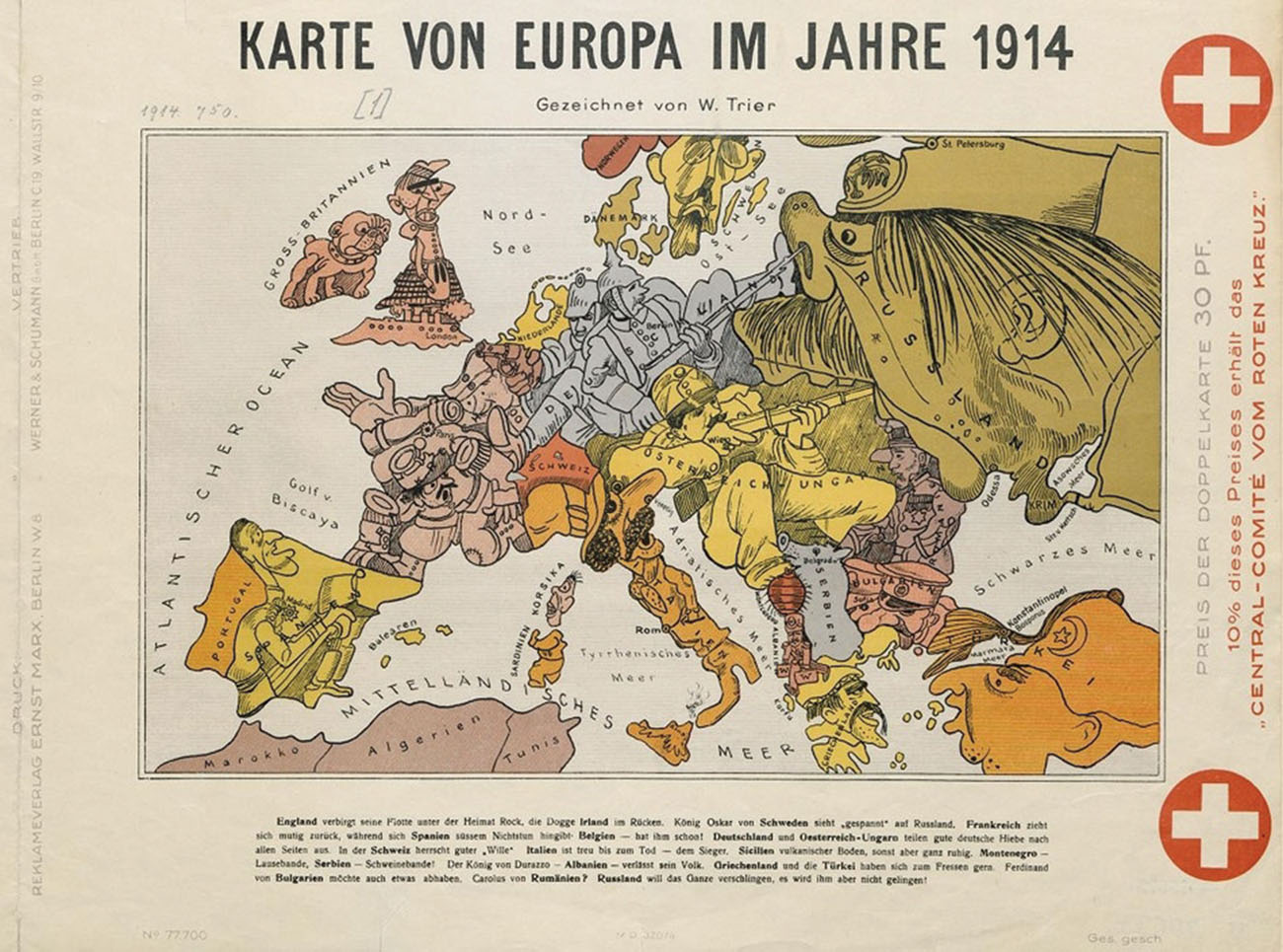
What these new alliances also did was provide fuel for the German emperor Wilhelm II’s growing concern that he was surrounded by hostile nations (Figure 11.4). Some of this preoccupation was undoubtedly justified. Germany faced a hostile France to its west and Russia to its east. But Wilhelm’s fixation on it drove him and Germany to adopt even more aggressive stances toward their “enemies” that helped create the cataclysm of World War I.
英語のヒント
これらの新しい同盟はまた、敵対国に包囲されているというドイツ皇帝ヴィルヘルム2世の募る懸念を煽った(図11.4)。その心配には、確かな根拠がある部分もあった。ドイツは西に敵対するフランス、東にロシアを抱えていた。しかし、この問題への皇帝の執着は、本人とドイツを「敵」に対するいっそう攻撃的な姿勢へと駆り立て、第一次世界大戦という大災厄を生み出す一因になった。
The Kaiser’s View of Germany.皇帝から見たドイツ。
(credit: “Cartoon Map of Europe in 1914” by Berlin State Library/The Public Domain Review, Public Domain) · Public Domain
Figure 11.4 This satirical German map from 1914 reflects Kaiser Wilhelm II’s growing concern that Germany was encircled by its enemies. (credit: “Cartoon Map of Europe in 1914” by Berlin State Library/The Public Domain Review, Public Domain)
図11.4 この1914年のドイツの風刺地図は、ドイツが敵に包囲されているというヴィルヘルム2世の募る懸念を反映している。(出典:ベルリン州立図書館/The Public Domain Reviewの「Cartoon Map of Europe in 1914」、パブリックドメイン)