第11章すべての戦争を終わらせるための戦争The War to End All Wars
11.4 War on the Homefront11.4 銃後の戦争
Learning Objectives学習の目標
By the end of this section, you will be able to:
この節を学ぶと、次のことができるようになる。
Explain how the combatant nations were transformed by the need to fight World War I
第一次世界大戦を戦う必要が交戦国をどのように変えたかを説明する
Analyze the role played by women in World War I
第一次世界大戦で女性が果たした役割を分析する
Describe life on the home front during World War I
第一次世界大戦中の銃後の生活を説明する
Discuss the events that led to the Irish Rising in 1916
1916年のアイルランド蜂起に至った出来事を論じる
The conflict of World War I mobilized not just soldiers but entire societies as civilians rose to meet the production levels needed to support the war effort. Home fronts were transformed as women took up new roles to replace men who had left for the war zone, families coped with shortages of food and consumer products, and civilian protests became more critical of the war and the national governments. Those governments often stepped in to set priorities and quotas for civilian entities like private manufacturers and even voluntary nursing associations in their efforts to prepare for and carry out their war aims. Some of these efforts were more successful than others. Meanwhile, Britain faced an additional challenge when tensions with Ireland reached a crisis point in 1916.
英語のヒント
第一次世界大戦は兵士だけでなく社会全体を動員し、民間人も戦争遂行を支えるのに必要な生産水準を満たすために立ち上がった。女性が戦地へ去った男性に代わる新しい役割を担い、家族が食糧や消費財の不足に対処し、市民の抗議が戦争や政府への批判を強める中、銃後は変容した。政府は戦争目的を準備・遂行するため、民間製造業者や志願の看護団体などの民間組織にまで介入し、優先順位や割当を設定することが多かった。その取り組みの成果には差があった。その一方、イギリスは1916年にアイルランドとの緊張が危機に達し、新たな難題に直面した。
Nations Remade for War戦争のために作り替えられた国家
The length and all-encompassing nature of the war forced each combatant’s home front to adapt. In the Allied countries of Britain and France, volunteer enthusiasm and conscription meant that many skilled laborers were now serving in the military, leaving manufacturing and production in need of new workers whose training took time. For other countries, such as Germany, the shortage of raw materials due to the Allied blockade forced a search for new sources.
英語のヒント
戦争の長期化と社会全体を巻き込む性質は、各交戦国の銃後に適応を迫った。連合国のイギリスとフランスでは、志願への熱狂と徴兵によって多くの熟練労働者が軍務に就き、製造・生産現場には訓練に時間がかかる新たな労働者が必要になった。ドイツなどの他国では、連合国の封鎖による原材料不足が、新たな調達先の探索を強いた。
Issues of production now also became political issues. In 1915, British commanders alleged that part of the reason they had been turned back during an attack was that they did not have enough artillery shells. This “shell crisis” raised the question of who was at fault in an industrialized government-directed economy. Was the government to be blamed for not making sure enough shells were produced? Were the workers not working hard enough at producing shells? The British government ended up blaming the army, claiming the military had not ordered enough shells. As a result, shell output from British munitions factories (and, in fact, from all combatants’ munitions factories) increased throughout that year.
英語のヒント
生産の問題は、今や政治問題にもなった。1915年、イギリスの指揮官たちは、攻撃が押し返された理由の一部は砲弾の不足だと主張した。この「砲弾危機」は、工業化した政府主導の経済で誰に責任があるのかという問題を提起した。十分な砲弾の生産を確保しなかった政府の責任なのか。労働者が懸命に砲弾を作っていなかったのか。結局イギリス政府は陸軍を非難し、軍が十分な砲弾を発注しなかったと主張した。その結果、その年を通じて、イギリスの軍需工場、実際にはすべての交戦国の軍需工場で砲弾生産量が増えた。
The British government found itself under immense pressure during the war. The Liberal Party was in control, but historically it had been anti-war, so the coming of World War I threw the party into disarray. The shell crisis and the failures at Gallipoli made the government appear weak. Continued maneuvering against the prime minister by David Lloyd George, minister of munitions and a fellow Liberal, solidified divisions within the party that came to a head by the end of the war.
英語のヒント
イギリス政府は戦争中、巨大な圧力にさらされた。自由党が政権を握っていたが、歴史的には反戦だったため、第一次世界大戦の到来は党を混乱させた。砲弾危機とガリポリでの失敗は、政府を弱く見せた。同じ自由党の軍需相デイヴィッド・ロイド・ジョージが首相に対する政治工作を続け、党内分裂を固定化し、それは終戦までに頂点に達した。
Once the United States entered the war, its government moved to control industrial output in a way it had never done before, with the creation of the War Industries Board (WIB). Run by financier Barnard Baruch, the WIB was charged with controlling prices and organizing production to support the war. However, because it had never embraced central planning or centralized economic control, the U.S. government did not have the command of war production that a country like Great Britain did. In the end, the WIB made some progress, but it never was in a position to dictate to industry and was immediately shut down at the end of the war. Its creation did foreshadow some of the examples of government control that became necessary in World War II, however.
英語のヒント
アメリカ合衆国が参戦すると、政府は戦時産業局(WIB)を設置し、かつてない形で工業生産の統制に乗り出した。金融家バーナード・バルークが率いるWIBは、戦争を支えるための価格統制と生産組織化を担った。しかし中央計画や中央集権的な経済統制を採用した経験がなかったため、アメリカ政府はイギリスのような国ほど軍需生産を掌握できなかった。最終的にWIBは一定の成果をあげたが、産業界に命令できる立場にはならず、終戦と同時に廃止された。それでも、その設置は第二次世界大戦で必要になる政府統制の一部を予示した。
Many national governments coped unsuccessfully with financing the war. Generally, less than a third of the cost was paid through taxation. Instead, borrowing by selling war bonds to the public, printing more money, and taking on more debt became the main method of paying for the war. Price inflation hit new highs as the combination of debt, the printing of money, and product shortages squeezed civilian budgets.
英語のヒント
多くの政府は戦費調達にうまく対処できなかった。一般に、税収で賄われたのは費用の3分の1未満だった。代わりに、国民への戦時公債販売による借入、通貨増刷、債務拡大が、戦費を支払う主な方法となった。債務、通貨増刷、物資不足が組み合わさって家計を圧迫し、物価上昇は新たな高水準に達した。
As the British army found itself in need of more troops, it began active recruitment campaigns. One popular tactic tried in the first half of the war was the development of “pals” units. Young men would sign up together and be guaranteed assignment to the same unit, a unit of their pals. While certainly an enticement to serve, this method of organizing units also meant that neighborhoods and villages might see nearly all their young men wounded or killed in the same engagement. The practice was discontinued after the high-casualty Somme campaign in 1916.
英語のヒント
イギリス陸軍はさらに兵を必要とし、積極的な募集運動を始めた。戦争前半に試した人気の方法が、「仲間部隊」の編成だった。若者が一緒に志願すると、友人同士で同じ部隊に配属されることが保証された。入隊の魅力にはなったが、この編成方法は、一つの戦闘で地区や村の若者のほぼ全員が負傷・死亡する可能性も意味した。1916年のソンム作戦で多数の死傷者が出た後、この慣行は廃止された。
For Russia, the war highlighted how far the country still needed to go in industrializing its economy. Railroads were not sufficient to move troops to the locations needed while also getting foodstuffs to the cities to feed factory workers. Arms manufacturers could not keep up with the numbers of guns and bullets necessary to supply the soldiers. The lack of equipment had serious consequences for the morale of the troops, who did not feel supported by their government and began to question its decision-making.
英語のヒント
ロシアにとって戦争は、経済の工業化にまだどれほどの道のりが必要かを明らかにした。鉄道は、必要な場所へ兵を運びながら、都市の工場労働者を養う食料も届けるには不十分だった。兵器メーカーは、兵士への補給に必要な銃や弾丸の数に追いつけなかった。装備不足は兵士の士気に深刻な影響を与え、彼らは政府に支えられていないと感じ、その意思決定を疑い始めた。
Women’s Work女性の仕事
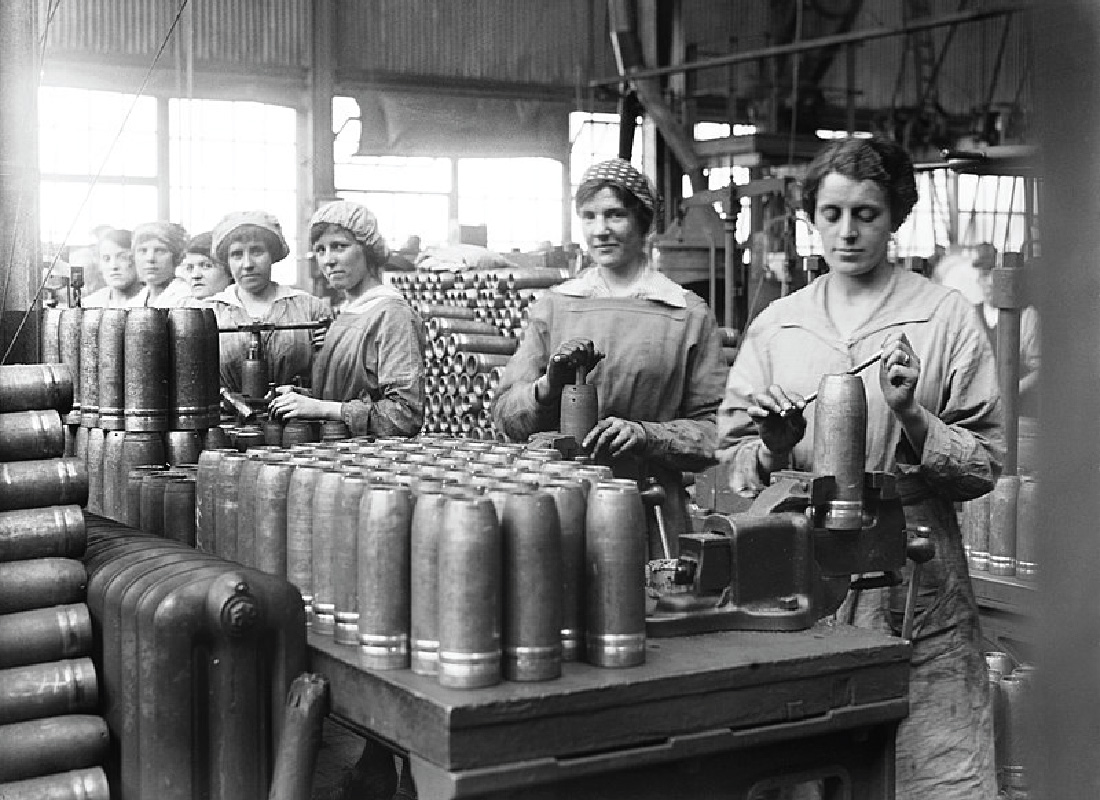
As the war progressed and more men set off to fight, women in many countries found job opportunities in traditionally male-oriented fields, most notably the defense industries and munitions plants. In Britain, women made up a significant percentage of war workers (Figure 11.16). They were sometimes called “canaries” because of the yellow hue cast on their skin and clothes from the TNT they worked with daily. Women in France were also disproportionately engaged in the manufacture of arms and armaments. In Germany, this pattern continued. While some women had worked in factories before the war, the need for more labor drew those who had worked in domestic service and other capacities, and they often earned more in the factories than in their old jobs.
英語のヒント
戦争が進み、より多くの男性が戦いに向かうと、多くの国で女性は、従来男性中心だった分野、とりわけ軍需産業や兵器工場で仕事を得た。イギリスでは、軍需労働者のかなりの割合を女性が占めた(図11.16)。毎日扱うTNTによって皮膚や衣服が黄色くなるため、「カナリア」と呼ばれることもあった。フランスでも女性は武器・軍備の製造に特に集中して従事した。ドイツでも同じ傾向が続いた。戦前から工場で働く女性もいたが、労働力需要の増大は家事奉公などの仕事をしていた女性を引き寄せ、工場では以前より多く稼げることが多かった。
British Women on the Home Front.銃後のイギリス女性。
(credit: “Women at work during the First World War” by Imperial War Museums/Wikimedia Commons, Public Domain) · Public Domain
Figure 11.16 This photo depicts women war workers in Great Britain during the war. They worked in munitions, providing the shells needed by the artillery in the British army. (credit: “Women at work during the First World War” by Imperial War Museums/Wikimedia Commons, Public Domain)
図11.16 戦時中のイギリスの女性軍需労働者。軍需品製造に従事し、イギリス陸軍の砲兵に必要な砲弾を供給した。(出典:帝国戦争博物館/ウィキメディア・コモンズの「Women at work during the First World War」、パブリックドメイン)
Women also did significant work in the medical field during the war. Few were doctors; most served as nurses. Among them were both professional nurses (women who had been nurses before the war) and volunteer nurses who came from both the elite and middle classes. Volunteer nurses from the United States even began to flow into French hospitals in 1915. The Red Cross organized both nursing and hospital building across France and Belgium as the war progressed. Women also served as ambulance drivers and worked in x-ray units, especially mobile ones. French scientist Marie Curie’s daughter, Irène Joliot-Curie, worked with and trained others for x-ray units.
英語のヒント
女性は戦時中、医療分野でも重要な仕事をした。医師は少なく、大半は看護師だった。戦前から看護師だった専門職の女性と、上流階級や中産階級出身の志願看護師の両方がいた。1915年にはアメリカからも志願看護師がフランスの病院へ来るようになった。赤十字は戦争の進行とともに、フランスとベルギー各地で看護と病院建設を組織した。女性は救急車運転手やX線部門、とりわけ移動式の部門でも働いた。フランスの科学者マリー・キュリーの娘イレーヌ・ジョリオ=キュリーは、X線部門で働くとともに、他の人々を訓練した。
Black women who wished to serve found their opportunities limited, just as they were in peacetime. In the United States, the absence of male workers meant that in restricted cases, African American women were hired for factory and office work. Overseas, African American women served with the Young Women’s Christian Association (YWCA) to aid U.S. soldiers, but they numbered fewer than twenty-five. Only two African American women served as social workers with the YWCA during the war in France. Black women in Britain were similarly constrained, though a few were nurses and munitions workers.
英語のヒント
従軍を望む黒人女性の機会は、平時と同様に限られていた。アメリカでは男性労働者の不在により、限定的な場合にアフリカ系アメリカ人女性が工場や事務の仕事に雇われた。海外ではYWCA(キリスト教女子青年会)で米兵を支援したが、25人未満だった。戦時中フランスでYWCAの社会福祉員として働いたアフリカ系アメリカ人女性は2人だけだった。イギリスの黒人女性も同様に制限されたが、少数は看護師や軍需労働者となった。
The sense of independence and the novelty of making their own money spurred many women involved in the war effort to see political reform and voting rights as the next step. For example, many women in Britain viewed the extension of voting rights as a way to reward them for their war work. Suffragists had been protesting for years about the need to include women among the voting population in numerous countries such as Britain, Germany, and the United States. In 1918, Britain extended the right to vote to property-owning women over thirty. Germany gave women the vote in 1918, the first country to grant universal adult female suffrage, as did the United States in 1920.
英語のヒント
自立の感覚と自分で稼ぐ新鮮さが、戦争遂行に関わった多くの女性に、政治改革や投票権を次の段階として求めさせた。たとえばイギリスの多くの女性は、選挙権の拡大を戦時の労働への報いと考えた。イギリス、ドイツ、アメリカなど多くの国で、女性参政権運動家は女性を有権者に含める必要を長年訴えていた。1918年、イギリスは30歳を超える有産女性に投票権を拡大した。ドイツは1918年に女性に選挙権を与え、成人女性の普通選挙権を認めた最初の国となり、アメリカも1920年に認めた。
Another way those on the home front felt the war’s effects was through deprivation and doing without. Shortages and later rationing came about in some countries, targeting a number of different resources but most often food. The idea was that the government would control the allotment of certain food items such as meat and sugar so they would be more equitably distributed among the population. Britain started rationing in 1918. The United States did not mandate food rationing but encouraged people to adopt it voluntarily.
英語のヒント
銃後の人々が戦争の影響を感じたもう一つの形は、欠乏と我慢だった。一部の国では物資不足が起こり、後に配給制となった。さまざまな資源が対象となったが、最も多かったのは食料だった。肉や砂糖など特定の食品の割当を政府が管理し、国民の間により公平に分配するという考えだった。イギリスは1918年に配給制を始めた。アメリカは食料配給を義務づけなかったが、自発的に取り入れるよう奨励した。
Britain was particularly vulnerable to shortages because it imported approximately 60 percent of its food. Ensuring there was enough to feed the soldiers and the civilian populace was the job of the Women’s Land Army. In this wartime program, nearly 100,000 British women volunteered to move to rural counties and keep farms running after farmers had volunteered or been conscripted into the war. The British government also assisted with moneys for new tractors on many farms whose horses had been requisitioned by the army.
英語のヒント
イギリスは食料の約60%を輸入していたため、とりわけ不足に弱かった。兵士と民間人を養うのに十分な食料を確保するのが、女性農業部隊の役割だった。この戦時の制度では10万人近いイギリス女性が志願し、農村へ移って、農民が志願入隊や徴兵で去った農場の営農を続けた。政府も、馬を軍に徴用された多くの農場に新しいトラクターを買う資金を援助した。
All these changes meant that after the war, women had different expectations for the future and no longer felt as constrained by traditional mores. Even fashion had altered considerably during the war to accommodate the new kinds of work that women did. Long restrictive skirts were no more, and skirts were several inches shorter than in the early 1900s. Many European women also found themselves remaining single. The millions of men lost in the war left many unable to find a mate.
英語のヒント
こうした変化によって、戦後の女性は将来に対する期待を変え、伝統的な慣習に以前ほど縛られないと感じた。女性の新しい仕事に合わせ、服装さえ戦時中に大きく変わった。長く動きを妨げるスカートは消え、丈は1900年代初めより数インチ短くなった。ヨーロッパの多くの女性は独身のままでもあった。戦争で数百万人の男性が失われ、多くの女性が伴侶を見つけられなかった。