第11章すべての戦争を終わらせるための戦争The War to End All Wars
Colonies and Conflict植民地と対立
The view that imperial strength should be devoted to colony building was still very much in place in the late 1800s. Still industrializing, and having unified as a country only in 1871, Germany soon felt the pressure to build an overseas empire, just as the other industrializing nations of the world—Britain, France, Belgium, the United States, Russia, and Japan—did. But there were limited locales it could target.
英語のヒント
帝国の力を植民地建設に注ぐべきだという見方は、1800年代後半にも根強く存在した。工業化の途上にあり、国として統一されたのも1871年にすぎなかったドイツは、世界の他の工業化国家、すなわちイギリス、フランス、ベルギー、アメリカ合衆国、ロシア、日本と同じように、海外帝国を築く圧力をほどなく感じた。しかし、狙える地域は限られていた。
Germany began to look to the Pacific as a place where it could establish itself as a colonial power. The United States, Britain, France, Japan, and the Netherlands already held extensive territory in the Pacific. Germany soon claimed part of New Guinea, part of the Solomon Islands, and the Marshall Islands. In 1899, Germany’s growing power in the Pacific led to the partitioning of the Samoan Islands with the United States. Germany also gained some of the smaller island groups—Palau, Caroline Islands, and Mariana Islands—by the beginning of the twentieth century. In addition, it planned to join the “Scramble for Africa” in which European nations were engaging to shore up their colonial holdings on the African continent.
英語のヒント
ドイツは、植民地大国としての地位を築ける場所として太平洋に目を向け始めた。アメリカ合衆国、イギリス、フランス、日本、オランダは、すでに太平洋で広大な領土を保有していた。ドイツはほどなく、ニューギニアの一部、ソロモン諸島の一部、マーシャル諸島を領有すると主張した。1899年、太平洋で拡大するドイツの力を背景に、サモア諸島がアメリカ合衆国との間で分割された。ドイツは20世紀初めまでに、パラオ、カロリン諸島、マリアナ諸島など、小さな島々の集団も獲得した。加えて、ヨーロッパ諸国がアフリカ大陸での植民地保有を強化するために行っていた「アフリカ分割」に加わる計画も立てた。
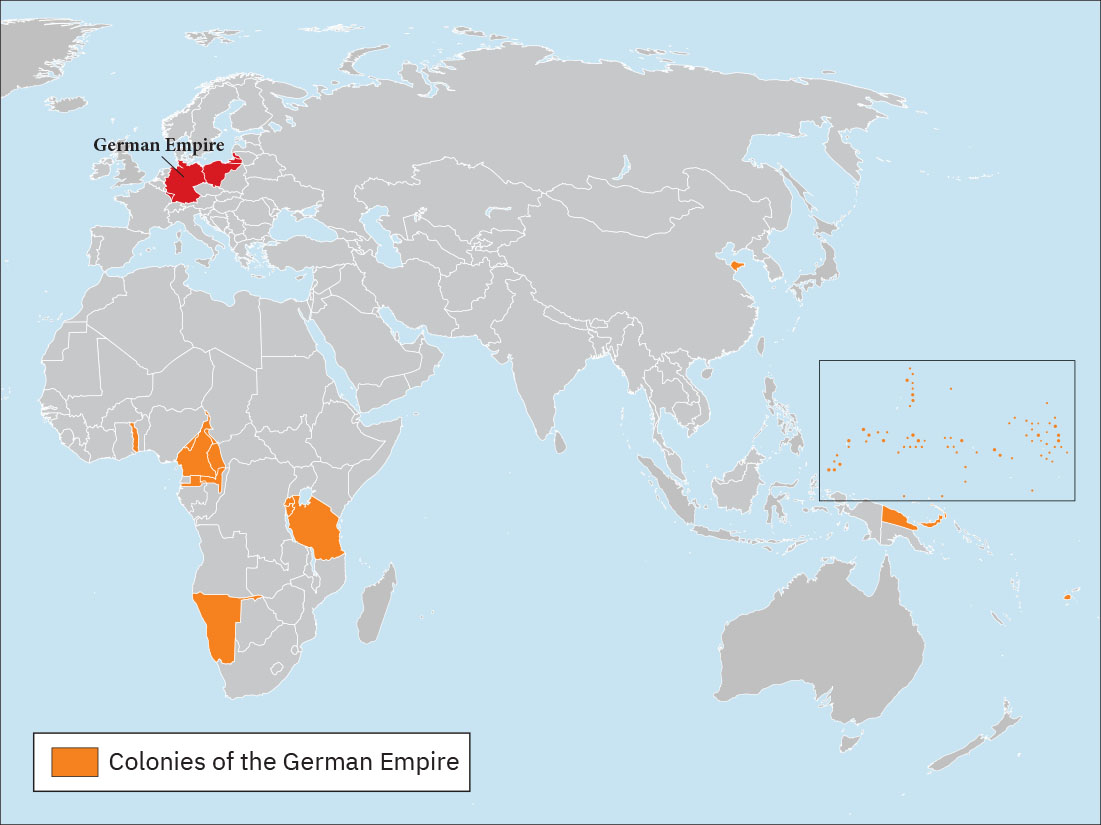
When Germany went in search of African colonies, there was not much left. Britain, France, Belgium, and Portugal had already seized control of most of the continent and did not welcome the claims of yet another European nation. Germany took a portion of East Africa and Southwest Africa, which had a large border with the British colonies. Togoland and the Cameroons also became part of the German colonial empire (Figure 11.5).
英語のヒント
ドイツがアフリカの植民地を探し始めたとき、残されている土地は多くなかった。イギリス、フランス、ベルギー、ポルトガルは大陸の大部分をすでに支配し、さらに別のヨーロッパ国家が領有を主張することを歓迎しなかった。ドイツは東アフリカと南西アフリカの一部を獲得し、そこはイギリス植民地と長い境界を接していた。トーゴランドとカメルーンもドイツの植民地帝国の一部となった(図11.5)。
German Colonies in 1914.1914年のドイツ植民地。
(credit: modification of work “BlankMap-World” by CIA World Factbook/Wikimedia Commons, Public Domain) · Public Domain
Figure 11.5 This map shows the regions around the world that Germany had claimed as colonies by the beginning of World War I. (credit: modification of work “BlankMap-World” by CIA World Factbook/Wikimedia Commons, Public Domain)
図11.5 第一次世界大戦の始まりまでに、ドイツが植民地として領有を主張した世界各地の地域を示す地図。(出典:CIA World Factbook/ウィキメディア・コモンズの「BlankMap-World」を改変、パブリックドメイン)
In 1905, Germany clashed with both France and Britain in North Africa. Kaiser Wilhelm II arrived in Morocco that year and made a speech in which he threw his full support behind its being an independent state led by the sultan. He also voiced his expectation that Germany would enjoy the same benefits of trade in the region that France and England did. Wilhelm hoped to divide Britain and France by thus claiming a place for Germany in North Africa equivalent to that held by other European nations. Instead, in response to this First Moroccan Crisis, Britain and France established stronger bonds of friendship.
英語のヒント
1905年、ドイツは北アフリカでフランスとイギリスの両国と衝突した。その年、皇帝ヴィルヘルム2世はモロッコを訪れ、スルタンが統治する独立国家であることを全面的に支持する演説を行った。また、ドイツもこの地域でフランスやイギリスと同じ貿易上の利益を享受するとの期待を表明した。ヴィルヘルムは、北アフリカで他のヨーロッパ諸国と同等の地位をドイツに要求することで、イギリスとフランスを分断しようとした。ところが、この第1次モロッコ事件への対応として、イギリスとフランスはかえって友好の絆を強めた。
A few years later, another crisis erupted over Morocco, though this one was more media driven and involved more national posturing. The Second Moroccan Crisis started in 1911. France and Germany had been negotiating over what say Germany would have in rail lines under construction in Morocco and over some territory in the French Congo that Germany wanted. Britain and France had earlier become alarmed by Germany’s plans to build another railroad in concert with the Ottoman Empire that would link Berlin to Baghdad. This railway would provide Germany with more direct access to both Persian Gulf oil and its African colonies. Moving oil and other goods by rail would also make Germany less vulnerable to potential British naval attacks.
英語のヒント
数年後、モロッコをめぐる別の危機が起こったが、今度は報道の影響がより大きく、国家による強硬姿勢の誇示も目立った。第2次モロッコ事件は1911年に始まった。フランスとドイツは、モロッコで建設中の鉄道にドイツがどの程度の発言権を持つか、またドイツが欲するフランス領コンゴの一部領土について交渉していた。イギリスとフランスはそれ以前から、ドイツがオスマン帝国と協力して、ベルリンとバグダードを結ぶ別の鉄道を建設する計画に警戒していた。この鉄道は、ドイツにペルシア湾の石油とアフリカ植民地への、より直接的なアクセスを与えることになる。石油やその他の商品を鉄道で運ぶことは、想定されるイギリス海軍の攻撃に対するドイツの脆弱性も減らすはずだった。
In May 1911, France, fearing rebellion in Morocco, sent troops to the city of Fez. In July of that year, Germany sent a gunboat to Agadir, a Moroccan port on the Atlantic, to ensure that it would be compensated for any loss of control over Moroccan territory that resulted from French intervention. Germany also undoubtedly intended to frighten Britain and force it to back out of its alliance with France. Soon British politicians and the media seized on the opportunity to attack Germany for its demands. The British said they were not yet sending in the Royal Navy but would be monitoring the situation. In the end, France and Germany held successful negotiations over the issues, with Germany receiving territory in the French Congo in exchange for acknowledging French dominance in Morocco, but the international effect of the crisis was broader. Britain was reinforced in its view that Germany posed a threat to its own colonial ambitions. On the German side, the military leadership gained greater political influence in the capital in Berlin.
英語のヒント
1911年5月、フランスはモロッコでの反乱を恐れ、フェズ市へ兵を送った。同年7月、ドイツはフランスの介入でモロッコ領土に対する支配力が失われた場合に補償を得られるよう、大西洋岸のモロッコの港アガディールへ砲艦を派遣した。ドイツはまた、イギリスを威嚇してフランスとの同盟から離脱させようとしたことも疑いない。まもなくイギリスの政治家と報道機関は、この機会を捉えてドイツの要求を攻撃した。イギリス側は、まだ海軍を派遣していないが、状況を監視すると述べた。結局、フランスとドイツの交渉は成功し、ドイツはモロッコでのフランスの優位を認める代わりにフランス領コンゴの領土を得た。しかし危機の国際的な影響は、それ以上に広かった。ドイツは自国の植民地獲得の野心を脅かすというイギリスの見方が、いっそう強まった。ドイツ側では、軍の指導部が首都ベルリンで政治的影響力を増した。
The Growth of Militaries軍隊の拡大
Naval power assumed a greater role in world affairs in the late nineteenth century. As more of the industrialized nations embarked on empire building, and as reaching international markets became an expected part of their strategy, the value of having strong navies to protect commercial trade only grew. Maintaining supply and fueling stations around the world to service these navies and fleets of merchant ships became a key argument in favor of developing more colonies.
英語のヒント
19世紀後半、海軍力は世界情勢でより大きな役割を担うようになった。工業国が次々に帝国建設へ乗り出し、国際市場への進出が当然の戦略となるにつれ、商業貿易を保護する強力な海軍の価値は高まり続けた。海軍と商船隊に補給する拠点や燃料補給所を世界各地に維持する必要は、植民地をさらに増やすことを支持する主要な論拠となった。
At the start of the twentieth century, Great Britain was still the unmatched naval power in the world. Kaiser Wilhelm II was determined to counter Britain’s sea power by building up the German navy. In this, he was ably assisted by Admiral Alfred von Tirpitz. Tirpitz had similarly grand dreams for the navy, and through his various positions in the naval high command, he set out an ambitious building program for new battleships.
英語のヒント
20世紀初頭、イギリスはなお世界で比類のない海軍大国だった。皇帝ヴィルヘルム2世は、ドイツ海軍を増強してイギリスの海軍力に対抗すると決意していた。この点で皇帝を有能に補佐したのが、アルフレート・フォン・ティルピッツ提督だった。ティルピッツも海軍に壮大な夢を抱いており、海軍最高司令部のさまざまな役職を通じて、新型戦艦の野心的な建造計画を打ち出した。
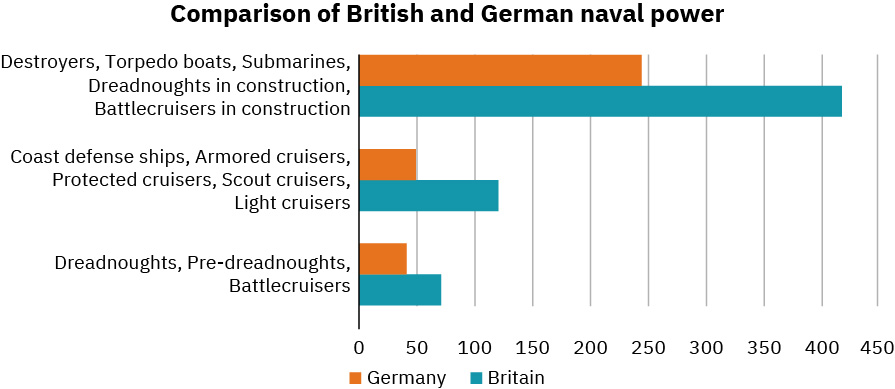
Germany’s fear of naval inferiority became especially strong after 1906. In that year, Britain debuted an entirely new class of ship when the HMS Dreadnought set sail. What made this ship different was its ten 12-inch guns, some of them mounted on rotatable turrets, and its faster speed, powered by steam turbines. Other ships of the period had only a handful of guns and not all of this size. No other warship could match it in battle. Germany tried to keep pace by constructing ships similar in size, but although it clearly hoped to one day outbuild Britain, at no point before or during the war did its fleet ever match the British numbers (Figure 11.6).
英語のヒント
ドイツの海軍力の劣勢に対する恐れは、1906年以降に特に強まった。その年、イギリスは戦艦ドレッドノートの出航によって、まったく新しい艦種を登場させた。この艦を特別なものにしたのは、一部を旋回砲塔に搭載した10門の12インチ砲と、蒸気タービンによる高速性能だった。当時の他の艦には数門の砲しかなく、すべてがこの口径でもなかった。戦闘で対抗できる軍艦はほかになかった。ドイツは同程度の大きさの艦を建造して追いつこうとし、いつかイギリスの建造数を上回ることを明らかに望んだ。しかし戦前も戦中も、艦隊の数がイギリスと並ぶことは一度もなかった(図11.6)。
Comparison of British and German Naval Power.イギリスとドイツの海軍力の比較。
; attribution: Copyright Rice University, OpenStax, under CC BY 4.0 license) · CC BY 4.0
Figure 11.6 This graph compares British naval power to German naval power at the start of World War I. The Germans were never able to match the numbers of the British. (data source: P. G. Halpern, A Naval History of World War I, (London: UCL Press, 1994); attribution: Copyright Rice University, OpenStax, under CC BY 4.0 license)
図11.6 第一次世界大戦開始時のイギリスとドイツの海軍力を比較したグラフ。ドイツの艦艇数はイギリスに並ぶことがなかった。(データ出典:P・G・ハルパーン『第一次世界大戦の海軍史』、ロンドン:UCL Press、1994年。著作権:ライス大学、OpenStax、CC BY 4.0ライセンス)
Germany’s army, however, was much larger than Britain’s. Compulsory military service was the norm in Germany and Austria-Hungary. Germany placed high reliance on its active military units, which totaled close to four million soldiers, and had numerous units on reserve as well. Germany’s ally Austria-Hungary had a smaller force of under 500,000. In reaction to the growth and power of the German army, other nations also built up their armies.
英語のヒント
しかしドイツ陸軍は、イギリス陸軍よりはるかに大きかった。ドイツとオーストリア=ハンガリーでは、徴兵制が標準だった。ドイツは合計400万人近い現役部隊に強く依存し、さらに多数の予備役部隊も持っていた。同盟国オーストリア=ハンガリーの軍は50万人未満と小さかった。ドイツ陸軍の拡大と強さに反応して、他国も陸軍を増強した。
In Russia, military service was required. Although its armies were poorly trained and outfitted, its peacetime forces numbered nearly 1.5 million, and millions more could be called up as part of military mobilization. France had also adopted compulsory service (at the time it required three years of service from all men) and fielded an active army of almost 1.3 million. Those who had already done their compulsory service were classified as reservists and could be mobilized as well.
英語のヒント
ロシアでは兵役が義務づけられていた。軍の訓練や装備は不十分だったが、平時の兵力は150万人近くに達し、軍事動員によってさらに数百万人を招集できた。フランスも徴兵制を採用し、当時はすべての男性に3年間の兵役を義務づけ、130万人近い現役軍を擁していた。兵役をすでに終えた者は予備役に分類され、同様に動員できた。
The British army, which relied on volunteer troops, was still relatively small at the onset of the war. The Old Regulars, as they were known, numbered only a little over a quarter-million. The strength of Britain lay rather in its navy. The British reveled in what they called the “splendid isolation” of their island, an acknowledgment that issues on the European continent did not directly touch it.
英語のヒント
志願兵に依存するイギリス陸軍は、開戦時にも比較的小規模だった。「古参正規兵」と呼ばれた兵士は、25万人を少し超えるにすぎなかった。イギリスの強みはむしろ海軍にあった。イギリス人は自らの島の「栄光ある孤立」を喜んでいた。これは、ヨーロッパ大陸の問題が自国に直接及ばないことを認める表現だった。
The United States, which did not enter the war until 1917, had also chosen to keep a small military force, numbering fewer than 130,000. It had built up its navy beginning in the 1890s, when its imperial advances necessitated a more efficient and up-to-date force, though it did not have the ship numbers that European powers possessed. For the United States, keeping a small force was compatible with the isolationist tendencies it had maintained through the 1800s. With oceans on two sides, the country was relatively protected from overseas entanglements and had diplomatically tried to avoid them.
英語のヒント
1917年まで参戦しなかったアメリカ合衆国も、13万人未満の小さな軍事力を維持することを選んでいた。帝国主義的進出によって、より効率的で最新の軍事力が必要になった1890年代から海軍を増強したが、ヨーロッパ列強ほどの艦艇数は持たなかった。小規模な軍を維持することは、1800年代を通じて保ってきた孤立主義的傾向と両立した。両側を大洋に守られるこの国は、海外での紛争に巻き込まれる危険から比較的保護されており、外交上もそうした関与を避けようとしてきた。
Besides building up their armies and navies, military planners in several European countries also began designing how operations would occur in the next war. Germany anticipated that, encircled by enemies, it would have to fight on two fronts—against Russia on one side and France on the other. Developed by Field Marshal Alfred von Schlieffen in the early 1900s, the Schlieffen Plan held that Russia would be slow to mobilize, so Germany should use that time to attack Belgium and France and then pivot to fight Russia. This plan would make the conflict a short one. The French designed Plan XVII, which called for a major French offensive through Alsace-Lorraine to target the industrial heartland of Germany. Russia developed Plan 19, which would order Russian attacks on East Prussia once Germany was engaged against France.
英語のヒント
いくつかのヨーロッパ諸国の軍事計画担当者は、陸海軍を増強するだけでなく、次の戦争でどのように作戦を実施するかの設計も始めた。ドイツは敵に囲まれているため、一方のロシアと他方のフランスを相手に、二正面で戦わなければならないと予測した。1900年代初めにアルフレート・フォン・シュリーフェン元帥が作ったシュリーフェン・プランは、ロシアの動員には時間がかかるので、その間にベルギーとフランスを攻撃し、それからロシアに向き直るべきだとした。この計画によれば戦争は短期に終わるはずだった。フランスは第17号計画を作り、アルザス=ロレーヌを通って大攻勢を行い、ドイツの工業中枢を狙うことを求めた。ロシアは第19号計画を策定し、ドイツがフランスとの戦闘に入った時点で東プロイセンを攻撃することとした。