第11章すべての戦争を終わらせるための戦争The War to End All Wars
11.2 The Collapse of the Ottomans and the Coming of War11.2 オスマン帝国の崩壊と戦争の到来
Learning Objectives学習の目標
By the end of this section, you will be able to:
この節を学ぶと、次のことができるようになる。
Identify the causes of the collapse of the Ottoman Empire
オスマン帝国が崩壊した原因を特定する
Analyze the rise of nationalism among minority ethnic groups within Austria-Hungary and the Ottoman Empire
オーストリア=ハンガリーとオスマン帝国内の少数民族におけるナショナリズムの台頭を分析する
Explain how the assassination of Franz Ferdinand triggered the start of World War I
フランツ・フェルディナント暗殺が第一次世界大戦の開始をどのように引き起こしたかを説明する
Describe the first few months of World War I
第一次世界大戦の最初の数か月を説明する
Former German chancellor Otto von Bismarck supposedly commented that the next big problem for Europe, most likely the next big war, would come out of “some damned foolish thing in the Balkans.” This prediction proved to be remarkably precise. The events of 1914 did not happen in a vacuum and were the result of many years of rising tensions in a volatile region of Europe, coupled with diplomatic maneuvers among the great empires of the continent. Yet even as the prelude to the war unfolded, most people did not truly expect conflict to be the outcome.
英語のヒント
ドイツの元宰相オットー・フォン・ビスマルクは、ヨーロッパの次の大問題、おそらく次の大戦争は「バルカン半島での何かひどく愚かな出来事」から起こるだろうと語ったとされる。この予測は驚くほど正確だった。1914年の出来事は何の背景もなく起こったのではなく、ヨーロッパの不安定な地域で長年高まってきた緊張と、大陸の大帝国の外交工作が合わさった結果だった。それでも開戦の前触れが進行する中、ほとんどの人は本当に戦争になるとは考えていなかった。
The “Sick Man of Europe”「ヨーロッパの病人」
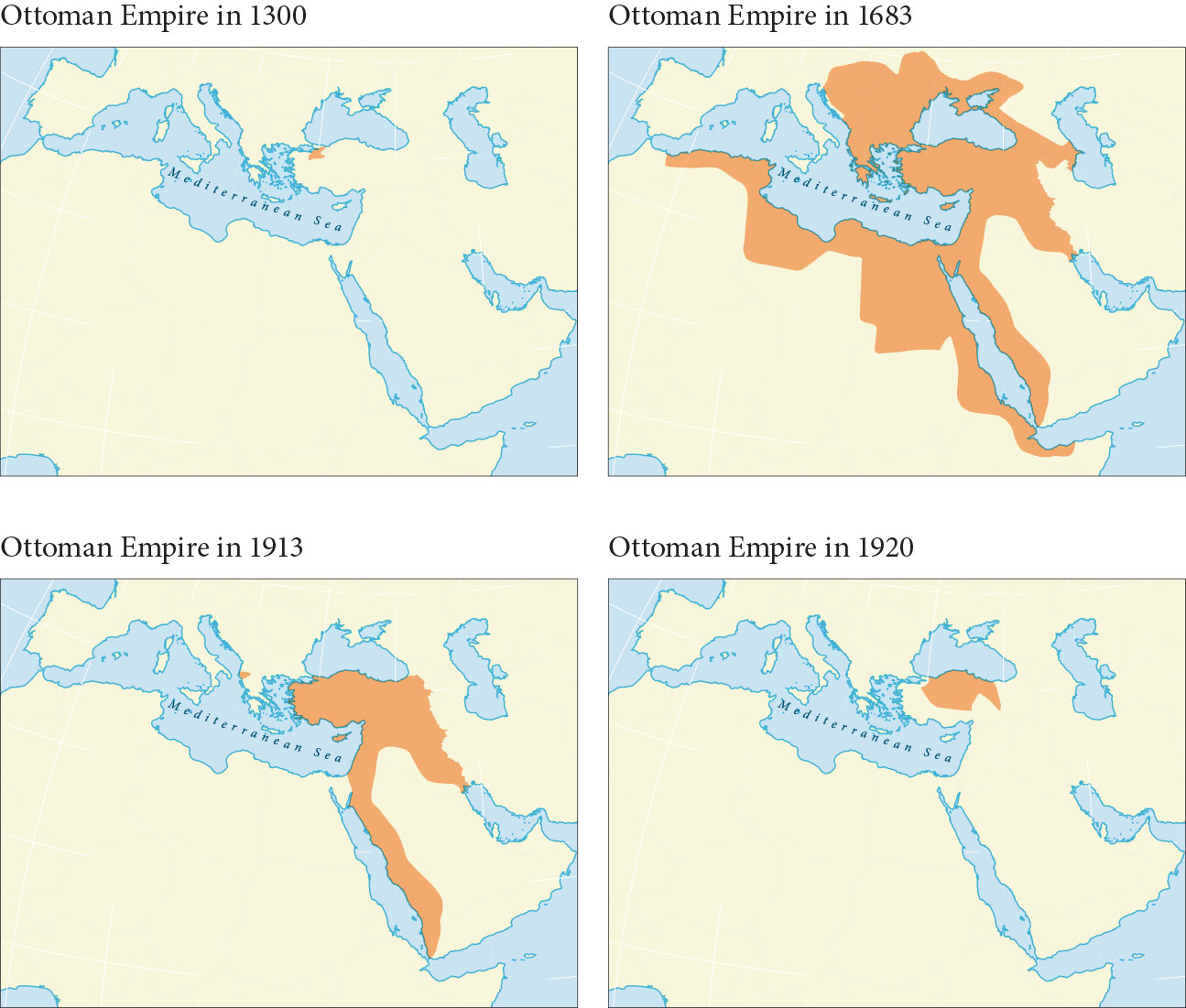
The Ottoman Empire had always been predicated on expansion. It drew its strength from its territorial gains and the exploitation of the best and brightest from these new territories to serve the leader of the empire, the sultan. The strategy had worked for a number of centuries, even delivering an Ottoman army as far as the gates of Vienna in 1683 before it was pushed back. At its height, the empire encompassed areas of the Middle East, northern Africa, and significant swaths of southeastern Europe (Figure 11.7).
英語のヒント
オスマン帝国は常に拡張を前提としていた。領土獲得と、新領土の最も優秀な人材を帝国の支配者であるスルタンに仕えさせることから力を得ていた。この戦略は数世紀にわたって成功し、1683年にはオスマン軍をウィーンの城門まで到達させたが、そこで押し戻された。最盛期の帝国は、中東、北アフリカ、ヨーロッパ南東部の広大な地域を含んでいた(図11.7)。
The Ottoman Empire, 1300–1920.オスマン帝国、1300〜1920年。
(credit: modification of work “Territorial changes of the Ottoman Empire” by “Esemono”/Wikimedia Commons, Public Domain) · Public Domain
Figure 11.7 These maps show the extent of the Ottoman Empire at its birth in northern Anatolia, at its height in the seventeenth century, on the eve of World War I, and after the war’s conclusion. (credit: modification of work “Territorial changes of the Ottoman Empire” by “Esemono”/Wikimedia Commons, Public Domain)
図11.7 これらの地図は、アナトリア北部で誕生したとき、17世紀の最盛期、第一次世界大戦前夜、そして戦争終結後のオスマン帝国の領域を示す。(出典:「Esemono」/ウィキメディア・コモンズによる「Territorial changes of the Ottoman Empire」を改変、パブリックドメイン)
Starting in the 1800s, however, the Ottoman Empire entered a period of waning power as it grew unable to respond to nationalistic challenges. In the 1820s, nationalist leaders in Greece began fighting the Greek Civil War, and in 1830 Greece gained its independence from the Ottomans. More countries split off from the Empire in the 1870s, including Serbia, Romania, and Bulgaria. By the end of the nineteenth century, the demise of the empire, now known as “the sick man of Europe,” was being predicted; only the timing was in question. The Ottoman Empire was no longer strong enough to hold onto its outlying areas, and these grew ever more destabilized. The other powers in Europe watched with concern as the Ottoman Empire became weaker and other countries stepped in to fill the power vacuum, occupying and administering a region but not annexing it as Ottoman influence withdrew.
英語のヒント
しかし1800年代になると、オスマン帝国は民族主義的な挑戦に対応できなくなり、衰退期に入った。1820年代、ギリシアの民族主義指導者はギリシア内戦を始め、1830年にギリシアはオスマン帝国から独立した。1870年代にはセルビア、ルーマニア、ブルガリアなど、さらに多くの国が帝国から離れた。19世紀末には「ヨーロッパの病人」と呼ばれるようになった帝国の滅亡が予測され、問題は時期だけだった。周辺地域を維持する力はもはやなく、それらの地域はますます不安定化した。オスマン帝国が弱まり、その影響力の後退に伴って他国が地域を併合せず占領・統治することで権力の空白を埋める様子を、ヨーロッパの他の列強は懸念をもって見守った。
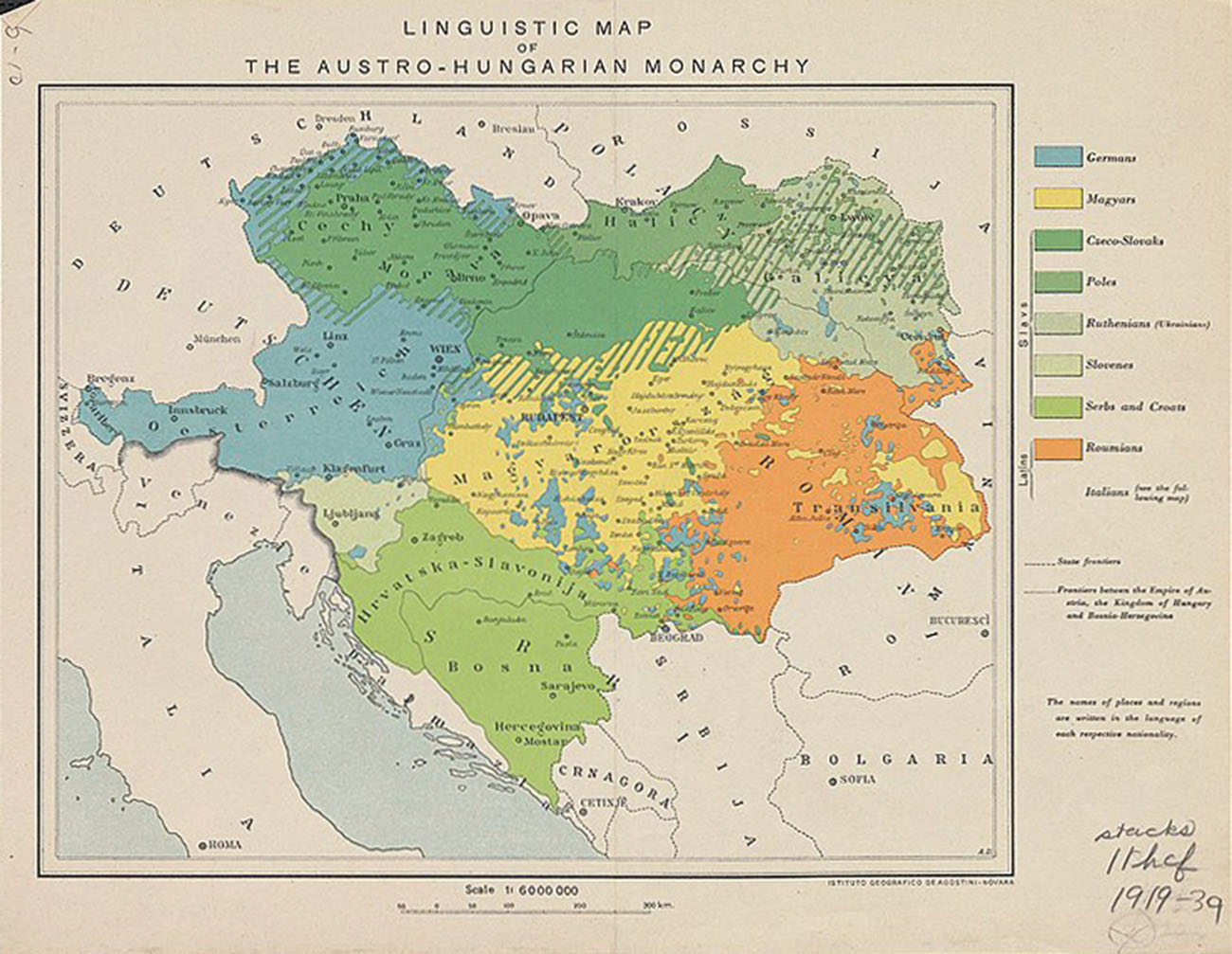
The ideology of nationalism was taking hold across Europe in the 1800s, and in the 1900s it only grew. The prospect of having a country for each nationality was tantalizingly appealing: Poland for the Poles, Serbia for the Serbs, and so on. In an empire, however, nationalism was a powerful danger. Empires were built of many different nationalities, and they would disintegrate if each group were granted its own land and nation. The Ottoman Empire had already seen such pressures develop in its eastern sections, and Austria-Hungary faced this problem as well: more than ten different nationalities could be found within its borders. The concept of nationalism threatened the Austro-Hungarian Empire’s very survival (Figure 11.8).
英語のヒント
ナショナリズムの思想は1800年代にヨーロッパ各地へ根づき、1900年代にはさらに強まった。ポーランド人にはポーランド、セルビア人にはセルビアというように、各民族が自らの国を持つ見通しは、強く人々を惹きつけた。しかし帝国では、ナショナリズムは大きな危険だった。帝国は多くの異なる民族から成り、各集団に独自の土地と国家が認められれば崩壊してしまう。オスマン帝国ではすでに東部でこうした圧力が生じており、オーストリア=ハンガリーも同じ問題に直面した。その国境内には10を超える民族が暮らしていた。ナショナリズムという考えは、オーストリア=ハンガリー帝国の存続そのものを脅かした(図11.8)。
Ethnic Groups in Austria-Hungary.オーストリア=ハンガリーの民族集団。
(credit: modification of work “Linguistic map of the Austro-Hungarian Monarchy in the 1910s” by Yale University Library/Wikimedia Commons, Public Domain) · Public Domain
Figure 11.8 This map displays the various nationalities that all resided within the empire of Austria-Hungary at the time of World War I. (credit: modification of work “Linguistic map of the Austro-Hungarian Monarchy in the 1910s” by Yale University Library/Wikimedia Commons, Public Domain)
図11.8 第一次世界大戦当時、オーストリア=ハンガリー帝国内に暮らしていたさまざまな民族を示す地図。(出典:イェール大学図書館/ウィキメディア・コモンズの「Linguistic map of the Austro-Hungarian Monarchy in the 1910s」を改変、パブリックドメイン)
The theory of pan-Slavic nationalism, which would unite all Slavic people under one rule, was a powerful one too. Slavic peoples have a shared historic culture and similar languages that include Bulgarian, Russian, Croatian, Serbian, Slovak, Czech, and Polish. They extended throughout the Balkan region and shared many of the same animosities toward the imperial powers of Austria-Hungary and the Ottoman Empire. By the twentieth century, Serbia had emerged as the leader of the pan-Slavic position in the Balkans. Its policy was characterized by hatred of Austria-Hungary and opposition to that empire’s forays into Balkan issues. Russia, too, was a Slavic nation and showed great interest in what was happening to its historic kin in the Balkans. Indeed, Russia saw itself as the natural leader of any potential pan-Slavic political entity that might emerge in the Balkans. Russia also saw Austria-Hungary and the Ottomans as rivals in the region and did not want either power to make any territorial gains. Russia hoped that by gaining influence in the Balkans, it could gain direct access to the Mediterranean Sea. Before 1914, however, Russia was not prepared to risk war to maintain this stance.
英語のヒント
すべてのスラヴ人を一つの支配のもとに統合する汎スラヴ主義も、強い影響力を持っていた。スラヴ諸民族は歴史的な文化を共有し、ブルガリア語、ロシア語、クロアチア語、セルビア語、スロヴァキア語、チェコ語、ポーランド語などの似た言語を話す。彼らはバルカン地域全体に広がり、オーストリア=ハンガリーとオスマン帝国という帝国勢力への敵意の多くを共有していた。20世紀までに、セルビアはバルカンで汎スラヴ主義の指導国となった。その政策はオーストリア=ハンガリーへの憎悪と、同帝国のバルカン問題への介入への反対に特徴づけられた。ロシアもスラヴ国家であり、バルカンの歴史的な同族の動向に強い関心を示した。実際、ロシアはバルカンに汎スラヴ的な政治体制が成立すれば、自国こそ当然その指導者になると考えた。またオーストリア=ハンガリーとオスマン帝国を地域の競争相手とみなし、いずれの領土拡大も望まなかった。バルカンで影響力を得ることで、地中海への直接の通路を確保しようとしたのである。しかし1914年以前には、この立場を守るために戦争を冒す用意はなかった。
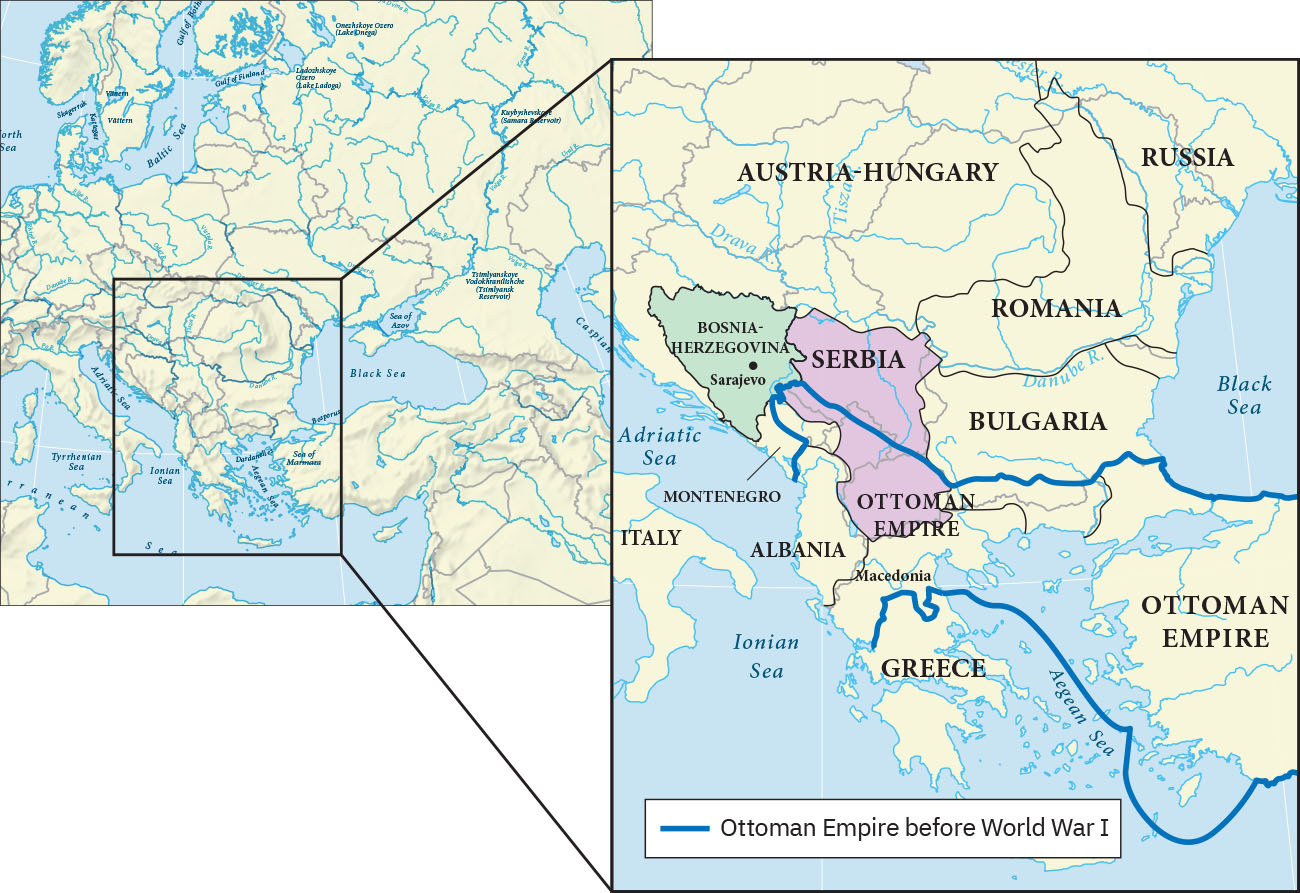
The Balkans was a prime example of both the threat of nationalism and the threat from the weakening power of the Ottoman Empire. The region housed people of different nationalities and different religions. The Ottomans had been steadily losing power there and were certain to continue to do so. The nearby empire of Austria-Hungary looked covetously upon the Balkans, seeing an opportunity to take over more territory. In 1908, Austria-Hungary moved to block Serbian expansion in the Balkans by taking over administration of Bosnia-Herzegovina, with its capital of Sarajevo (Figure 11.9).
英語のヒント
バルカン半島は、ナショナリズムの脅威とオスマン帝国の弱体化がもたらす脅威の両方を示す代表例だった。異なる民族や宗教の人々がこの地域に住んでいた。オスマン帝国は着実に力を失っており、今後もそうなることは確実だった。近隣のオーストリア=ハンガリー帝国は、より多くの領土を獲得する好機と見て、バルカンに貪欲な目を向けた。1908年、同帝国はサラエボを首都とするボスニア=ヘルツェゴヴィナの統治を引き継ぐことで、バルカンにおけるセルビアの拡張を阻止しようとした(図11.9)。
The Balkans before the War.戦前のバルカン半島。
(credit: modification of work “Bosnia and Herzegovina” by CIA/The World Factbook, Public Domain) · Public Domain
Figure 11.9 This map shows the Balkan region in the period before World War I. Note the size of Serbia and its proximity to Sarajevo in Bosnia-Herzegovina. (credit: modification of work “Bosnia and Herzegovina” by CIA/The World Factbook, Public Domain)
図11.9 第一次世界大戦前のバルカン地域を示す地図。セルビアの大きさと、ボスニア=ヘルツェゴヴィナのサラエボに近いことに注目しよう。(出典:CIA/The World Factbookの「Bosnia and Herzegovina」を改変、パブリックドメイン)
Serbia continued its plan to exercise more control through the Balkans and helped found the Balkan League with Greece, Bulgaria, and Montenegro in 1912. The league then touched off the First Balkan War in October 1912 by attacking Macedonia, which was still held by the Ottomans. In May 1913, the Balkan League comprehensively defeated the Ottomans and forced them to give up most of their territory in Europe. Disagreements among the victors in the Balkans soon devolved into the Second Balkan War as Bulgaria attacked Serbia and Greece in 1913. Bulgaria was soon defeated, but this loss drove it to forge a deeper alliance with the Central powers—Germany, Austria-Hungary, and the Ottoman Empire—when World War I broke out.
英語のヒント
セルビアはバルカン全域で支配を強める計画を続け、1912年にはギリシア、ブルガリア、モンテネグロとバルカン同盟を結成する一助となった。同盟は同年10月、まだオスマン帝国が保有するマケドニアを攻撃し、第1次バルカン戦争を引き起こした。1913年5月、バルカン同盟はオスマン帝国を全面的に破り、ヨーロッパの領土の大部分を放棄させた。勝者間の不和はすぐに第2次バルカン戦争へ発展し、1913年にブルガリアがセルビアとギリシアを攻撃した。ブルガリアはほどなく敗れたが、この敗北が、第一次世界大戦の勃発時に中央同盟国、すなわちドイツ、オーストリア=ハンガリー、オスマン帝国とのより強い同盟を結ぶ方向へと駆り立てた。
The Balkan Wars also forced continued displacement of Muslims from the region. After Serbia’s independence decades earlier, there had been systematic efforts to force Muslims to leave. This drive spread throughout the Balkans as Christians increasingly attacked Muslims, causing hundreds of thousands to relocate to the Ottoman Empire. As the empire withdrew from the Balkans, many of these Muslims left with it, although substantial Muslim populations remained and still live in the Balkans today. The Ottoman Empire then had to cope with a substantial population increase at the same time that its standing in the world was on a decline.
英語のヒント
バルカン戦争は、同地域からのムスリムの追放も引き続きもたらした。数十年前のセルビア独立後には、ムスリムを立ち退かせる組織的な取り組みがあった。この動きはバルカン全域に広がり、キリスト教徒によるムスリムへの攻撃が増え、数十万人がオスマン帝国へ移住した。帝国がバルカンから撤退すると、多くのムスリムもともに去ったが、相当数のムスリムは残り、今日もバルカンに住んでいる。その結果、オスマン帝国は国際的地位が低下するのと同時に、大幅な人口増加への対処も迫られた。