第11章すべての戦争を終わらせるための戦争The War to End All Wars
The combatants rushed to begin recruiting more troops for their militaries. Conscription laws in some countries meant that adult men had already received some military training and were assigned to reserve units, so there was a straightforward means to organize and deploy these troops. Other places, such as Great Britain, had a volunteer military. Either way, there was mass enthusiasm as the war broke out, and men thronged to recruiting stations (Figure 11.11).
英語のヒント
交戦国は急いで軍の兵員募集を始めた。徴兵法のある国では、成人男性はすでに軍事訓練を受けて予備役部隊に配属されていたため、これらの兵を組織して配備する方法は明確だった。イギリスなどは志願制の軍隊を持っていた。いずれにせよ、開戦時には大衆の熱狂があり、男性たちは募集所へ押し寄せた(図11.11)。
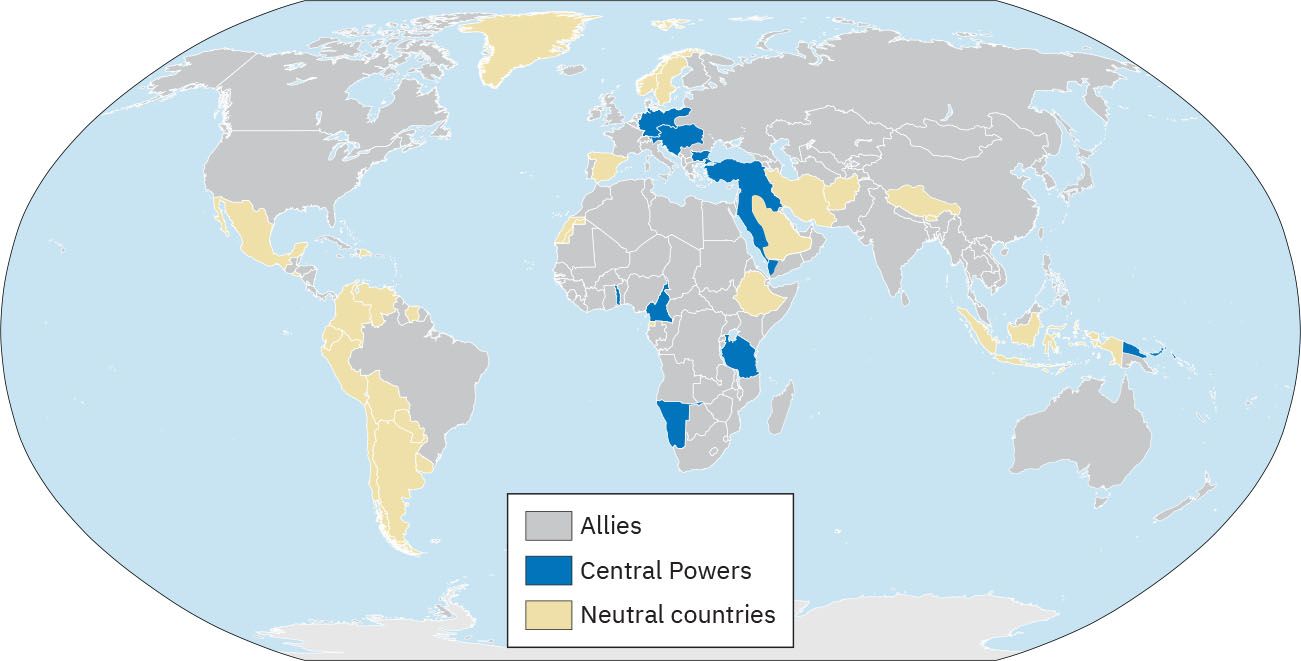
Allegiances in World War I.第一次世界大戦の陣営。
(credit: modification of work “BlankMap-World” by CIA World Factbook/Wikimedia Commons, Public Domain) · Public Domain
Figure 11.11 This map shows all the countries that ultimately participated in World War I and their allegiances. (credit: modification of work “BlankMap-World” by CIA World Factbook/Wikimedia Commons, Public Domain)
図11.11 最終的に第一次世界大戦へ参加したすべての国と、それぞれの陣営を示す地図。(出典:CIA World Factbook/ウィキメディア・コモンズの「BlankMap-World」を改変、パブリックドメイン)
The World at War戦争の中の世界
Some German units never made it out of Belgium, and fierce fighting there continued for the duration of the war. Other units swept south and continued their advance through northern France. French troops moved swiftly to block them. The Battle of the Marne in September 1914 created front lines where a stalemate lasted several years as both sides dug a trench system from which to fight. German armies were moving toward Paris when the French were able to exploit a gap between two of the divisions. A series of flanking maneuvers ensued as the French and Germans both raced to the sea. Additional French troops were called up, and at one point the French reserves even commandeered the taxicabs of Paris to ferry themselves to the front. The Battle of the Marne went on for a week before the German advance was stopped. The battle was fought so close to Paris that civilians could hear the sounds of the fighting. Given an information blackout due to government censors, rumors about the threat to Paris were rampant. Approximately 800,000 people left the city, anticipating a German invasion.
英語のヒント
ドイツ軍の一部はベルギーを出ることなく、同地では戦争中ずっと激戦が続いた。他の部隊は南へ回り、フランス北部を進撃した。フランス軍は素早く動いて阻止した。1914年9月のマルヌの戦いで前線が生まれ、双方が戦うための塹壕網を掘るにつれ、膠着状態が数年間続いた。ドイツ軍がパリに向かう途中、フランス軍は二つの部隊の間の隙間を利用できた。両軍が海を目指して競う中、互いの側面へ回り込む一連の機動が続いた。フランスは追加の兵を招集し、ある時点では予備役兵がパリのタクシーまで徴用して前線へ移動した。マルヌの戦いは1週間続き、ドイツ軍の進撃は止められた。戦場はパリに非常に近く、市民にも戦闘音が聞こえた。政府の検閲によって情報が途絶える中、パリへの脅威をめぐる噂が広がった。約80万人がドイツ軍の侵入を予想し、市を離れた。
In the east, Germany found itself facing the Russians in battle much earlier than expected. Due to its size, the potential of the Russian military was great, but the reality was quite different; the troops were poorly equipped and poorly trained. At the Battle of Tannenberg, for example, communication problems developed among the Russian high command, while the troops suffered from lack of supplies; the country’s limited rail lines could not keep up with their needs. The Germans decimated them. They took more than 90,000 prisoners, and another 50,000 Russians had become casualties in the week of fighting. The Germans suffered fewer than 20,000 casualties in comparison. The general in command of the Russian army committed suicide.
英語のヒント
東部では、ドイツは予想よりずっと早くロシアとの戦闘に直面した。規模が大きいためロシア軍の潜在力は大きかったが、現実はまったく異なり、兵士の装備も訓練も不十分だった。たとえばタンネンベルクの戦いでは、ロシア軍最高司令部の間に連絡の問題が生じ、兵士は補給不足に苦しんだ。国内の限られた鉄道は需要に追いつけなかった。ドイツ軍はロシア軍を壊滅させた。9万人以上を捕虜にし、さらに5万人のロシア兵が1週間の戦闘で死傷した。これに対しドイツ軍の死傷者は2万人未満だった。ロシア軍を指揮する将軍は自殺した。
The Russians’ dearth of supplies also featured in a major engagement with the Austro-Hungarian forces as Russia laid siege to Przemyśl in modern-day Poland. As the siege continued from the summer into the fall and then the winter, Russian soldiers lacked coats and boots to withstand the plummeting temperatures, though Russia ultimately took the city in 1915. The Austro-Hungarian forces bore the brunt of the siege and fighting in the nearby mountains to relieve the fortress, experiencing well over 900,000 casualties—an astronomical number.
英語のヒント
ロシア軍が現在のポーランドにあるプシェミシルを包囲した際のオーストリア=ハンガリー軍との大規模な交戦でも、ロシア側の物資不足が目立った。包囲が夏から秋、そして冬へと続く中、ロシア兵は急激な気温低下に耐える外套や長靴を欠いていたが、最終的には1915年に市を陥落させた。オーストリア=ハンガリー軍は、包囲と、要塞を救援するための近隣の山地での戦闘の打撃をまともに受け、90万人を大きく超えるという途方もない数の死傷者を出した。
The naval power of Great Britain was soon brought to bear. The British instituted a blockade of German ports that made it exceedingly difficult for Germany to import the goods it needed. The country’s industrial strength helped it survive this blockade for a good portion of the war, but by its last year, shortages were being felt by every German family. Its navy was not large enough to implement a retaliatory blockade against Britain, but Germany did consider the North Sea a war zone and used mines and submarines to sink ships sailing there.
英語のヒント
イギリスの海軍力はほどなく発揮された。イギリスはドイツの港を封鎖し、必要な物資の輸入を極めて困難にした。ドイツは工業力のおかげで戦争のかなりの期間をこの封鎖に耐えたが、最終年にはすべての家庭が物資不足を感じていた。ドイツ海軍にはイギリスに報復的な封鎖を行うだけの規模がなかったが、北海を戦闘区域とみなし、機雷と潜水艦で航行する船を沈めた。
In Asia, the coming of the war caused nations to take sides. The Japanese Empire, emboldened by its success against Russia less than a decade earlier in the Russo-Japanese War (1904–1905), saw the opportunity to increase its standing in the world and sided with the Allies. Japanese forces attacked the German colonial port at Qingdao (Tsingtao), a city on the Chinese coast that Germany had held for less than twenty years as the planned headquarters of its Asian empire. In mid-August 1914, Japan demanded that Germany abandon Qingdao. When it refused, Japan blockaded the port and began bombarding it. The attacks continued for two months until Germany surrendered the city in November. Japan was able to cement its relationship with Great Britain and give its modernizing military another victory that increased its pride.
英語のヒント
アジアでは、戦争の到来によって国々が陣営を選ぶことになった。日本帝国は、10年足らず前の日露戦争(1904〜1905年)でロシアに勝ったことで自信を深め、国際的地位を高める好機と見て連合国側についた。日本軍は、中国沿岸のドイツ植民地の港、青島を攻撃した。ドイツがアジア帝国の拠点にしようとしたこの都市を保有していた期間は、20年未満だった。1914年8月半ば、日本はドイツに青島の放棄を要求した。拒否されると港を封鎖し、砲撃を始めた。攻撃は2か月続き、11月にドイツが都市を明け渡した。日本はイギリスとの関係を固め、近代化を進める軍に新たな勝利を与えて、その誇りを高めた。
The Allies rejected offers of military troops from China at the beginning of the war. By 1916, however, the situation had changed, and Britain and France allowed Chinese laborers to come to Europe. China had been willing to send combat troops, hoping to gain leverage in treaty negotiations after the war and support for ousting Japan from its borders, but Japan, which had taken control of Qingdao and hoped to establish itself as the unquestioned military power in Asia, would not permit it. Thus, approximately 130,000 Chinese laborers arrived in Europe, to repair equipment and dig trenches but not to fight.
英語のヒント
開戦当初、連合国は中国からの兵員派遣の申し出を拒んだ。しかし1916年までに状況が変わり、イギリスとフランスは中国人労働者の渡欧を認めた。中国は、戦後の条約交渉での発言力と、日本を自国から追い出す支持を得ようと、戦闘部隊を派遣する意向だった。しかし青島を支配し、アジアで疑いのない軍事大国になろうとしていた日本は、それを認めなかった。そのため、約13万人の中国人労働者がヨーロッパに渡ったが、戦うためではなく、装備の修理や塹壕掘りを行うためだった。
Other combatant powers entered the war after the summer of 1914. In October, the Ottoman Empire engaged in combat on behalf of the Central powers by attacking Russia’s fleet on the Black Sea. For the Ottomans, entering into the war was a calculated risk. The empire hoped to regain some standing in the world and even possibly more territory, and clear bonds had developed between the Ottoman leadership and that of Germany over the past years. Other countries soon followed suit. Bulgaria entered the war via secret agreement in 1915 on the side of the Central powers, also hoping for territorial acquisition at the conclusion of the fighting. On the other side of the spectrum, Italy had announced its neutrality when the war broke out, but many Italians harbored a dislike of Austria-Hungary, and there had been many disagreements about the border between the two countries over the years. In May 1915, Italy declared war against the Central powers, having first secured Allied support through a secret agreement in April. The hope of reclaiming land lost to Austria-Hungary was paramount in its decision.
英語のヒント
1914年夏以降、他の交戦国も戦争に加わった。10月、オスマン帝国は黒海のロシア艦隊を攻撃し、中央同盟国側で戦闘に入った。帝国にとって参戦は計算された賭けだった。国際的地位をある程度回復し、できれば領土も増やそうとし、過去数年間にはオスマン帝国とドイツの指導部の間に明確な絆も生まれていた。他国もすぐに続いた。ブルガリアは1915年、秘密協定によって中央同盟国側で参戦し、同じく戦後の領土獲得を望んだ。反対の側では、開戦時に中立を宣言したイタリアでも、長年の国境紛争からオーストリア=ハンガリーに反感を抱く人々が多かった。1915年5月、イタリアは4月の秘密協定で連合国の支持を確保したうえで、中央同盟国に宣戦布告した。オーストリア=ハンガリーに失った土地を取り戻す希望が、その決断で最も重要だった。
Isolationism had been a consistent practice of U.S. foreign policy, and the United States planned to maintain it, while at the same time selling products to both the Allied powers of Britain and France and the Central powers of Germany and Austria-Hungary. It was clear from the outset, however, that “[Quotation omitted for rights reasons.]” partly because of Britain’s substantial role in U.S. naval, merchant, and credit operations but also because the British blockade made it difficult for anyone to trade with Germany. U.S. banks were soon extending loans and lines of credit to both sides as well, although approximately $2 billion had been extended to the Allies by the spring of 1917 and a mere $27 million to the Central powers.
英語のヒント
孤立主義はアメリカ合衆国の外交政策の一貫した慣行であり、同国はそれを維持すると同時に、連合国のイギリス・フランスにも、中央同盟国のドイツ・オーストリア=ハンガリーにも製品を売るつもりだった。しかし当初から「〔権利の関係で割愛〕」という状況は明らかだった。その理由の一つは、アメリカの海運、商取引、信用取引でイギリスが大きな役割を果たしていたことだが、イギリスの封鎖によって、誰にとってもドイツとの貿易が難しくなったこともあった。アメリカの銀行もほどなく双方に融資や信用供与を始めたが、1917年春までに連合国には約20億ドルが供与されたのに対し、中央同盟国にはわずか2700万ドルだった。
Among the American public, there was little support for or interest in entering this European war. Not hampered by censorship of the news as the combatant powers were, American readers could easily learn about the casualty numbers and the horror of the war. They congratulated themselves that they were not party to this insanity and showed little desire to enter it.
英語のヒント
アメリカの世論には、このヨーロッパの戦争への参戦を支持する声や関心はほとんどなかった。交戦国のような報道検閲に妨げられず、アメリカの読者は死傷者数や戦争の恐怖を容易に知ることができた。人々はこの狂気に加わっていないことを喜び、参戦したいという気持ちをほとんど示さなかった。
There were additional complicating issues for the United States. The country’s volunteer army was quite small and would have little impact on the war if it entered at this time. While businesses and banks were siding with the Allied cause, a substantial number of Irish immigrants were vehemently anti-British because of ongoing conflicts in Ireland, and it was questionable how they would react to the United States entering a war on the British side. There was also a significantly large German population in the United States that could oppose siding with the Allies. President Woodrow Wilson had shown little interest in foreign policy in his previous career as a professor of government and history; instead, he saw domestic reform as his administration’s main focus when he came into office. He had been willing to intervene in Latin America as a neighboring region but did not have that same approach regarding Europe. However, his commitment to the freedom of the seas and the rights of neutral nations in times of war soon put him on a collision course with Germany.
英語のヒント
アメリカ合衆国には、さらに事態を複雑にする問題があった。志願制の陸軍は小さく、この時点で参戦しても戦争への影響はわずかだった。企業や銀行は連合国を支持していたが、アイルランドで続く紛争のため、相当数のアイルランド系移民は激しく反英的であり、イギリス側での参戦にどう反応するかは疑問だった。ドイツ系住民も非常に多く、連合国側に立つことに反対する可能性があった。ウッドロウ・ウィルソン大統領は、以前政治学・歴史学の教授だったときも外交政策にあまり関心を示しておらず、就任時には国内改革を政権の中心課題とした。近隣地域であるラテンアメリカへの介入には積極的だったが、ヨーロッパには同じ姿勢をとらなかった。しかし海洋の自由と戦時中の中立国の権利へのこだわりは、ほどなくドイツとの衝突へ彼を向かわせた。