第7章ヨーロッパと北アメリカの革命Revolutions in Europe and North America
7.4 Nationalism, Liberalism, Conservatism, and the Political Order7.4 ナショナリズム、自由主義、保守主義と政治秩序
Learning Objectives学習の目標
By the end of this section, you will be able to:
この節を学ぶと、次のことができるようになる。
Explain the causes, main ideologies, and values of nationalism, liberalism, and conservativism
ナショナリズム、自由主義、保守主義の成立原因、主な思想、価値観を説明する。
Discuss the unification of Germany and Italy in terms of nationalism
ナショナリズムの観点から、ドイツとイタリアの統一を論じる。
Describe the impact of the Congress of Vienna and the career of Metternich on the balance of power in Europe
ウィーン会議とメッテルニヒの政治活動が、ヨーロッパの勢力均衡に及ぼした影響を説明する。
In the early nineteenth century, the upheaval of revolution gave way to political philosophies and ideologies intended to restore order and prevent the types of violent clashes that had defined much of the previous century. As belief in popular sovereignty and principles of liberty and equality spread, particularly in Europe and North America, emerging nations came to hold different ideas about the best way to safeguard these revolutionary gains. In particular, nationalism, liberalism, and conservatism became entrenched forces that, while unique, all temporarily subdued the unrest of the revolutionary period. In a radically transformed political landscape, however, revolts and revolutions eventually emerged that challenged the last remnants of the prerevolutionary status quo.
英語のヒント
19世紀初めには、革命の激動に代わって、秩序を取り戻し、前世紀の多くを特徴づけたような暴力的衝突を防ごうとする政治哲学や思想が現れた。人民主権や自由・平等の原理への信念が、とくにヨーロッパと北アメリカに広がると、生まれつつある国々は、革命の成果を守る最善の方法について、異なる考えを抱くようになった。とくにナショナリズム、自由主義、保守主義は、それぞれ異なりながらも、革命期の騒乱を一時的に鎮める、定着した勢力となった。しかし政治情勢が根本的に変わるなか、やがて革命以前の秩序の最後の名残に挑む、新たな反乱や革命が起こった。
Nationalismナショナリズム
The turbulence of the revolutionary era started to wane, and a sense of shared goals and values grew to shape people’s perceptions of national identity. As a consequence of the French Revolution and the revolutionaries’ subsequent wars against neighboring monarchies they saw as hostile to their new republic, the novel idea of a nation began to provide a sense of belonging and community. It replaced the older ideas of dynasty and city-state and became the primary focus of individuals’ political allegiance. By using fear of foreign attacks as a means to gather support for the government and raise an army that represented the interests of the people rather than the monarch, French revolutionaries had inspired loyalty to the state, which also represented the people. In some cases, Great Britain, for example, the nation coexisted with a traditional monarchy. In others, like Haiti, France, and the United States, the old order was completely replaced, and a brand-new political system and cultural landscape emerged in its stead.
英語のヒント
革命期の動乱が弱まると、目標や価値観を共有しているという感覚が強まり、人々の国民としての帰属意識を形づくるようになった。フランス革命と、その後、革命家たちが自分たちの新共和国に敵対するとみなす周辺の君主国と行った戦争の結果、「国民・国」という新しい考えが、帰属感や共同体意識を与え始めた。それは王朝や都市国家という古い考えに代わり、個人の政治的忠誠の主な対象となった。フランスの革命家は、外国からの攻撃への恐れを利用して政府への支持を集め、君主ではなく人民の利益を代表する軍を組織した。それにより、人民をも代表する国家への忠誠を呼び起こした。イギリスのように、国民国家が伝統的な君主制と共存する場合もあった。ハイチ、フランス、アメリカ合衆国のように、旧秩序が全面的に置き換わり、まったく新しい政治制度と文化的状況が現れる場合もあった。
A radical political ideology that promotes the interests of the nation over international concerns, nationalism advocates the uniqueness and inherent superiority of an individual’s own country and the right to self-determination and political autonomy. While this ideology can foster domestic stability by generating unity and loyalty from within, it can also generate hostility toward outsiders and marginalize minority communities. Although nationalism was a powerful force in Europe throughout the nineteenth century, it was by no means limited to the continent and came to play a powerful role in the modern development of countries such as Egypt and Japan.
英語のヒント
ナショナリズムとは、国際的な配慮より自国の利益を優先する急進的な政治思想で、自国の独自性と本来的な優越性、自己決定と政治的自治の権利を主張する。この思想は、国内の団結と忠誠を生み出して安定を促すこともあるが、外部の人々への敵意を生み、少数派の共同体を周縁に追いやることもある。ナショナリズムは19世紀を通じてヨーロッパの強力な力だったが、大陸だけに限られるものではなく、エジプトや日本などの近代的発展でも大きな役割を果たすようになった。
As fledgling nations began to materialize in the nineteenth century, many used language, ethnicity, religion, a sense of shared origin, or some combination of these as a foundation of national identity. Often, a group of people who share a national identity based on ethnicity, language, or religion also live in the same state, a political unit that occupies a given territory with defined borders and imposes laws on its residents, and govern themselves. This was the goal for which nationalists strive.
英語のヒント
19世紀に新しい国々が姿を現し始めると、多くは言語、民族性、宗教、起源を共有する感覚、またはこれらの組み合わせを、国民としての帰属意識の基盤にした。民族性、言語、宗教に基づく共通の国民意識を持つ人々は、しばしば同じ国家に暮らし、自らを統治する。国家とは、明確な国境を持つ一定の領域を占め、その住民に法を課す政治的単位である。これが、ナショナリストたちの目指す目標だった。
At times, though, people who share a national identity (or “nationality”) may be scattered across a variety of different states. For example, in Europe in the nineteenth century, people who were ethnically German and spoke the German language lived in many different kingdoms, principalities, and other political units. In such a case, nationalists seek to unify all those with the same national identity in the same state, so that all live under the same government, which members of that nationality control, within the same territorial borders.
英語のヒント
しかし、共通の国民意識、すなわち民族的な帰属を持つ人々が、複数の国家に散らばっていることもある。たとえば19世紀ヨーロッパでは、民族的にドイツ人でドイツ語を話す人々は、多くの王国、公国、その他の政治的単位で暮らしていた。このような場合、ナショナリストは、同じ国民意識を持つ人々を一つの国家に統一し、同じ領域の境界の内側で、その民族の成員が支配する同じ政府のもとに、全員が暮らすことを目指す。
At other times, people who share a national identity may live in a state governed by people of a different nationality. Jews, for example, share a Jewish identity but, except for those who live in Israel (a state that was founded only in 1948), Jews live in states dominated by people of other nationalities. In such cases, nationalists may advocate that a separate state be formed by members of the minority nationality, so that they may live and govern themselves without the interference of other, sometimes hostile, groups. In the nineteenth century, a Jewish movement called Zionism formed to advocate for the establishment of a separate state for Jews.
英語のヒント
また、共通の国民意識を持つ人々が、別の民族の人々に統治される国家に暮らす場合もある。たとえばユダヤ人は、ユダヤ人としての共通の帰属意識を持つが、1948年になって成立したイスラエルという国家に住む人々を除けば、他の民族の人々が支配する国家で暮らしている。この場合、ナショナリストは、ときに敵対的でもある他集団の干渉を受けずに暮らし、自らを統治できるよう、少数派民族の成員による独立した国家の形成を主張することがある。19世紀には、ユダヤ人のための別個の国家の樹立を唱える「シオニズム」という運動が生まれた。
By the end of the nineteenth century, Italy and Germany were among the nations that most fully embraced these means of reinforcing their political sovereignty and bolstering resistance to the threat of tyranny. Narratives of national dominance and righteousness were perpetuated in schools, the military, and the bureaucracy. This sense of shared identity and heritage laid the groundwork for the nationalism that ultimately led to the unification of Italy and of Germany over the course of the nineteenth century.
英語のヒント
19世紀末までに、イタリアとドイツは、こうした方法を最も全面的に受け入れ、政治的主権を強め、専制の脅威への抵抗を支えた国々の一部となった。学校、軍隊、官僚機構では、国の優位性と正しさを語る物語が繰り返し伝えられた。この共通の帰属意識と遺産の感覚が、19世紀を通じて最終的にイタリアとドイツの統一へつながるナショナリズムの土台となった。
In the first half of the nineteenth century, Italy was a loose coalition of states under the control of the Austrian Empire and the Catholic Church. Although the states all had different cultural traditions, political systems, and dialects, the growing influence of nationalism and a desire for greater freedom and relief from authoritarian rule led to many uprisings and rebellions against traditional monarchies and foreign powers across the Italian peninsula. The ideals of equality and patriotism that spread across Europe in the nineteenth century fostered a growing sense of common goals and collective aspirations in the Italian states.
英語のヒント
19世紀前半、イタリアはオーストリア帝国とカトリック教会の支配下にある諸国の、緩やかなまとまりだった。各国の文化的伝統、政治制度、方言は異なっていたが、ナショナリズムの影響の高まりと、より大きな自由や権威主義的統治からの解放を望む気持ちが、半島各地で、伝統的な君主制や外国勢力に対する多くの蜂起や反乱を生んだ。19世紀ヨーロッパに広まった平等と愛国心の理想は、イタリアの諸国で、共通の目標と願望を持つ感覚を強めた。
After founding an organization known as Young Italy in 1831, Giuseppe Mazzini began promoting a sense of shared Italian identity and encouraged his supporters to dedicate their lives to their nation. Mazzini hoped a new republic would be the means of throwing off the tyranny of foreign monarchs and the authority of the pope. Nationalist ideology was considered so radical at the time, however, that he was eventually arrested and exiled for political subversion.
英語のヒント
1831年に青年イタリアという組織を創設すると、ジュゼッペ・マッツィーニは、イタリア人として共通の帰属意識を広め、支持者に自分の人生を国へ捧げるよう促し始めた。彼は、新しい共和国が、外国の君主の専制と教皇の権威を振り払う手段となることを望んだ。しかし当時、ナショナリズムの思想はきわめて急進的と考えられていたため、彼はやがて政治的な体制転覆活動を理由に逮捕され、追放された。
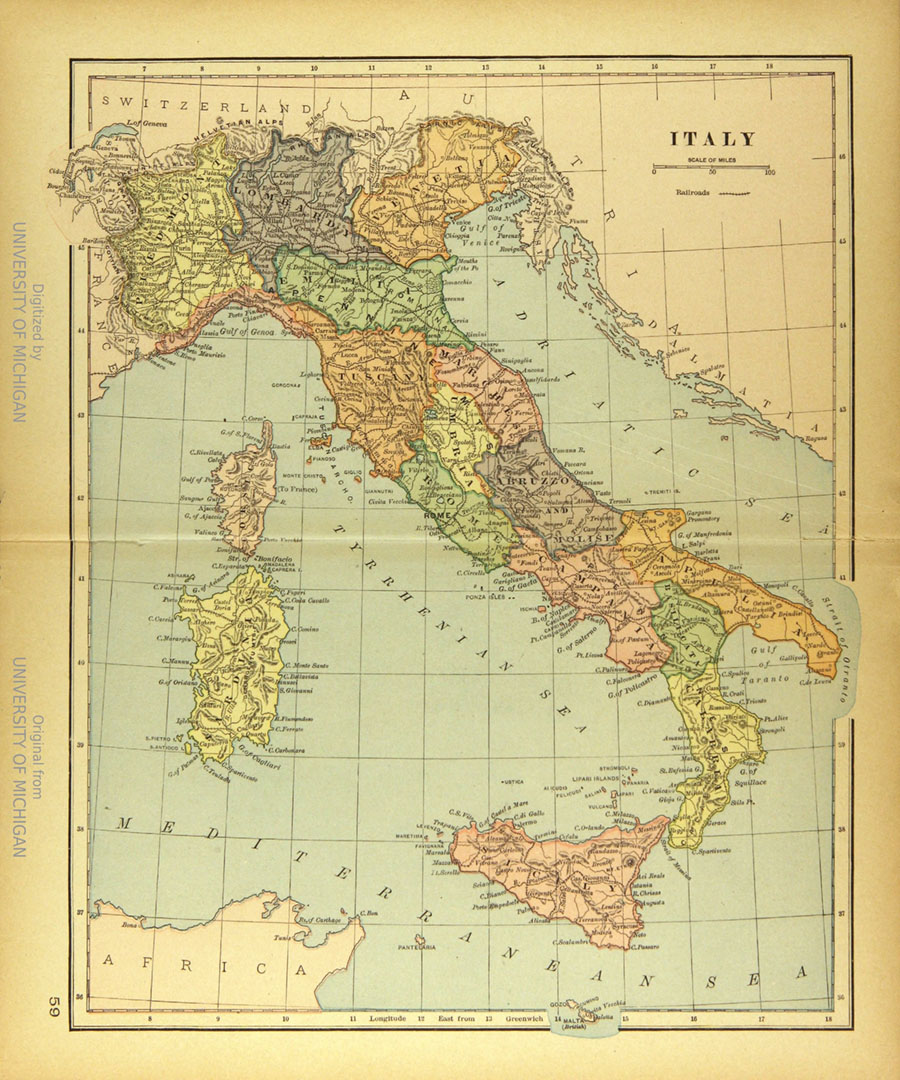
After Mazzini’s arrest, the soldier and patriot Giuseppe Garibaldi continued to build momentum for a unified Italian state. However, after participating in a failed insurrection in Piedmont, he fled the country. Garibaldi’s military experience and training in guerrilla warfare during his self-imposed exile in Latin America enabled him to lead his troops to victory in revolutionary campaigns in 1848–1849. Initiated by these Italian nationalists who sought to eliminate Austrian control, the unification cause received powerful support from King Victor Emmanuel II of Piedmont-Sardinia and his prime minister Count Camillo di Cavour. Revolutionary struggles culminated in Garibaldi’s declaring Victor Emmanuel II king of the unified kingdom of Italy in 1861. The unification, also known as the Risorgimento, thus occurred under a monarchical system of government. It was completed when Rome was annexed in 1870 (Figure 7.15).
英語のヒント
マッツィーニの逮捕後、軍人で愛国者のジュゼッペ・ガリバルディは、統一イタリア国家への勢いをさらに高めた。しかしピエモンテで失敗した反乱に参加した後、国外へ逃れた。ラテンアメリカでの自主的な亡命中に得た軍事経験とゲリラ戦の訓練によって、彼は1848〜1849年の革命戦争で、部隊を勝利へ導くことができた。オーストリア支配の排除を求めるイタリアのナショナリストが始めた統一運動は、ピエモンテ=サルデーニャ王国の国王ヴィットーリオ・エマヌエーレ2世と、その首相カミッロ・ディ・カヴール伯爵から強い支援を受けた。革命的闘争は、1861年にガリバルディがヴィットーリオ・エマヌエーレ2世を統一イタリア王国の王と宣言することで、頂点に達した。こうして、リソルジメントとも呼ばれる統一は、君主制のもとで起こった。1870年にローマが併合されて、統一は完成した(図7.15)。
The Kingdom of Italy.イタリア王国。
(credit: “1894 Map of Italy” by Hathi Trust Digital Library/Wikimedia Commons, Public Domain) · Public Domain
Figure 7.15 This map printed in 1894 depicts the Kingdom of Italy after unification but before the addition of the northern regions of Valle d’Aosta, Friuli Venezia Giulia, and Trentino-Alto Adige, three of the twenty regions that form the Italian Republic of today. (credit: “1894 Map of Italy” by Hathi Trust Digital Library/Wikimedia Commons, Public Domain)
図7.15 1894年に印刷されたこの地図は、統一後のイタリア王国を描く。ただし、現在のイタリア共和国を構成する20州のうち、北部のヴァッレ・ダオスタ、フリウリ=ヴェネツィア・ジュリア、トレンティーノ=アルト・アディジェの3州が加わる前の姿である。(画像:Hathi Trust Digital Library/Wikimedia Commons「1894 Map of Italy」、パブリックドメイン。)
In predominantly German-speaking lands, an alliance of thirty-nine sovereign states known as the Germanic Confederation emerged as a replacement for the former Holy Roman Empire in 1815. Because each of the member states retained political autonomy, the Germanic Confederation lacked executive power or centralized authority. The main goal of the Confederation, however, was not to replace the governmental powers of its member states but rather to create a unified defense against France and Russia. Although it eventually succumbed to the Austrian Empire in 1866, the Confederation laid the groundwork for the nationalism that inspired German unification in 1871 and the creation of the modern nation-state of Germany.
英語のヒント
主にドイツ語が話される地域では、1815年、かつての神聖ローマ帝国に代わって、「ドイツ連邦」と呼ばれる39の主権国家の同盟が生まれた。各加盟国が政治的自治を保ったため、連邦には行政権や中央集権的な権威がなかった。しかし連邦の主な目的は、加盟国の統治権に取って代わることではなく、フランスとロシアに対する統一した防衛を作ることだった。最終的に1866年にオーストリア帝国に屈したものの、連邦は、1871年のドイツ統一と近代的国民国家ドイツの創設を促すナショナリズムの土台を築いた。
As Germany moved toward political unification in the middle of the nineteenth century, it sought to remove foreign political influence and solidify the cultural and linguistic unity that expanded the momentum of the Germanic Confederation. In 1848, the Frankfurt Assembly, the first freely elected German parliament, attempted to draft a constitution to unite Germany as an empire headed by a centralized emperor. The attempt failed, however, when it was rejected by the aristocracy, the military, and King Frederick William IV of Prussia, who refused to accept that a monarch’s divine authority could be granted by an elected assembly. After the failure of the Frankfurt Assembly, momentum for German unification resumed with the mounting success of the Zollverein, a customs union formed by Prussia in 1834. By 1854, nearly all German states had joined the union, which continued to build the wealth and prosperity of its member states. However, the pace of unification stalled when the new king, William I of Prussia, sought to double the size of his army, and middle-class liberals opposed compulsory military service. Frustrated by this stalemate, William appointed a highly conservative prime minister, Count Otto von Bismarck, in 1862.
英語のヒント
19世紀半ば、政治的統一へと向かうドイツは、外国の政治的影響を排し、ドイツ連邦の勢いを広げた文化・言語の一体性を固めようとした。1848年、自由選挙で選ばれた最初のドイツ議会であるフランクフルト国民議会は、中央の皇帝が率いる帝国としてドイツを統一する憲法を起草しようとした。しかし、貴族、軍、そして選挙で選ばれた議会が君主の神授の権威を与えられるとは認めなかったプロイセン王フリードリヒ・ヴィルヘルム4世に拒否され、この試みは失敗した。議会の失敗後、1834年にプロイセンが作った関税同盟ツォルフェラインの成功が増すにつれ、ドイツ統一への動きは再び勢いを得た。1854年までに、ほぼすべてのドイツ諸国が加わり、同盟は加盟国の富と繁栄をさらに高めた。しかし、新王ヴィルヘルム1世が軍の規模を倍増しようとし、中間階級の自由主義者が義務的な兵役に反対すると、統一の進み方は停滞した。この膠着にいら立った王は、1862年、きわめて保守的なオットー・フォン・ビスマルク伯爵を首相に任命した。
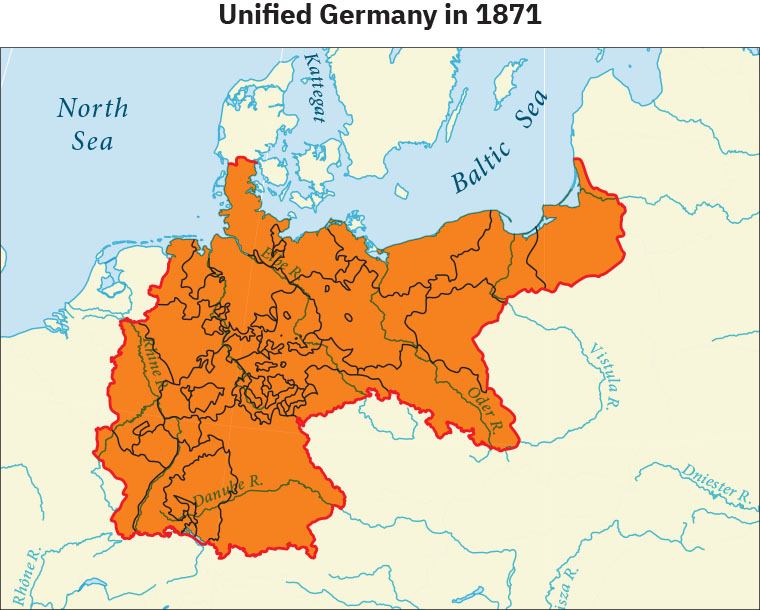
Whereas Mazzini’s initial movement in Italy had emphasized national unity as a means of promoting popular sovereignty, Bismarck’s ambitions focused primarily on fortifying the strength and interests of Protestant Prussia. Despite opposition from middle-class liberals and Parliament, Bismarck prioritized military spending and focused on building a powerful state. After initiating a series of decisive wars with Austria, Denmark, and France to expand German power, he excluded Catholic Austria from German affairs and acquired the duchies of Schleswig and Holstein from Denmark, as well as the German-speaking territories of Alsace and Lorraine from France. This series of victories reinvigorated the cause of unification through the triumph of militarism and authoritarianism. Bismarck’s efforts culminated in the formation of a unified Germany, and on January 18, 1871, he was appointed Imperial Chancellor of the German Empire (Figure 7.16).
英語のヒント
イタリアのマッツィーニの初期の運動が、人民主権を促す手段として国民的統一を重視したのに対し、ビスマルクの野心は主に、プロテスタント国家プロイセンの力と利益を強めることに向けられていた。中間階級の自由主義者と議会の反対にもかかわらず、彼は軍事費を優先し、強い国家の建設に力を注いだ。ドイツの力を広げるため、オーストリア、デンマーク、フランスと決定的な戦争を相次いで起こした後、彼はカトリックのオーストリアをドイツの問題から排除し、デンマークからシュレースヴィヒとホルシュタインの両公国を、フランスからドイツ語圏のアルザスとロレーヌを獲得した。この一連の勝利は、軍国主義と権威主義の成功によって、統一運動に新たな活力を与えた。ビスマルクの取り組みは統一ドイツの成立に結実し、1871年1月18日、彼はドイツ帝国の宰相に任命された(図7.16)。
Germany Unified.統一されたドイツ。
(credit: modification of work “Map of the German Empire (1871-1918)” by “Mnmazur”/“MaggotMaster”/Wikimedia Commons, Public Domain) · Public Domain
Figure 7.16 This map depicts the unified German nation in 1871 and the patchwork of previously autonomous states that merged under the principles of nationalism to form a single country. (credit: modification of work “Map of the German Empire (1871-1918)” by “Mnmazur”/“MaggotMaster”/Wikimedia Commons, Public Domain)
英語のヒント
図7.16 この地図は、1871年の統一ドイツ国家と、ナショナリズムの原理のもとで合併し一国になった、それまで自律的だった諸国家の入り組んだ配置を示す。(画像:「Mnmazur」/「MaggotMaster」/Wikimedia Commons「Map of the German Empire (1871-1918)」を改変、パブリックドメイン。)
As the ideology of nationalism continued to gain momentum in the nineteenth century, patriotism also garnered increased support across the European continent. Although the two share some commonalities, they represent differing ideological perspectives. Rooted in ancient Greek and Roman conceptions of loyalty to a city or community, patriotism implies a sense of civic spirit. In the Enlightenment, especially in the work of the philosopher Jean-Jacques Rousseau, it eventually evolved into the idea of love for the nation. Unlike nationalism, patriotism does not entail asserting the superiority of one nation over others.
英語のヒント
19世紀にナショナリズムが勢いを増し続けると、ヨーロッパ大陸では愛国心も支持を広げた。両者には共通点もあるが、思想的な見方は異なる。古代ギリシアやローマの、都市や共同体への忠誠という考えに根ざす愛国心は、市民としての公共心を含んでいる。啓蒙時代、とくに哲学者ジャン=ジャック・ルソーの著作で、それはやがて国への愛という考えへ発展した。ナショナリズムとは異なり、愛国心は自国が他国より優れていると主張することを伴わない。