第7章ヨーロッパと北アメリカの革命Revolutions in Europe and North America
The Republic of Letters文芸共和国
Conversation and debate in the public sphere were inseparable from the flourishing print culture of the Enlightenment era. Literacy rates, which hovered around 30 percent for men and 14 percent for women in late-seventeenth-century French cities, had increased to 48 percent for men and 27 percent for women by the mid-eighteenth century. These rising rates led to an explosion of books, pamphlets, newspapers, and political cartoons. The spread of printed materials not only standardized spelling and systems of knowledge, but it also enabled news, opinion, poetry, political philosophy, scientific texts, and information of all kinds to reach a much wider audience than the spoken word alone. The Republic of Letters was a long-distance community of writers who corresponded with each other across Europe and the Atlantic in the seventeenth and eighteenth centuries, sending handwritten letters and published materials of every kind that provided a crucial international exchange and transmission of ideas. The Republic of Letters was a society whose citizens, rather than living in the same geographic area, like the citizens of a political republic, were united by ideas spread through print. No matter where in Europe or the Atlantic world they lived, all literate people could belong to the Republic of Letters. They engaged with one another on terms of intellectual equality and freely exchanged ideas, just like citizens of a political republic who were, theoretically, free and equal.
英語のヒント
公共圏での会話や討論は、啓蒙時代に栄えた出版文化と切り離せなかった。17世紀末のフランスの都市で男性約30%、女性約14%だった識字率は、18世紀半ばまでに男性48%、女性27%へと上昇した。この上昇に伴い、書籍、パンフレット、新聞、政治風刺画が急増した。印刷物の普及は、綴りや知識体系を標準化しただけでなく、ニュース、意見、詩、政治哲学、科学書、あらゆる種類の情報を、話し言葉だけの場合よりはるかに広い読者に届けた。「文芸共和国」は、17〜18世紀にヨーロッパと大西洋の両岸にわたって文通した著述家たちの、遠距離の共同体だった。彼らは手書きの手紙や各種の出版物を送り合い、思想の国際的な交流と伝達に決定的な役割を果たした。この社会の市民は、政治的な共和国の市民のように同じ地域に住むのではなく、印刷物で広まる思想によって結ばれていた。ヨーロッパや大西洋世界のどこに住んでいても、読み書きのできる人は誰でも文芸共和国に属することができた。理論上は自由で平等な政治的共和国の市民と同様に、彼らは知的に対等な立場で交流し、自由に思想を交換した。
Among the luminaries were prominent philosophers and political leaders, including Voltaire, Benjamin Franklin, and Catherine the Great. Given that those who participated in the Republic of Letters hailed from many different countries and spoke many different languages, much of their writing either was in Latin, then the universal language of scholarship in multilingual Europe, or required access to proficient translators. This obstacle made it difficult for the majority of people to participate directly in the print culture of the Enlightenment.
英語のヒント
その著名な参加者には、ヴォルテール、ベンジャミン・フランクリン、エカチェリーナ大帝などの哲学者や政治指導者がいた。文芸共和国の参加者はさまざまな国の出身で、異なる言語を使っていたため、文章の多くは、多言語のヨーロッパで当時の学問の共通語だったラテン語で書かれるか、熟練した翻訳者を必要とした。この障壁により、大多数の人々が啓蒙時代の出版文化に直接参加することは難しくなった。
Despite the pervasive influence of print culture, the direct impact of Enlightenment texts among the general public was limited by relatively low literacy rates among the artisans, peasants, and tradespeople of the era. Literacy rates were climbing rapidly among members of the urban elite, particularly wealthy merchants and aristocrats, but they remained well below 20 percent for those at the lower end of the socioeconomic hierarchy, especially in rural areas. Although the Enlightenment embraced, in theory, some democratic principles about the exchange of knowledge, in practice, participation in that exchange was limited to those with adequate wealth and leisure time. Books were prohibitively expensive and remained well out of the reach of all but the wealthiest members of society. Even cheaply printed pamphlets represented a significant expense for most eighteenth-century laborers and peasants. By the second half of the eighteenth century, lending libraries had emerged to expand the reading public’s access to printed materials, but only select academics and government officials were permitted to borrow books. By the end of the century, however, reading clubs whose members paid an annual fee for access to books and periodicals began to expand the size of the reading public and increase levels of literacy among the middle class.
英語のヒント
出版文化は広く影響を及ぼしたが、当時の職人、農民、商売人の識字率が比較的低かったため、啓蒙の著作が一般の人々に直接与える影響は限られていた。都市の上層者、とくに裕福な商人や貴族の間では識字率が急上昇していたが、社会経済的序列の下位の人々、とくに農村部では20%を大きく下回ったままだった。啓蒙思想は理論上、知識交流について民主的な原理をいくつか受け入れたものの、実際の参加者は十分な富と余暇を持つ人に限られた。本は手が出ないほど高く、最も裕福な人々を除けば、誰もが買えるものではなかった。安く印刷されたパンフレットでさえ、18世紀の大半の労働者や農民にとって大きな出費だった。18世紀後半までには、読者が印刷物を利用する機会を広げる貸出図書館が生まれたが、貸出を認められたのは選ばれた学者や政府官僚だけだった。とはいえ世紀末には、会費を年ごとに払い、本や定期刊行物を利用する読書クラブが、読者層を広げ、中間階級の識字率を高め始めた。
Academies, Universities, and Intellectuals学術団体、大学、知識人
The salons, print shops, and coffeehouses of the public sphere existed alongside more formal educational institutions and academies that also contributed to the intellectual culture of the era. Universities and scientific societies played significant roles in advancing experimental science and philosophy, but they were far less accessible to the reading public than coffeehouses and even salons. Women, for example, attended salons, but they did not attend universities and generally did not belong to scientific societies. Likewise, working-class men, who could sometimes be found frequenting coffeehouses, had no access to universities or scientific societies. These institutions also tended to be somewhat conservative in outlook, given their religious foundations and traditional emphasis on a theologically based curriculum. Even as the curriculum of universities became less based on religion in the eighteenth century, they still largely fell under the wing of state and royal authorities rather than being autonomous.
英語のヒント
公共圏のサロン、印刷所、コーヒーハウスと並んで、より正式な教育機関や学術団体も存在し、当時の知的文化に貢献した。大学や科学の学会は、実験科学と哲学の発展に重要な役割を果たしたが、読書をする一般の人々にとって、コーヒーハウスやサロンよりはるかに利用しにくかった。たとえば女性はサロンに参加したが、大学には通わず、一般に科学の学会にも属さなかった。同様に、コーヒーハウスで見かけることもあった労働者階級の男性も、大学や科学の学会には入れなかった。これらの機関は、宗教に基礎を持ち、伝統的に神学に立脚する教育課程を重視していたため、考え方もやや保守的な傾向があった。18世紀に大学の教育課程が宗教への依存を弱めても、大学はなお、自律的になるより、主に国家や王権の庇護のもとに置かれていた。
Unlike modern research universities, those in the early modern era existed to train students—exclusively male and economically privileged—for careers in the civil service or to practice one of three professions: medicine, law, or theology. The curriculum was generally designed to uphold tradition rather than innovate. Nevertheless, being affiliated with prestigious universities like Oxford, Bologna, and Paris carried power and prestige that enabled academics to make connections with wealthy patrons in court and aristocratic circles. These connections, in turn, could be exploited to finance more innovative research and scholarship in settings outside the universities.
英語のヒント
現代の研究大学とは異なり、近世の大学は、男性だけで、しかも経済的に恵まれた学生を、官吏になるか、医学・法律・神学という3つの専門職のいずれかに就くために教育する機関だった。教育課程は一般に、革新よりも伝統の維持を目指していた。それでも、オックスフォード、ボローニャ、パリなどの名門大学に所属することは権威と名声をもたらし、学者が宮廷や貴族の世界の裕福な後援者とつながるのに役立った。こうしたつながりは、今度は大学の外で行う、より革新的な研究や学問の資金を得るために利用できた。
Scientific research thus generally took place in private laboratories with the assistance of a variety of academies and scientific societies. Their dependence on the economic support and protection of monarchs and princes meant that these institutions maintained ties to the state and lacked the full autonomy of the public sphere. One of the first was the Royal Society of London, which first met on November 28, 1660, and was formally chartered and recognized by King Charles II shortly thereafter (Figure 7.9). Francis Bacon’s development of the scientific method was considered the inspiration for the society’s founding. His emphasis on perfecting experimental techniques became a central focus of its principles and continued to influence scientists like Isaac Newton for many years after its founding. Newton was one of the group’s most celebrated members. The machine-like view of the universe he developed, and the laws of planetary motion and gravity upholding it, were in turn a source of inspiration to French philosophers like Voltaire, who saw Newton’s work as evidence of a rational universe.
英語のヒント
そのため科学研究は一般に、さまざまな学術団体や科学の学会の援助を得て、私設の実験室で行われた。これらの機関は君主や諸侯の経済的支援と保護に頼ったため、国家とのつながりを保ち、公共圏のような完全な自律性は持てなかった。初期の機関の一つがロンドン王立協会である。1660年11月28日に初めて会合を開き、その後まもなくチャールズ2世の正式な勅許と承認を受けた(図7.9)。協会の創設を促したのは、フランシス・ベーコンによる科学的方法の発展だと考えられた。実験技法の改善を重んじた彼の姿勢は、協会の原理の中心となり、創設後も長く、アイザック・ニュートンなどの科学者に影響を与え続けた。ニュートンは協会で最も著名な会員の一人だった。彼が展開した機械のような宇宙観と、それを支える惑星運動・重力の法則は、今度はヴォルテールなどのフランスの哲学者に着想を与えた。彼らはニュートンの仕事を、宇宙が理性的秩序を持つ証拠とみなした。
The Royal Society of London.ロンドン王立協会。
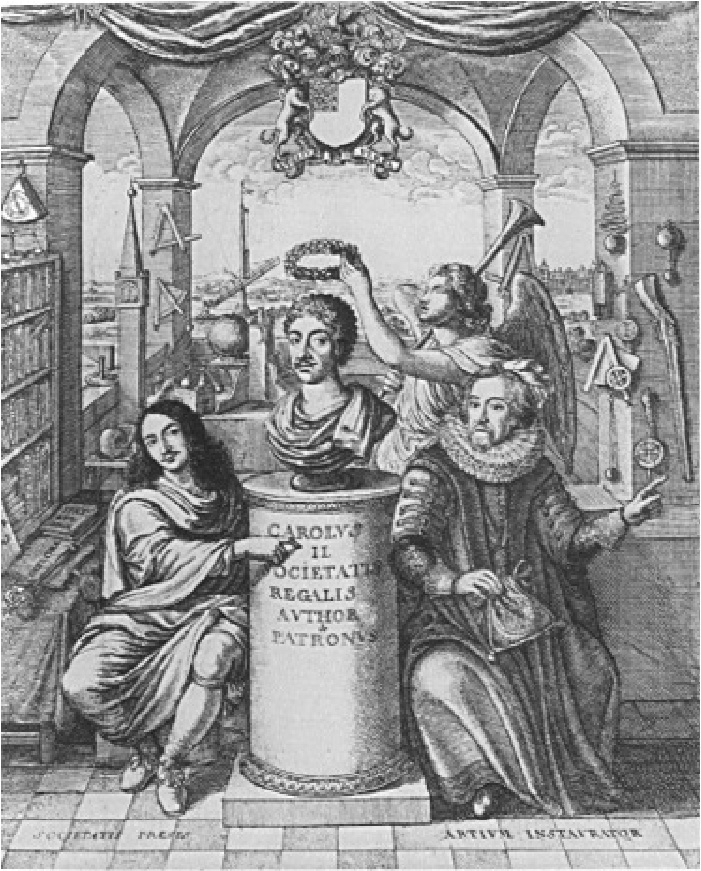
(credit: “A History of the Royal Society, by Thomas Sprat (frontispiece)” by “Airunp”/Wikimedia Commons, Public Domain) · Public Domain
Figure 7.9 John Evelyn’s 1667 frontispiece for Thomas Sprat’s History of the Royal Society, showing a bust of Charles II. On the right is Francis Bacon, and on the left is mathematician William Brouncker, Second Viscount and the first president of the Royal Society. (credit: “A History of the Royal Society, by Thomas Sprat (frontispiece)” by “Airunp”/Wikimedia Commons, Public Domain)
図7.9 トマス・スプラットの『王立協会史』のためにジョン・イーヴリンが1667年に制作した扉絵で、チャールズ2世の胸像が描かれている。右はフランシス・ベーコン、左は数学者で第2代ブラウンカー子爵、王立協会の初代会長ウィリアム・ブラウンカーである。(画像:「Airunp」/Wikimedia Commons「A History of the Royal Society, by Thomas Sprat (frontispiece)」、パブリックドメイン。)
Like the Royal Society of London, the Academy of Sciences in France operated with the support and protection of royalty, in this case Louis XIV, who founded it in 1666. Unlike its English counterpart, however, the French academy was well funded and tightly controlled by its royal patron, who sponsored scientists and their work with monetary allowances and pensions.
英語のヒント
ロンドン王立協会と同じく、フランスの科学アカデミーも王の支援と保護のもとで活動した。その王は、1666年にアカデミーを創設したルイ14世だった。しかしイングランドの協会とは異なり、フランスのアカデミーは王の後援者から潤沢な資金を受け、厳しく統制された。王は手当や年金を支給し、科学者とその研究を支援した。
Because of their connections to the court, members of scientific societies and academies were a small elite, but they also participated in public forums and salons of the Enlightenment and represented the beginning of scientific professionalization in the eighteenth century. Due to their connections with the salons, some scientific societies provided opportunities for women to engage in the practice of science. Although they were barred from university admission and formal membership in royal academies in England and France, some noble and aristocratic women, such as Maria Winkelmann of Germany and Margaret Cavendish, Duchess of Newcastle in England, not only served as patrons of science but also actively participated in scientific research.
英語のヒント
科学の学会やアカデミーの会員は、宮廷とのつながりから少数の特権層だったが、啓蒙時代の公の討論の場やサロンにも参加し、18世紀に科学が職業化し始める動きを代表していた。サロンとのつながりのおかげで、一部の科学の学会は、女性が科学を実践する機会も提供した。イングランドやフランスの大学への入学や王立アカデミーの正式会員になる道は閉ざされていたが、ドイツのマリア・ヴィンケルマンや、イングランドのニューカッスル公爵夫人マーガレット・キャヴェンディッシュのような貴族女性は、科学の後援者となるだけでなく、自らも科学研究に積極的に参加した。