第7章ヨーロッパと北アメリカの革命Revolutions in Europe and North America
The French Revolutionフランス革命
Inspired by the success of their North American counterparts, critics of absolute monarchical power and entrenched aristocratic privilege in France began agitating for change. They found themselves in the midst of a significant economic crisis brought on by a combination of the king’s extravagant spending and (ironically) France’s support of the American Revolutionary War.
英語のヒント
北アメリカの人々の成功に励まされ、フランスでは、君主の絶対権力や根深い貴族の特権を批判する人々が、変革を求めて行動し始めた。当時フランスは、王の浪費と、皮肉にもアメリカ独立戦争への支援が重なって生じた、深刻な経済危機のただ中にあった。
Like the battle for independence in the North American colonies, the revolutionary movement in France reflected a complex web of causes and consequences. After a series of poor harvests and the near-bankruptcy of the French Crown left many peasants and urban poor on the brink of starvation in the 1770s, resentment of the regime’s inability to provide relief led to extensive unrest and rioting. The Crown’s subsequent attempt to institute a land tax on aristocrats, who had previously been exempt from such assessments, resulted in broad resistance from social elites reluctant to surrender their traditional privileges. Meanwhile, the growing middle class, resentful of its exclusion from political power, agitated for change inspired by the Enlightenment rhetoric of rights and liberties. Demands for the reform of an antiquated system of government and social hierarchy reached a point of no return in the mid-1780s.
英語のヒント
北米植民地の独立闘争と同様、フランスの革命運動も、原因と結果が複雑に絡み合っていた。1770年代、不作が続き、フランス王室も破産寸前になったため、多くの農民や都市の貧民は飢餓の瀬戸際に追い込まれた。救済できない体制への憤りから、広範な騒乱と暴動が生じた。続いて王室は、それまで土地税を免除されていた貴族に課税しようとしたが、伝統的な特権を手放すことに抵抗する社会の上層者から、幅広い反発を受けた。その間、成長する中間階級は政治権力からの排除に憤り、権利と自由を唱える啓蒙の言説に励まされて、変革を求めて動いた。時代遅れの政治制度と社会序列を改革せよという要求は、1780年代半ばには、後戻りできない地点に達した。
Whereas the American Revolutionary War resulted in the birth of an independent new nation, the French Revolution radically restructured long-standing political systems and reshaped the balance of power in Europe. Although the revolt’s radical rejection of authoritarian rule, which enforced obedience to government authority and limited individual freedom, ultimately faltered, the social and political reforms it inspired heavily influenced the character of modern nations.
英語のヒント
アメリカ独立戦争が新たな独立国家の誕生をもたらしたのに対し、フランス革命は、長年続いていた政治制度を根本から組み替え、ヨーロッパの勢力均衡を変えた。政府の権威への服従を強制し、個人の自由を制限する権威主義的支配を、革命は徹底的に拒もうとしたが、その試みは最終的に挫折した。それでも、革命が促した社会・政治改革は、近代国家の性格に強い影響を与えた。
At the core of revolutionary fervor in France was the traditional division of French society into three estates—clergy, aristocracy, and commoners—that reinforced the wealth and political power of the aristocracy and the church. In this system, which had emerged in the Middle Ages, the First Estate consisted of the Catholic clergy, who made up less than 1 percent of the population but held roughly 10 percent of French lands. Virtually exempt from taxes, the church derived substantial wealth from tithes (taxes of one-tenth of annual income) and fees imposed on the general population. The nobility, who were the Second Estate, represented roughly 3–4 percent of the population but held upward of 30 percent of the country’s lands. They also dominated the most prestigious administrative, military, and judicial positions in the royal bureaucracy by virtue of their aristocratic status and were exempt from taxes as well. The burden of paying taxes fell largely on the shoulders of the Third Estate, the remaining 95 percent of the French population consisting of peasants, the urban poor, the wealthy bourgeoisie or urban middle class who made a living largely through commerce and the professions, and everyone else who did not fall within the other two estates (Figure 7.12).
英語のヒント
フランスの革命的熱情の中心にあったのは、社会を聖職者・貴族・平民という3つの身分に分け、貴族と教会の富や政治権力を強める、伝統的な身分制度だった。中世に成立したこの制度で、第1身分はカトリックの聖職者であり、人口の1%未満ながら、フランスの土地のおよそ10%を保有していた。教会はほぼ免税で、十分の一税、すなわち年間所得の10分の1の税や、一般住民に課す手数料から、大きな富を得ていた。第2身分の貴族は人口の約3〜4%だが、国土の30%以上を保有した。貴族という地位のおかげで、王の官僚機構のなかで最も名誉ある行政・軍事・司法の職も独占し、やはり税を免除されていた。税負担は主に、残る人口の95%に当たる第3身分が背負った。この身分には、農民、都市の貧民、主として商業や専門職で生計を立てる裕福なブルジョワジー、すなわち都市の中間階級、そして他の2身分に属さないすべての人が含まれた(図7.12)。
French Inequalities.フランスの不平等。
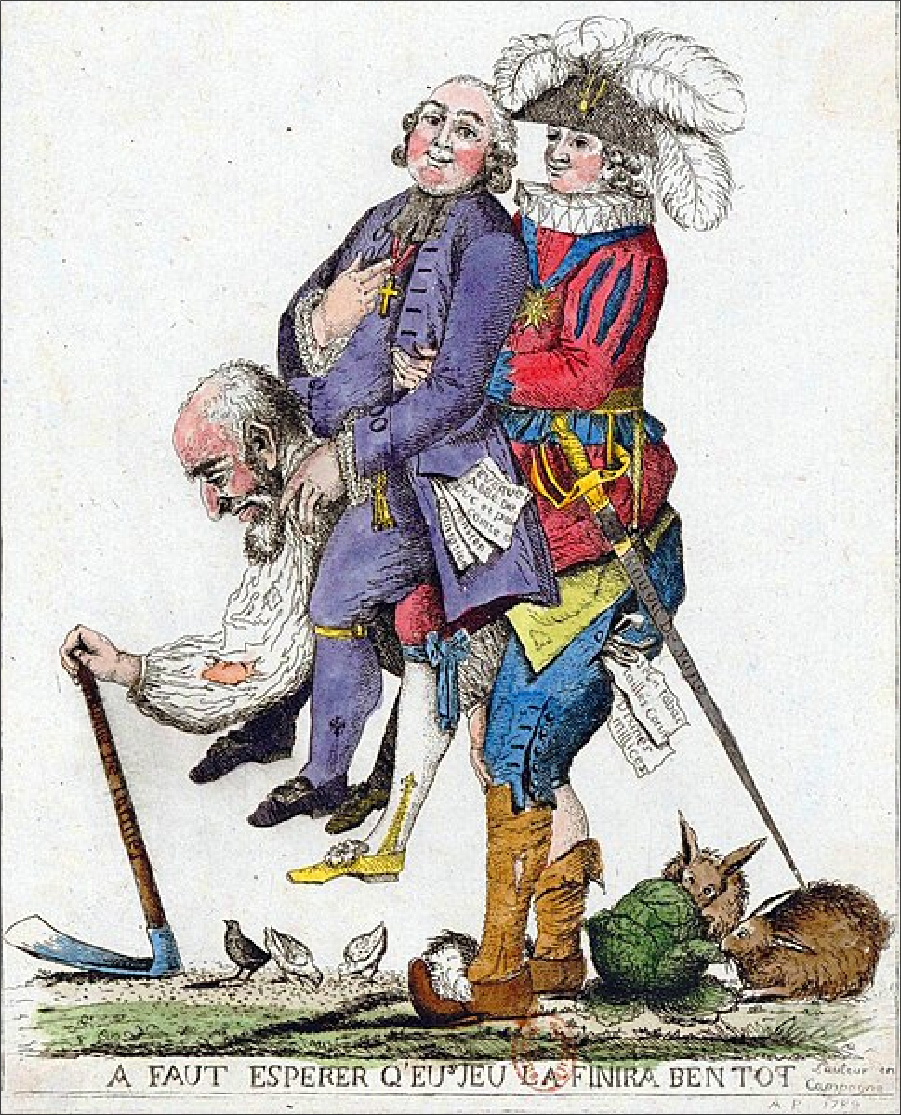
(credit: “Les Trois Ordres” by Gallica Digital Library/Wikimedia Commons, Public Domain) · Public Domain
Figure 7.12 This cartoon of 1789 depicts the social inequalities and tensions that pervaded French society on the eve of the French Revolution. The First and Second Estates, a small minority of the population, controlled the majority of land and wealth, while the labor and tax burden fell on the Third Estate. The caption reads, “We must hope this game will be over soon.” (credit: “Les Trois Ordres” by Gallica Digital Library/Wikimedia Commons, Public Domain)
英語のヒント
図7.12 1789年のこの風刺画は、フランス革命前夜の社会に広がっていた不平等と緊張を描いている。人口のごく少数を占める第1・第2身分が、土地と富の大半を握る一方、労働と税の負担は第3身分にのしかかった。添え書きには「この遊びが早く終わることを願わなければならない」とある。(画像:Gallica Digital Library/Wikimedia Commons「Les Trois Ordres」、パブリックドメイン。)
Although persistent wealth inequality became a significant sore point for the French masses, particularly in the midst of a national economic crisis, exclusion from political power was another issue leading up to the revolution. The Enlightenment’s emphasis on public opinion, natural rights, and freedom from tyranny also resonated with many educated commoners and aristocrats, who believed that political and economic reforms were desperately needed in France. However, the Estates General, a general assembly made up of representatives of the nobles, clergy, and commoners that was France’s closest approximation to a constitutional body, had not been convened by a French monarch since 1614. Equally problematic was the voting structure of this body, which gave each estate one vote. Since the clergy and nobility generally shared common interests, their votes typically defeated any initiatives the Third Estate might propose.
英語のヒント
根強い富の不平等は、とくに国の経済危機のなかで、フランスの民衆にとって大きな不満の種となったが、政治権力からの排除も革命へとつながる問題だった。世論、自然権、専制からの自由を重視する啓蒙思想は、フランスには政治・経済改革が切実に必要だと考える、多くの教養ある平民や貴族の共感を呼んだ。しかし、貴族・聖職者・平民の代表からなる全体の集会で、フランスで憲法に基づく議会に最も近い存在だった三部会は、1614年以来、フランスの君主によって招集されていなかった。同じく問題だったのは、各身分に1票を与える投票の仕組みである。聖職者と貴族は一般に利害を共有したため、その票は通常、第3身分が提案するどの構想も否決した。
In 1789, in an act of desperation, King Louis XVI summoned the Estates General to propose a radical reform of the economy and the creation of new taxes. But the Third Estate refused to participate until the king reformed the voting system. After a period of stalemate, the Third Estate gained the support of many members of the clergy and met separately as a National Assembly. This act of political rebellion reinforced the sovereignty of the people, to which the king responded by amassing military forces with the goal of subduing the people by force. His plan backfired, however, when a series of popular uprisings in Paris and throughout the country resulted in the commoners’ seizure of sites associated with royal authority, such as the Bastille, a fortress in Paris, land redistribution, and refusal to pay taxes.
英語のヒント
1789年、窮地に追い込まれたルイ16世は、経済の抜本改革と新税の導入を提案するため三部会を招集した。しかし第3身分は、王が投票制度を改革するまで参加を拒んだ。膠着状態が続いた後、第3身分は多くの聖職者の支持を得て、別個に国民議会として会合を開いた。この政治的反抗は人民主権を強めたが、王は武力で人々を従わせようと、軍を集結させて応じた。ところが計画は裏目に出た。パリや全国各地で民衆蜂起が相次ぎ、平民たちはパリの要塞バスティーユなど王権と結びつく場所を占領し、土地を再分配し、納税を拒んだ。
In a position of strength, the National Assembly then issued the Declaration of the Rights of Man and of the Citizen, which upheld natural rights such as liberty and property, like the U.S. Declaration of Independence, but also mandated the adoption of representative government, equality before the law, and freedom of expression. As a means of reducing monarchical power and enforcing the mandates of the Declaration, the National Assembly created a new constitution in 1791 and charged a newly formed Legislative Assembly with governing France as a constitutional monarchy and developing legislative reform.
英語のヒント
有利な立場に立った国民議会は、次に「人間と市民の権利の宣言」を発した。これはアメリカ独立宣言と同様、自由や財産といった自然権を守るとともに、代議制の政治、法の下の平等、表現の自由の採用も求めた。王権を減らし、宣言の要請を実行するため、国民議会は1791年に新憲法を作り、新たな立法議会に、立憲君主制のもとでフランスを統治し、法制度の改革を進める任務を与えた。
Despite its progressive reforms, the Declaration faced opposition from critics such as French playwright Olympe de Gouges for failing to address women’s rights. In 1791, Gouges published her Declaration of the Rights of Woman and of the Female Citizen, which emphasized women’s equality with men and asserted that women should experience the same rights of citizenship as their male counterparts.
英語のヒント
進歩的な改革にもかかわらず、この宣言は女性の権利を扱わなかったため、フランスの劇作家オランプ・ド・グージュなどの批判を受けた。1791年、グージュは『女性および女性市民の権利宣言』を発表し、女性と男性の平等を強調し、女性も男性と同じ市民としての権利を享受すべきだと主張した。
Meanwhile, France’s economic situation continued to worsen, and a group of women struggling to feed their families organized a crowd of thousands to confront the king and demand action. Also instrumental in building revolutionary momentum against the king and the nation’s profound wealth inequality were the sans-culottes, radicals from the lower and working classes who could not afford the culottes, or fashionable short pants, that were worn by the aristocracy and indicated one did not have to perform manual labor for a living (sans is French for “without”). After the angry mob captured the royal family, the king lost all remaining popular support when he and his wife, Queen Marie-Antoinette, attempted to escape.
英語のヒント
その間もフランスの経済状況は悪化し続け、家族を養うことに苦しむ女性たちが、国王に直接行動を求めるため、数千人の群衆を組織した。王と国内の深刻な富の不平等に抗する革命の勢いを強めるうえで、サンキュロットも重要な役割を果たした。彼らは下層・労働者階級の急進派であり、貴族が着用する流行の短いズボン「キュロット」を買えなかった。キュロットは、生活のため肉体労働をする必要がないことのしるしだった(サンはフランス語で「〜なし」の意味)。怒った民衆が王一家を捕らえた後、王と妻のマリ=アントワネット王妃が逃亡を試みると、王は残っていた民衆の支持をすべて失った。
The newly formed Legislative Assembly suspended the king and created a representative body known as the National Convention, which convicted Louis of treason. The National Convention was composed of a number of different groups of revolutionaries with conflicting opinions regarding what the government of France and French society should be like. A variety of political clubs and organizations expressed a range of ideas about the goals of the revolution and the best course of action to achieve them. Founded in 1789, the Jacobins quickly became the most influential of these clubs. The Jacobins sought to end the reign of King Louis XVI and establish a republic to replace the French monarchy. However, disagreements between their radical and moderate factions made consensus difficult to achieve. Whereas the Girondins, a moderate faction of the Jacobins, some of whom hailed from the Gironde region of southwestern France, opposed executing the king, the radical Jacobin faction the Mountain, so named because its members sat on the highest benches of the National Convention, supported sentencing him to death. After the Convention held a trial for the king, the Mountain ultimately prevailed, and the king was executed in January 1793.
英語のヒント
新たな立法議会は国王の権能を停止し、国民公会と呼ばれる代表機関を設けた。国民公会はルイを反逆罪で有罪とした。公会は、フランスの政府と社会がどうあるべきかについて相対立する意見を持つ、複数の革命派の集団で構成されていた。さまざまな政治クラブや団体が、革命の目標と、それを達成する最善の行動について、幅広い考えを示した。1789年に創設されたジャコバン派は、すぐに最も影響力のあるクラブとなった。彼らはルイ16世の治世を終わらせ、君主制に代えて共和国を樹立しようとした。しかし急進派と穏健派の意見の不一致により、合意を得るのは難しかった。ジャコバン派の穏健派で、一部がフランス南西部のジロンド地方出身だったジロンド派は、国王の処刑に反対した。これに対して、国民公会の最も高い席に座ったことから名づけられた急進派の山岳派は、死刑判決を支持した。公会が国王の裁判を行った後、最終的に山岳派が勝ち、国王は1793年1月に処刑された。
After declaring those who opposed the king’s execution enemies of the revolution, in 1793 the Mountain and their supporters initiated a period of violent repression known as the Reign of Terror. Maximilien de Robespierre, a lawyer who championed the principles of equality, led the provisional government of France, known as the Committee of Public Safety, from 1793 to 1794. Under the battle cry liberté, égalité, fraternité (liberty, equality, brotherhood), this radical phase of the revolution achieved many progressive reforms, including controlling the price of grain, legalizing divorce, and abolishing slavery. Despite such achievements, however, it was also inherently contradictory, since tens of thousands of people were arbitrarily imprisoned or executed as a means of silencing dissent.
英語のヒント
山岳派とその支持者は、国王の処刑に反対した人々を革命の敵と宣言した後、1793年に「恐怖政治」と呼ばれる暴力的な弾圧の時期を始めた。平等の原理を擁護した法律家マクシミリアン・ド・ロベスピエールは、1793〜1794年、公安委員会と呼ばれるフランスの臨時政府を率いた。「自由、平等、友愛」の掛け声のもと、革命のこの急進的な段階では、穀物価格の統制、離婚の合法化、奴隷制の廃止など、多くの進歩的改革が実現した。しかし、異論を封じるために数万人が恣意的に投獄・処刑されたため、この段階にも本質的な矛盾があった。
Disagreements between the Committee of Public Safety and the Convention over religious and economic policies hastened the end of the Reign of Terror as support for Robespierre’s repressive policies dwindled. By 1794, members of the opposition had removed Robespierre from power, and the Terror finally came to an end in July 1794 when its leaders, including Robespierre, were executed on the guillotine. The Convention then dismantled the executive powers of the Committee of Public Safety and sought to restore political stability by creating a constitution in 1795 that established a new executive council of five men known as the Directory. Despite the new government’s efforts to prevent rebellions and dissent, it faced a variety of challenges from radical Jacobins who wanted to restore the Terror’s revolutionary fervor and from conservative factions that sought to restore the monarchy. Growing conflict between moderates and radicals, sharpened by a period of famine and economic difficulty, ultimately led the Directory to invite Napoléon Bonaparte, a charismatic and ruthless general in the French army, to help them develop a more authoritative government in 1799 and quiet the voices of opposition.
英語のヒント
宗教政策と経済政策をめぐる公安委員会と国民公会の対立は、ロベスピエールの弾圧的政策への支持がしぼむなか、恐怖政治の終わりを早めた。1794年までに反対派はロベスピエールを失脚させ、同年7月、彼を含む指導者たちがギロチンで処刑されて、恐怖政治はついに終わった。公会はその後、公安委員会の行政権を解体し、1795年に憲法を作って政治の安定を回復しようとした。この憲法は、5人からなる新しい行政機関「総裁政府」を設けた。新政府は反乱や異論を抑えようとしたが、恐怖政治期の革命的熱情を復活させたい急進的ジャコバン派や、王政復古を望む保守派などから、さまざまな挑戦を受けた。飢饉と経済的苦境によって穏健派と急進派の対立はさらに激しくなり、ついに総裁政府は1799年、フランス軍の、カリスマ性があり冷酷な将軍ナポレオン・ボナパルトを招いた。より強い権威を持つ政府を作り、反対の声を鎮めるのを助けてもらうためだった。
Following the Terror’s failure, the revolution took a more conservative turn, and the idealism of the French Revolution came to an end. The modern democratic tradition emerging in France then transformed into popular authoritarianism when Napoléon seized control. Although he safeguarded some revolutionary gains, Napoléon also reinstated slavery in France’s colonies and declared himself emperor in 1804. At the height of his power, he ruled over a massive empire.
英語のヒント
恐怖政治が失敗すると、革命はより保守的な方向へ転じ、フランス革命の理想主義は終わった。その後ナポレオンが権力を握ると、フランスに生まれつつあった近代民主主義の伝統は、民衆の支持に基づく権威主義へと変わった。彼は革命の成果の一部を守ったが、フランスの植民地で奴隷制を復活させ、1804年に自ら皇帝を称した。権力の絶頂期には、巨大な帝国を支配した。
Following a series of failed military campaigns stemming from his desire to dominate Europe, however, including a disastrous attempted invasion of Russia, Napoléon abdicated his throne in 1814. He then returned and led France again until his defeat by the British and Prussians at Waterloo (Belgium) in 1815. After this loss, Napoléon was ultimately banished from France and forced to spend the rest of his days in exile.
英語のヒント
しかし、ヨーロッパを支配したいという野望から行った一連の軍事遠征が、悲惨な結果に終わったロシア侵攻の試みを含めて失敗すると、ナポレオンは1814年に退位した。その後復帰し、1815年にワーテルロー(ベルギー)でイギリス軍とプロイセン軍に敗れるまで、再びフランスを率いた。この敗北の後、彼は最終的にフランスから追放され、残りの人生を流刑地で過ごさなければならなくなった。
The French Revolution now appeared to come full circle with the restoration of the French monarchy in 1814–1815. However, Louis XVIII, the restored French king, could not rule as an absolute monarch and had to recognize his subjects’ new constitutional rights to participate in government and regulate the king’s power. Notwithstanding Napoléon’s brief autocratic reign, the French Revolution successfully dismantled the nobility’s and clergy’s disproportionate share of power and defeated the strongest absolute monarchy in Europe.
英語のヒント
1814〜1815年にフランスの王政が復活すると、革命は出発点へ一巡して戻ったかのように見えた。しかし復位したルイ18世は、絶対君主として統治できず、政治に参加し、王権を規制する臣民の新しい憲法上の権利を認めなければならなかった。ナポレオンの短い独裁的な治世にもかかわらず、フランス革命は、貴族と聖職者が不釣り合いに多く占めていた権力を解体し、ヨーロッパで最も強力な絶対君主制を打倒することに成功した。
The French revolutionaries failed to fully establish the principles of liberty, equality, and fraternity that had long inspired the movement. They sought to replace royal and aristocratic privilege with sweeping reforms rooted in ideals of natural rights and protection from tyrannical government. Yet in practice, and regardless of the instrumental roles they played in the revolution, women in France did not receive many of the rights extended to their male counterparts. In fact, France was the last of the major Western powers to extend voting rights to women, in 1944.
英語のヒント
フランスの革命家たちは、運動を長く鼓舞した自由・平等・友愛の原理を、十分には確立できなかった。王や貴族の特権を、自然権と専制政府からの保護という理想に根ざす、広範な改革に置き換えようとした。しかし実際には、革命で重要な役割を果たしていても、フランスの女性は、男性に与えられた権利の多くを得られなかった。実際、女性に選挙権を認めたのは1944年で、フランスは主要な西洋列強のうち最後だった。
Perhaps even more paradoxical was the contradiction between Enlightenment ideals of liberty that fueled the revolution on one hand and France’s ongoing colonialism, exploitation of slave labor, and discrimination against free people of color on the other. Except for a brief period during the Reign of Terror, France continued to uphold the institution of slavery in its colonies. In particular, in the colony of Saint-Domingue, now known as Haiti, few if any rights were extended to enslaved or free people of color in the wake of the French Revolution. Ultimately, then, the legacy of revolution in France was mixed.
英語のヒント
おそらくさらに逆説的だったのは、革命を促した啓蒙の自由の理想と、フランスが続けた植民地主義、奴隷労働の搾取、自由身分の有色人種への差別との矛盾だった。恐怖政治の間の短い時期を除いて、フランスは植民地で奴隷制度を維持し続けた。とくに、現在ハイチと呼ばれるサン=ドマング植民地では、フランス革命後、奴隷にされた有色人種にも自由身分の有色人種にも、権利はほとんど、あるいはまったく与えられなかった。結局、フランス革命の遺産は複雑なものだった。