第7章ヨーロッパと北アメリカの革命Revolutions in Europe and North America
7.1 The Enlightenment7.1 啓蒙思想
Learning Objectives学習の目標
By the end of this section, you will be able to:
この節を学ぶと、次のことができるようになる。
Explain the relationship between scientific developments and the Enlightenment
科学の発展と啓蒙思想の関係を説明する。
Discuss major theories of natural rights
英語のヒント
自然権に関する主要な理論を論じる。
Analyze Enlightenment ideas about the social contract and the consent of the governed
英語のヒント
社会契約と被治者の同意についての啓蒙思想を分析する。
The key principles of the sixteenth- and seventeenth-century Scientific Revolution established the view that the universe was orderly and rational. By the beginning of the eighteenth century, this idea had prompted significant challenges to Christianity’s traditional justification for social hierarchies and its view of the nature of the cosmos. By defying long-standing notions of nature, the universe, and the limits of human intelligence, the early modern revolution in scientific thought expanded the frontiers of knowledge and inspired intellectual innovation. During the eighteenth century, thinkers in academia and beyond continued their critical exploration, scrutinizing traditional structures from religion to the monarchy. This newfound critical spirit and robust exchange of ideas ultimately became known as the Enlightenment.
英語のヒント
16〜17世紀の科学革命の主要な原理は、宇宙には秩序があり、理性によって理解できるという見方を確立した。18世紀の初めまでに、この考えは、キリスト教が伝統的に示してきた社会的序列の正当化や宇宙観に対する、大きな異議を生み出していた。自然、宇宙、人間の知性の限界に関する長年の通念を覆すことで、近世の科学思想の革命は知識の領域を広げ、知的な革新を促した。18世紀には、学問の世界の内外の思想家たちが批判的な探究を続け、宗教から君主制まで、従来の仕組みを厳しく吟味した。この新たな批判精神と活発な思想の交流が、やがて「啓蒙」と呼ばれるようになった。
Historians have typically located the birthplace of the Enlightenment in western Europe. Its inspirations were truly global in nature, however, ranging from the cosmopolitanism of the ethnically, religiously, and culturally diverse Ottoman Empire to the rich philosophical traditions of China. Ultimately, these ideas were more influential in Europe than elsewhere, but the consequences of the Enlightenment were by no means limited to Europe. Enlightenment thinkers in Europe created a new synthesis of knowledge that later spread to the rest of the world, where colonial subjects added their own interpretations and put these ideas to their own uses.
英語のヒント
歴史家は一般に、啓蒙思想の発祥地を西ヨーロッパとしてきた。しかし、その着想の源は本当に世界各地に及び、民族・宗教・文化の多様なオスマン帝国の国際性から、中国の豊かな哲学的伝統にまで広がっていた。最終的にこれらの思想は他の地域よりヨーロッパで強い影響力を持ったが、啓蒙の結果がヨーロッパだけに限られたわけでは決してない。ヨーロッパの啓蒙思想家は知識を新たに総合し、それが後に世界各地へ広まると、植民地の人々も自らの解釈を加え、自分たちの目的に役立てた。
The Authority of Reason理性の権威
We cannot reduce the Enlightenment to a single unifying philosophy or body of thought. But Enlightenment thinkers in intellectual circles in Asia, Europe, and the Americas were inspired by the seventeenth century’s emphasis on using reason to grapple with questions about human nature, the complexities of political power and the social order, and the principles of logic and scientific thinking.
英語のヒント
啓蒙思想を、単一の統一的な哲学や思想体系に還元することはできない。しかし、アジア、ヨーロッパ、アメリカ大陸の知識人の集まりにいた啓蒙思想家たちは、人間の本性、政治権力と社会秩序の複雑さ、論理や科学的思考の原理をめぐる問いに理性で取り組むことを重んじた、17世紀の姿勢に触発されていた。
Many of the components of Western science that, along with the ideas of the Italian Renaissance, inspired Enlightenment thought were built on scientific traditions developed in the Islamic world, which had absorbed ancient Greek and Indian systems of knowledge. In particular, Al-Andalus, the Muslim-ruled area of Spain and Portugal that rose to power in 711, began wielding significant influence on European intellectual activity in the eleventh and twelfth centuries. By preserving and translating the works of ancient Greek thinkers, such as Aristotle and Plato, that were not available in Europe at the time, Muslim scholars in Spain fueled both the European Renaissance of the twelfth century and the Italian Renaissance of the fourteenth and fifteenth centuries. In addition to preserving seminal Greek texts, Muslim scholars in medieval Al-Andalus, such as the twelfth-century intellectual Averroes, also wrote and translated Arabic philosophical treatises that were widely read by scholars in Christian Europe.
英語のヒント
イタリア・ルネサンスの思想とともに啓蒙思想を促した西洋科学の諸要素の多くは、古代ギリシアとインドの知識体系を取り入れたイスラーム世界で育まれた、科学の伝統に基づいていた。とくに、711年に勢力を築いたスペインとポルトガルのムスリム支配地域、アル=アンダルスは、11〜12世紀にヨーロッパの知的活動に大きな影響を及ぼし始めた。当時ヨーロッパでは手に入らなかったアリストテレスやプラトンなどの古代ギリシア思想家の著作を保存・翻訳することで、スペインのムスリム学者たちは、12世紀のヨーロッパ・ルネサンスと、14〜15世紀のイタリア・ルネサンスの両方を促進した。12世紀の知識人アヴェロエスなど、中世アル=アンダルスのムスリム学者は、後世に大きな影響を与えるギリシアの文献を保存しただけでなく、アラビア語の哲学論考を執筆・翻訳し、それらはキリスト教圏ヨーロッパの学者に広く読まれた。
Elsewhere in the Muslim world, Arabic, Indian, and Persian treatises on mathematics, medicine, and astronomy had long wielded significant influence on European science and philosophy. The contributions of medieval Persian mathematicians such as Muhammad ibn Musa al-Khwarizmi and Omar Khayyam to the study of algebra, and the pivotal role of sixth-century Indian philosopher Aryabhata in the field of trigonometry, for example, provided scholars of the Scientific Revolution with the intellectual tools to develop novel theories about the cosmos and the nature of planetary motion (Figure 7.4). These advances, however, could not have occurred without the development of the decimal number system in classical India and the innovation of fractions in the Arabic numeral systems of North Africa by the tenth century. Scientists’ ability to calculate advanced mathematical formulas and describe the subtleties of planetary motion not only spurred the Scientific Revolution but also substituted concrete information for superstition and firmly held religious beliefs. The Enlightenment was thus a result of cross-cultural networks of scholarship and knowledge exchange that facilitated the growth of science.
英語のヒント
イスラーム世界の他の地域でも、数学・医学・天文学に関するアラビア、インド、ペルシアの論考は、長くヨーロッパの科学と哲学に大きな影響を及ぼしていた。たとえば、中世ペルシアの数学者ムハンマド・イブン・ムーサー・アル=フワーリズミーやウマル・ハイヤームの代数学への貢献、6世紀のインドの哲学者アーリヤバタの三角法における重要な役割は、科学革命の学者が宇宙や惑星運動の性質について新理論を構築するための、知的な道具を提供した(図7.4)。しかし、古代インドでの十進数体系の発達と、10世紀までに北アフリカのアラビア数字体系で行われた分数の革新がなければ、こうした進歩は起こりえなかった。複雑な数式を計算し、惑星運動の微妙な違いを説明できるようになった科学者たちは、科学革命を進めただけでなく、迷信や固く信じられていた宗教的信念を、具体的な情報に置き換えた。このように啓蒙思想は、科学の成長を可能にした、文化を越える学問のネットワークと知識交流の成果だった。
A Ninth-Century Algebra Book.9世紀の代数学書。
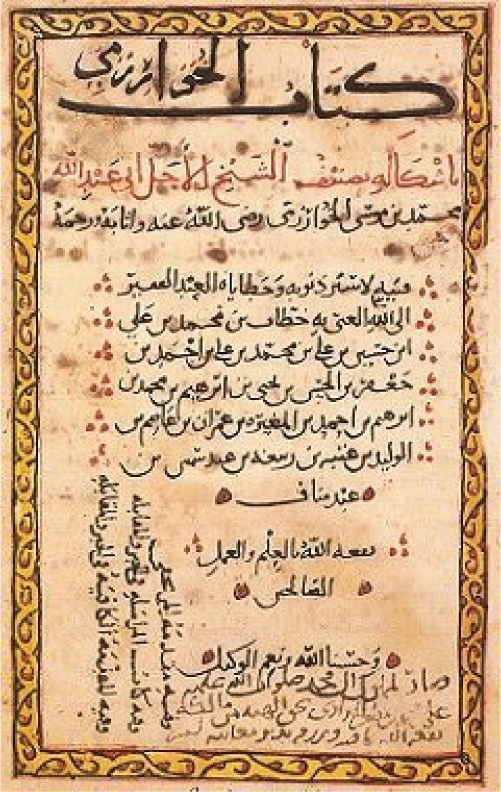
(credit: “The Compendious Book on Calculation by Completion and Balancing” by Muhammad ibn Musa al-Khwarizmi in Oxford University Press/Wikimedia Commons, Public Domain) · Public Domain
Figure 7.4 This page from Muhammad ibn Musa al-Khwarizmi’s algebra treatise, The Compendious Book on Calculation by Completion and Balancing, was first published around 820 and reflects the advanced mathematical scholarship of the Islamic Golden Age. (credit: “The Compendious Book on Calculation by Completion and Balancing” by Muhammad ibn Musa al-Khwarizmi in Oxford University Press/Wikimedia Commons, Public Domain)
英語のヒント
図7.4 これはムハンマド・イブン・ムーサー・アル=フワーリズミーの代数学論考『復元と対置による計算法の書』の1ページである。同書は820年ごろに初めて刊行され、イスラーム黄金時代の高度な数学研究を示している。(画像:Muhammad ibn Musa al-Khwarizmi、Oxford University Press/Wikimedia Commons「The Compendious Book on Calculation by Completion and Balancing」、パブリックドメイン。)
Among the principles that influenced Enlightenment perceptions of knowledge were the twin concepts of deductive and inductive reasoning. Inherited from the intellectual framework of the Scientific Revolution, these approaches represent different methods of organizing information and developing hypotheses. While inductive reasoning gathers specific examples and observations to arrive at a broad generalization, deductive reasoning, in contrast, begins with a general statement or theory and applies it to specific conclusions.
英語のヒント
啓蒙思想の知識観に影響を与えた原理には、演繹的推論と帰納的推論という対になる考え方があった。科学革命の知的な枠組みから受け継がれたこの2つの方法は、情報を整理し、仮説を立てるうえで異なる道筋を示す。帰納的推論は、個別の事例や観察を集めて広い一般化に至る。これに対して演繹的推論は、一般的な命題や理論から出発し、それを具体的な結論に適用する。
Deductive reasoning had its origins in the fourth century BCE in the teachings of the Greek philosopher Aristotle, but it became a vital component of the Scientific Revolution in the work of French philosopher René Descartes. Descartes combined deductive reasoning with empiricism, the acquisition of knowledge from sensory experiences, to establish the foundations of the scientific method. Inductive reasoning, on the other hand, played an important role in the work of the English natural philosopher Francis Bacon. Bacon asserted that whereas the deductive method began with a proposition and discarded evidence that did not support that premise, inductive reasoning reached a conclusion only after the collection of evidence. According to Bacon, only inductive reasoning enabled researchers to support observations with empirical data rather than conjecture.
英語のヒント
演繹的推論の起源は紀元前4世紀のギリシアの哲学者アリストテレスの教えにあったが、フランスの哲学者ルネ・デカルトの業績を通じて、科学革命の重要な要素となった。デカルトは、感覚的経験から知識を得る経験主義と演繹的推論を組み合わせ、科学的方法の基礎を築いた。これに対して帰納的推論は、イングランドの自然哲学者フランシス・ベーコンの仕事で重要な役割を果たした。ベーコンは、演繹法が命題から出発し、その前提を支持しない証拠を捨てるのに対し、帰納的推論は証拠を集めて初めて結論に至ると主張した。彼によれば、推測ではなく実証的なデータによって観察を裏づけることを研究者に可能にするのは、帰納的推論だけだった。
Ultimately, both inductive and deductive reasoning influenced the intellectual context of the Enlightenment by providing two systematic means of drawing conclusions about the natural world from observations and evidence. Whichever method they adopted, Enlightenment thinkers embraced the scientific method as a means of applying reason and objectivity to the collection and analysis of information.
英語のヒント
結局、帰納的推論も演繹的推論も、観察と証拠から自然界について結論を導く2つの体系的な方法を提供し、啓蒙思想の知的な環境に影響を与えた。どちらの方法を採用したにせよ、啓蒙思想家たちは、情報の収集と分析に理性と客観性を適用する手段として、科学的方法を支持した。