第7章ヨーロッパと北アメリカの革命Revolutions in Europe and North America
Liberalism自由主義
Like nationalism, the political philosophy of liberalism is rooted in Enlightenment principles and born of the revolutionary struggles of the eighteenth century. Its underlying goal is freedom from restraint, more specifically freedom of expression, popular sovereignty, representative government, and the protection of private property and civil rights. The liberalism of the nineteenth century is different from the liberalism of the late twentieth and twenty-first centuries, however. The meaning of the term has changed over time, and, although people who are regarded as liberals in the twenty-first century United States generally advocate for government assistance for the poor and government intervention to ensure equality, nineteenth-century liberals opposed government intervention. Liberalism and nationalism are not mutually exclusive; nationalist leaders like Mazzini, for instance, also adopted many liberal principles. Nevertheless, a distinction between political and economic liberalism evolved from the work of Enlightenment thinkers like John Locke and Adam Smith.
英語のヒント
ナショナリズムと同じく、自由主義という政治哲学は啓蒙思想の原理に根ざし、18世紀の革命闘争から生まれた。根本の目標は制約からの自由であり、具体的には表現の自由、人民主権、代議制政治、私有財産と市民的権利の保護である。しかし19世紀の自由主義は、20世紀末や21世紀の自由主義とは異なる。この語の意味は時とともに変わっており、21世紀のアメリカでリベラルとみなされる人々は一般に、貧しい人への政府援助や平等を確保する政府介入を支持するのに対し、19世紀の自由主義者は政府の介入に反対した。自由主義とナショナリズムは互いに排他的ではない。たとえばマッツィーニのようなナショナリストの指導者も、多くの自由主義的原理を取り入れた。それでも、ジョン・ロックやアダム・スミスなど啓蒙思想家の仕事から、政治的自由主義と経済的自由主義の区別が発展した。
Based on Locke’s emphasis on the consent of the governed and the natural rights of life, liberty, and property, political liberalism promotes limited government and the right to oppose any political authority that does not carry the consent of the people. These goals can be ensured by imposing limits on government authority and guaranteeing rights to all citizens in a written constitution. Religious toleration and the separation of church and state also became fundamental principles of liberalism in the eighteenth century. All played a significant role in shaping revolutionary movements in Britain’s North American colonies, Haiti, and France, all of which issued written constitutions asserting the sovereignty of the people. Enlightenment ideas of natural rights—tested through a series of revolutions—developed into a lasting commitment to consent of the governed and equality before the law in the liberal political philosophies of the nineteenth century.
英語のヒント
政治的自由主義は、被治者の同意と生命・自由・財産の自然権を重視するロックの考えに基づき、制限された政府と、人民の同意を得ない政治権力に反対する権利を支持する。政府の権限に限界を設け、成文憲法ですべての市民の権利を保障すれば、これらの目標を確保できる。宗教的寛容と政教分離も、18世紀の自由主義の基本原理となった。これらはすべて、イギリスの北米植民地、ハイチ、フランスの革命運動を形づくるうえで重要な役割を果たし、それらの地域はすべて、人民主権をうたう成文憲法を発した。一連の革命を通じて試された啓蒙の自然権思想は、19世紀の自由主義的政治哲学において、被治者の同意と法の下の平等を永続的に守ろうとする姿勢へと発展した。
One of the most celebrated proponents of liberalism in the nineteenth century was the English philosopher John Stuart Mill, who argued for the protection of individual rights from censorship and tyranny. On Liberty, his classic treatise published in 1859, emphasized the importance of toleration and stressed that multiple ethical codes could coexist peacefully in a given society. Mill asserted that people should be free to make ethical choices governing their own lives without government intrusion or obstruction. As an advocate of equality, moreover, he was an important supporter of women’s rights, and his essay On the Subjection of Women played an influential role in the nineteenth-century women’s rights movement.
英語のヒント
19世紀の自由主義の最も著名な提唱者の一人は、イングランドの哲学者ジョン・スチュアート・ミルだった。彼は、検閲と専制から個人の権利を守ることを唱えた。1859年に出版された代表的論考『自由論』では、寛容の重要性を説き、同じ社会のなかでも複数の倫理規範が平和に共存できると強調した。ミルは、人々が政府の介入や妨害なしに、自分の生活を方向づける倫理的な選択をする自由を持つべきだと主張した。さらに平等の擁護者として、女性の権利の重要な支持者でもあり、論考『女性の隷従』は、19世紀の女性の権利運動に大きな影響を与えた。
Whereas Mill and Locke focused liberalism on principles of natural rights and equality, economic liberalism derived from the Enlightenment theories of Scottish economist Adam Smith. Smith, whose theories shaped the burgeoning capitalism of the era, argued for the principle of laissez-faire, the idea that economic affairs should be free of government interference. In The Theory of Moral Sentiments, written in 1759, he asserted that self-interested participation in a free market would be regulated by unseen forces—an “invisible hand”—that any sort of government interference would only disrupt. If individuals were permitted to seek financial success free of government restraint, according to Smith, everyone else would benefit from the greater prosperity that would ensue. Although Smith’s laissez-faire theory focused primarily on economic concerns, like Mill and Locke, he was a proponent of freedom from government restraint and protection of natural rights as underlying principles of successful government.
英語のヒント
ミルとロックが自由主義を自然権と平等の原理に結びつけたのに対し、経済的自由主義はスコットランドの経済学者アダム・スミスの啓蒙理論から生まれた。その理論によって当時拡大する資本主義を形づくったスミスは、経済活動は政府の干渉を受けるべきでないという、レッセフェールの原理を主張した。1759年の『道徳感情論』では、自由市場への自己利益を求める参加は、目に見えない力、すなわち「見えざる手」によって調整され、政府のどのような介入もそれを乱すだけだと述べた。スミスによれば、個人が政府の制約なしに経済的成功を求めることを認められれば、その結果生じる繁栄の拡大は、他のすべての人にも恩恵をもたらす。レッセフェール論は主として経済を扱ったが、ミルやロックと同じく、スミスは、政府の制約からの自由と自然権の保護を、成功する政府の根本原理として支持した。
Conservatism保守主義
While liberalism and nationalism represented the continuation of Enlightenment ideals of natural rights and liberty, the rise of conservatism was a reaction against the ideological changes and increased freedoms associated with the revolutions of the eighteenth century. Realizing they could not return to the prerevolutionary era, proponents of conservatism instead sought to suppress the forces of nationalism and liberalism as a means of reining in newfound principles of democracy and republicanism. Based on the belief that sudden change in the form of revolution was illegitimate, conservatism advocated submitting to government authority and allowing religious doctrine to play a central role in maintaining social order and stability. Conservative theorists like Edmund Burke, moreover, asserted that individual rights were secondary to the rights of the community, and that the only acceptable way to generate political change was slowly and gradually rather than through revolution.
英語のヒント
自由主義とナショナリズムが、自然権と自由という啓蒙の理想の継続だったのに対し、保守主義の台頭は、18世紀の革命に伴う思想の変化と自由の拡大への反発だった。革命以前へ戻れないと悟った保守主義者は、新たな民主政と共和政の原理を抑えるために、ナショナリズムと自由主義の力を封じようとした。革命という形での急激な変化は正当でないという信念に基づき、保守主義は、政府の権威への服従と、社会秩序・安定の維持において宗教教義に中心的な役割を与えることを主張した。エドマンド・バークなどの保守的理論家は、さらに、個人の権利は共同体の権利に従属し、許容できる政治変革の方法は革命ではなく、ゆっくりと段階的に進めることだけだと論じた。
The central goal of conservative leaders in early nineteenth-century Europe, like the Austrian foreign minister Klemens von Metternich, was to prevent future revolutions and maintain a favorable balance of power, an equilibrium that prevents one nation from dominating others. In response to the Napoleonic Wars, during which Napoléon sought to create a Grand Empire that expanded French power over much of the European continent at the beginning of the nineteenth century, Metternich and his allies sought to contain France and restore order by establishing conservative political regimes.
英語のヒント
オーストリアの外相クレメンス・フォン・メッテルニヒのような、19世紀初めのヨーロッパの保守的指導者の中心目標は、将来の革命を防ぎ、一国が他国を支配できない均衡、すなわち自分たちに有利な勢力均衡を保つことだった。19世紀初めにナポレオンが、ヨーロッパ大陸の広い範囲にフランスの力を及ぼす大帝国を作ろうとしたナポレオン戦争に対し、メッテルニヒと同盟者は、保守的な政治体制を樹立してフランスを抑え込み、秩序を回復しようとした。
In the wake of Napoléon’s defeat, Metternich and diplomats from Prussia, Russia, and Great Britain agreed to form a united front to maintain European peace and stability. To solidify their peace agreement, members of this Quadruple Alliance met at the Congress of Vienna in 1814–1815. Although it was in theory a collective effort, Metternich dominated the proceedings. He asserted that the only way to maintain stability in Europe was to restore the legitimacy of overthrown monarchs, who would reinforce traditional beliefs and institutions. By exercising a firm hand, moreover, monarchs would demand loyalty from their subjects and reverse the democratic principles of the social contract and individual liberty.
英語のヒント
ナポレオンの敗北後、メッテルニヒと、プロイセン、ロシア、イギリスの外交官は、ヨーロッパの平和と安定を保つため共同戦線を作ることで合意した。和平の合意を固めるため、この四国同盟の参加国は1814〜1815年のウィーン会議に集まった。理論上は共同の取り組みだったが、議事を支配したのはメッテルニヒだった。彼は、ヨーロッパの安定を保つ唯一の方法は、倒された君主の正統性を回復することであり、君主たちは伝統的な信念と制度を強めるはずだと主張した。さらに君主は、強い統治を行うことで臣民に忠誠を求め、社会契約や個人の自由という民主的原理を覆すだろうと考えた。
The powers at Vienna also hoped that restoring monarchy would maintain Europe’s political equilibrium and balance of power (Figure 7.17). To ensure that no single country could conquer others, they agreed to divide military and political power more equitably among themselves. For example, Russia, Prussia, and Austria all had claims to Polish territory. To ensure an equitable distribution of power, Prussia and Austria were permitted to keep some of their Polish lands, but others, such as the Duchy of Warsaw, were ceded to Russian control. Austria and Prussia were then compensated for the loss of their Polish lands with control of additional territories in the German and Italian states. France, moreover, was required to return lands it had acquired under Napoléon before the restoration of the French monarchy in 1814.
英語のヒント
ウィーンに集まった列強は、君主制を復活させれば、ヨーロッパの政治的均衡と勢力均衡も保てると期待した(図7.17)。一国が他国を征服できないようにするため、軍事力と政治権力を、自分たちの間でより均等に分けることで合意した。たとえばロシア、プロイセン、オーストリアは、いずれもポーランド領への要求を持っていた。力を公平に配分するため、プロイセンとオーストリアはポーランド領の一部を保持することを認められたが、ワルシャワ公国など他の地域はロシアの支配に譲られた。次いでオーストリアとプロイセンは、ポーランド領を失った埋め合わせとして、ドイツとイタリアの諸国で追加の領土を支配する権利を得た。さらにフランスは、1814年の王政復古より前にナポレオンのもとで獲得した土地を、返還するよう求められた。
The Congress of Vienna.ウィーン会議。
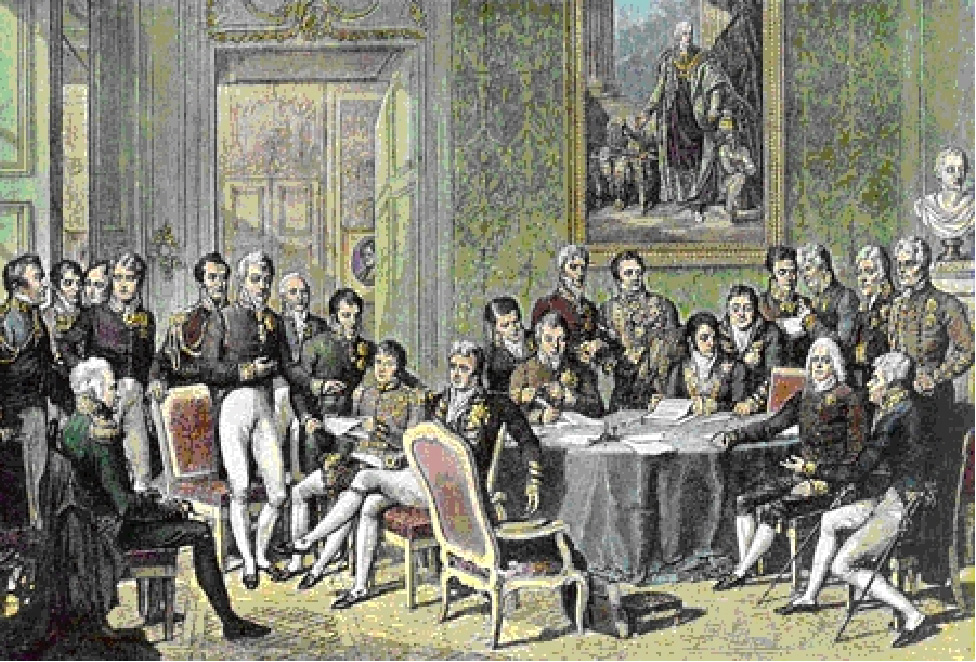
(credit: “The Congress of Vienna” by Unknown/Wikimedia Commons, Public Domain) · Public Domain
Figure 7.17 This 1819 image by French artist Jean-Baptiste Isabey shows the delegates at the Congress of Vienna, held five years before. Commissioned by the French delegate Charles Maurice de Talleyrand, it depicts the moment when the Duke of Wellington (far left, in profile), arrived to take over from Robert Stuart, Viscount Castlereagh, the head of the British delegation (seated at center with legs crossed). (credit: “The Congress of Vienna” by Unknown/Wikimedia Commons, Public Domain)
図7.17 フランスの画家ジャン=バティスト・イザベイによるこの1819年の画像は、その5年前に開かれたウィーン会議の代表たちを描く。フランス代表シャルル・モーリス・ド・タレーランの依頼で制作され、イギリス代表団長ロバート・スチュアート、カスルレー子爵(中央で脚を組んで座る人物)から任務を引き継ぐため、ウェリントン公爵(左端の横向きの人物)が到着した瞬間を示している。(画像:作者不詳/Wikimedia Commons「The Congress of Vienna」、パブリックドメイン。)
Although Vienna’s peace settlement of 1815 was intended to restrain the liberalism and nationalism of the revolutionary era, conservative leaders like Metternich underestimated the extent of popular support for these ideologies, which had become irreversible in places like the United States and France. Greek supporters of national sovereignty, for example, were guided by revolutionary principles to seek independence from the Ottoman Empire in 1821, and they gained it in 1830. Nevertheless, after 1815, conservatism continued to gain favor among those who supported the leadership and privilege of hereditary monarchs, organized religion, and the aristocracy.
英語のヒント
1815年のウィーンの和平は、革命時代の自由主義とナショナリズムを抑えることを意図していた。しかしメッテルニヒなどの保守的指導者は、これらの思想への民衆の支持の大きさを過小評価した。アメリカ合衆国やフランスなどでは、その流れはもはや元に戻せなかった。たとえばギリシアの国民主権の支持者たちは、革命の原理に導かれ、1821年にオスマン帝国からの独立を求めて立ち上がり、1830年に独立を得た。それでも1815年以降、世襲君主、組織化された宗教、貴族の指導的地位と特権を支持する人々の間では、保守主義が引き続き支持を広げた。