第12章インド・インド洋世界・東アジアIndia, the Indian Ocean Basin, and East Asia
12.3 Border States: Sogdiana, Korea, and Japan12.3 周辺の諸国――ソグディアナ・朝鮮・日本
Learning Objectives学習の目標
By the end of this section, you will be able to:
この節を学ぶと、次のことができるようになる。
Discuss the rise of the kingdoms of Sogdiana, Korea, and Japan
ソグディアナ、朝鮮、日本における国々の台頭を論じる。
Explain how long-distance trade along the Silk Roads influenced the growth of border states like Sogdiana
シルクロードの遠距離交易が、ソグディアナのような周辺国家の発展に及ぼした影響を説明する。
Describe the cultural influence of China on the states of Korea and Japan
朝鮮と日本の国々に対する、中国の文化的影響を説明する。
Sogdiana, in modern Uzbekistan and Tajikistan, traded both with the Chinese and, increasingly in its long history, with other nomadic peoples such as the Turks. The Chinese, in turn, influenced both Korea and Japan. Both already participated in oceanic trade, but the additional benefits of the Silk Roads’ interchange of ideas came to Korea and Japan through the Chinese as Koreans studied writing, Confucianism, and Buddhism in China and brought back the ideas and methods that suited them best. These innovations and ideas then spread to Japan, especially Buddhism.
英語のヒント
現在のウズベキスタンとタジキスタンに位置するソグディアナは、中国人と交易するとともに、その長い歴史の中で、テュルク人など他の遊牧民との交易も次第に増やしていった。一方、中国人は朝鮮と日本の双方に影響を与えた。朝鮮も日本も、すでに海洋交易に参加していたが、中国を通じて、シルクロードでの思想交流の恩恵も受けるようになった。朝鮮の人々は中国で文字、儒教、仏教を学び、自分たちに最も適した思想や方法を持ち帰った。こうした新しい方法や考え、特に仏教は、その後日本へも広がった。
Sogdiana and Silk Road Tradeソグディアナとシルクロード交易
East of the Sasanian Empire and west of Tang China, in what is now Uzbekistan and Tajikistan, lay the region of Sogdiana, a territory whose documented history stretches back to the fifth century BCE. Inhabited primarily by nomadic groups, Sogdiana was subject to the rule of a succession of empires and kingdoms throughout antiquity, from the Achaemenid Persians, Alexander the Great, and the Hellenistic successor kingdoms to the Kushan Empire. As a result, the region became a cultural melting pot. Indeed, under first the Seleucids and then the breakaway kingdoms of the Bactrian and Sogdian rulers, Greek learning flourished in Sogdiana, prompting later Islamic rulers to recruit scholars from the area. The Kushan Empire in central Asia was key to stabilizing the heartland that connected the eastern and western ends of the Silk Roads. After Kushan’s fall in 375 CE, the Sogdians came to control an array of vital oasis towns, including Bukhara and Samarkand (both in modern-day Uzbekistan), from which they dominated regional trade for hundreds of years.
英語のヒント
ササン朝の東、唐の西に当たる、現在のウズベキスタンとタジキスタンには、ソグディアナという地域があった。記録に残るその歴史は、紀元前5世紀にさかのぼる。主に遊牧集団が住んでいたソグディアナは、古代を通じて、次々に現れる帝国や王国の支配下に置かれた。アケメネス朝ペルシア、アレクサンドロス大王、その後継のヘレニズム諸王国から、クシャーナ朝に至るまでである。その結果、この地域は文化のるつぼとなった。最初はセレウコス朝の下で、次いで、そこから分かれたバクトリアやソグディアナの支配者の王国の下で、ギリシアの学問が栄えた。これが、後のイスラームの支配者たちがこの地域から学者を招くきっかけとなった。中央アジアのクシャーナ朝は、シルクロードの東端と西端をつなぐ中核地域の安定に重要な役割を果たした。375年にクシャーナ朝が滅びると、ソグド人はブハラやサマルカンド(ともに現在のウズベキスタン)を含む重要なオアシス都市の数々を支配するようになった。そこを拠点に、何百年もの間、地域の交易を掌握した。
Although Sogdiana was never unified into a single polity and was almost always ruled by larger states, its long exposure to so many different cultures produced a multilingual population of merchants and skilled craftspeople. The Sogdians were able to use these traits to dominate their portion of the Silk Roads from their city-states such as Panjikent (in Tajikistan). So effective was their control that Sogdiana became the richest country in central Asia. Archaeological excavations of the palace complex at Panjikent have revealed large and elaborate buildings with interiors bearing frescoes of armored cavalry engaged in combat, clearly showing the influence on Sogdian culture of the warrior aristocracy of the Sasanids (Figure 12.25).
英語のヒント
ソグディアナは一つの政体に統一されたことがなく、ほぼ常に大国の支配下にあった。それでも、長く多様な文化に接したことで、多言語を操る商人や熟練の職人が育った。ソグド人はこうした強みを生かし、パンジケント(タジキスタン)などの都市国家を拠点に、シルクロードの自分たちの担当する区間を支配した。その掌握は非常に有効で、ソグディアナは中央アジアで最も豊かな国となった。パンジケントの宮殿群の考古学的発掘によって、大規模で精巧な建築物が見つかっている。内部のフレスコ画には、鎧を着けて戦う騎兵が描かれており、ササン朝の戦士貴族がソグド文化に与えた影響をはっきりと示している(図12.25)。
A Sogdian Fresco.ソグドのフレスコ画
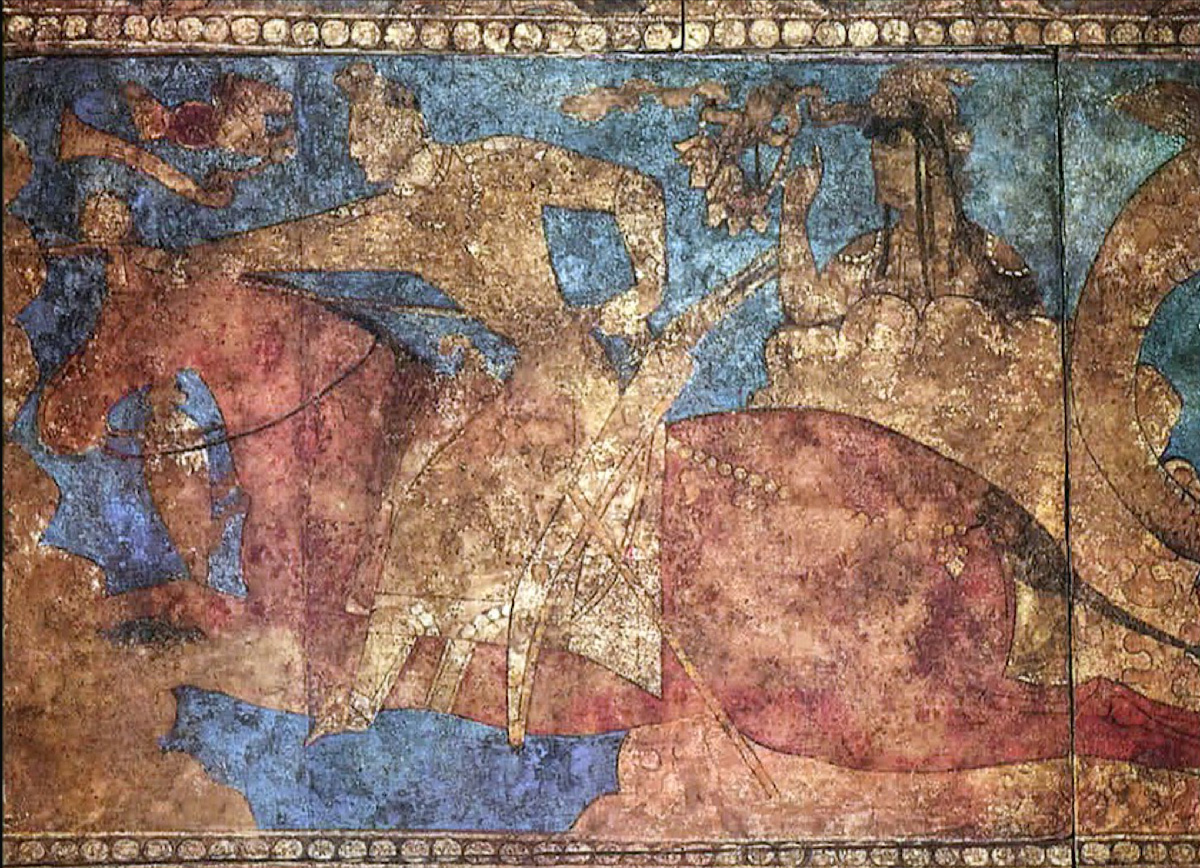
(credit: “Panjikent mural (6th-7th century CE)” by “Pendjikent”/Wikimedia Commons, Public Domain) · Public Domain
Figure 12.25 This Sogdian fresco (wall painting) of the sixth or seventh century CE depicts a warrior on horseback. It was discovered on a wall of the palace complex at Panjikent in what is today Tajikistan. (credit: “Panjikent mural (6th-7th century CE)” by “Pendjikent”/Wikimedia Commons, Public Domain)
図12.25 6~7世紀のソグドのフレスコ画(壁画)。騎乗する戦士を描く。現在のタジキスタンにあるパンジケントの宮殿群の壁で発見された。(出典:“Pendjikent”/Wikimedia Commons「Panjikent mural (6th-7th century CE)」、パブリックドメイン)
Sogdiana reached the peak of its wealth and influence between the fourth and eighth centuries CE. Concentrated in a patchwork of oasis towns and city-states among larger kingdoms, the Sogdians traded frequently with Romans to the west and with nomadic peoples of the steppes and the Chinese to the east. Sogdian communities that exchanged leather and animal products for Chinese silk and manufactured goods were also found in thriving Chinese river ports like Dunhuang and Chang’an.
英語のヒント
ソグディアナの富と影響力は、4~8世紀に最盛期を迎えた。より大きな王国の間に、継ぎはぎのように散在するオアシスの町や都市国家へ集住していたソグド人は、西のローマ人、東のステップの遊牧民や中国人と盛んに交易した。敦煌や長安など、中国の繁栄する河川港にも、ソグド人の共同体があった。彼らは皮革や動物性の産物を、中国の絹や製品と交換していた。
The Sogdians were also keen agents of cultural transmission throughout this period. As early as the fourth century, for example, Sogdian merchants and traders helped spread Buddhism beyond the borders of South Asia. By the sixth century, Sogdians had followed the Silk Roads into Europe, bringing Nestorianism, the branch of Christianity from Asia Minor and Syria that believed Jesus had two separate natures. Sogdians also brought Manichaeism, a dualistic philosophy of good versus evil that emerged in the Sasanid Empire and blended Persian Zoroastrianism, Buddhism, and Christianity. Manichaeism was the chief competitor of Catholic Christianity in Late Antiquity until the arrival of Islam.
英語のヒント
この時期を通じ、ソグド人は文化の伝達にも積極的な役割を果たした。たとえば4世紀にはすでに、ソグドの商人や交易商が、仏教を南アジアの外へ広めることを助けていた。6世紀までには、ソグド人はシルクロードをたどってヨーロッパへ入り、ネストリウス派キリスト教をもたらした。これは小アジアとシリアに由来し、イエスには二つの別個の本性があるとするキリスト教の一派だった。ソグド人はマニ教も伝えた。ササン朝で生まれた善と悪の二元論的な思想で、ペルシアのゾロアスター教、仏教、キリスト教を融合させていた。古代末期には、イスラームが登場するまで、マニ教がカトリック・キリスト教の主要な競争相手となった。
Sogdian traders also established alliances with some of the peoples they encountered in the west, including groups of nomadic Turks who adopted not only Manicheanism but also Sogdian, which was the language of the Silk Roads until the seventh century when it was replaced by Persian. By the eighth century, however, parts of Sogdiana including Samarkand were ruled by the expanding Islamic caliphate, which saw the potential in monopolizing the central Asian corridor of the Silk Roads. The diffusion of Muslim culture into Sogdiana prompted many Sogdian merchants and traders to convert, seeing benefits that included reliable contracts among believers to safeguard goods moving along the Silk Roads. By the middle of the century, the revolutionary Abbasid caliphs who overthrew their Umayyad predecessors had extended their Muslim empire all the way to Tang China, against whose forces they engaged in the Battle of Talas River in 751. For all its significance in ending Abbasid expansion eastward, the battle is also noteworthy in the story of Sogdiana for one unexpected reason: the response of the rebellious Tang general An Lushan.
英語のヒント
ソグド商人は、西で出会った諸民族の一部とも同盟を結んだ。その中には、マニ教だけでなくソグド語も採用したテュルク系遊牧民の集団があった。ソグド語は、7世紀にペルシア語に取って代わられるまで、シルクロードの共通語だった。しかし8世紀までには、サマルカンドを含むソグディアナの一部は、勢力を広げるイスラームのカリフ国家に支配されていた。カリフ国家は、シルクロードの中央アジア回廊を独占することに可能性を見いだしていた。イスラーム文化がソグディアナへ広まると、多くのソグド商人や交易商は改宗するようになった。信徒同士の信頼できる契約がシルクロードを移動する商品を守るなど、改宗に利益があると考えたためである。世紀半ばまでに、先行するウマイヤ朝を倒して革命を起こしたアッバース朝のカリフたちは、イスラーム帝国を唐の領域に接するまで拡張し、751年、唐の軍とタラス河畔の戦いを戦った。この戦いは、アッバース朝の東進を終わらせた点で重要だった。それに加え、ソグディアナの歴史では、一つの意外な理由でも注目に値する。唐に反乱を起こした将軍、安禄山の反応である。
Although An’s biological parentage is shrouded in mystery, the record suggests he was adopted by a Turkic-speaking mother and a Sogdian father and swiftly rose to prominence in the Tang army as an interpreter in the military markets along the Silk Roads. His aggressive nature endeared him to no one, but by the 730s, An had come to the attention of Emperor Xuanzong and ingratiated himself into court politics. He and the emperor became fast friends, but An’s fears about his future should the emperor die led him to rebel against the Tang state following its defeat at Talas River. An Lushan’s rebellion decided the fate of the Tang presence in central Asia, for it prompted the Tang to withdraw from the region. The story of An reminds us yet again of the interconnected nature of the premodern world.
英語のヒント
安禄山の実の親については謎に包まれているが、記録によれば、テュルク語を話す母とソグド人の父の養子となり、シルクロード沿いの軍の市場で通訳を務め、唐の軍内で急速に頭角を現したという。攻撃的な性格のため誰からも好かれなかったが、730年代までには玄宗皇帝の目に留まり、宮廷政治で取り入ることに成功した。安禄山と皇帝は親しい友となった。しかし、もし皇帝が死んだら自分の将来はどうなるかという不安から、タラス河畔の戦いで敗れた後の唐に対して、反乱を起こした。この反乱は唐に中央アジアからの撤退を促し、同地における唐の勢力の運命を決定づけた。安禄山の物語は、前近代の世界が互いにつながっていたことを、改めて思い起こさせる。
By the end of the eighth century, much of Sogdiana was ruled by the Abbasid Caliphate, and Sogdian communities abroad gradually assimilated, as in China, for example. Still, Arab, Byzantine, Chinese, and Armenian sources refer to Sogdians as the “great traders of Inner Asia,” while caravanners’ graffiti in India and the presence of Sogdian loanwords in the Turkish vocabulary testify to the intensity and durability of their commercial interactions long after their absorption into the Islamic world.
英語のヒント
8世紀末までに、ソグディアナの大部分はアッバース朝カリフ国家の支配下に入り、国外のソグド人共同体も、中国などで徐々に同化していった。それでも、アラブ、ビザンツ、中国、アルメニアの史料は、ソグド人を「内陸アジアの大商人」と呼んでいる。また、インドに残る隊商の人々の落書きや、トルコ語に入ったソグド語からの借用語は、イスラーム世界に吸収された後も長く、彼らの商業上の交流が盛んで持続的だったことを物語っている。
The dual Muslim/Chinese control of the Silk Roads that began in the eighth century was shaken by the coming of the Mongols in the thirteenth century. Chinggis Khan’s second son Chagatai and his descendants controlled central Asia as the Chagatai Khanate from the mid-thirteenth century onward, until the Turkic warlord Timur (Tamerlane) took over in 1363 and made his capital at Samarkand, the old Sogdian center of the Silk Roads.
英語のヒント
8世紀に始まったムスリムと中国によるシルクロードの二重の支配は、13世紀のモンゴル人の到来によって揺らいだ。チンギス・ハンの次男チャガタイとその子孫は、13世紀半ば以後、チャガタイ・ハン国として中央アジアを支配した。その支配は、テュルク系の武将ティムール(タメルラン)が1363年に実権を握り、シルクロードの古いソグドの中心地サマルカンドを首都とするまで続いた。