第12章インド・インド洋世界・東アジアIndia, the Indian Ocean Basin, and East Asia
An upsurge of violence began in the late 1150s when two families, the Taira and the Minamoto, vied for power. In 1160, the Taira were ascendant, but a generation later, in the uprising known as the Genpei War, the Minamoto triumphed, winning the naval Battle of Dannoura in 1185. The Kamakura period of Japan’s history then began and lasted until 1333. In this period, the imperial capital remained at Heian-kyo, but the warrior families, first the Minamoto and then the Hojo, were headquartered in Kamakura.
英語のヒント
1150年代後半、平氏と源氏の二つの家が権力を争い、戦闘が激しくなり始めた。1160年には平氏が優勢となった。しかし一世代後、源平合戦として知られる争いで源氏が勝ち、1185年、壇ノ浦の海戦でも勝利を収めた。その後、日本史の鎌倉時代が始まり、1333年まで続いた。この時期、天皇の都は平安京に置かれたままだったが、武家は、最初は源氏、次いで北条氏が、鎌倉を本拠地とした。
From 1180 to 1185, with the help of the samurai, the warrior aristocracy of Japan, Yoritomo, the heir of the Minamoto clan, successfully wiped out all rivals, even eradicating the northern branch of the Fujiwara in 1189. In 1192, he gave himself the title of shogun, or commander in chief. From then on, the military shogun exercised the power of state, while the emperor was little more than a figurehead. Regional lords also had samurai retainers. Samurai adhered to a strict code of behavior called bushi, or “way of the warrior.” One of the expected behaviors was disdain for capture, leading to ritual suicide known as seppuku.
英語のヒント
1180~1185年、源氏の後継者頼朝は、日本の戦士貴族である武士の助けを得て、対抗勢力をすべて打ち破った。1189年には、北方の藤原氏の一族までも滅ぼした。1192年、頼朝は将軍、すなわち軍の最高司令官という称号を自らに与えた。それ以後、軍事指導者である将軍が国家の権力を行使し、天皇は名目上の存在に近いものとなった。地方の領主も武士の家臣を抱えていた。武士は「bushi」、すなわち「戦士の道」と呼ばれる厳格な行動規範に従った。求められた振る舞いの一つは、捕虜になることを恥とする態度で、それが切腹と呼ばれる儀礼的な自死につながった。
In 1268, envoys arrived in Kamakura on behalf of some new rulers in Asia, the Mongols. Though they declared friendly intentions, these emissaries were ignored by the court. In response the Mongols sailed to Japan and invaded in 1274, only to be repelled when a storm arose following bitter fighting (Figure 12.32). Knowing they would return, the ruling Hojo clan built several land- and sea-based fortifications to halt any future invasion. When the Mongols did reappear in 1281, there was no clear victor, but a typhoon arose and scattered the Mongol ships, convincing many that divine winds, or kamikaze, were being sent by the gods to protect Japan.
英語のヒント
1268年、アジアの新しい支配者モンゴル人を代表する使節が、鎌倉に到着した。使節は友好の意図を宣言したが、朝廷は無視した。これに応じて、モンゴル軍は海を渡って1274年に日本へ侵攻した。しかし激しい戦闘の後に嵐が起こると、結局は退けられた(図12.32)。再来を見越した支配者の北条氏は、次の侵攻を止めるため、陸と海に複数の防御施設を築いた。実際にモンゴル軍が1281年に再び現れたとき、明確な勝者はまだなかったが、台風が起こってモンゴルの船を散り散りにした。これによって多くの人は、神々が日本を守るため、神の風、すなわち神風を送っていると信じた。
The First Mongol Invasion of Japan.最初のモンゴル軍の日本侵攻
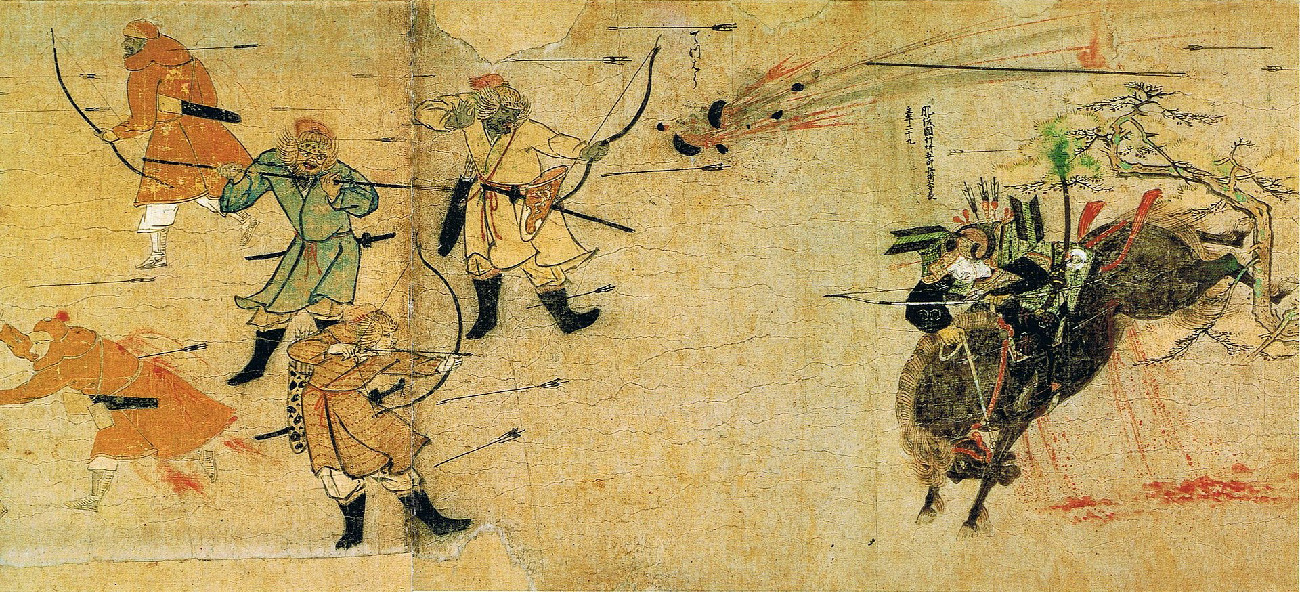
(credit: “Mōko Shūrai Ekotoba 2” by Unknown/Wikimedia Commons, Public Domain) · Public Domain
Figure 12.32 This scene from an illustrated scroll called Mōko Shūrai Ekotoba from the late thirteenth or early fourteenth century shows the first Mongol invasion of Japan in 1274. It depicts the combatants using arrows as well as bombs. (credit: “Mōko Shūrai Ekotoba 2” by Unknown/Wikimedia Commons, Public Domain)
図12.32 13世紀後半または14世紀初めの『蒙古襲来絵詞』の一場面。1274年、最初のモンゴル軍による日本侵攻を描く。戦う人々は、矢に加えて爆弾も使っている。(出典:作者不詳/Wikimedia Commons「Mōko Shūrai Ekotoba 2」、パブリックドメイン)
Section Summaryこの節のまとめ
Sogdiana was vital to the operation of the Silk Roads beginning in the fourth century CE. Over the course of some four hundred years, Sogdian city-states like Samarkand and Panjikent grew into key markets, and Sogdian trading communities were established in China. At its height, Sogdiana was the wealthiest region in central Asia.
英語のヒント
4世紀以後、ソグディアナはシルクロードが機能するうえで不可欠な存在だった。約400年をかけて、サマルカンドやパンジケントなどソグドの都市国家が重要な市場へ成長し、中国にはソグド人の交易共同体が築かれた。最盛期のソグディアナは、中央アジアで最も豊かな地域だった。
Like many other states in East Asia, Korea was greatly influenced by Chinese civilization. Korean students were educated in Confucian schools, and Korean culture took on the patriarchal character and traditions favored by Confucianism. China’s meritocratic civil service system was incorporated into Korea’s bureaucratic state system, and the Korean capital built by the Silla dynasty at Geumseong was modeled on the Tang capital at Chang’an.
英語のヒント
東アジアの多くの国々と同じく、朝鮮は中国文明から強い影響を受けた。朝鮮の学生は儒教の学校で教育を受け、朝鮮の文化には、儒教が重んじる家父長制的な性格や伝統が取り入れられた。中国の能力を基準とする官僚制度は朝鮮の官僚的な国家制度に組み込まれ、新羅王朝が金城に築いた都は、唐の都長安を手本としていた。
China likewise influesnced ancient Japan, though less directly. In the sixth and seventh centuries, countless Korean artisans and craftspeople emigrated to Japan, where their knowledge was put to use. Foreign relations with Korea introduced Buddhism to Japan in the sixth century, and Japanese contact with China brought Confucianism to the island chain, as well as Chinese-influenced written language. Still, unique cultural traditions emerged in Japan, from Shintoism and the development of obscure forms of Buddhism to the institutions of insei, the samurai, and the shogun.
英語のヒント
中国は古代日本にも、より間接的ながら影響を与えた。6~7世紀には、多くの朝鮮の職人や技術者が日本へ移住し、その知識が活用された。朝鮮との対外関係を通じ、6世紀には仏教が伝わった。また中国との接触によって、日本列島には儒教と、中国の影響を受けた書き言葉がもたらされた。それでも日本には、神道や難解な形の仏教の発展から、院政、武士、将軍という制度に至るまで、独自の文化的伝統が生まれた。