第12章インド・インド洋世界・東アジアIndia, the Indian Ocean Basin, and East Asia
Sui and Tang China隋と唐の中国
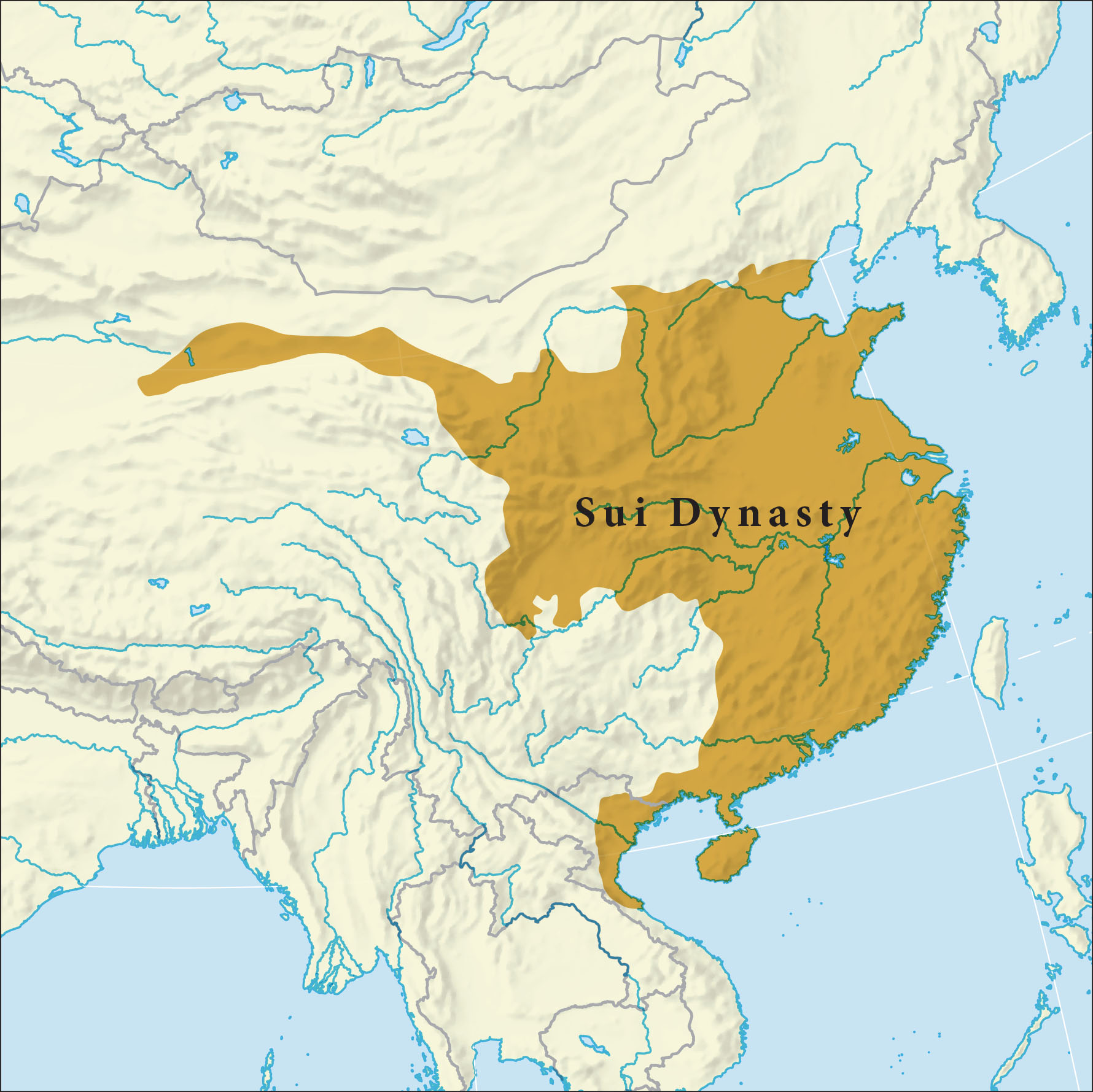
Following the collapse of the Han Empire in 220 CE, three states ruled over China: the Wei in the north, the Wu in the south, and the Shu in the west. A temporary reunification occurred under the Western Jin dynasty from 265 to 316, but from 316 to 589 China was again divided, this time into north and south. Along the Silk Roads, merchants established monasteries, convents, and shrines, bringing Buddhist traditions into China. Many Chinese traders therefore adopted Buddhism, particularly under the Sui dynasty (Figure 12.8).
英語のヒント
220年に漢帝国が崩壊した後、中国は北の魏、南の呉、西の蜀の三国に分かれた。西晋のもとで265~316年に一時的な再統一が行われたが、316~589年には再び分裂し、今度は南北に分かれた。シルクロード沿いで、商人たちは僧院、尼寺、祠を建立し、中国に仏教の伝統をもたらした。そのため中国の交易商の多くも、とりわけ隋の時代に仏教を受け入れた(図12.8)。
The Sui Dynasty.隋
(attribution: Copyright Rice University, OpenStax, under CC BY 4.0 license) · CC BY 4.0
Figure 12.8 This map shows the extent of the Sui dynasty in 609. Like the Qin before them, the Sui pursued empire-building and vast public works projects such as the Grand Canal, which was vital to the movement of Sui armies during campaigns in the south. (attribution: Copyright Rice University, OpenStax, under CC BY 4.0 license)
図12.8 609年の隋の領域を示す地図。先行する秦と同じく、隋は帝国の建設と、大運河などの大規模な公共事業を推進した。大運河は、南方への遠征で隋軍が移動するうえで不可欠だった。(帰属:© Rice University、OpenStax、CC BY 4.0)
A Mongol general from northern China, Yang Jian, was an affirmed Buddhist. His military abilities allowed him to gain such fame that he was able to create a marriage alliance between one of his daughters and a northern prince. With growing power, at the death of the ruler, he claimed the role of regent to his grandson before later deposing him. Yang then made himself the first emperor of the new Sui dynasty in 581 and adopted the name Wen. Emperor Wen gained his soldiers’ allegiance by granting them lands acquired through conquest, a years-long process that reunified most of the old Han lands. To consolidate his control over the empire, Emperor Wen created a powerful centralized government, with loyal bureaucrats appointed to rule its many territories. To eliminate the risk that these powerful regional administrators could amass followers into a rebellious army, Wen periodically moved them to different territories, forcing them to build new networks from scratch.
英語のヒント
中国北部出身で、原文ではモンゴル系の将軍とされる楊堅は、熱心な仏教徒だった。軍事的能力によって大きな名声を得たため、娘の一人と北方の皇族との婚姻関係を結ぶことができた。勢力を強めた楊堅は、君主の死後、孫の摂政の地位を手に入れ、後にその孫を廃位した。581年には自ら新たな隋の初代皇帝となり、文帝と称した。文帝は征服で獲得した土地を兵士たちに与えて忠誠を得た。数年にわたる征服によって、旧漢帝国の領土の大部分が再統一された。帝国への支配を固めるため、文帝は強力な中央集権政府を作り、忠実な官僚を各地の統治者に任命した。強力な地方行政官が支持者を集めて反乱軍を作る危険を除くため、文帝は定期的に彼らを別の地域へ移し、人脈を一から築き直させた。
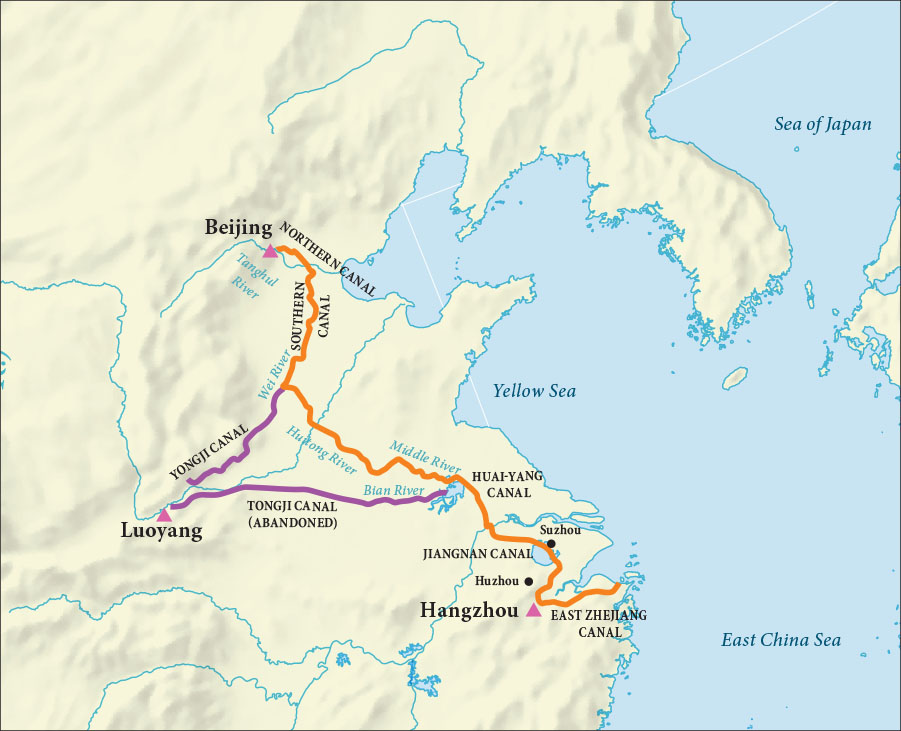
Emperor Wen was succeeded by his son Yang Guang. Like his father before him, Emperor Yang Di, as Yang was known, was ambitious and grandiose. During his reign, he continued his father’s practice of building large public works through forced labor, completing the Grand Canal in 609 to connect Luoyang in central China with Hangzhou in the south. The canal made the movement of foodstuffs and supplies between north and south possible on an unimaginable scale. From the south, with its warmer and wetter climate, came rice; from the drier and cooler north came crops such as wheat and millet (Figure 12.9). A crucial step in the economic integration of overland trade was taken when the canal was connected to the Sui capital and eastern terminus of the Silk Roads in Chang’an, finally extending all the way north to Beijing. Construction of this arm of the canal took seven years and required as many as five million workers, sometimes including entire populations conscripted to labor on the project. An early form of a police force supervised, enforcing corporal punishment on anyone refusing to work.
英語のヒント
文帝の後を継いだのは、息子の楊広だった。煬帝として知られる楊広は、父と同じく野心的で壮大な事業を好んだ。父の方針を引き継いで強制労働による大規模な公共事業を進め、609年に大運河を完成させ、中国中部の洛陽と南部の杭州を結んだ。運河によって、食料や物資を南北の間で、それまで想像もできなかった規模で運べるようになった。温暖で雨の多い南からは米が、乾燥して涼しい北からは小麦やキビ類などが運ばれた(図12.9)。運河が隋の都でありシルクロードの東端でもある長安に接続され、最後には北京まで北へ延びたことで、陸路交易の経済的統合は重要な一歩を進めた。この支線の建設には7年を要し、最大500万人の労働者が動員された。地域の住民全員が工事の労働に徴発される場合もあった。初期の警察のような組織が監督し、労働を拒む者には体罰を加えた。
China’s Grand Canal.中国の大運河
(attribution: Copyright Rice University, OpenStax, under CC BY 4.0 license) · CC BY 4.0
Figure 12.9 This map of China’s Grand Canal shows how it connects the country’s north and south, just as rivers connect the east and west. The canal became critical to centralizing control of the Sui Empire. Its primary route is shown in orange, while the purple indicates shorter-lived expansions constructed to connect the southern Chinese provinces with this important economic thoroughfare. (attribution: Copyright Rice University, OpenStax, under CC BY 4.0 license)
図12.9 中国の大運河が、川が東西を結ぶのと同じように、国の南北を結んでいることを示す地図。運河は隋帝国の支配を中央に集中させるうえで決定的に重要になった。主要経路をオレンジ色で示し、紫色は、中国南部の地方とこの重要な経済的幹線とを結ぶために建設された、比較的短期間しか使われなかった延長区間を示している。(帰属:© Rice University、OpenStax、CC BY 4.0)
The Grand Canal was essential to the economic and administrative integration of the newly reunified Chinese empire under the Sui. The canal made it easier for goods to be transported and provided increased revenue by allowing the government to tax the products being shipped. It also greatly improved communication and the effectiveness of the government, as officials were able to travel quickly between north and south and to send communication more easily across the Chinese interior. The canal was also a vital tool of Sui foreign policy, allowing Chinese armies from the north to travel to the borders of Korea, from which Yang Di launched his futile campaigns of conquest.
英語のヒント
隋のもとで再統一された中国帝国を、経済と行政の両面でまとめるために、大運河は欠かせなかった。商品の輸送が容易になり、政府は運ばれる品物に課税して収入を増やせた。役人が南北の間をすばやく移動し、中国の内陸各地に情報を送りやすくなったため、連絡の行き来も政府の働きも大きく改善した。運河は隋の対外政策にも重要だった。北部の中国軍が朝鮮との境界まで移動できるようになり、煬帝はそこから、結局は徒労に終わる征服遠征を開始した。
In the end, and despite the great benefits of the Grand Canal, its construction overextended the Sui. Enormously costly in labor and materiel, the waterway became a great source of grievance among the Chinese people, millions of whom were forced to work on it and neglect their families and farms. The situation was worsened by the combined effects of a natural disaster—the Yellow River flooded the North China plain and triggered famine throughout the countryside—and military defeat—the Sui invasion of Korea was repelled in 612. Undaunted, Yang Di pushed ahead with a second invasion campaign, stopping only when the exhausted military revolted. The emperor was assassinated in a period of turmoil in the region before Li Yuan, a provincial governor, acceded to the throne and announced the founding of the Tang dynasty in 618.
英語のヒント
大運河は多くの利益をもたらしたが、その建設は結局、隋の力を限界以上に引き伸ばした。労働力と資材の負担が極めて大きく、運河は中国の人々の深い不満の源となった。何百万人もの人が工事を強制され、家族と農地の世話をできなくなったのである。さらに自然災害と軍事的敗北が重なり、状況は悪化した。黄河が華北平原に氾濫して農村各地に飢饉を引き起こし、612年には隋の朝鮮侵攻が撃退された。それでも煬帝はひるまず、2度目の侵攻を進め、疲弊した軍隊が反乱を起こして初めて中止した。この地域が混乱するなかで皇帝は暗殺された。その後、地方の長官だった李淵が即位し、618年に唐の建国を宣言した。
The Tang Empire, which lasted until 907, emerged just as Islam exploded out of Arabia and swept across North Africa and the Iberian Peninsula and into central Asia. Like the great Islamic empires that thrived during this period, the Tang promoted a cosmopolitan culture, a character greatly enhanced by wider international developments. In 674, for example, the advancing tide of Arab armies from the west forced members of the Sasanian royal family to flee to the safety of the Tang court at Chang’an, at the eastern terminus of the Silk Roads. This event inspired whole communities of merchants to move from Sasanian Persia to the Chinese capital, bringing all manner of exotic products and luxury goods, from silver artwork to Arab, Persian, and central Asian musical forms and dance.
英語のヒント
907年まで続いた唐帝国は、イスラームがアラビアの外へ急速に広がり、北アフリカ、イベリア半島を席巻し、中央アジアへ進出したのとちょうど同じ時期に成立した。この時代に栄えた大イスラーム帝国と同じく、唐は国際色豊かな文化を育てた。その性格は、より広い国際的な動きによっていっそう強まった。たとえば674年、西方から押し寄せるアラブ軍によって、ササン朝王家の人々は、シルクロード東端の長安にある唐の宮廷へ逃れ、その安全に頼らざるを得なくなった。この出来事に促され、商人の共同体がまとまってササン朝ペルシアから中国の都へ移住した。彼らは銀工芸からアラブ、ペルシア、中央アジアの音楽や舞踊まで、さまざまな異国の品や奢侈品をもたらした。
It did not take long for the Tang elite to develop a taste for these items, creating an impressive industry of Persian-Arab-inspired goods and services to meet the growing demand. As a taste for Persian-Arab culture spread, trade relations between the Tang and India blossomed, bringing everything from mathematics to new sciences and medicines to China. These different cultural streams met in Tang China’s major cities, which soon generated a diverse international culture greatly enhanced by the presence of merchant communities of Jewish people, Christians, Zoroastrians, peoples of the major Indian traditions, and a sizable minority of Muslims.
英語のヒント
唐の上層の人々はほどなく、こうした品々を好むようになった。増える需要を満たすため、ペルシア・アラブ文化に着想を得た商品やサービスの大きな産業が生まれた。ペルシア・アラブ文化への嗜好が広まるにつれ、唐とインドの交易関係も花開き、数学から新たな科学や医薬に至るまで、さまざまなものが中国へ伝わった。こうした文化の流れは唐の主要都市で合流した。都市にはユダヤ教徒、キリスト教徒、ゾロアスター教徒、インドの主要な宗教的伝統を受け継ぐ人々、そして相当数の少数派ムスリムの商人共同体が存在し、その存在によって、多様で国際的な文化が急速に育まれた。
For much of its duration, Tang China was the most powerful empire in existence, and among its priorities was completing the consolidation and expansion begun under the Sui. To this end, the Tang embarked on a series of military campaigns into central Asia. Their large professional army was organized around a core of aristocratic cavalry of some seven million troops who routinely clashed with the mounted nomads of the Inner Asian Steppe, and an immense peasant infantry several million strong and garrisoned in the interior. By the 750s, Tang frontier units increasingly relied on pastoral nomadic peoples from the steppes, such as the Uyghurs, Turkish-speaking peoples who constituted the empire’s most potent military force. Over time, Tang forces pushed into Manchuria (the area immediately north of the Korean Peninsula), Vietnam, and Tibet. At its height in the late ninth century, the Tang army controlled more than four million square miles of territory, an area roughly the size of the entire Islamic world during the same period.
英語のヒント
存続期間の大半において、唐は当時存在した最強の帝国だった。その優先課題の一つは、隋が始めた統合と拡張を完成させることだった。この目的のため、唐は中央アジアへの一連の軍事遠征に乗り出した。その大規模な職業軍は、内陸アジアの草原の騎馬遊牧民と日常的に衝突する、貴族層を中心とした約700万人の騎兵と、内地に駐屯する数百万人規模の農民歩兵を軸に編成されていた。750年代までには、唐の辺境部隊は、ウイグルなど草原の牧畜遊牧民にますます頼るようになった。ウイグルはテュルク語系の言葉を話し、帝国で最も強力な軍事勢力をなした。やがて唐の軍勢は、満州(朝鮮半島のすぐ北)、ベトナム、チベットへ進出した。9世紀後半の最盛期には、唐軍は400万平方マイル以上、同時代のイスラーム世界全体とほぼ同じ広さの領域を支配した。
The Tang achieved several early foreign policy successes, including reestablishing Chinese rule over Korea in 668, resulting in a tributary relationship with the peninsula’s Silla dynasty. The Tang also opened diplomatic relations with Japan, which proved so effective that in 645 Japan embarked on its “Great Reform”—an all-encompassing adoption of Tang culture, including its imperial institutions (which the Silla also adopted), Confucian bureaucracy, and Buddhism.
英語のヒント
唐は初期の対外政策でいくつもの成功を収めた。その一つが668年に朝鮮に対する中国の支配を再び確立したことで、これによって半島の新羅王朝との朝貢関係が生まれた。唐は日本とも外交関係を開いた。その影響は非常に大きく、日本は645年に「大化の改新」に着手した。これは、新羅も取り入れた皇帝統治の制度、儒教的な官僚制、仏教など、唐の文化を全面的に採用するものだった。
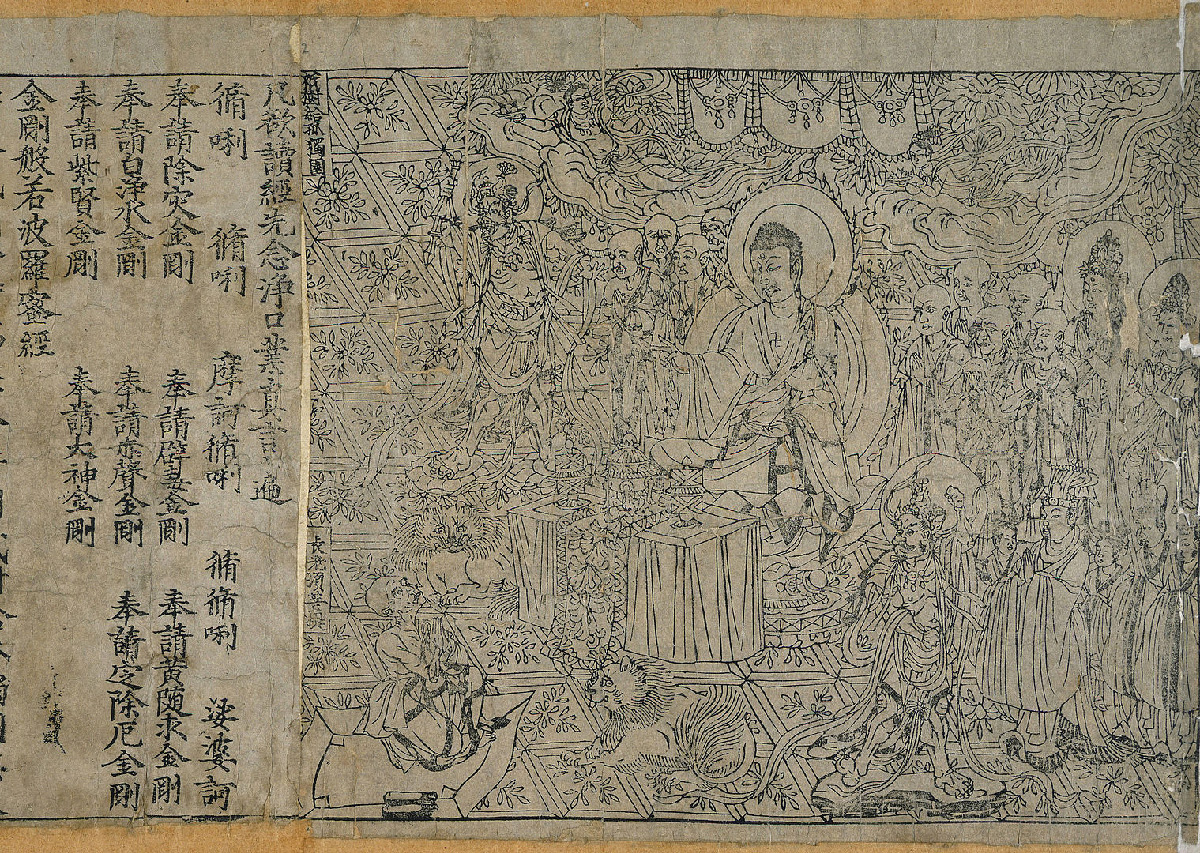
The spread of Tang culture was greatly enhanced by several major innovations in China, including the world’s first block-printing process, which proved opportune for printing Buddhist scriptures (Figure 12.11). Like the Sui, the Tang embraced and promoted Buddhism, the scriptures of which were usually hand-copied by scribes and disseminated among students. The scarcity of these works meant that most commoners and even many elites had no access to them. China’s artisans, however, devised a way to carve the mirror-image of a text into a block of wood, add ink, and then press the block onto paper. Scriptures and other forms of writing now became more accessible, spreading ideas from the elites to the masses. Block-printing remained the major method of transferring images onto paper until the end of the nineteenth century.
英語のヒント
唐文化の広がりは、中国で生まれたいくつもの重要な技術革新によって大いに促進された。なかでも世界初の木版印刷技術は、仏教経典を印刷するのにうってつけだった(図12.11)。唐は隋と同じく仏教を受け入れ、奨励した。仏教経典は通常、書写を担う人々が手で写し、学ぶ者たちに配っていた。その数が少なかったため、庶民の大半だけでなく上層の多くの人々も、経典を手に取れなかった。しかし中国の職人は、板に文字の鏡像を刻み、墨を付けて紙に押し当てる方法を考案した。経典やほかの文書が入手しやすくなり、思想は上層から民衆へ広がった。木版印刷は19世紀末まで、図像を紙に転写する主要な方法であり続けた。
The First Block-Printed Book.最初の木版印刷の本
(credit: modification of work “Jingangjing” by British Library/Wikimedia Commons, Public Domain) · Public Domain
Figure 12.11 This is a page from the Diamond Sutra, the world’s first block-printed book, made in China in 868. Note the image of the Buddha in the center, and consider how the production of multiple copies of documents such as this could lead to wider knowledge of Buddhism. (credit: modification of work “Jingangjing” by British Library/Wikimedia Commons, Public Domain)
図12.11 中国で868年に制作された、世界初の木版印刷の本『金剛般若経』の一頁。中央の仏の姿に注目し、このような文書を複数部作れることが、仏教についての知識の普及にどうつながるか考えよう。(出典:British Library/Wikimedia Commons「Jingangjing」を改変、パブリックドメイン)
Buddhism was important not only under the Sui. The Tang period witnessed the rapid growth of two forms of Mahayana Buddhism in particular: Pure Land, which had originated much earlier in India and had found adherents in China since the fifth century, and Chan, which developed during the fifth and sixth centuries but became popular under the Tang. Pure Land Buddhism was a school of popular devotion to Amida (or Amitabha), the Buddha of the “pure land” or the uncorrupt plane of existence believers anticipated reaching on their rebirth. Like the Hindu bhakti sects in India, Pure Land Buddhists held that to achieve salvation it was necessary not to study sacred texts but rather to engage in practices accessible to everyone, especially by invoking Amida’s name.
英語のヒント
仏教が重要だったのは隋の時代だけではない。唐の時代には、とりわけ大乗仏教の二つの形態、浄土教と禅が急速に発展した。浄土教はそれよりはるか前にインドで生まれ、5世紀以来、中国でも信徒を得ていた。禅は5~6世紀に形成され、唐代に盛んになった。浄土教は、阿弥陀(アミターバ)の仏に広く帰依する教えだった。「浄土」とは、信者が来世に生まれることを願う、汚れのない世界である。インドのヒンドゥー教のバクティ諸派と同様、浄土教徒は、救済に必要なのは聖典の研究ではなく、誰にでもできる実践、とりわけ阿弥陀の名を唱えることだと考えた。
Chan Buddhism, like Pure Land, deemphasized scriptural study but rejected the notion of personal devotion to a savior. Instead, Chan Buddhism, known more popularly by its Japanese name Zen, stressed the disciplined practice of meditation and following the example of a Chan master, who underwent great hardships performing humble tasks and wrestling with paradoxical questions, to achieve enlightenment. Chan Buddhism was austere and monastic in character, whereas Pure Land was the more popular form observed by lay people.
英語のヒント
禅も浄土教と同じく経典研究の重みを減らしたが、救済者への個人的な帰依という考えは退けた。その代わり、英語圏では日本語名Zenでよく知られる禅は、悟りに至るために、厳しく修練する瞑想と禅の師に倣うことを重視した。師たちは、質素な日常の務めを果たし、逆説的な問いに取り組みながら、大きな苦難に耐えた。禅は厳格で僧院中心の性格をもっていたのに対し、浄土教は在家の人々が実践する、より大衆的な形態だった。