第12章インド・インド洋世界・東アジアIndia, the Indian Ocean Basin, and East Asia
12.2 East-West Interactions in the Early Middle Ages12.2 中世前期の東西交流
Learning Objectives学習の目標
By the end of this section, you will be able to:
この節を学び終えると、次のことができるようになる。
Discuss the trade in goods, technology, and ideas that occurred along the Silk Roads
シルクロード沿いで行われた物品、技術、思想の交流について説明する。
Describe how Islam spread in South and Southeast Asia
南アジアと東南アジアにイスラームがどのように広がったかを説明する。
Discuss the role of East Africa in Indian Ocean trade
インド洋交易における東アフリカの役割を説明する。
The Silk Roads made up one of the greatest trade routes in world history, linking east and west in a vast interlocking network that reached its heyday between the fifth and eighth centuries. It had begun to form a few hundred years before, when the Chinese Han dynasty sought to placate and control the great Xiongnu nomadic peoples to the north by trading with them, and with other nomadic peoples such as the Yuezhi in Bactria (modern-day Afghanistan). The Silk Roads eventually connected China, central Asia, South Asia, the Middle East, and even the Mediterranean basin, facilitating the exchange of goods such as silk and spices, technologies such as papermaking, and cultural traditions and religions such as Buddhism and Islam.
英語のヒント
シルクロードは、世界史上最大級の交易路の一つをなしていた。東西を結ぶ広大で相互につながった網であり、5世紀から8世紀に最盛期を迎えた。その形成は、それより数百年前に始まっていた。中国の漢王朝が、北方の強大な遊牧民である匈奴や、バクトリア(現在のアフガニスタン)の月氏など、ほかの遊牧民との交易を通して、匈奴を懐柔し統制しようとした時期である。シルクロードはやがて、中国、中央アジア、南アジア、中東、さらに地中海地域をもつないだ。絹や香辛料などの商品、製紙のような技術、仏教やイスラームなどの文化的伝統や宗教の交換を促した。
These road networks were critical to the spread of Islam, as seen in the wake of Muslim raiders entering the Sindh area of northwest India in the early eighth century. Maritime networks centered on the Indian Ocean also played a large role in this expansion. From India and through both the Persian Gulf and the Red Sea, Muslim sailors began to dominate much of the Malabar Coast of western India and the Swahili coast of eastern Africa, becoming fixtures in the lucrative Indian Ocean trade all the way to China and beyond. The influence of Muslim traders throughout the region went far beyond commercial exchange, however. One of the most significant results of this trade-based diffusion of Islamic culture in South and East Asia was the emergence of powerful states such as Indonesia, which has the world’s largest Muslim population today.
英語のヒント
こうした陸上交通網は、イスラームの広がりに決定的な役割を果たした。8世紀初めにムスリムの襲撃者がインド北西部のシンドへ入った後の展開にも、それが見られる。インド洋を中心とする海上交通網も、この拡大を大きく支えた。インドから、またペルシア湾と紅海の双方を経由して、ムスリムの船乗りはインド西部のマラバール海岸と東アフリカのスワヒリ海岸の多くで優勢となった。中国やその先にまで及ぶ、利益の大きなインド洋交易で、欠かせない存在になったのである。しかしムスリム商人の地域全体への影響は、商業上の交換をはるかに超えていた。交易を通じた南アジアと東アジアへのイスラーム文化の普及がもたらした特に大きな結果の一つが、現在世界最大のムスリム人口をもつインドネシアなど、強力な国家の出現だった。
Travel and Exchange along the Silk Roadsシルクロード沿いの旅と交流
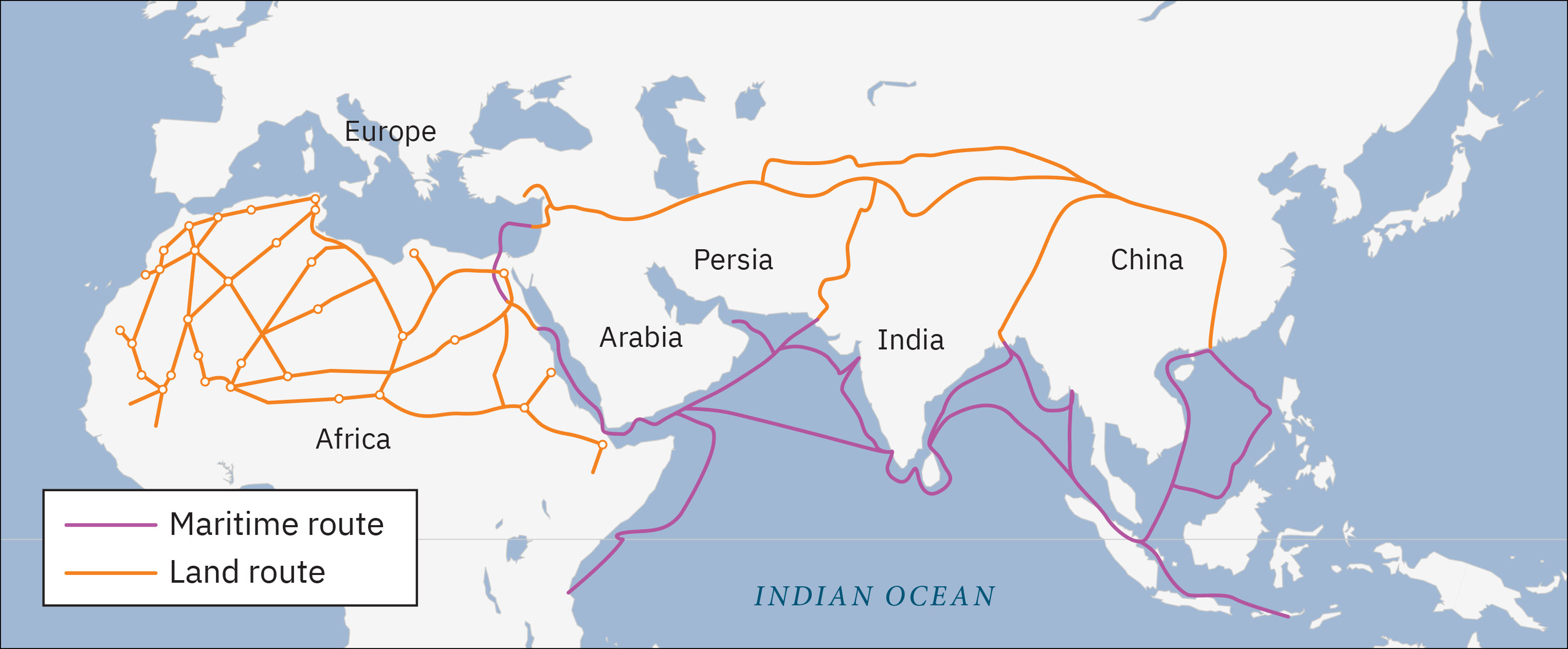
By the first century BCE, China had become firmly established as the eastern end of the Silk Roads, with Rome as the western end. The Romans also traveled by sea to secure the goods that came through the ports of western India, the Red Sea, and the Persian Gulf, as well as trading through key centers in Syria such as the great caravan cities of Petra and Palmyra, the Nabatean city famed as the main entry point for Chinese silk and eastern incense. In exchange for such goods, the Roman provinces of North Africa traded Roman glassware, wool, gold, and silver through intermediaries in the Middle East and central Asia and even into India (Figure 12.14).
英語のヒント
紀元前1世紀までには、中国はシルクロードの東端として確立し、西端にはローマがあった。ローマ人は西インド、紅海、ペルシア湾の港を経由する品物を確保するため、海路も利用した。同時に、ペトラやパルミラといった大きな隊商都市など、シリアの主要拠点を通じても交易した。原文は、後者を中国の絹や東方の香の主要な入口として有名なナバテア人の都市と説明している。こうした品物の代わりに、北アフリカのローマ属州は、中東や中央アジアの仲介者を通じて、さらにインドにまで、ローマのガラス製品、羊毛、金、銀を送り出した(図12.14)。
The Silk Roads in the First Century CE.1世紀のシルクロード
(credit: modification of work “World map blank shorelines” by Maciej Jaros/Wikimedia Commons, Public Domain) · Public Domain
Figure 12.14 The Silk Roads network was not a single route but many, including caravan routes that linked to the main trading regions, oasis towns, and overseas routes—the so-called Maritime Silk Roads—throughout the Indian Ocean. (credit: modification of work “World map blank shorelines” by Maciej Jaros/Wikimedia Commons, Public Domain)
図12.14 シルクロードは単一路線ではなく、多数の経路からなる網だった。主要交易地域やオアシス都市を結ぶ隊商路と、インド洋全域にわたる、いわゆる「海のシルクロード」を含んでいた。(出典:Maciej Jaros/Wikimedia Commons「World map blank shorelines」を改変、パブリックドメイン)
Before they reached the Romans, trade goods from the east were largely in the hands of the Kushan Empire. The Yuezhi confederacy in Bactria had unified to form this empire, trading with both China and the Indian subcontinent and providing a conduit between the two, particularly from the city of Taxila. The Kushan Empire managed to stabilize the trading routes connecting the Parthian western leg of the road with that of the central Asian steppes, spreading its control halfway down the Indian subcontinent in the process and ideally positioning itself to handle trade between India, China, and the Mediterranean.
英語のヒント
東方からの商品は、ローマ人の手に届く前、おおむねクシャーナ朝の手中にあった。バクトリアの月氏の連合体がまとまってこの帝国を形成し、中国とインド亜大陸の双方と交易して、特にタキシラを拠点として両者を結ぶ通路となった。クシャーナ朝は、交易路の西側のパルティアの区間と中央アジアの草原の区間を結ぶ道を安定させた。その過程でインド亜大陸の中ほどまで支配を伸ばし、インド、中国、地中海の間の交易を扱ううえで、理想的な位置を占めるようになった。
By the third century CE, many empires using the Silk Roads had begun to decline, including the Romans, the Kushans, the Parthians, and the Han. The Kushans and Parthians were replaced by the Sasanids in Persia, who also annexed the northern portion of the Kushan Empire. The Gupta soon controlled the southern portion of India. The Mediterranean world was changing too; the Silk Roads’ new trade destination was the surviving Eastern Roman Empire, known as the Byzantine Empire from the late fifth century onward, following the fall of Roman dominance in western Europe. These new players continued and extended the trade network.
英語のヒント
3世紀までに、シルクロードを利用していた多くの帝国――ローマ、クシャーナ、パルティア、漢――が衰え始めた。クシャーナ朝とパルティアに代わって、ペルシアではササン朝が台頭し、クシャーナ朝の北部も併合した。まもなくグプタ朝がインド南部を支配した。地中海世界も変化していた。西ヨーロッパでローマの支配が崩壊すると、シルクロードの交易の新たな目的地は、存続していた東ローマ帝国となった。原文は、東ローマが5世紀後半からビザンツ帝国として知られると説明する。これらの新しい勢力は、交易網を維持し、さらに広げた。
Long-distance trade during the early and later Middle Ages was fraught. The Silk Roads were not a four-thousand-mile-long superhighway outfitted to bridge eastern and western markets from Rome to China but rather a series of interconnected roads, many ill maintained, that were built up over time and eventually linked dozens of oasis towns and market cities such as Palmyra in the west and Bactria in the east. It is most useful to imagine it as a network of “legs” on a journey, along which merchants and traders traveled via caravan with their wares, pausing to rest at caravansaries along the way. Goods changed hands many times over these long distances, being exchanged between merchants who each traveled only part of the “road,” and their price increased the farther they went from their origin.
英語のヒント
中世の前期にも後期にも、遠距離交易は危険に満ちていた。シルクロードは、ローマから中国まで東西の市場を結ぶために整備された、全長4000マイル(約6400キロメートル)の一本の幹線道路ではない。時間をかけて形成された、相互につながる多数の道路であり、その多くは整備が悪かった。やがて、西のパルミラや東のバクトリアのような、何十ものオアシス都市や市場都市を結んだ。旅のいくつもの「区間」がつながる網と考えると理解しやすい。商人や交易商は品物を携えて隊商で区間を進み、途中の隊商宿で休んだ。長い距離を運ばれるうちに、商品は何度も持ち主を変えた。商人はそれぞれ道の一部だけを旅し、商品を受け渡したのである。そして商品は、産地から遠くへ行けば行くほど値段が上がった。
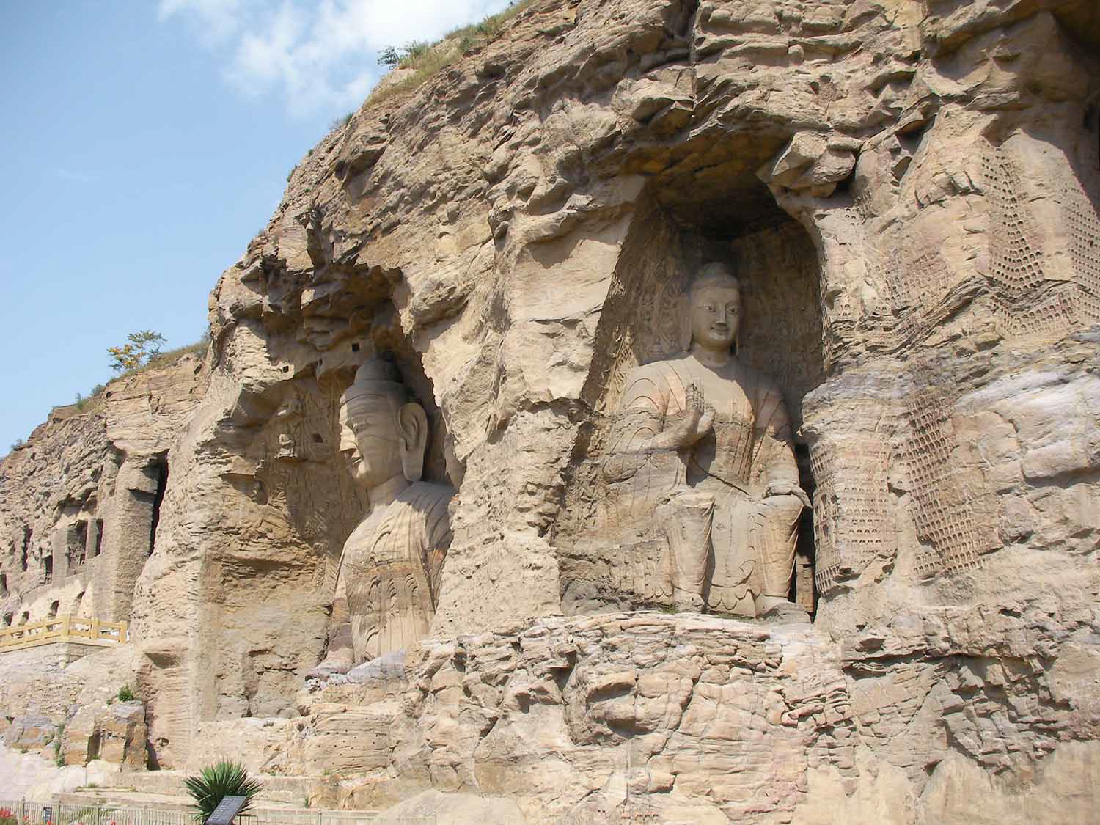
Buddhism arrived in China sometime during the period known as the Six Dynasties (220–589 CE). Monks traveling the Silk Roads between northern India and Afghanistan brought its universalizing message of a lifestyle open to all and offering salvation to any willing to listen, and they found a receptive audience among countless merchants traveling between China and central Asia. Over time, Buddhist monks established themselves in small communities and set up monasteries at a string of oases the length of the Taklamakan Desert—a chain that ran all the way to the Great Wall in northern China. At one of these, Yungang, weary travelers were greeted by five huge Buddhas carved from the cliffs and surrounded by tens of thousands of statues representing Buddhist deities and patrons (Figure 12.15). This great religious complex offered not only an opportunity to rest and recover but also an entry point to the Chinese market.
英語のヒント
仏教は、六朝と呼ばれる時代(220~589年)のある時期に中国へ到来した。北インドとアフガニスタンの間のシルクロードを旅する僧侶は、すべての人に開かれ、耳を傾けようとする誰にでも救済を差し出す生き方という、普遍的な教えをもたらした。中国と中央アジアを行き来する数多くの商人は、その教えを受け入れた。やがて仏僧は小さな共同体に住み着き、タクラマカン砂漠に沿うオアシスの連なりに僧院を設けた。その鎖は中国北部の万里の長城まで達していた。その一つ、雲崗では、崖から彫り出された5体の巨大な仏と、それを囲む何万もの仏教の神々や庇護者の像が、疲れた旅人を迎えた(図12.15)。この大きな宗教施設群は、休息と回復の機会だけでなく、中国の市場へ入る入口にもなっていた。
Buddha Statues at Yungang.雲崗の仏像
(credit: “Yungang Grottoes 2008” by Mirinda K./Wikimedia Commons, Public Domain) · Public Domain
Figure 12.15 These huge statues of Buddha were carved along the Silk Roads by the Northern Wei dynasty in China around the fourth century. They clearly demonstrate the importance of trade routes in the spread of culture and ideas. (credit: “Yungang Grottoes 2008” by Mirinda K./Wikimedia Commons, Public Domain)
図12.15 中国の北魏王朝によって、4世紀ごろにシルクロード沿いに彫られた巨大な仏像。交易路が文化や思想の普及に果たした重要性をはっきり示している。(出典:Mirinda K./Wikimedia Commons「Yungang Grottoes 2008」、パブリックドメイン)
Many legs of the Silk Roads were perilous in the extreme. For example, upon departing Chang’an, the Tang capital and eastern terminus of the network, travelers almost immediately confronted the Gobi, the largest desert in Asia. Its terrain is compacted and rocky and thus ideal for long-distance travel by camel, but the lack of water necessitated the establishment of caravansaries, usually about a day apart along the road connecting China to the central Asian interior. To geographic and environmental hazards, travelers could add warring tribes and roving bandits and thieves. A menace since the beginning of the Silk Roads, robbers targeted the convoys of precious cargoes as they headed across open and unprotected terrain. While small armies and groups of archers accompanied some larger and better-funded caravans, and caravans sometimes merged into “super-caravans” for safety, these were the exceptions, not the rule. Most travelers undertook a caravan journey at great risk to themselves and the goods they carried.
英語のヒント
シルクロードには、極めて危険な区間が多かった。たとえば唐の都で交易網の東端でもある長安を出ると、旅人はほとんどすぐ、アジア最大の砂漠であるゴビに直面した。地面は硬く締まり岩が多いため、ラクダによる長距離移動には適していた。しかし水が乏しく、中国と中央アジアの内陸を結ぶ道沿いには、通常1日行程ほどの間隔で隊商宿が必要だった。地形や環境の危険に加え、争う部族、徘徊する山賊や盗賊もいた。シルクロードが生まれた当初から、盗賊は脅威だった。貴重な荷を運ぶ隊列が、開けた無防備な土地を進むところを襲ったのである。大きく資金の豊かな隊商の一部には小規模な軍隊や弓兵が同行し、安全のため複数の隊商がまとまって「大隊商」となることもあった。しかしそれは例外だった。旅人の多くは、自分自身と運ぶ商品に大きな危険を負って旅をした。
Despite its dangers, however, the overland route was more appealing for many than the alternative, a hazardous and costly voyage across the sea. Pirates lurking in coastal waters harassed ships on the Maritime Silk Roads, and shifting weather and poorly charted waters posed enormous challenges to even the sturdiest vessels and hardiest merchants. The loss of a ship to a sudden storm or shallow reef (as happened repeatedly at the Gelasa Strait in Indonesia) could mean not only the deaths of crew and passengers but also the ruin of the merchants whose goods were sunk. To most merchants and traders, the risks posed by seaborne trade, not to mention the cost of hiring a ship and its crew, made it the less appealing of the two Silk Road routes open to them. As land empires such as the Sasanian Persians’ realm in central Asia grew more stable, the overland route became even more attractive.
英語のヒント
それほど危険でも、多くの人にとって陸路は、もう一つの選択肢である、危険で費用のかかる海上航路より魅力的だった。沿岸の海賊は海のシルクロードの船を襲い、変わりやすい天候や海図の不十分な海域は、どれほど頑丈な船や屈強な商人にも大きな難題を突き付けた。突然の嵐や浅い礁で船を失えば、乗員や乗客が死ぬだけでなく、積荷を沈められた商人も破産しかねなかった。インドネシアのグラサ海峡では、そうした事故が繰り返し起きた。多くの商人や交易商にとって、海上交易の危険に、船や船員を雇う費用も加わると、利用できる二つのシルクロードのうち海路は魅力に乏しかった。中央アジアのササン朝ペルシアの領域など、陸上の帝国が安定するにつれて、陸路の魅力はさらに増した。
The Sasanian Persians were able to provide a great deal of security, allowing for more peaceful and effective trading. Much of their power in fact relied on and was derived from this trade. The Sasanian Empire was soon displaced by the Islamic Umayyad Caliphate, however, which came to control trade and produce textiles and other goods of its own to sell along the route, although demand for Chinese silks continued. In 750, the Umayyads in turn were overthrown by the Abbasids (749–1258), a new Islamic dynasty that sought to expand eastward from the Middle East even as the Tang dynasty drove westward from China. The Abbasids moved their capital to Baghdad, along the Tigris River in what is modern-day Iraq. This change streamlined their dominance of the Silk Roads, letting them use the Persian Gulf to effectively bypass the Red Sea, which was the seaborne trade route closest to the former Umayyad capital in Syria.
英語のヒント
ササン朝ペルシアはかなりの安全を確保できたため、交易はより平和に、効率よく行われた。実際、その権力の多くは交易に依存し、交易から生まれていた。しかしササン朝は、ほどなくイスラームのウマイヤ朝に取って代わられた。中国の絹への需要は続いたものの、ウマイヤ朝は交易を支配するとともに、織物などの独自の商品を作り、交易路沿いで売るようになった。750年には今度はウマイヤ朝がアッバース朝(749~1258年)に倒された。この新たなイスラーム王朝は、唐が中国から西へ進むのと同時に、中東から東への拡大を目指した。アッバース朝は、現在のイラクに当たるティグリス川沿いのバグダードへ遷都した。この変化によって、シルクロード支配は効率化された。ウマイヤ朝の旧都があったシリアに最も近い海上交易路は紅海だったが、アッバース朝はペルシア湾を使い、紅海を効果的に迂回できるようになったのである。
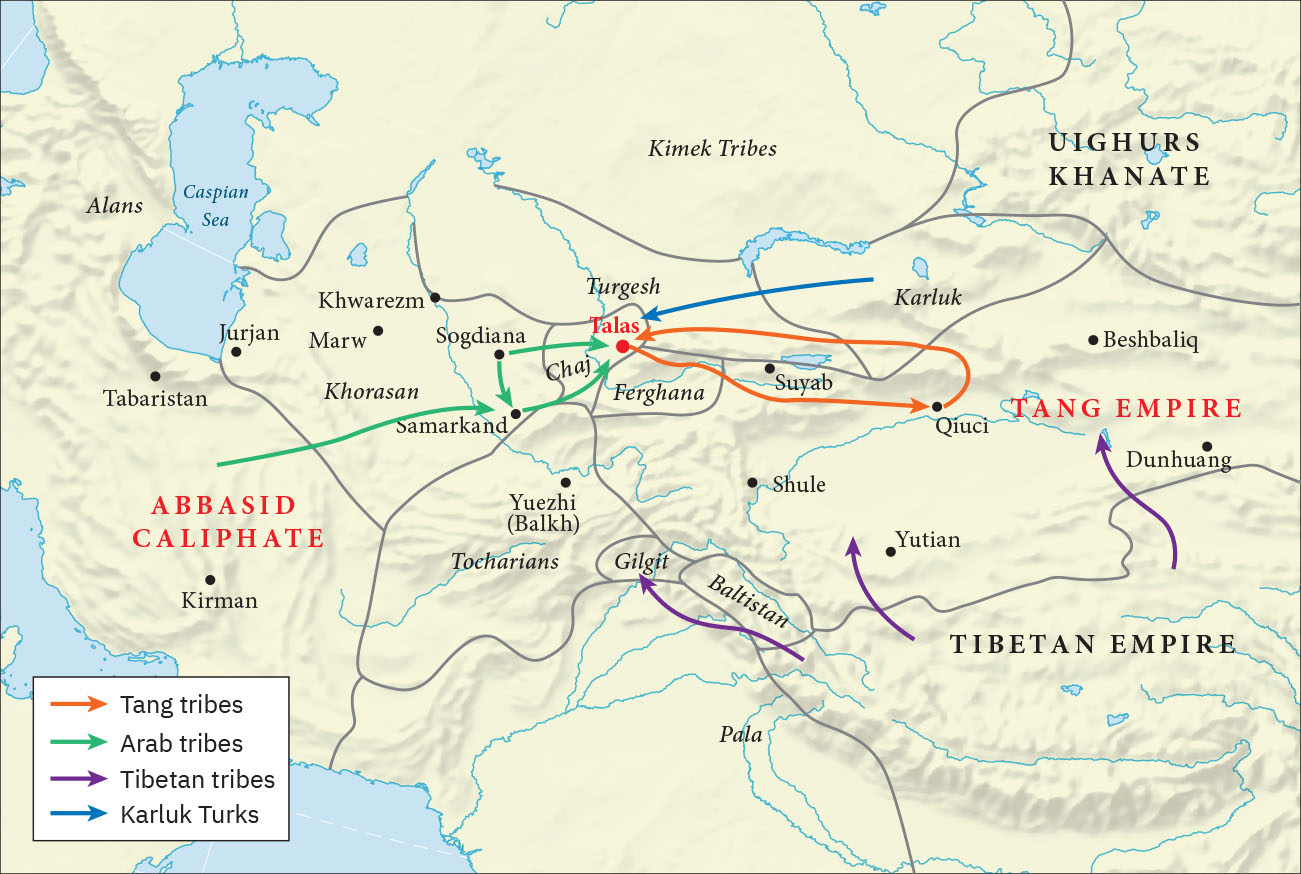
Despite their ambitions, the Abbasids’ eastward expansion was halted in 751 when a combined Arab-Tibetan army met Tang forces in the Battle of Talas River near the town of Atlakh (Figure 12.16). Initially a stalemate, the battle turned in favor of the Abbasids when Turkic forces that were allied with the Tang switched allegiances and joined the Abbasids. Although the Abbasids were victorious, the engagement marked the end of expansion for both empires.
英語のヒント
アッバース朝は拡大を望んだが、その東進は751年に止まった。アラブ・チベット連合軍が、アトラフ近郊のタラス河畔の戦いで唐軍と遭遇したのである(図12.16)。戦況は当初、膠着していた。しかし唐と同盟していたテュルク系の軍勢が陣営を変えてアッバース朝側につき、形勢はアッバース朝有利に傾いた。アッバース朝は勝利したものの、この戦闘は両帝国の拡張の終わりを画した。
The Battle of Talas River.タラス河畔の戦い
(attribution: Copyright Rice University, OpenStax, under CC BY 4.0 license) · CC BY 4.0
Figure 12.16 Note the centrally located site of the 751 Battle of Talas River, between the Abbasids in the west and the Tang in the east. (attribution: Copyright Rice University, OpenStax, under CC BY 4.0 license)
図12.16 751年のタラス河畔の戦いの場所が、西のアッバース朝と東の唐の間、中央に位置することに注目しよう。(帰属:© Rice University、OpenStax、CC BY 4.0)
Throughout the rise and fall of these empires and others, control of trade routes, particularly the Silk Roads, was paramount. For example, people from the central Asian steppes exchanged hides, wool, and livestock for Chinese manufactured goods such as lacquerware, silk, floss, paper, porcelain, and iron tools. These goods and commodities were then traded for similar items along the way, eventually reaching buyers as far away as the Sanhaja tribes of West Africa and the Egyptians and Ethiopians in East Africa. The Silk Roads were never as vital to the Chinese economy, however, as they were to the others. The domestic Chinese economy was large enough to meet all the needs of the state and its people without imports, frustrating European powers intent on breaking into the Chinese economy well into the modern period. At the same time, there was great desire for Chinese goods by western peoples, meaning that the balance of power in trade was almost always skewed in favor of East Asia.
英語のヒント
これらの帝国やほかの帝国が興亡する間、交易路、とりわけシルクロードを支配することは最も重要な課題だった。たとえば中央アジアの草原の人々は、皮、羊毛、家畜と引き換えに、中国製の漆器、絹、真綿、紙、磁器、鉄製工具を手に入れた。こうした品物や商品は、道中で同様の品々と交換され、やがては西アフリカのサンハージャ諸部族や、東アフリカのエジプト人、エチオピア人といった、はるか遠くの買い手にまで届いた。しかしシルクロードが中国経済にとって占める重要性は、他の地域ほどではなかった。中国の国内経済は、輸入がなくても国家と人々のあらゆる必要を満たせるほど大きく、中国経済へ参入しようとするヨーロッパ勢力を近代に至るまで苦しめた。その一方、西方の人々は中国の品物を強く求めたため、交易の力関係はほとんど常に東アジアに有利に傾いた。
The silk that gave the Silk Roads their name may have originally come from China, but it was not long before many other states began raising silkworms and processing the silk thread from their cocoons into luxurious cloth. The Byzantines, legend has it, acquired silkworms clandestinely in the sixth century when Christian monks visiting China spirited some cocoons away in hollowed-out walking sticks. Much of the labor of producing silk fell to women, who grew the mulberry trees needed to feed the silkworms, unraveled the cocoons, and wove the threads into textiles. They were vital to the trade that led to Chinese dominance of the luxury goods market that the Silk Roads were so famous for. The men were responsible for the upkeep of the tree farms and the sale and exchange of the finished products. Many rural and even urban areas survived by producing silk cloth in this way, like the cottage industries that thrived later in Europe.
英語のヒント
シルクロードの名の由来となった絹は、もとは中国から来たのかもしれないが、ほどなく多くの他の国もカイコを育て、繭から取り出した糸をぜいたくな布に加工するようになった。伝説によると、ビザンツ人がカイコを秘密裏に手に入れたのは6世紀で、中国を訪れたキリスト教の修道士が、中をくり抜いた杖に繭を隠して持ち去ったという。絹生産の労働の多くは女性が担った。カイコの餌となるクワの木を育て、繭をほどき、糸を布に織った。シルクロードで名高い奢侈品市場における中国の優位を生んだ交易に、女性たちは欠かせない存在だった。男性はクワ畑の維持管理と、完成品の販売や交換を担った。多くの農村、さらには都市の地域も、後のヨーロッパで栄えた家内工業のように、こうした絹織物生産で生計を立てた。