第12章インド・インド洋世界・東アジアIndia, the Indian Ocean Basin, and East Asia
Early Korea初期の朝鮮
The Korean peninsula is a mere six hundred miles long, from the Yalu River in the north to the Korean Strait in the south. Manchuria is located north of it and has historically been home to many nomadic peoples; at times it was part of the kingdoms that made up the lands of Korea. Situated so close to China and at the crossroads of much oceangoing traffic in East Asia, Korea and Manchuria have been influenced a great deal by Chinese culture, from landscape painting techniques to city planning, as well as by ideas such as Confucianism and Buddhism.
英語のヒント
朝鮮半島は、北の鴨緑江から南の朝鮮海峡まで、長さわずか600マイルほどである。その北にある満洲は、歴史的に多くの遊牧民の本拠地となり、時には朝鮮の国々の領土の一部でもあった。中国に近く、東アジアの海上交通の交差点に位置する朝鮮と満洲は、山水画の技法から都市計画まで、中国文化の大きな影響を受けた。儒教や仏教などの思想も、その影響に含まれる。
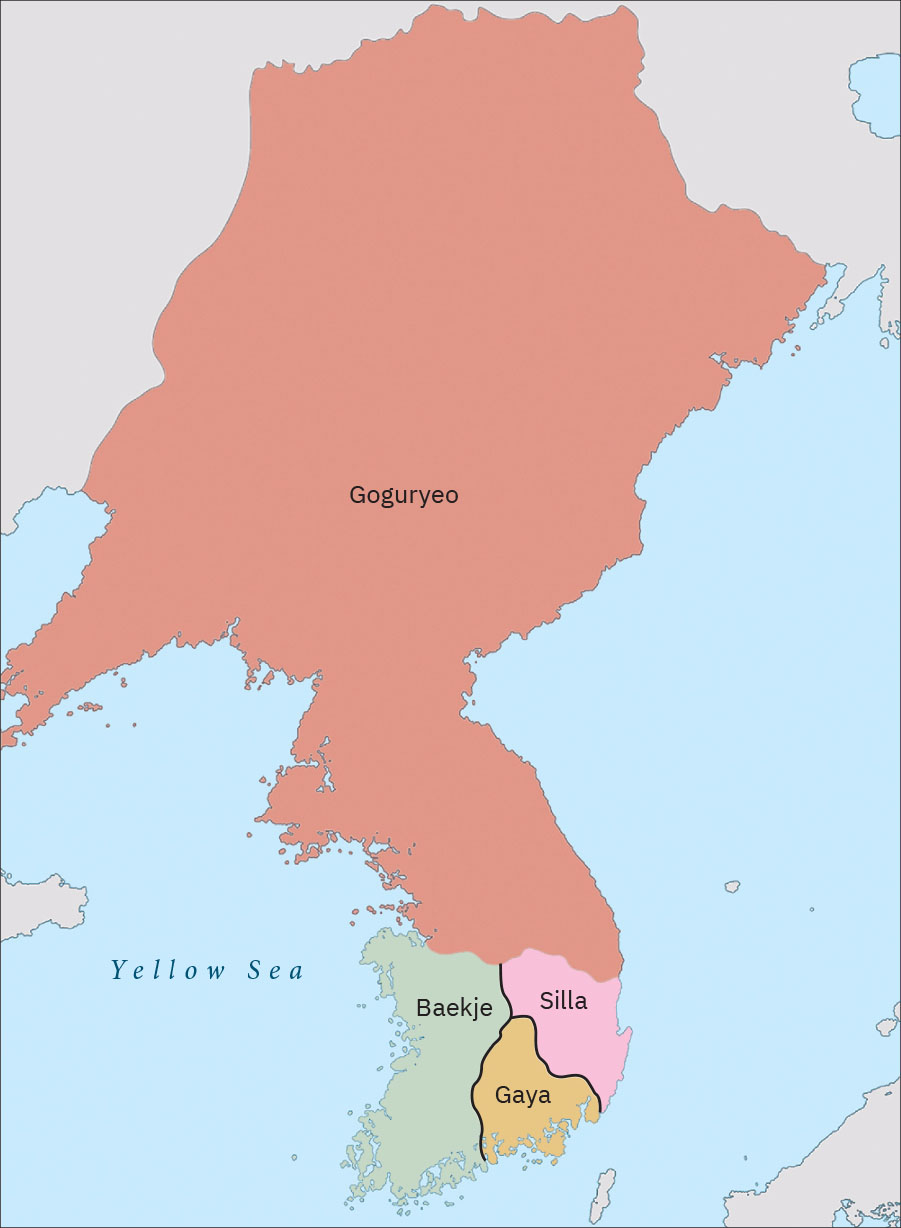
Before the common era, an early Korean state was established in the northwest portion of the peninsula and part of Manchuria. This was the state of Gojoseon, and its people founded their capital at the site of Pyongyang, the current capital of North Korea. During the period of the Han in China (220 BCE–220 CE), three separate kingdoms formed in the peninsula: Goguryeo in the north (37 BCE–668 CE), and in the south Baekje (18 BCE–660 CE) and Silla (57 BCE–935 CE). The northern kingdom of Goguryeo had been overrun by the Han, but in 313 CE it was able to throw off the Chinese and reestablish independence. A fourth state, the confederacy of Gaya (42–532 CE), was also established in this period, but it remained relatively weak and in 532 CE was absorbed by the kingdom of Silla (Figure 12.26).
英語のヒント
紀元前、半島北西部と満洲の一部に、初期の朝鮮国家が成立した。古朝鮮である。人々は、現在の北朝鮮の首都である平壌の地に都を置いた。中国の漢の時代(紀元前220年~紀元220年)、半島には三つの別々の王国が成立した。北の高句麗(紀元前37年~紀元668年)、南の百済(紀元前18年~紀元660年)と新羅(紀元前57年~紀元935年)である。北の高句麗は漢に制圧されていたが、313年、中国人を追い払い、独立を回復することができた。この時期には第4の国家、伽耶連合(42~532年)も成立した。しかし比較的弱いままで、532年に新羅に吸収された(図12.26)。
The Three Kingdoms.三国
(credit: modification of work “Map of Goguryeo (476)” by “solicitatia”/Wikimedia Commons, CC0 1.0) · CC0 1.0
Figure 12.26 This map shows Korea during the Three Kingdoms period. Note the locations of the three—Baekje, Silla, and Goguryeo—which all vied to unify Korea under their own rule. Eventually the Kingdom of Silla absorbed the confederacy of Gaya in 532 and allied with the Tang to defeat Baekje in 660, and then Goguryeo in 668. (credit: modification of work “Map of Goguryeo (476)” by “solicitatia”/Wikimedia Commons, CC0 1.0)
図12.26 三国時代の朝鮮を示す地図。百済・新羅・高句麗の位置に注目しよう。三国はいずれも、自らの支配下に朝鮮を統一しようと争った。やがて新羅は532年に伽耶連合を吸収し、唐と同盟して、660年に百済、668年に高句麗を倒した。(出典:“solicitatia”/Wikimedia Commons「Map of Goguryeo (476)」を改変、CC0 1.0)
It was during this Three Kingdoms period that cultural influences such as Buddhism were being spread along the Silk Roads. One of the Chinese dynasties to succeed the Han, the Jin, sent Buddhist missionaries into Goguryeo in 372. Many elites soon converted, and the kingdoms of Baekje and Silla followed suit. Other cultural innovations that influenced the three kingdoms were Confucian teachings and Chinese writing; Chinese became the official governmental language. The three kingdoms soon fell to quarreling among themselves, however. The southern two allied against Goguryeo in 550, though their victory was delayed for quite some time.
英語のヒント
仏教などの文化的影響がシルクロード沿いに広がっていたのは、この三国時代のことだった。漢の後に現れた中国の王朝の一つ、晋は、372年、高句麗へ仏教の布教者を送った。すぐに多くの支配層が改宗し、百済と新羅もそれに続いた。三国に影響したほかの新しい文化には、儒教の教えと漢字があった。漢文は政府の公用の書き言葉となった。しかし三国は、やがて互いに争い始めた。南の二国は550年に高句麗に対抗して同盟したが、勝利を得るまでには、かなりの時間がかかった。
When the Sui reunified China in 589, they also sought to regain control of Korea, finding themselves in conflict with Goguryeo but repeatedly defeated. In 612, for example, when the Sui attacked with 300,000 soldiers, only 2,700 were reported to have survived. This and other failed attempts to conquer Korea weakened the Sui and were among the key reasons for the dynasty’s collapse and replacement by the Tang in 618.
英語のヒント
589年に中国を再統一した隋は、朝鮮の支配も取り戻そうとして高句麗と衝突したが、繰り返し敗れた。たとえば612年、隋は30万の兵で攻めたが、生き残ったのはわずか2,700人だったと伝えられる。これをはじめ朝鮮征服の試みが失敗したことは、隋を弱体化させ、618年の隋の滅亡と唐への交代の主要な原因の一つとなった。
The second Tang emperor, Taizong, also attacked Goguryeo and was likewise defeated. The Tang therefore allied with the Kingdom of Silla in their bid to dominate the peninsula. Together they defeated Baekje in 660, and then Goguryeo in 668. By 668, Silla was the sole remaining kingdom in Korea. In exchange for victory, however, Korea was now a tributary state of the Tang, although it extended only as far as the city of Pyongyang.
英語のヒント
唐の第2代皇帝太宗も高句麗を攻めたが、同じく敗れた。そこで唐は、半島を支配しようと新羅と同盟した。両国は660年に百済、続いて668年に高句麗を破った。668年までに、朝鮮に残った王国は新羅だけとなった。しかし勝利の代償として、朝鮮は唐の朝貢国となり、その範囲は平壌の街までにとどまった。
The new capital of Silla was located at Geumseong. Basing their city on the Tang capital of Chang’an, the Silla built many Confucian schools, and many Koreans traveled to China to acquire a solid Confucian education and learn more about Buddhism. The ideas of Confucianism and Buddhism slowly influenced and altered Korean culture. For example, Korea had been relatively matrilocal, with the husband joining the wife’s family after marriage. But thanks to the influence of Confucianism and its patriarchal traditions, the opposite now began to occur.
英語のヒント
新羅の新しい都は金城に置かれた。新羅は唐の都長安を手本に都市を造り、多くの儒教の学校を設けた。また多くの朝鮮の人々が中国へ渡り、しっかりとした儒教教育を受け、仏教をさらに学んだ。儒教と仏教の思想は、朝鮮の文化に徐々に影響を与え、変えていった。たとえば朝鮮では、結婚後に夫が妻の家族に加わる妻方居住の傾向が比較的強かった。しかし儒教とその家父長制的伝統の影響によって、今度は逆のことが起こり始めた。
The Koreans did not adopt Chinese values wholesale. Although they accepted aspects of China’s examination system for filling the state bureaucracy based on merit, for instance, aristocratic control remained strong. High aristocrats were often given entire villages to govern and directly chose the local governing officers, and many of these nobles did what they could to protect their indigenous identities. And although China had few enslaved people, Korea had many.
英語のヒント
朝鮮の人々は、中国の価値観を丸ごと取り入れたわけではない。たとえば、能力に基づいて官僚を登用する中国の試験制度の一部は受け入れたものの、貴族の支配は強く残った。上級貴族にはしばしば、統治するために村全体が与えられ、彼らは地方の役人を直接選んだ。こうした貴族の多くは、固有の独自性を守るため、できる限りのことをした。また中国には奴隷化された人々が少なかったが、朝鮮には多くいた。
In 780, an uprising occurred in which the king of Silla was killed. This event marked the beginning of the kingdom’s decline, and a number of additional revolts occurred over the following century. A general named Wang Geon overthrew the kingdom in 935 and established the Goryeo dynasty (from which modern Korea derives its name). The new capital was located where the city of Kaesong now stands, and its administration was based largely on the former Tang governmental system; examination systems and Confucian education increased in importance. To guard against northern nomadic invaders, the Goryeo dynasty built a wall just south of the Yalu River, based on China’s Great Wall.
英語のヒント
780年に反乱が起き、新羅の王が殺された。この事件を境に王国の衰退が始まり、その後の1世紀にも、さらに多くの反乱が起こった。王建という将軍が935年に王国を倒し、高麗王朝を建てた。現代の朝鮮を指す英語名Koreaは、この高麗に由来する。新しい都は、現在の開城の地に置かれた。行政の仕組みは、おおむね旧唐王朝の統治制度に基づき、試験制度と儒教教育の重要性が増した。北方の遊牧民の侵入を防ぐため、高麗王朝は中国の万里の長城を手本に、鴨緑江のすぐ南に長城を築いた。
The new Korean state persisted for some two centuries until a military coup in 1170. Although the Goryeo dynasty remained on the throne, successor kings were figureheads; the army generals held real power and maintained a powerful hold on the military establishment. In the early thirteenth century, however, the Korean capital in Kaesong was besieged by the Mongols, and in 1231 the government was forced to flee southward. The Mongols overran the state itself in 1258, bringing this formative period of Korean history to an end.
英語のヒント
新たな朝鮮国家は、1170年の軍事クーデターまで約2世紀にわたって存続した。高麗王朝は王位を保ったが、後の王たちは名目上の君主となり、実権は軍の将軍たちが握った。将軍たちは軍事組織を強固に掌握した。しかし13世紀初め、首都開城はモンゴル軍に包囲され、1231年、政府は南へ逃れざるを得なくなった。1258年にはモンゴル軍が国家自体を制圧し、朝鮮史のこの形成期は終わった。