第12章インド・インド洋世界・東アジアIndia, the Indian Ocean Basin, and East Asia
12.1 The Indian Ocean World in the Early Middle Ages12.1 中世前期のインド洋世界
Learning Objectives学習の目標
By the end of this section, you will be able to:
この節を学び終えると、次のことができるようになる。
Identify important political developments in South Asia
南アジアの重要な政治的展開を挙げる。
Discuss religious and social practices in South and East Asia
南アジアと東アジアの宗教的・社会的慣行について説明する。
Describe the rise and fall of the Sui and Tang dynasties in China
中国の隋と唐の興亡を説明する。
Beginning in the eighth century, the Khyber Pass, renowned as the means by which Alexander the Great and his army traveled from Afghanistan to India, made it possible for a new religious tradition to enter northern India. This tradition was Islam, which soon came to dominate the areas of modern-day Pakistan and Bangladesh as well as portions of India. In time, Muslims created the powerful Delhi Sultanate, which stretched from the Punjab in the northwest to Bengal in the northeast.
英語のヒント
カイバル峠は、アレクサンドロス大王とその軍隊がアフガニスタンからインドへ向かう際に通った経路として名高い。8世紀になると、この峠を通って、新たな宗教的伝統が北インドに入り込むようになった。それはイスラームだった。イスラームはやがて、現在のパキスタンとバングラデシュに当たる地域、そしてインドの一部で支配的になった。やがてムスリムは強大なデリー・スルタン朝を築き、その領域は北西のパンジャーブから北東のベンガルにまで及んだ。
Islam arrived in China during the early Tang period (618–690 CE) by way of the Silk Roads trade as well as through diplomatic missions sent to the Tang court at Chang’an by the Umayyad caliph at Damascus. Before Islam’s appearance in China, the Tang dynasty, like its predecessor the Sui, had been influenced by the Indian tradition of Buddhism; the Sui emperor and his Tang cousins adhered to many Buddhist precepts. Monumental constructions such as the Grand Canal and the Huaisheng Mosque, which was built in the seventh century CE and stands today in Guangzhou, demonstrate the grandeur of these two dynasties. Yet, in the end, their expenses outran their income, leading to their ultimate collapse.
英語のヒント
イスラームは唐の初期(618~690年)、シルクロードの交易を通じて、またダマスクスのウマイヤ朝カリフが長安の唐朝廷に送った外交使節を通じて、中国に到来した。イスラームの登場以前、唐はその前の隋と同じく、インドに起源をもつ仏教の影響を受けていた。隋の皇帝とその親族に当たる唐の君主たちは、仏教の多くの教えに従っていた。大運河や、7世紀に建立されて現在も広州に立つ懐聖寺のモスクなどの巨大建造物は、両王朝の壮大さを示している。しかし最終的には支出が収入を上回り、それが両王朝の崩壊につながった。
South Asia in the Early Middle Ages中世前期の南アジア
India, usually referred to as South Asia, shares the Asian subcontinent, culture, and history with several countries in the modern period, including Pakistan and Bangladesh. Before the Middle Ages, two powerful religious and philosophical traditions emerged there, Hinduism and Buddhism, the latter spreading by traveling merchants via the Silk Roads, both overland and overseas.
英語のヒント
ここで南アジアと呼ぶインドの地域は、現代ではパキスタンやバングラデシュなど複数の国に分かれ、これらの国々は同じ亜大陸に位置し、文化と歴史を共有している。中世以前、この地にはヒンドゥー教と仏教という二つの有力な宗教・哲学の伝統が生まれた。後者の仏教は、旅する商人によって、陸と海の双方のシルクロードを通じて広がった。
In the fourth century BCE, Alexander the Great, his army, and his people came to what is today Afghanistan and the region of the Hindu Kush. Although they did not remain there, for the next three centuries this Hellenistic Seleucid kingdom continued to trade with India and spread Greek ideas. The arrival of Alexander’s army in the region was a crucial step in the process of bringing the Afro-Eurasian world closer together. Long-distance travel in this period was still arduous and undertaken primarily by merchants, but important cultural shifts were beginning. Although Alexander’s death shortly after his Indian campaigns meant that neither he nor his successors came to rule over this part of the world, disparate and previously separate cultures and peoples began sharing material goods, technologies, and ideas in ways that only continued as the centuries passed. This change was accelerated by the rise of the Mauryan Empire, the first major kingdom to dominate the Asian subcontinent. The Mauryan Empire was founded by Chandragupta Maurya in 322 BCE and lasted until around 185 BCE. During that time, the region saw great intellectual developments, such as the implementation of place value in numbers and the addition of zero to the numbering system, while long-distance trade continued to expand and widen the spread of these new ideas and concepts.
英語のヒント
紀元前4世紀、アレクサンドロス大王とその軍隊、人々は、現在のアフガニスタンとヒンドゥークシュ地方にやって来た。彼ら自身はそこにとどまらなかったが、その後の3世紀にわたり、このヘレニズム世界のセレウコス朝はインドとの交易を続け、ギリシアの思想を広めた。アレクサンドロスの軍隊の到来は、アフリカ・ユーラシア世界の結び付きを強める過程で重要な一歩となった。この時期の遠距離の旅は依然として困難で、おもに商人が行うものだった。それでも、重要な文化的変化は始まっていた。アレクサンドロスはインド遠征の直後に死去したため、彼自身も後継者たちもこの地域を支配するには至らなかった。しかし、それまで互いに隔たっていた異なる文化や人々の間で、物品、技術、思想の共有が始まり、その交流は世紀を重ねても続いていった。こうした変化を加速させたのが、亜大陸を支配した最初の大王国、マウリヤ朝の台頭だった。マウリヤ朝はチャンドラグプタ・マウリヤが紀元前322年に建国し、紀元前185年ごろまで続いた。原文はこの時期について、数の位取りの導入や記数法へのゼロの追加など、重要な知的発展が起こったと述べている。また、遠距離交易が拡大を続け、新たな思想や概念をさらに広く伝えていった。
While India experienced a time of unity and great success during the Mauryan age, the subcontinent again broke into separate kingdoms following invasions by the White Huns, which fatally weakened the empire. One of the more stable regimes to emerge in this period was the northern kingdom of Thanesar, under its Buddhist ruler Harsha Vardhana, whose reign lasted from 606 to 647 CE. We know a great deal about Harsha thanks to contemporary accounts by the Indian poet Bana and the Chinese Buddhist monk Xuan Zang. According to both, Buddhism had penetrated the region surrounding Thanesar to a considerable degree, despite the Guptas’ earlier favoring of Hinduism. It was also clear, though, that Buddhism had declined as a result of Gupta neglect because its monasteries throughout India were in a state of disrepair. Still, Xuan Zang found Harsha’s kingdom well run, wealthy, and justly administered. As far as the monk was concerned, Thanesar was a model state. It did not outlive its king by many years, however. Soon after Harsha’s death, the Arab advance that began in the early part of his reign had become a wave that, in the early eighth century, swept across northern India.
英語のヒント
原文では、マウリヤ時代にインドが統一と繁栄を経験したのち、エフタル(白フン)の侵入で帝国が致命的に弱体化し、亜大陸は再び諸王国へ分裂したと述べられている。この時期に現れた比較的安定した政権の一つが、仏教徒の王ハルシャ・ヴァルダナの治めた北部のタネーサル王国だった。ハルシャの在位は606~647年である。インドの詩人バーナと中国の仏僧・玄奘が残した同時代の記録によって、ハルシャについては多くが知られている。両者によれば、それ以前にグプタ朝がヒンドゥー教を優遇していたにもかかわらず、タネーサル周辺には仏教がかなり浸透していた。その一方で、インド各地の僧院が荒廃していたことから、グプタ朝が仏教を顧みなかった結果、その勢力が衰えたことも明らかだった。それでも玄奘は、ハルシャの王国が豊かで、よく統治され、公正に運営されていると見た。彼にとってタネーサルは模範国家だった。しかし、王の死後、その国が存続したのはわずかな年月にすぎなかった。ハルシャの治世初期に始まったアラブ勢力の進出は、彼の死後ほどなく大きな波となり、8世紀初めには北インドを席巻した。
In the early seventh century, the new religion of Islam had begun to expand, encompassing Arabia and soon spreading even farther. By 659, Muslim forces were advancing eastward and clashed with the rulers of Sindh in modern-day Pakistan; by the early eighth century, armies of the Umayyad Islamic state had conquered the region. Under increasing pressure from foreign invaders, India splintered into rival principalities ruled by independent rajas, or princes. These kingdoms, which extended from the Indus River valley in northwestern India to the Ganges River in the northeast, flourished for a time. However, long centuries of fending off invasions by Islamized Turkic warlords from central Asia had taken their toll.
英語のヒント
7世紀初め、新宗教イスラームは拡大を始め、アラビアを覆い、まもなくさらに遠方へ広がった。659年までにはムスリムの軍勢が東へ進み、現在のパキスタンに当たるシンドの支配者たちと衝突していた。8世紀初めまでに、ウマイヤ朝の軍隊がこの地域を征服した。外来の侵入者からの圧力が強まるなか、インドは独立したラージャ、すなわち王侯が治める競合する小国家へと分裂した。これらの王国は、北西のインダス川流域から北東のガンジス川まで広がり、しばらくは繁栄した。しかし、中央アジアから侵入してくるイスラーム化したテュルク系軍事指導者を何世紀にもわたって撃退し続けたことで、深く疲弊していた。
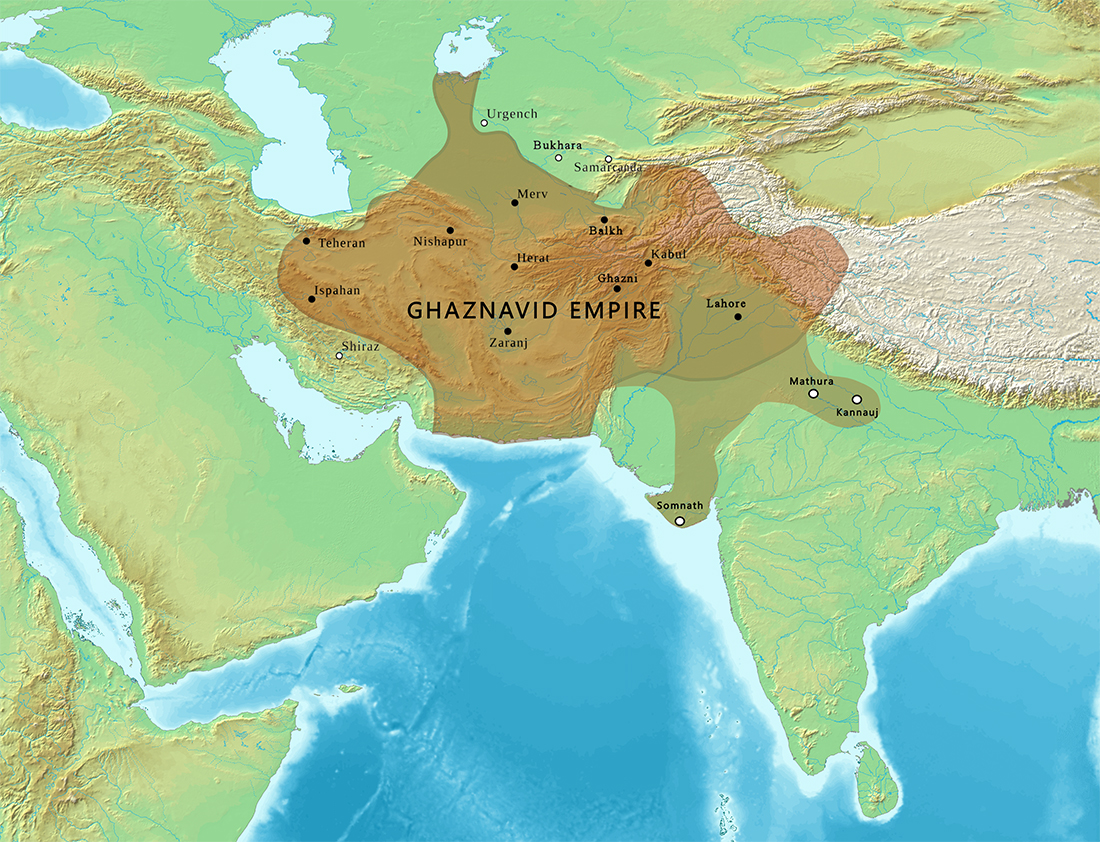
The career of Mahmud of Ghazna is a good example of these developments. The son of a Turkic mamluk, or military slave, who ruled from 998 to 1030, Mahmud was intent on developing his region as an important Islamic state and launched dozens of campaigns against the princes of northern India from his base in Afghanistan. The onslaught was quite successful, for by the twelfth century, the Muslim Ghaznavid dynasty ruled an area that stretched from the Aral Sea in the north to Lahore in the east and encompassed the vital Silk Roads conduit of Khurasan in the southwest (Figure 12.3). The Muslim advance did not end with the establishment of the Ghaznavid state, however. Wars raged across northern India, and by the end of the twelfth century, the remaining independent Indian princes had become fatally weakened. Vulnerable to conquest, the kingdoms of the rajas collapsed.
英語のヒント
こうした展開をよく示すのが、ガズナのマフムードの生涯である。テュルク系のマムルーク、すなわち軍人奴隷の息子として生まれ、998~1030年に統治したマフムードは、自分の地域を重要なイスラーム国家へ発展させようと決意していた。アフガニスタンを拠点に、北インドの王侯たちに対して数十回もの遠征を行った。猛攻は大きな成果を収めた。12世紀までには、ムスリムのガズナ朝は北のアラル海から東のラホールにまで広がる地域を支配し、南西にはシルクロードの重要な通路であるホラーサーンを含んでいた(図12.3)。しかし、ムスリム勢力の進出はガズナ朝の成立で終わらなかった。北インドでは戦争が続き、12世紀末までには、なお独立を保っていたインドの王侯たちも致命的に弱体化した。征服に対して無防備となったラージャたちの王国は崩壊した。
The Ghaznavid Dynasty.ガズナ朝
(credit: “Map of the Ghaznavid Empire” by Unknown, created in DEMIS World Map Server/Wikimedia Commons, CC BY 4.0) · CC BY 4.0
Figure 12.3 At its height, the Ghaznavid Empire encompassed a vast swath of central Asia and included parts of modern Iran, Afghanistan, and the historical region of Turkestan. With several vital trade centers such as Samarkand and Merv, the state for a time played a key role in maintaining Silk Roads connections between the East and West. (credit: “Map of the Ghaznavid Empire” by Unknown, created in DEMIS World Map Server/Wikimedia Commons, CC BY 4.0)
図12.3 最盛期のガズナ帝国は中央アジアの広大な一帯に及び、現在のイラン、アフガニスタン、歴史的なトルキスタンの一部を含んでいた。サマルカンドやメルヴなどの重要な交易拠点を擁し、東西を結ぶシルクロードのつながりを維持するうえで、一時期重要な役割を果たした。(出典:作者不詳、DEMIS World Map Serverで作成/Wikimedia Commons「Map of the Ghaznavid Empire」、CC BY 4.0)
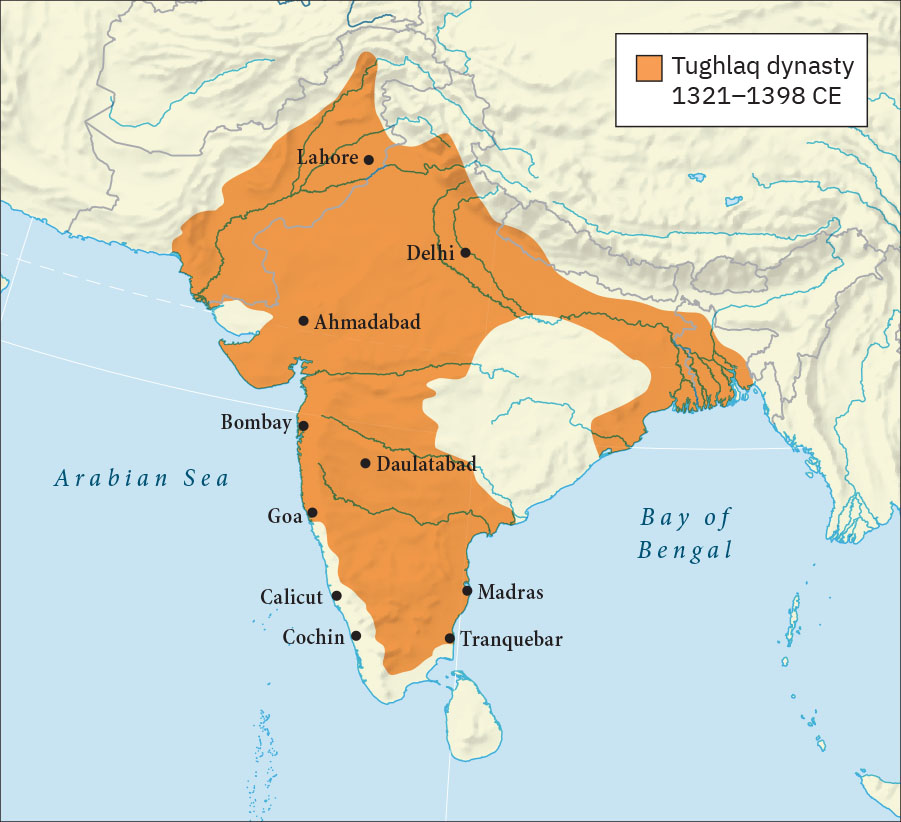
In the twelfth century, a new line of Turkic invaders arose in present-day Afghanistan, led by Muhammad of Ghur (Ghur was an especially important town in the region). A Persian ruler subject to the Ghaznavids, Muhammad declared his independence from Ghazna and conquered most of the lands of his former lords. In 1192, his forces defeated an army of some 100,000 Rajputs, considered Hindu India’s most ferocious warriors, in one of the most violent engagements of his increasingly bloody career. The crowning achievement of Muhammad’s campaigns was establishing a Muslim state at Delhi, deep in the heart of northern India. It endured as the Delhi Sultanate for more than three centuries (1206–1526), during which time it was the center of Islamic India (Figure 12.4).
英語のヒント
12世紀、現在のアフガニスタンで、ゴールのムハンマドに率いられた新たなテュルク系侵入勢力が台頭した。ゴールはこの地域のとりわけ重要な町だった。ガズナ朝に従属していたペルシア系の支配者ムハンマドは、ガズナからの独立を宣言し、かつての主君の領土の大半を征服した。1192年、彼の軍勢は、ヒンドゥー教徒のインドで最も勇猛な戦士とみなされていたラージプート約10万人の軍隊を破った。流血の度を増していく彼の軍歴のなかでも、とりわけ激しい戦闘の一つだった。ムハンマドの遠征の最大の成果は、北インドの奥深く、デリーにムスリム国家を築いたことだった。その国家はデリー・スルタン朝として3世紀以上(1206~1526年)存続し、その間、イスラーム世界に属するインドの中心となった(図12.4)。
The Delhi Sultanate.デリー・スルタン朝
(attribution: Copyright Rice University, OpenStax, under CC BY 4.0 license) · CC BY 4.0
Figure 12.4 The orange shading shows the Delhi Sultanate in 1330, at its greatest extent. Its size allowed it to control much of the Indian Ocean trade on the western side of the subcontinent. However, the absence of larger cities in the center and south-center of the subcontinent meant that Indigenous peoples there were less likely to come into contact with Islam and its practitioners, so this region was not under the control of an Islamic state. (attribution: Copyright Rice University, OpenStax, under CC BY 4.0 license)
図12.4 オレンジ色は、領土が最大に達した1330年のデリー・スルタン朝を示す。その広さにより、亜大陸西側のインド洋交易の多くを支配できた。しかし、亜大陸の中央部と南寄りの中央部には大都市がなかったため、そこに暮らす人々がイスラームやその信徒と接する機会は少なかった。その結果、この地域はイスラーム国家の支配下にはなかった。(帰属:© Rice University、OpenStax、CC BY 4.0)
Thus, through a series of invasions over the course of some five hundred years, Arab and then Turkic invaders made their way into northern India, bringing Islam and stimulating political integration in the process. Because the minority Muslim rulers did not enforce cultural homogeneity, the invasions also strengthened the cultural diversity that was already a hallmark of Indian social order. For example, the Islamic rulers of the sultanate gave Hindu subjects the status of dhimmis, which protected their rights as non-Muslims, although they still had to pay the special tax, the jizya, placed on non-believers. The sultans of Delhi often employed Hindu laborers on construction projects such as the building of mosques, which led Muslims to integrate certain forms of Hindu symbolism and motifs such as trees and plant life into the structures. In the fourteenth century, Sultan Muhammad bin Tughluq expanded and even encouraged Hindu religious freedom, himself participating in Holi, the annual celebration of spring, while he allowed Hindu pilgrimages to the Ganges River, Hinduism’s holiest site.
英語のヒント
このように、およそ500年にわたる相次ぐ侵入を通して、まずアラブ系、次いでテュルク系の侵入者が北インドへ進出し、イスラームをもたらすとともに政治的統合を促した。少数派であるムスリムの支配者は文化を一様にすることを強制しなかったため、侵入は、もともとインドの社会秩序の特徴だった文化的多様性を強めることにもなった。たとえばスルタン朝のイスラームの支配者は、ヒンドゥー教徒の臣民にズィンミーの身分を認めた。この身分は非ムスリムとしての権利を保護したが、彼らは依然として、異教徒に課される特別税ジズヤを納めなければならなかった。デリーのスルタンはモスク建設などの事業にヒンドゥー教徒の労働者をしばしば雇い、その結果、樹木や植物など、ヒンドゥー教に由来する象徴や意匠の一部が建物に取り入れられた。14世紀のスルタン、ムハンマド・ビン・トゥグルクは、ヒンドゥー教の信仰の自由を広げるばかりか、これを奨励した。毎年春を祝うホーリー祭に自ら参加し、ヒンドゥー教で最も神聖な場所であるガンジス川への巡礼を認めた。
Before the arrival of Islam in South Asia, Hinduism was the dominant religion in the subcontinent. The result of a synthesis of beliefs that occurred after the Vedic period of Ancient India (c. 1500–500 BCE) and a response to Buddhism’s commercial and urban influence, Hinduism developed a philosophy and belief system more widely accessible to the rural and agrarian peoples of India. An elaborate universe of Hindu deities was also established that included divinities from other religions, widening Hinduism’s accessibility and appeal. Perhaps most importantly, Hinduism stressed personal devotion to a particular deity to obtain a truly individualized religious experience.
英語のヒント
イスラームが南アジアに到来する前、亜大陸の主要な宗教はヒンドゥー教だった。古代インドのヴェーダ時代(紀元前1500~500年ごろ)の後に起きた諸信仰の融合の産物であり、商業や都市における仏教の影響への応答でもあったヒンドゥー教は、インドの農村の人々や農耕民に、より広く受け入れられる哲学と信仰体系を発展させた。他の宗教の神々も取り込んだ精緻な神々の世界も形成され、ヒンドゥー教の受け入れやすさと魅力は増した。おそらく何より重要だったのは、一人ひとりが特定の神に献身することによって、自分自身の宗教体験を得るという考えを重視したことである。
The Muslim Turks who arrived in India in the twelfth century recognized the Hindus as a protected people, allowing them to practice their own religious traditions and govern individual territories so long as they paid taxes and tribute. Buddhists, however, were not given the same measures of religious freedom, although it is not clear why. They were forced to flee or be executed, and many went to areas of Southeast Asia, Nepal, or Tibet, where Buddhism remains a major religion today. Over time, in the northern areas of the Indian subcontinent, which include modern Pakistan and Bangladesh, many Hindus converted to Islam, which then became the majority religion of the region. In the Vijanagar Empire in southern India, on the other hand, far fewer conversions took place, perhaps due to its distance from the centers of Islam.
英語のヒント
12世紀にインドに到来したムスリムのテュルク系の人々は、ヒンドゥー教徒を保護の対象となる民として認めた。税と貢納を支払うかぎり、自分たちの宗教的伝統を実践し、それぞれの領地を治めることを許した。しかし仏教徒には、理由は明確でないものの、同じ程度の信仰の自由は与えられなかった。彼らは逃亡するか処刑されるかの選択を迫られ、多くが東南アジア、ネパール、チベットへ移った。これらの地域では、今日も仏教が主要な宗教である。やがて、現在のパキスタンやバングラデシュを含む亜大陸北部では、多くのヒンドゥー教徒がイスラームへ改宗し、イスラームが地域の多数派の宗教となった。それに対し南インドのヴィジャヤナガル王国では、イスラームの中心地から遠かったためか、改宗ははるかに少なかった。
In 1221, the province of Khurasan, which had invaded the Punjab in the tenth century, was itself invaded by the Mongols from China, led by Chinggis Khan (often referred to as “Genghis Khan” in the West). The Mongols then turned their attention to the Delhi Sultanate, which managed to successfully weather an attempted Mongol invasion in 1222. Over the next several decades, northern India experienced a series of invasions accompanying renewed Mongol expansion. Although most were repelled, countless Muslims were displaced and resettled on sultanate lands deeper in the subcontinent’s interior.
英語のヒント
10世紀にパンジャーブへ侵入したホラーサーン地方は、1221年には逆に、チンギス・ハン(西洋ではしばしば「Genghis Khan」と呼ばれる)に率いられ、中国からやって来たモンゴル軍の侵入を受けた。モンゴル軍は次いでデリー・スルタン朝へ目を向けたが、スルタン朝は1222年の侵攻の試みを何とか切り抜けた。その後数十年、モンゴル勢力が再び拡大するなかで、北インドは相次ぐ侵入を受けた。大半は撃退されたものの、数え切れないムスリムが住み慣れた地を追われ、亜大陸のさらに内陸にあるスルタン朝領へ移住した。