第12章インド・インド洋世界・東アジアIndia, the Indian Ocean Basin, and East Asia
The Swahili Coast and Indian Ocean Tradeスワヒリ海岸とインド洋交易
Following the decline of the Kingdom of Aksum, the Indian Ocean trade shifted in part to the East African states. Factors that helped elevate the role of maritime trade in this region included improved shipbuilding, the rise of the Umayyad and Abbasid caliphates, the decline of the Tang dynasty—which disrupted overland trade—and even environmental changes such as desertification that made some areas of Africa uninhabitable.
英語のヒント
アクスム王国の衰退後、インド洋交易の一部は東アフリカの諸国へ移った。この地域で海上交易の役割を高めた要因には、造船技術の進歩、ウマイヤ朝とアッバース朝の台頭、陸上交易を混乱させた唐の衰退、さらには、アフリカの一部地域を人の住めない土地にした砂漠化などの環境変化もあった。
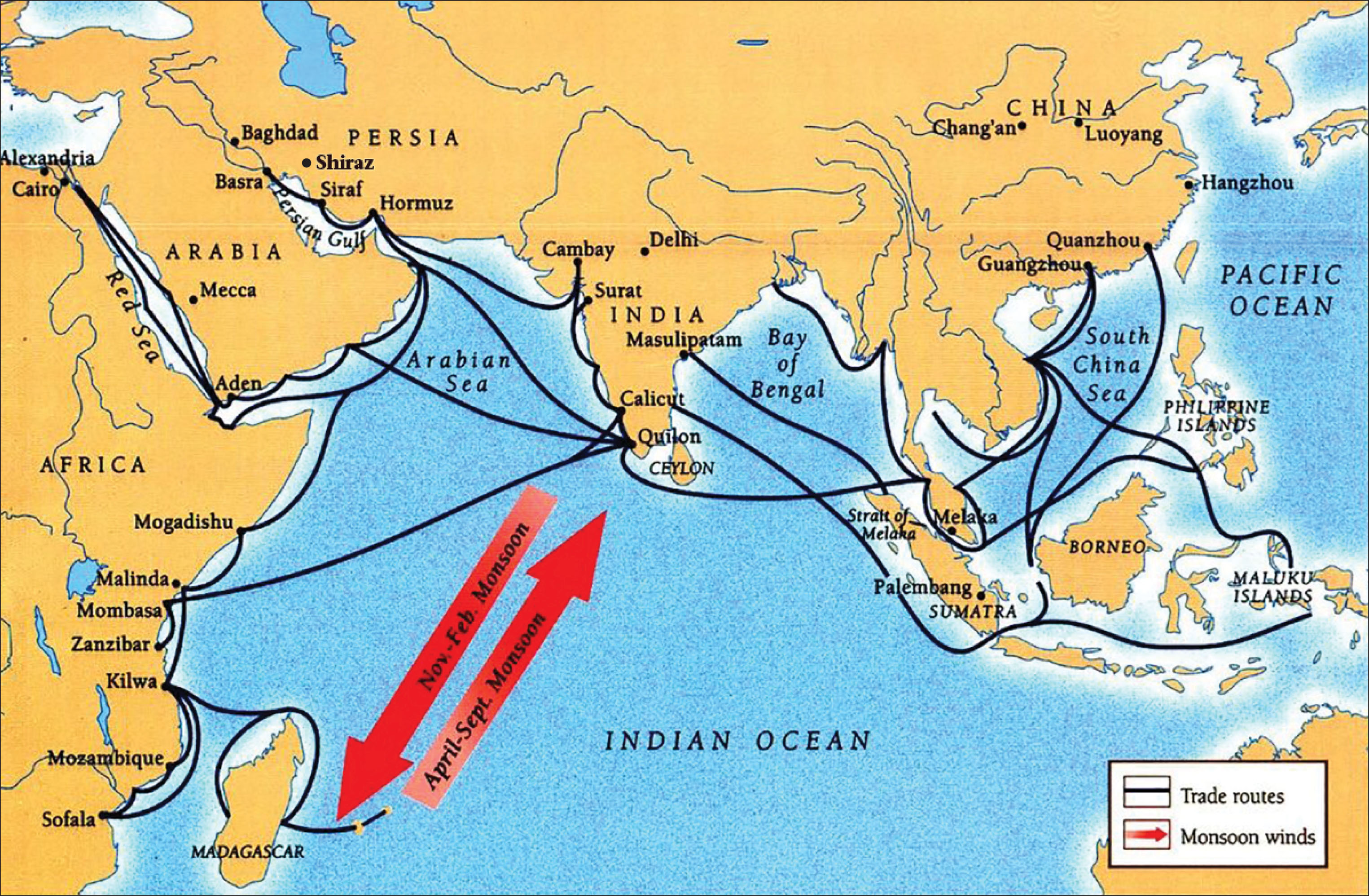
While the Kingdom of Aksum was in decline, the internal migration of Bantu peoples was making its way from Africa’s northwest to its east and southeast. The Bantu brought their language, their cultural traditions, and especially the technology of ironmongering. Many began settling in coastal communities in East Africa, where they displaced or mixed with the Khoisan and other indigenous African peoples, particularly on the coasts of modern Tanzania and Kenya. They also traveled south, establishing many fishing and trading villages. These exported ivory, hides, quartz, and gems in return for cotton, glass, jewelry, and other items the Bantu people were unable to make themselves. Port towns such as Shang and Manda began growing into major port centers. Soon Arab merchants began living among the Bantu peoples to participate in the newly developing trade (Figure 12.23).
英語のヒント
アクスム王国が衰退する一方で、バントゥー系諸民族の大陸内移動は、アフリカ北西部から東部、南東部へと進んでいた。彼らは言語や文化的伝統、とりわけ鉄器製造の技術をもたらした。多くは東アフリカの海岸沿いに定住し始め、特に現在のタンザニアとケニアの沿岸で、コイサン人などアフリカの先住民を押しのけたり、混じり合ったりした。また南にも移動し、多くの漁村や交易村を築いた。これらの村は象牙、獣皮、水晶、宝石を輸出し、引き換えに、バントゥーの人々が自分たちでは作れなかった綿、ガラス、装飾品などを得た。シャングやマンダなどの港町は、主要な港湾拠点へと成長し始めた。やがてアラブ商人も、新しく発展する交易に参加するため、バントゥーの人々の間で暮らすようになった(図12.23)。
The Swahili Coast.スワヒリ海岸
(credit: modification of work “Muslim countries Trade” by Muslim countries/Wikimedia Commons, Public Domain) · Public Domain
Figure 12.23 Key cities along the Swahili coast included Mombasa, Zanzibar, and Kilwa. They were in the path of the monsoon winds and therefore ideally placed to participate in the Indian Ocean trade. (credit: modification of work “Muslim countries Trade” by Muslim countries/Wikimedia Commons, Public Domain)
図12.23 スワヒリ海岸の主要都市には、モンバサ、ザンジバル、キルワがあった。いずれも季節風の通り道にあり、インド洋交易に参加するうえで理想的な位置にあった。(出典:Muslim countries/Wikimedia Commons「Muslim countries Trade」を改変、パブリックドメイン)
Yemeni traders began arriving along the coast in East Africa in the eighth century and settled in such important areas as Mogadishu (in modern-day Somalia) and the island of Zanzibar. Some of the earliest of these traders were the Kharijites, dissidents from Arabia who held very different opinions from the mainstream on the role of the caliph and the centralization of Muslim society. Many settled in Oman; there and in eastern Africa they developed complex networks of exchange with merchant families and villages and towns along the coast. Over time, the Muslim traders married into these families, mixing cultures and languages, particularly those of Arabs, Persians, and the Bantu-speakers of East Africa, and produced the Swahili (from the Arabic for “of the coast”) civilization.
英語のヒント
8世紀、イエメンの交易商が東アフリカ沿岸に来るようになり、モガディシュ(現在のソマリア)やザンジバル島などの重要な地域に定住した。最初期の交易商には、ハワーリジュ派の人々もいた。彼らはアラビアの反主流派で、カリフの役割やムスリム社会の中央集権化について、主流とは大きく異なる考えを持っていた。多くがオマーンに定住し、そこで、また東アフリカで、沿岸の商人家族や村、町を結ぶ複雑な交易網を築いた。やがてムスリム商人はそうした家族と婚姻関係を結び、文化や言語、特にアラブ人、ペルシア人、東アフリカのバントゥー語系の言葉を話す人々の文化と言語が混じり合った。こうしてスワヒリ文明が生まれた。スワヒリの名は、アラビア語で「海岸の」を意味する言葉に由来する。
Thanks to expanding trade with the Muslim world, coastal African traders and port cities from Mogadishu in the north to Sofala in the south adapted to long-distance trade and to Islamic civilization. This adaptation shaped what is known as the Swahili coast, a region of the East African coast dotted by dozens of city-states such as Zanzibar that date from the Middle Ages and served as centers of exchange, particularly of luxury goods.
英語のヒント
ムスリム世界との交易が広がったことで、北のモガディシュから南のソファラに至るアフリカ沿岸の交易商と港湾都市は、遠距離交易とイスラーム文明に適応していった。この適応によって形づくられたのが、スワヒリ海岸として知られる地域である。東アフリカ沿岸のこの地域には、ザンジバルなど中世以来の都市国家が数十も点在し、特に奢侈品の交易拠点となっていた。
After 1050, a new wave of Muslim immigrants arrived from the Iranian capital city of Shiraz and pushed many of the previous settlers farther south along the coast. They retained their Islamic cultural heritage and adopted much of the Bantu language, adding Arabic words and creating the language of Kiswahili, which is today a main language of modern Tanzania. The newcomers were eager to trace their Persian heritage as a means of legitimating themselves in the eyes of the peoples of the area, to which end some even claimed descent from the prophet Muhammad himself. In time, these Shirazi Muslims came to dominate trade along the coast, such as at Mombasa, Malinda, Lamu, and Sofala. Many chose to move onto the islands of the coast, particularly Pemba, Mafia, and Zanzibar. Those who dominated trade and claimed descent from the Middle East were known as patricians.
英語のヒント
1050年以後、イランの首都シーラーズから新たなムスリム移民の波が到来し、それ以前の入植者の多くを海岸沿いにさらに南へ押しやった。新来者はイスラームの文化的伝統を保ちながら、バントゥー系言語を大幅に取り入れ、アラビア語の語彙も加えて、キスワヒリ語を生み出した。この言語は、現在のタンザニアでも主要言語の一つである。新来者は、地域の人々から正統な存在と認められるため、ペルシアにさかのぼる出自を強調した。この目的から、預言者ムハンマド自身の子孫であると主張する者までいた。やがて、こうしたシーラーズ系ムスリムは、モンバサ、マリンディ、ラム、ソファラなど沿岸の交易を支配するようになった。多くは沿岸の島々、特にペンバ、マフィア、ザンジバルへ移る道を選んだ。交易を支配し、中東に出自を持つと称した人々は、パトリシアンと呼ばれた。
About forty new Muslim towns formed, many of them city-states independently ruled by their own sultans. A council of other patricians often served as advisors or sometimes simply ran the town without a sultan. In either case they formed an elite, hereditary merchant class, speaking Arabic or Kiswahili and trading with Africans in the interior for such items as ivory, furs, and gold. Gold came from Sofala, the southernmost settled point at that time, and was shipped to the northern part of the Swahili coast, where it was traded to the city-states and from there to the Indian Ocean trade network. The merchants of the city-state of Kilwa sought to bypass intermediaries and purchase gold directly. They therefore established the trading colony of Sofala in the region of the same name. Mostly due to its domination of the gold trade, Kilwa became the most important of the Swahili towns, although Zanzibar proved nearly as powerful. For periods in the fourteenth century, in fact, Kilwa ruled over many other towns.
英語のヒント
ムスリムの町が約40、新たに生まれた。その多くは、それぞれのスルタンが独立して治める都市国家だった。ほかのパトリシアンから成る評議会が助言役を務めることが多く、ときにはスルタンを置かず、評議会だけで町を運営した。いずれの場合も、彼らは世襲の有力商人層を形成した。アラビア語またはキスワヒリ語を話し、内陸のアフリカ人と、象牙、毛皮、金などを取引した。金は、当時の入植地の南端ソファラからスワヒリ海岸北部へ運ばれた。そこで都市国家の間で売買され、さらにインド洋交易網へ流れた。都市国家キルワの商人は、仲介人を介さず、直接金を買い付けようとした。そのため、ソファラ地方に同名の交易植民地を築いた。主に金交易を支配したことで、キルワはスワヒリの町の中で最も重要になった。ザンジバルも、それにほぼ匹敵する力を示した。実際、14世紀には、キルワがほかの多くの町を支配する時期もあった。
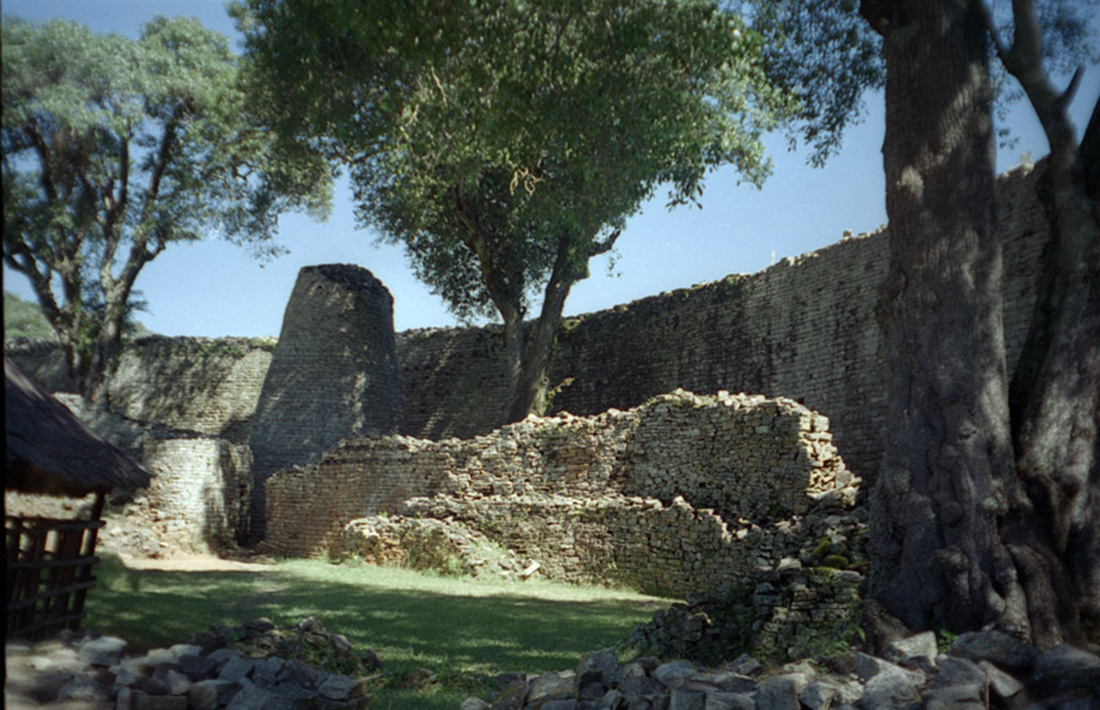
The development of the Swahili city-states also had the effect of connecting the interior of central southern Africa with the wider trade of the Indian Ocean basin. Merchants from city-states such as Sofala, for example, traveled up the Zambezi and Limpopo Rivers to the great fairs that took place on the Zimbabwean plateau, a region dominated by the Bantu peoples of Great Zimbabwe (Figure 12.24). There they exchanged shells, ceramics, and coins from the East African coast for such high-value luxury goods as gold and ivory. Archaeologists have found everything from ancient Indian coins to fourteenth-century Longquan Chinese ceramics in the region of the Zimbabwean plateau, testifying to the reach of Swahili-borne oceanic trade in the African interior.
英語のヒント
スワヒリ都市国家の発展は、アフリカ中南部の内陸を、より広いインド洋の交易圏と結び付ける効果ももたらした。たとえばソファラなどの都市国家の商人は、ザンベジ川やリンポポ川をさかのぼり、ジンバブエ高原で開かれる大きな市へ出向いた。この地域は、グレート・ジンバブエのバントゥー系の人々が支配していた(図12.24)。商人はそこで、東アフリカ沿岸から運んだ貝殻、陶磁器、貨幣を、金や象牙など高価な奢侈品と交換した。考古学者はジンバブエ高原で、古代インドの貨幣から14世紀の中国・龍泉の陶磁器まで、さまざまな品を発見している。こうした発見は、スワヒリの人々が担った海洋交易が、アフリカ内陸のどこまで及んでいたかを示す。
Great Zimbabwe.グレート・ジンバブエ
(credit: “Inside of the Great Enclosure which is part of the Great Zimbabwe ruins” by Jan Derk/Wikimedia commons, Public Domain) · Public Domain
Figure 12.24 Great Zimbabwe was an advanced trade-based civilization established by Bantu speakers between the Limpopo and Zambezi Rivers in the south-central African interior. Shown here are the remains of the one of the walls of Great Zimbabwe. (credit: “Inside of the Great Enclosure which is part of the Great Zimbabwe ruins” by Jan Derk/Wikimedia commons, Public Domain)
図12.24 グレート・ジンバブエは、アフリカ中南部内陸のリンポポ川とザンベジ川の間に、バントゥー語系の言葉を話す人々が築いた、交易を基盤とする高度な文明だった。写真は、グレート・ジンバブエの壁の一つの遺構を示す。(出典:Jan Derk/Wikimedia Commons「Inside of the Great Enclosure which is part of the Great Zimbabwe ruins」、パブリックドメイン)
The Bantu societies of eastern and south-central Africa tended to be more matrilineal than Arabic or Persian societies were. Many Middle Eastern immigrants cemented their power by marrying the daughters of local ruling elites. But eventually a culture began to form in which women in the city-states veiled themselves and lived in separate quarters. Even the smallest city-state had a mosque, and many of these can still be seen today. Many of the more powerful city-states, such as Kilwa, began to mint their own money in the form of copper and silver coins. Generally not used internationally, these coins were nonetheless useful among the coastal people themselves.
英語のヒント
東部および中南部アフリカのバントゥー系社会には、アラブやペルシアの社会よりも強い母系的な傾向があった。中東から来た移民の多くは、現地の支配層の娘と結婚して自らの権力を固めた。しかしやがて、都市国家の女性がヴェールをまとい、男女で住まいの区画を分ける文化が生まれ始めた。最も小さな都市国家にもモスクがあり、その多くは現在も見ることができる。キルワなど有力な都市国家の多くは、銅貨や銀貨の形で独自の貨幣を鋳造し始めた。こうした貨幣は、国際的には一般に使われなかったが、沿岸の人々の間では役立った。
If the merchant ruling class were the elite and upper class, the second class comprised the townspeople, the artisans, clerks, and other non-elite workers. They were generally non-elite because they could not trace their genealogy in a line of descent from Shirazi Muslims. Many non-Muslims also resided in the towns and were even lower in social status, such as servants or other manual laborers.
英語のヒント
商人の支配階級を上層のエリートとすると、第2の階層を構成したのは、町の住民である職人、書記など、非エリートの働き手だった。一般に彼らがエリートではなかったのは、シーラーズ系ムスリムにさかのぼる系譜を示せなかったためである。町には非ムスリムも多く暮らしていた。使用人やその他の肉体労働者など、その社会的地位はさらに低かった。
The lowest class of all were the enslaved, people purchased from the mainland who performed much, if not all, the necessary agricultural labor. Slavery played as much of a role in East Africa at this time as it did in the Atlantic world later, following European colonization of the Americas. Enslaved people also became a key trade item in the Indian Ocean trade route and remained long after the arrival of Portuguese sailors and other Europeans in the sixteenth century. Merchants purchased enslaved Bantu peoples from the interior through African intermediaries; they then shipped them to southern Iraq. During the ninth century, these enslaved people, whom the Muslims called Zanj, labored to drain the swamps near the mouths of the Tigris and Euphrates rivers and to grow sugarcane and rice. But one of the greatest uprisings of enslaved people in history began in 868 when the Zanj rebelled against their enslavers. Although it was eventually crushed in 883, this unrest effectively ended much of the large-scale slave trade between the Swahili coast and the Persian Gulf in this period. The trade in enslaved people continued throughout the Indian Ocean networks, but this form of slavery never again took hold in the Persian Gulf.
英語のヒント
最下層は、アフリカ本土で購入された奴隷化された人々だった。彼らは、必要な農作業のすべてとはいわないまでも、その大部分を担った。当時の東アフリカで奴隷制が果たした役割は、後にヨーロッパ人がアメリカ大陸を植民地化してからの大西洋世界にも匹敵するものだった。奴隷化された人々はインド洋交易路の主要な取引対象にもなり、16世紀にポルトガル人の船乗りなどヨーロッパ人が到来した後も、長くその状態が続いた。商人はアフリカ人仲介業者を通じて、内陸のバントゥー系の人々を奴隷として購入し、イラク南部へ船で運んだ。9世紀、この人々はムスリムからザンジュと呼ばれ、ティグリス川とユーフラテス川の河口付近の湿地を排水し、サトウキビや稲を栽培する労働を担った。しかし868年、ザンジュが奴隷にした側に反乱を起こすと、史上最大級の奴隷反乱が始まった。反乱は883年に最終的に鎮圧されたものの、この動乱によって、この時期のスワヒリ海岸とペルシア湾の間の大規模な奴隷交易は、その多くが事実上終わった。奴隷化された人々の取引はインド洋の交易網全体で続いたが、この形態の奴隷制がペルシア湾で再び根付くことはなかった。
By the twelfth century, East Africa had become a key center of Indian Ocean trade. The combination of monsoon winds that allowed ships to sail toward India in the summer and toward Africa in the winter facilitated the spread of Islam and the unifying culture it created among the merchant classes. Trade-based societies developed along the great arc of land that encircled the Indian Ocean basin. The ivory, animals, skins, rhinoceros’ horns, and gold that played such a large role in this trade came from East Africa to be exchanged for luxuries such as silks, glassware, and tools.
英語のヒント
12世紀までに、東アフリカはインド洋交易の主要な中心地となっていた。夏には船をインドへ、冬にはアフリカへと進ませる季節風の組み合わせが、イスラームの普及と、それが商人層の間に生んだ共通文化の広がりを促した。インド洋を弧状に取り巻く陸地には、交易を基盤とする社会が発達した。交易で重要な位置を占めた象牙、動物、獣皮、サイの角、金は、東アフリカから運ばれ、絹、ガラス製品、道具などの奢侈品と交換された。