第12章インド・インド洋世界・東アジアIndia, the Indian Ocean Basin, and East Asia
A Multicultural South Asia多文化の南アジア
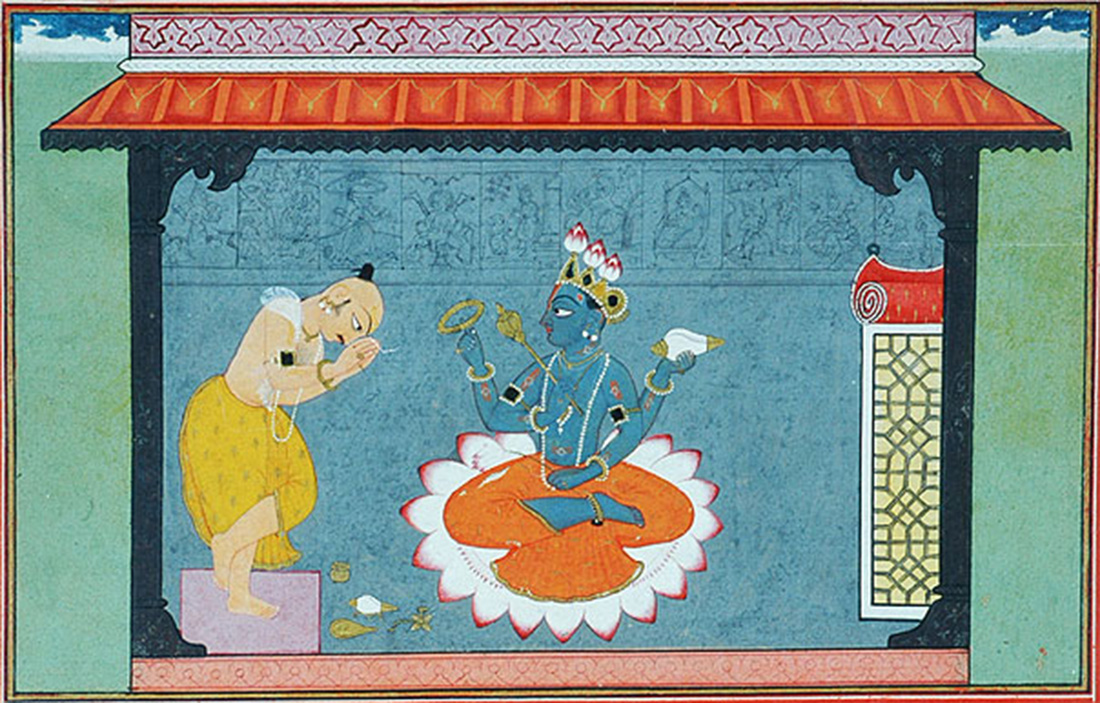
Throughout the decline of the independent principalities of northern India and, ultimately, the conquest of the Delhi Sultanate, the north slowly became increasingly Muslim, while the south retained Hindu cultural beliefs and ideas. By the thirteenth century, Buddhism had diminished as a popular form of worship in India and Hinduism had evolved from a religion in which only priests offered sacrifices to one in which a wider array of people could actively participate. With this change came increased personal devotion to the individual gods, including Vishnu and Shiva (Figure 12.5). Each village usually had a temple in which they were enshrined and worshipped, and various incarnations of the gods developed from these numerous local beliefs. For example, Krishna was an incarnation of Vishnu. Eventually, Vishnu and Shiva came to have consort wives, and their powers could not be activated except through union. Thus, many female deities also came to be worshipped. In contrast, Christianity, Islam, Buddhism, and Confucianism all feature male-centered systems.
英語のヒント
北インドの独立した王侯国が衰退し、最終的にデリー・スルタン朝による征服へ至る過程で、北部では徐々にイスラームが広がった。それに対して南部は、ヒンドゥー教の文化的信仰や思想を保った。13世紀までに、インドでは仏教が広く行われる信仰としては衰退した。他方、ヒンドゥー教は、祭司だけが供犠を行う宗教から、より幅広い人々が積極的に参加できる宗教へと変化した。この変化に伴い、ヴィシュヌやシヴァなど、個々の神への個人的な帰依が強まった(図12.5)。通常、村ごとに神々を祀って礼拝する寺院があり、そうした多数の地方的な信仰から、神々のさまざまな化身が生まれた。たとえばクリシュナはヴィシュヌの化身だった。やがてヴィシュヌとシヴァには配偶神としての妻が伴うようになり、その力は両者の結合によってのみ発揮されるとされた。このため、多くの女神も崇拝されるようになった。これに対し、キリスト教、イスラーム、仏教、儒教はいずれも男性中心の体系を特徴としている。
The Hindu God Vishnu.ヒンドゥー教の神ヴィシュヌ
(credit: “Jaydev worshipping lord Vishnu” by The Government Museum and Art Gallery, Chandigarh/Wikimedia Commons, Public Domain) · Public Domain
Figure 12.5 This eighteenth-century painting on paper shows the poet Jayadeva (left) bowing to Vishnu, the beneficent preserver. Vishnu is one of three major Hindu gods; the others are Brahma (creator of the universe) and Shiva (giver and destroyer of life). (credit: “Jaydev worshipping lord Vishnu” by The Government Museum and Art Gallery, Chandigarh/Wikimedia Commons, Public Domain)
図12.5 18世紀のこの紙本画は、詩人ジャヤデーヴァ(左)が、慈悲深い維持神ヴィシュヌにお辞儀をする姿を描いている。ヴィシュヌはヒンドゥー教の三大神の一柱で、ほかの二柱はブラフマー(宇宙の創造者)とシヴァ(生命を与え、破壊する者)である。(出典:The Government Museum and Art Gallery, Chandigarh/Wikimedia Commons「Jaydev worshipping lord Vishnu」、パブリックドメイン)
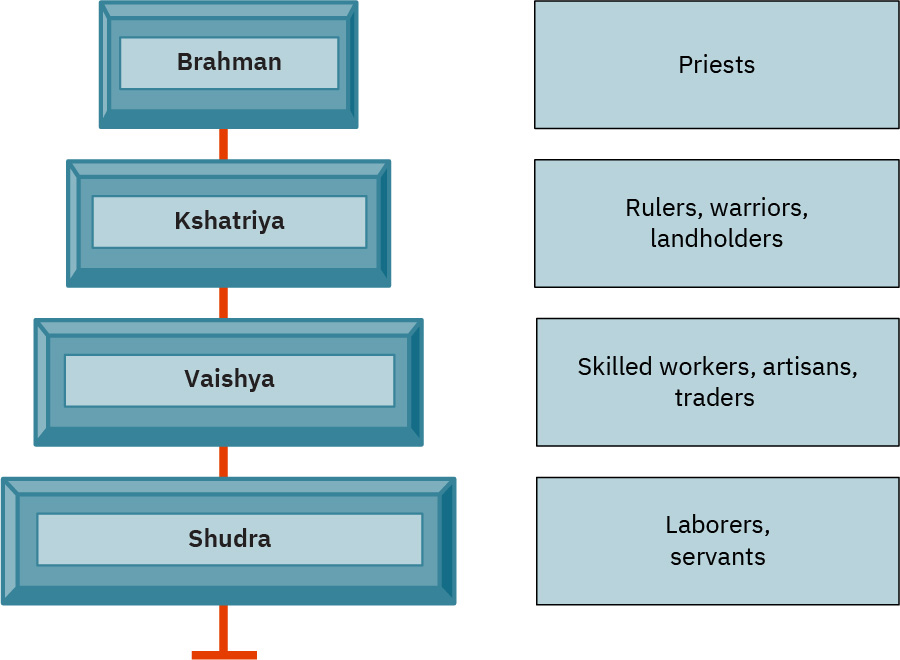
The Hindu religion evolved to become the dominant religion likely because it was a belief system with broader appeal than Buddhism. Originating in the period following the Vedic Age (c. 1500–500 BCE) and evolving over centuries, Hinduism developed from much older traditions, especially those of the Aryan peoples who arrived in India beginning in the third millennium BCE. One particularly distinctive facet of Hindu tradition that originated among these peoples was the Indian caste system. At its origin, the caste system was limited, and all of society was organized into four categories known as varnas. The four major varnas were Brahman (priests), Kshatriya (warriors), Vaishya (merchants and farmers), and Shudra (servile people). In these early days of the system, a person’s varna was determined by their profession but also their dharma—their adherence to proper behaviors for their caste as stipulated by cosmic law, including avoiding contact with lower castes—and the karma they accrued by virtue of their dharma (Figure 12.6).
英語のヒント
ヒンドゥー教が発展して主要な宗教となったのは、おそらく仏教より幅広い人々を引き付ける信仰体系だったためである。ヴェーダ時代(紀元前1500~500年ごろ)に続く時期に生まれ、何世紀もかけて変化したヒンドゥー教は、はるかに古い伝統、とりわけ原文によれば紀元前3千年紀からインドに到来し始めたアーリヤ人の伝統を受け継いでいた。この人々の間に起源をもつ、特に顕著なヒンドゥー教の伝統が、インドのカースト制度だった。当初の制度は限られたもので、社会全体はヴァルナと呼ばれる四つの区分に組織されていた。主要な四つは、バラモン(祭司)、クシャトリヤ(戦士)、ヴァイシャ(商人と農民)、シュードラ(奉仕する人々)である。制度の初期には、個人のヴァルナは職業だけでなく、ダルマと、それに従うことで積み重ねたカルマによっても決まった。ダルマとは、宇宙の法に定められた、自分のカーストにふさわしい行動を守ることであり、下位のカーストとの接触を避けることなどを含んでいた(図12.6)。
Bodhisattvas.菩薩
(credit: “Astasahasrika Prajnaparamita Maitreya Detail” by Unknown/Wikimedia Commons, Public Domain) · Public Domain
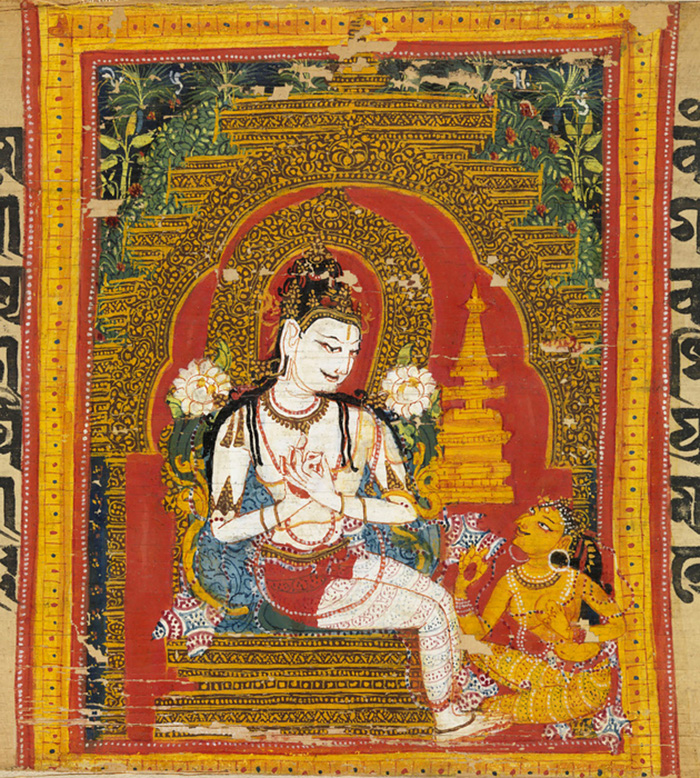
Figure 12.6 In Buddhism, bodhisattvas are people who are seen as spiritually advanced and on the path toward Buddhahood. This detail of a twelfth-century manuscript painting depicts Maitreya, a bodhisattva who, according to Indian tradition, is the teacher of dharma. (credit: “Astasahasrika Prajnaparamita Maitreya Detail” by Unknown/Wikimedia Commons, Public Domain)
図12.6 仏教の菩薩とは、精神的に高い段階に達し、仏となる道を歩んでいるとみなされる存在である。この12世紀の写本画の細部には、インドの伝統でダルマを説く師とされる菩薩、弥勒が描かれている。(出典:作者不詳/Wikimedia Commons「Astasahasrika Prajnaparamita Maitreya Detail」、パブリックドメイン)
Karma worked both ways: A believer’s failure to follow their dharma resulted in negative residue, whereas faithful obedience resulted in positive residue. At the personal level, the incentive behind amassing karma was samsara, the continuance of the soul after death and the soul’s transformation. The more positive karma someone built up, the greater the chances of being reincarnated in a higher varna in the next life—with the ultimate goal being the attainment of moksha, or release from the karmic cycle and the achievement of a complete understanding of the world. If too much bad karma accumulated, on the other hand, the opposite occurred: reincarnation at a lower varna.
英語のヒント
カルマは正負の両方向に働いた。信者がダルマに従わなければ悪い結果が残り、忠実に従えばよい結果が残った。個人にとって、カルマを蓄える動機となったのは輪廻、すなわち死後も魂が続き、姿を変えるという考えだった。よいカルマを多く積むほど、次の生でより高いヴァルナに生まれ変わる見込みは高まった。その究極の目標はモークシャ、すなわち業による輪廻の循環から解放され、世界を完全に理解することだった。それに対し、悪いカルマを蓄えすぎれば、逆に、より低いヴァルナに生まれ変わった。
Yet the ramifications of the caste system went far beyond the personal. Nothing less than the continued existence of the universe was at stake. Adherence to dharma helped ensure the universe remained in balance, while failure to do so risked chaos and destruction. A rigidly hierarchical system of social segregation maintained this belief system. However, the varna communities created by the caste system also provided social support to their members and a vital stabilizing element in an Indian society otherwise rocked by political upheaval, foreign invasion, and war (Figure 12.7).
英語のヒント
しかしカースト制度の影響は、個人の範囲をはるかに超えていた。そこにかかっていたのは、ほかならぬ宇宙の存続そのものだった。ダルマを守れば宇宙の均衡を保つ助けとなり、守らなければ混沌と破壊を招く危険があった。この信仰体系を支えていたのは、厳格な上下関係をもつ社会的な分離の制度だった。その一方で、カースト制度が生み出したヴァルナの共同体は、成員に社会的支援を与え、政治的激変、外からの侵入、戦争に揺さぶられがちなインド社会を安定させる重要な要素にもなった(図12.7)。
The Indian Caste System.インドのカースト制度
(attribution: Copyright Rice University, OpenStax, under CC BY 4.0 license) · CC BY 4.0
Figure 12.7 The Indian caste system was a hierarchical one, with ranked varnas that, in the system’s earliest days, related to a person’s profession. Someone could move up or down within this hierarchy depending on their dharma and their accrual of karma during their lifetime. Still, such mobility came primarily through reincarnation at the end of a person’s life. (attribution: Copyright Rice University, OpenStax, under CC BY 4.0 license)
図12.7 インドのカースト制度には上下関係があり、ヴァルナは序列化されていた。制度の最初期には、それは人の職業と関係していた。人はダルマと生涯に蓄えたカルマに応じて、この階層の上下へ移ることができた。ただし、そのような移動は主として、人生を終えた後の生まれ変わりによって起こるものだった。(帰属:© Rice University、OpenStax、CC BY 4.0)
The basic social unit of Indian society and the focus of life was the extended family, which included parents, grandparents, aunts, uncles, cousins, and in-laws. Most peasant families lived in villages and worked as farmers. Farming was more important than cattle raising for several reasons, not least the prohibition against eating cows. Hindus believe these animals to be sacred but also used them as draft animals on farms. Their manure helped fertilize crops, and their milk was a sustaining element of the Hindu diet. Key crops were rice, millet, wheat, barley, lentils, and peas. The extended family’s large web of relationships encouraged everyone to work together for the betterment of the community. Villages were usually walled, with gates that were shut at night after the farmers returned from the fields.
英語のヒント
インド社会の基本単位であり生活の中心だったのは、両親、祖父母、おじ、おば、いとこ、姻族を含む拡大家族だった。農民の家族の多くは村に住み、農耕に従事した。牛を食べることが禁じられていた点をはじめ、いくつもの理由から、牧畜より耕作の方が重要だった。ヒンドゥー教徒は牛を神聖と考えたが、農場で荷や農具を引かせる役畜としても使った。糞は作物の肥料となり、乳は食生活を支えた。主要な作物は米、キビ類、小麦、大麦、レンズ豆、エンドウだった。拡大家族の広い人間関係の網は、共同体をよりよくするために皆が協力することを促した。村は通常、壁で囲まれ、農民が畑から戻った後、夜になると門が閉じられた。
Like Confucianism in China, Hinduism fostered a patriarchal family structure in which women were subservient. Men were viewed as stronger than women and less governed by their emotions, while older men, due to age and presumed experience, were thought to be wiser than younger men and thus superior to all others. Male domination of Hindu family life was reinforced by the fact that the oldest male was head of the household and might have several wives, who generally came to live with their husband’s parents.
英語のヒント
中国の儒教と同様、ヒンドゥー教は、女性が従属する家父長制的な家族構造を育てた。男性は女性より強く、感情に左右されにくいと考えられた。また年長の男性は、年齢とそれに伴うと想定された経験によって、若い男性より賢明であり、したがって他のすべての人より上位にあるとされた。ヒンドゥー教徒の家族生活における男性支配は、最年長の男性が家長であり、複数の妻をもつ場合もあったことによって強化された。妻たちは一般に、夫の両親と同居するようになった。
Although children often assisted the family in daily work such as farming, in wealthier homes the basics such as reading, writing, and arithmetic might be taught. Daughters were often married at a young age, and finding the ideal husband—who could provide for the family financially—was a key concern. A wife had no life apart from her husband, and if widowed, she might shave her head, sleep on the floor, eat only a single meal a day, and avoid attending family festivals. A wealthier widow, particularly from the Kshatriya or warrior caste, might throw herself on her husband’s funeral pyre in an act of ritual suicide known as sati.
英語のヒント
子どもは農作業など家族の日常の仕事を手伝うことが多かったが、裕福な家庭では読み書きや算術などの基礎を教えられる場合もあった。娘は若くして結婚することが多く、家族を経済的に養える理想的な夫を見つけることが大きな関心事だった。妻の人生は夫から切り離せなかった。寡婦となると、髪をそり、床で寝て、食事を1日1回だけにし、家族の祝い事への出席を避ける場合があった。裕福な寡婦、とりわけクシャトリヤ、すなわち戦士階級の女性は、サティーと呼ばれる儀礼的な自死として、夫の火葬の薪の山に身を投じることもあった。
Toward the end of the Gupta period, in the sixth century, rulers began giving land grants to officials and Brahman priests to help stimulate local economies. Often entire villages were included in the gifts, and their inhabitants came under the control of the grantees. Eventually, land grants were also awarded to temples and monasteries, in the hope that this could encourage wider economic growth and lessen dependence on the central state.
英語のヒント
グプタ時代の終わりに近い6世紀、支配者は地方経済を活性化させるため、役人やバラモンの祭司に土地を与え始めた。村全体が贈与の対象となることも多く、住民は受贈者の支配下に入った。やがて寺院や僧院にも土地が寄進されるようになった。より広い経済成長を促し、中央の国家への依存を減らせると期待されたのである。
Although this was a politically chaotic period, new ideas and belief systems spread and many cultural and technological advances occurred. Improvements in shipbuilding and textile manufacturing stimulated coastal trade, for example, especially in Southeast Asia. Paradoxically, many such developments were the result of the same forces that destabilized India’s politics, for the continual invasions and migrations of foreigners in the north cross-fertilized the region’s cultural base, producing new ideas and practical innovations. The diffusion of ideas was enhanced by India’s annual monsoon winds, which lengthened maritime traders’ exposure to Indian society and culture by preventing those who arrived in summer from returning home until the winter monsoon season.
英語のヒント
政治的には混乱した時代だったが、新しい思想や信仰体系が広まり、文化と技術の多くの進歩が生まれた。たとえば、造船や織物生産の改善は、特に東南アジアの沿岸交易を促した。逆説的にも、こうした発展の多くを生んだのは、インドの政治を不安定にしたのと同じ力だった。北部への外国人の絶え間ない侵入と移住によって、地域の文化的基盤には異なる要素が交じり合い、新しい思想と実用的な革新が生まれたからである。インドの毎年の季節風も、思想の普及を促した。夏に到来した海上交易商は、冬の季節風の季節まで帰郷できず、インドの社会や文化に接する期間が長くなったのである。
One of the most influential and enduring effects of trade was the spread of Buddhism, which began to take hold elsewhere as it competed with, and in some ways reshaped, Hinduism. Many Southeast Asian regions adopted it, from what is now Thailand up to the Mekong Delta in Vietnam and down to Java. By the first century BCE, there were two branches of Buddhism: Theravada (“the path of the elders,” the oldest extant form of Buddhism) and Mahayana (“the greater vehicle”). Mahayana, the larger branch, spread along the great trade routes of Asia into the borderlands of the Parthian Empire, eventually reaching China, Korea, and Japan, where it was gradually infused with local ideas. Theravada Buddhism established itself in Sri Lanka, southern India, and parts of Southeast Asia. Unlike Hinduism, Buddhism did not emphasize the caste system and in many instances opposed it, thus strengthening its influence abroad. It therefore appealed to lower-caste individuals as well. Nonetheless, Hinduism influenced many monarchies, particularly through the concept of dharma. Sanskrit, the written language of India, also spread to many southeast Asian courts, cementing the broad influence of Indian culture.
英語のヒント
交易がもたらした影響のうち、特に大きく長く続いたものの一つが仏教の広まりだった。仏教はヒンドゥー教と競合し、ある面ではその姿を変えながら、他の土地にも根付き始めた。現在のタイからベトナムのメコン川デルタ、さらに南のジャワまで、東南アジアの多くの地域が仏教を受け入れた。紀元前1世紀までには、仏教には上座部(「長老たちの道」で、現存する最古の仏教の形態)と大乗(「大きな乗り物」)の二つの系統があった。より大きな系統である大乗は、アジアの主要交易路を伝ってパルティア帝国の周辺地域へ広がり、やがて中国、朝鮮、日本へ達した。そこでは地域の思想が徐々に取り込まれた。上座部仏教は、スリランカ、南インド、東南アジアの一部に定着した。ヒンドゥー教と異なり、仏教はカースト制度を重視せず、しばしば反対した。このことは国外での影響力を強め、低いカーストの人々をも引き付けた。それでもヒンドゥー教は、とりわけダルマの観念を通じて、多くの王権に影響を与えた。インドの書き言葉であるサンスクリットも東南アジアの多くの宮廷へ広がり、インド文化の幅広い影響を固めた。