第8章古代の南北アメリカThe Americas in Ancient Times
The members of the Council of Four also came from the noble class. The council’s primary task was to select the Aztec emperor, or Huey Tlatoani, from the ranks of the nobility. The emperor occupied a position far above everyone else in Aztec society. His coronation included elaborate rituals, processions, speeches, and performances, all meant to imbue him with enormous power. Even high-ranking nobles were obliged to lie face down in his presence.
英語のヒント
四人評議会の構成員も、貴族階層の出身だった。評議会の主な仕事は、貴族の中からアステカ皇帝、すなわちウェイ・トラトアニを選ぶことだった。皇帝は、アステカ社会の他のすべての人々をはるかに上回る地位にあった。即位式には、手の込んだ儀礼、行列、演説、上演があり、いずれも皇帝に強大な力を帯びさせるためのものだった。高位の貴族でさえ、皇帝の前ではうつ伏せに伏す義務があった。
The Aztec rulers had not always been so powerful or elevated so far above the masses. Their great authority and the ceremony of their office increased with the expansion of the empire. By the coronation of Moctezuma II in 1502, the office of emperor had reached its height, as had the empire. The expansion of the preceding decades had slowed, and demands for tribute and captives for ritual sacrifice were taking their toll and stirring resentment in many corners of the empire. It was into this context that the first Spanish explorers came. They were able to exploit the weaknesses in the empire and eventually bring about a new Spanish-centered order built on top of the old Aztec state.
英語のヒント
アステカの支配者が、常にこれほど強大で、民衆からかけ離れた高い地位にあったわけではない。その大きな権威や地位をめぐる儀礼は、帝国の拡大とともに増していった。1502年にモクテスマ2世が即位するころには、皇帝の地位も帝国そのものも、頂点に達していた。それまで数十年続いた拡大は鈍り、貢納や儀礼的供犠のための捕虜への要求が、帝国の各地に重荷を負わせ、反感をかき立てていた。最初のスペイン人探検者が入ってきたのは、まさにこうした状況だった。彼らは帝国の弱点につけ込み、やがて古いアステカ国家の上に、スペインを中心とする新しい秩序を築くことができた。
The Inca Empireインカ帝国
At around the same time the Aztec Empire was expanding across Mesoamerica, an equally impressive new civilization was on the rise in the Andes region of South America. Known today as the Inca, its cultural and technological roots extend back to the earlier Andean cultures of the Moche, Nazca, and Tiwanaku. The heart of what became the Inca Empire was the city of Cuzco, located more than eleven thousand feet above sea level in the central Andes and northwest of the shores of Lake Titicaca. But centuries before it became an imperial city, it was a relatively modest agricultural community where the predecessors of the Inca farmed potatoes and maize and raised llamas and guanacos.
英語のヒント
アステカ帝国がメソアメリカで拡大していたのとほぼ同じころ、南アメリカのアンデス地域でも、それに劣らず見事な新しい文明が台頭していた。現在インカと呼ばれるこの文明の、文化と技術の起源は、モチェ、ナスカ、ティワナクなど、それ以前のアンデス文化にさかのぼる。インカ帝国となるものの中心は、中央アンデスの、ティティカカ湖岸の北西にある、標高1万1,000フィートを超える都市クスコだった。しかし、帝国の都市となる何世紀も前には、比較的小規模な農村であり、インカの前身となる人々がジャガイモやトウモロコシを育て、リャマやグアナコを飼っていた。
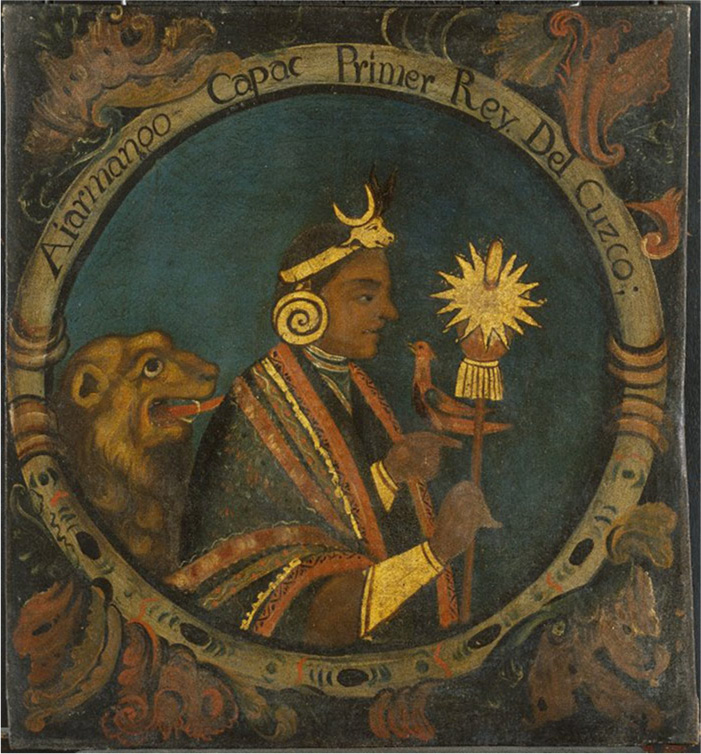
According to one Andean tradition, the origin story of the Inca began with a great flood that displaced four brothers and their wives and sent them on a mission to find fertile land where they could settle. During the journey, one of the brothers acquired incredible and supernatural strength. Consumed with jealousy, the other brothers sealed him in a cave and left him to die. They continued on, somewhat remorseful, but on the outskirts of Cuzco, two were mysteriously turned to stone. This left only one brother, Ayar Manco, who reached Cuzco, dipped his golden cane into the ground, and founded the city (Figure 8.32).
英語のヒント
アンデスのある伝承によると、インカの起源の物語は、大洪水に始まる。洪水で住む場所を失った4人の兄弟とその妻たちは、定住できる肥沃な土地を探す旅に出た。道中、兄弟の1人が、驚くべき超自然的な力を得た。ほかの兄弟は嫉妬にかられ、彼を洞窟に閉じ込め、死ぬに任せた。多少の後悔を抱えながら旅を続けたが、クスコの郊外で、2人が不思議な力によって石に変えられてしまった。残ったのは、アヤル・マンコただ1人だった。彼はクスコにたどり着き、黄金の杖を地面に差し込み、都市を築いた(図8.32)。
Ayar Manco.アヤル・マンコ
(credit: “Manco Capac, First Inca, 1 of 14 Portraits of Inca Kings” by Dick S. Ramsay Fund, Mary Smith Dorward Fund, Marie Bernice Bitzer Fund, Frank L. Babbott Fund, The Roebling Society, The American Art Council, Anonymous, Maureen and Marshall Cogan, Karen B. Cohen, Georgia and Michael deHavenon, Harry Kahn, Alastair B. Martin, Ted and Connie Roosevelt, Frieda and Milton F. Rosenthal, Sol Schreiber in memory of Ann Schreiber, Joanne Witty and Eugene Keilin, Thomas L. Pulling, Roy J. Zuckerberg, Kitty and Herbert Glantz, Ellen and Leonard L. Milberg, Paul and Thérèse Bernbach, Emma and J. A. Lewis, Florence R. Kingdon/Brooklyn Museum/Wikimedia Commons, Public Domain) · Public Domain
Figure 8.32 This eighteenth-century depiction of Ayar Manco, by Inca tradition the founder of the city of Cuzco, names him its first king and shows him with his golden staff. (credit: “Manco Capac, First Inca, 1 of 14 Portraits of Inca Kings” by Dick S. Ramsay Fund, Mary Smith Dorward Fund, Marie Bernice Bitzer Fund, Frank L. Babbott Fund, The Roebling Society, The American Art Council, Anonymous, Maureen and Marshall Cogan, Karen B. Cohen, Georgia and Michael deHavenon, Harry Kahn, Alastair B. Martin, Ted and Connie Roosevelt, Frieda and Milton F. Rosenthal, Sol Schreiber in memory of Ann Schreiber, Joanne Witty and Eugene Keilin, Thomas L. Pulling, Roy J. Zuckerberg, Kitty and Herbert Glantz, Ellen and Leonard L. Milberg, Paul and Thérèse Bernbach, Emma and J. A. Lewis, Florence R. Kingdon/Brooklyn Museum/Wikimedia Commons, Public Domain)
図8.32 インカの伝承でクスコの建設者とされるアヤル・マンコを描いた、18世紀の絵。彼を最初の王と記し、黄金の杖を持つ姿で表している。(出典:「Manco Capac, First Inca, 1 of 14 Portraits of Inca Kings」、Brooklyn Museum、Wikimedia Commons、パブリックドメイン。取得支援:Dick S. Ramsay Fund、Mary Smith Dorward Fund、Marie Bernice Bitzer Fund、Frank L. Babbott Fund、The Roebling Society、The American Art Council、Anonymous、Maureen and Marshall Cogan、Karen B. Cohen、Georgia and Michael deHavenon、Harry Kahn、Alastair B. Martin、Ted and Connie Roosevelt、Frieda and Milton F. Rosenthal、Sol Schreiber in memory of Ann Schreiber、Joanne Witty and Eugene Keilin、Thomas L. Pulling、Roy J. Zuckerberg、Kitty and Herbert Glantz、Ellen and Leonard L. Milberg、Paul and Thérèse Bernbach、Emma and J. A. Lewis、Florence R. Kingdon)
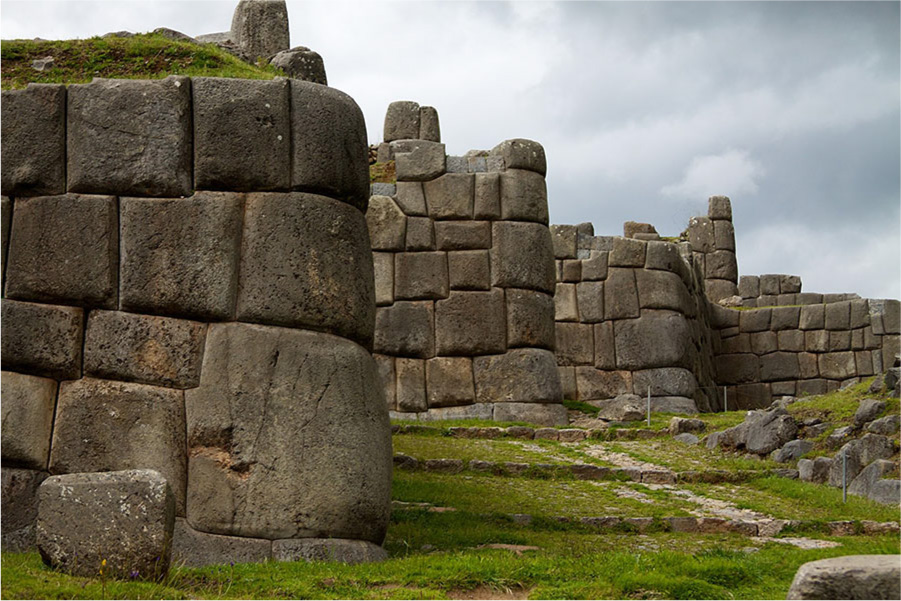
The fantastical story of the Ayar brothers, with its descriptions of magic and supernatural events, is clearly partly fictional, and it is not the only origin myth about the Inca. However, it may preserve a kernel of truth about the early group that founded Cuzco, perhaps after some type of migration prompted by changes in climate. We may never fully know, but based on historical and archaeological evidence, we do know the people of Cuzco emerged as agricultural villagers by around 1000. Through both peaceful and violent means, they assumed a dominant position in the larger surrounding region. Over time, their numbers grew, and they became one of a number of small military powers in the Andean region, centered on the growing city of Cuzco. As master stonemasons, the Inca were capable of carefully carving stones so they fit tightly together (Figure 8.33). At its height in the early sixteenth century, Cuzco was an impressive stone city built high in the Andes.
英語のヒント
魔法や超自然的な出来事を描くアヤル兄弟の幻想的な物語は、明らかに一部が作り話であり、インカについての唯一の起源神話でもない。それでも、クスコを築いた初期の集団について、真実の一端を残しているかもしれない。その集団は、気候の変化に促され、何らかの移住をした後に都市を築いた可能性がある。すべてを知ることは、ついにできないかもしれない。しかし、歴史的・考古学的な証拠から、クスコの人々が1000年ごろまでには農村の住民として現れたことはわかっている。平和的な手段と暴力的な手段の両方を通して、周囲の広い地域で優位な立場を得た。時とともに人口が増え、成長するクスコを中心とする、アンデスの小さな軍事勢力の一つとなった。熟練した石工であったインカの人々は、石がぴったりとかみ合うよう、精密に加工することができた(図8.33)。16世紀初頭の最盛期、クスコは、アンデス高地に築かれた見事な石造都市だった。
Inca Stonework at Sacsayhuamán.サクサイワマンのインカの石組み
(credit: “Peru - Cusco Sacred Valley & Incan Ruins 005 – Sacsaywamán” by McKay Savage/Flickr, CC BY 2.0) · CC BY 2.0
Figure 8.33 While many of the Inca-built parts of Cuzco were destroyed in later centuries, the sixteenth-century site of Sacsayhuamán nearby preserves its ancient walls of stones, so skillfully hewn as to fit together tightly without mortar. (credit: “Peru - Cusco Sacred Valley & Incan Ruins 005 – Sacsaywamán” by McKay Savage/Flickr, CC BY 2.0)
図8.33 インカが築いたクスコの多くの部分は後世に破壊されたが、近郊の16世紀の遺跡サクサイワマンには、古い石壁が残る。石は、モルタルを使わずに隙間なく組み合わさるほど、巧みに切り出されている。(出典:McKay Savage「Peru - Cusco Sacred Valley & Incan Ruins 005 – Sacsaywamán」、Flickr、CC BY 2.0)
The leap to imperial expansion is explained by another Inca legend, this time telling of a military challenge from a rival group known as the Chanka and involving real historical figures. When the Chanka arrived at Cuzco, King Wiraqocha fled the city with his heir, leaving only a small group of nobles aligned with another son, Yupanki, to stand their ground. The defenders’ act of courage inspired the creator god of the Inca to intervene by transforming the surrounding stones into warriors who helped Yupanki defeat the Chanka. In the aftermath of the victory, the story goes on, Yupanki assumed the additional title of Pachacuti, meaning “cataclysm.” But the victory also led to an internal dispute between Pachacuti Yupanki and the reigning king, his father. This was ultimately resolved in Pachacuti Yupanki’s favor, and he assumed control of Cuzco and the Inca, whereupon he began a series of wars of expansion that gave birth to the Inca Empire.
英語のヒント
帝国的な拡大への飛躍は、別のインカの伝説で説明される。今度は、チャンカと呼ばれる敵対集団からの軍事的な挑戦を扱い、実在の歴史上の人物も登場する。チャンカがクスコへ来ると、王ウィラコチャは後継者を連れて逃げた。別の息子ユパンキに味方する少数の貴族だけが残り、踏みとどまった。守備者の勇気に心を動かされたインカの創造神は、周囲の石を戦士に変えて介入し、その戦士たちはユパンキのチャンカ撃破を助けた。物語によると、勝利の後、ユパンキは「大変動」を意味するパチャクティという称号を、さらに名乗った。しかし、勝利は、パチャクティ・ユパンキと、在位中の王である父との内紛も引き起こした。最終的には、パチャクティ・ユパンキに有利な形で決着し、彼はクスコとインカを掌握した。それを受け、一連の拡張戦争を始め、インカ帝国を生み出した。
While this story was partly contrived, there is no doubt that Inca expansion did occur, and Pachacuti appears to have been a real leader. The empire’s growth began in earnest around 1430 during his reign, and as king he oversaw the conquest of much of modern Peru. His successors, Thumpa and Wayna Qhapaq, further expanded the empire by adding territory far to the south in today’s Chile and Argentina, to the east in the edges of the Amazon basin, and to the north in Ecuador and Colombia. These wars were costly in lives and material, but they were also important for sharpening the skills of the Inca military.
英語のヒント
この物語は一部が作られたものだったが、インカの拡大が実際に起きたことは疑いなく、パチャクティも実在の指導者だったようである。帝国の拡大が本格化したのは、彼の治世の1430年ごろで、王として、現在のペルーの大部分の征服を指揮した。後継者のトゥンパとワイナ・カパックは、さらに領土を増やした。南は現在のチリやアルゼンチン、東はアマゾン盆地の縁、北はエクアドルやコロンビアへと広げた。これらの戦争は、人命や物資の面で大きな犠牲を伴ったが、インカ軍の技量を磨くうえでも重要だった。
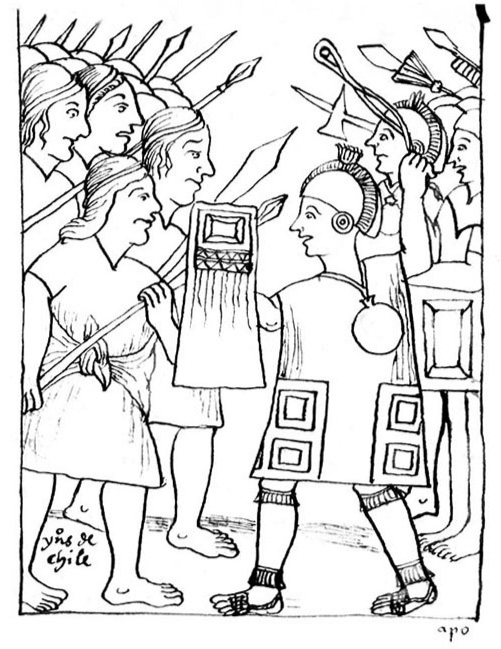
Inca warriors wore helmets and cloth armor, carried shields, and were equipped with weapons like clubs, spears, slings, and axes (Figure 8.34). Typically, they could use their great numbers to overwhelm and awe the enemy into capitulation. If that failed, they rushed into the fray, often with little discipline but with great courageous resolve. Apart from the sheer power of numbers, the Inca military excelled in its ability to move swiftly along the empire’s complicated highland road systems to surprise the enemy and put down any emerging rebellions.
英語のヒント
インカの戦士は、兜と布の鎧を着け、盾を持ち、棍棒、槍、投石紐、斧などの武器を装備した(図8.34)。通常は、兵数の多さによって敵を圧倒し、威圧して降伏させることができた。それでうまくいかなければ、しばしば統制には乏しくとも、強い勇気と決意を持って乱戦に飛び込んだ。数の圧倒的な力だけでなく、インカ軍は、帝国の入り組んだ高地の道路網を素早く移動し、敵を不意打ちにし、起こりかけた反乱を鎮圧する能力にも優れていた。
Inca Soldiers.インカの兵士
(credit: “Huamán Poma de Ayala’s picture of the confrontation between the Mapuches (left) and the Incas (right)” by Unknown/Wikimedia Commons, Public Domain) · Public Domain
Figure 8.34 The Inca armies could use their vast numbers to intimidate rivals into capitulation. In this seventeenth-century image by Huamán Poma de Ayala, a Peruvian chronicler of the Spanish conquest, the Inca soldiers in their feathered helmets are on the right, and their enemy faces them on the left. (credit: “Huamán Poma de Ayala’s picture of the confrontation between the Mapuches (left) and the Incas (right)” by Unknown/Wikimedia Commons, Public Domain)
図8.34 インカ軍は、兵数の多さによって敵を威圧し、降伏させることができた。スペイン人の征服を記録したペルーの年代記作者、ワマン・ポマ・デ・アヤラによる17世紀の図では、羽根飾りの兜をかぶるインカの兵士が右側に、その敵が左側に描かれる。(出典:「Huamán Poma de Ayala’s picture of the confrontation between the Mapuches (left) and the Incas (right)」、Wikimedia Commons、パブリックドメイン)
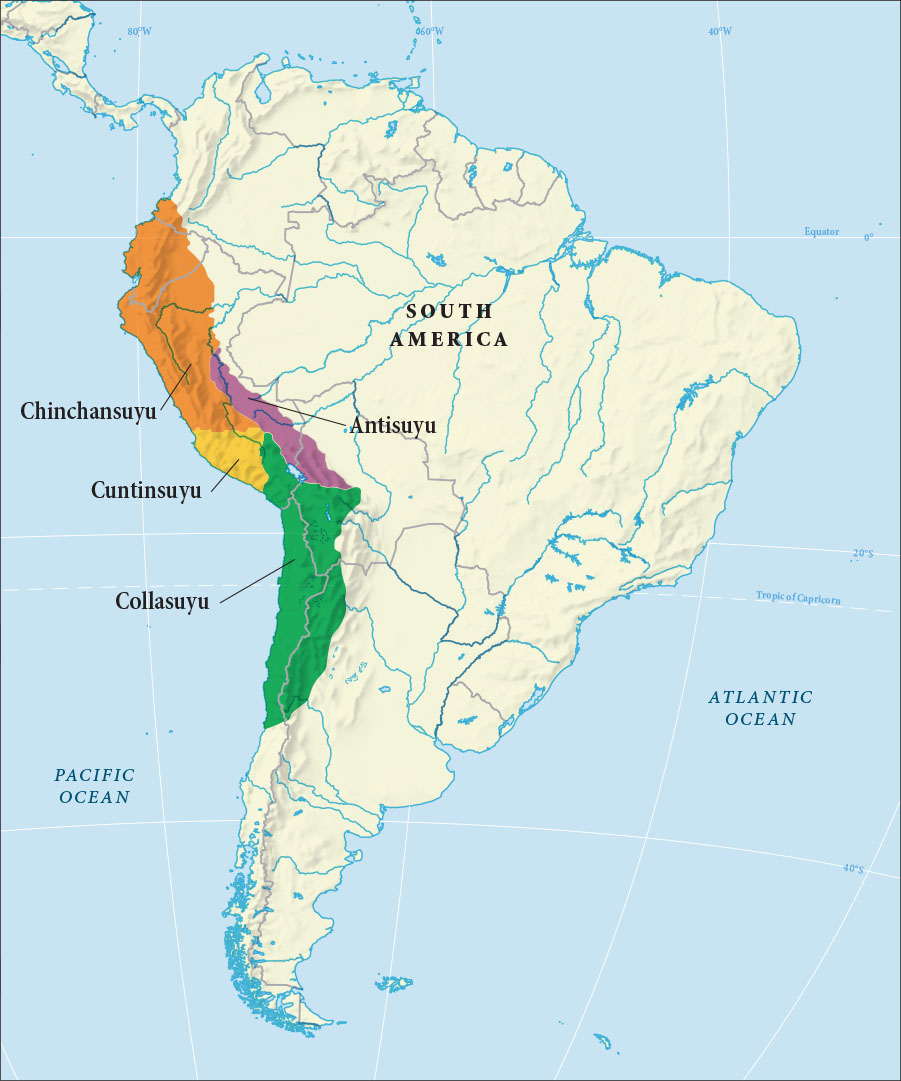
The empire created through conquest was divided into four administrative regions controlled by close relatives of the emperor (Figure 8.35). Each region was then broken down into a number of provinces, organized generally along ethnic lines and ruled by an imperial governor selected from the Inca nobility. A great variety of crops were produced across the empire including potatoes, coca, cotton, and maize. Surpluses were held in large storehouses to feed the armies and provide sustenance in times of famine. The subjects of the empire were also expected to provide labor for the construction of roads, bridges, palaces, and religious structures and to serve as messengers, transport food to storehouses, or serve in the military. Certain members of each household submitted their labor tax while others stayed home to manage the family’s affairs.
英語のヒント
征服によって作られた帝国は、皇帝の近親者が統括する四つの行政区に分けられた(図8.35)。各行政区は、さらにいくつもの属州に分かれた。属州はおおむね民族ごとに組織され、インカの貴族から選ばれた総督が治めた。帝国全体では、ジャガイモ、コカ、綿、トウモロコシなど、多種多様な作物が生産された。余剰は大きな倉庫に蓄えられ、軍を養い、飢饉のときの食料となった。帝国の臣民には、道路、橋、宮殿、宗教建築の建設労働に加わり、使者となり、食料を倉庫へ運び、あるいは軍務に就くことも求められた。各世帯の一定の構成員が労働税を納める間、ほかの人々は家に残り、家族の生活を維持した。
The Inca Empire.インカ帝国
(attribution: Copyright Rice University, OpenStax, under CC BY 4.0 license) · CC BY 4.0
Figure 8.35 At its height in the early sixteenth century, the Inca Empire controlled an enormous area that reached from modern Columbia down into modern Chile and Argentina. It was divided into four administrative regions: Chinchansuyu, Antisuyu, Cuntinsuyu, and Collasuyu. (attribution: Copyright Rice University, OpenStax, under CC BY 4.0 license)
図8.35 16世紀初頭の最盛期、インカ帝国は、現在のコロンビアから南のチリ、アルゼンチンまで届く広大な領域を支配した。帝国は、チンチャイスユ、アンティスユ、クンティスユ、コリャスユの四つの行政区に分かれていた。(出典:© Rice University, OpenStax、CC BY 4.0)
Apart from military violence and an organized imperial administration system, the Inca used religious symbolism to hold their empire together. A complex ritual calendar was overseen by religious experts whom the king and nobles regularly consulted before making political or military decisions. The Inca used human sacrifice in some rituals, but apparently not as readily as the Aztec of Mesoamerica. Among their most important deities was the sky god, who could manifest in a number of different forms such as the creator god Wiraqocha, the thunder god Illapa, and the sun god Inti. Inti was of particular importance because Inca rulers claimed direct descent from him. They constructed temples to Inti around the empire, encouraged his worship, and incorporated representations of conquered peoples into Inti’s key temple in Cuzco. In this way, the Inca cemented stronger ties between their rulers and the large and diverse empire they had created.
英語のヒント
軍事的な暴力と組織的な帝国の行政制度に加え、インカは宗教的な象徴を使って、帝国を一つにつなぎとめた。宗教の専門家が複雑な儀礼暦を管理し、王や貴族は、政治的・軍事的な決定の前に、定期的に彼らの助言を求めた。インカも一部の儀礼で人身供犠を行ったが、メソアメリカのアステカほど、ためらいなく行ったわけではないようである。最も重要な神々の一つに天空神があり、創造神ウィラコチャ、雷神イリャパ、太陽神インティなど、さまざまな姿で現れることができた。インカの支配者は、インティの直系の子孫だと主張したため、インティはとりわけ重要だった。支配者は帝国各地にインティの神殿を築き、その崇拝を奨励し、クスコの主要な神殿には、征服した諸民族を表す像などを取り入れた。こうしてインカは、支配者たちと、彼らの築いた大きく多様な帝国との間の結びつきを、さらに固めた。
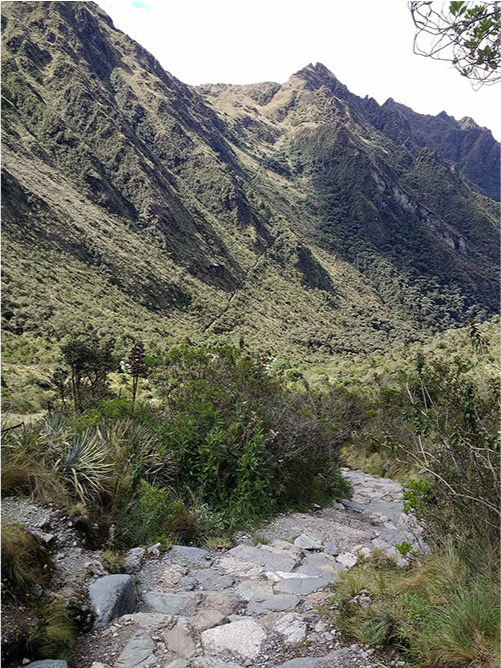
One of the empire’s most important features, and one that held its expansive territory together, were the many roads and bridges that laced through its vast domains. Unlike the Aztec Empire, which expanded across a far more topographically consistent landscape, the Inca Empire included large mountain ranges, canyons, deserts, and narrow coastal valleys. Travel and communication were difficult in this extreme landscape and necessitated a technologically sophisticated road and bridge system. While elements of the network predated the Inca, it was under Inca rule that the larger network was expanded and greatly improved. At the height of the empire, the system may have included as many as twenty-five thousand miles of roads. These roads were as diverse as the landscape itself, including straight passages across flat land, winding paths and staircases around and up mountains, and numerous canyon-spanning bridges made of rope, stone, and wood (Figure 8.37). On them the Inca armies traveled, and goods produced in the provinces made their way to the imperial storehouses.
英語のヒント
帝国の最も重要な特徴の一つであり、広大な領土を一つにつないだのが、領内を網の目のように通る、多数の道路と橋だった。比較的地形の一様な地域へ広がったアステカ帝国とは異なり、インカ帝国には、大きな山脈、峡谷、砂漠、細い海岸の谷が含まれていた。この険しい景観の中では、移動や連絡は難しく、技術的に高度な道路・橋の仕組みが必要だった。道路網の一部はインカ以前からあったが、全体の網が拡張され、大きく改良されたのは、インカの支配下でのことだった。最盛期には、全長2万5,000マイルもの道路があった可能性がある。道路は、地形そのものと同じくらい多様だった。平地をまっすぐ進む道、山を回り、上っていく曲がりくねった道や階段、綱、石、木で造った、峡谷を渡る多数の橋があった(図8.37)。その上をインカ軍が移動し、属州の生産物が帝国の倉庫へ運ばれた。
An Inca Road.インカの道
(credit: “Stone steps and mountains on the Inca Trail” by “Mx._Granger”/Wikimedia Commons, CC0 1.0) · CC0 1.0
Figure 8.37 The mountainous terrain of the Inca Empire necessitated roads like this one to connect the many important cities and regions.(credit: “Stone steps and mountains on the Inca Trail” by “Mx._Granger”/Wikimedia Commons, CC0 1.0)
図8.37 山がちなインカ帝国では、多くの重要な都市や地域を結ぶため、このような道路が必要だった。(出典:「Mx._Granger」「Stone steps and mountains on the Inca Trail」、Wikimedia Commons、CC0 1.0)
Like the Aztec Empire, the Inca Empire had just reached its height on the eve of the Spanish arrival in the early 1530s. Diseases brought by Europeans had already weakened it by then, even leading to the untimely death of Emperor Wayna Qhapaq in 1528. Just a few years later, the Spanish conqueror Francisco Pizarro reached Ecuador with his small army. There he found new Inca subjects eager to ally themselves with a possible enemy of the empire, while the Inca themselves were in the midst of a minor civil war over who would ascend the newly vacated throne. By 1532, the Spanish had entered the conflict and emerged masters of the empire, upon which they constructed their own system.
英語のヒント
アステカ帝国と同じく、インカ帝国も、1530年代初めにスペイン人が到来する直前に、頂点へ達したばかりだった。そのころまでに、ヨーロッパ人が持ち込んだ病気が帝国を弱め、1528年には皇帝ワイナ・カパックの早すぎる死さえ招いていた。そのわずか数年後、スペインの征服者フランシスコ・ピサロが、小さな軍を率いてエクアドルに到着した。そこには、帝国の敵となるかもしれない相手と、進んで手を結ぼうとする、新たにインカの支配下に入った人々がいた。他方、インカ自身は、空位となったばかりの王位に誰が就くかをめぐる、小規模な内戦のさなかにあった。1532年までに、スペイン人はこの争いに加わり、帝国の支配者として台頭した。その上に、自分たちの制度を築いていったのである。