第8章古代の南北アメリカThe Americas in Ancient Times
Early Cultures and Civilizations in South America南アメリカの初期の文化と文明
South of Mesoamerica and north of the Andes lies a dense tropical jungle that long prevented any regular communication or cultural transmission between the two areas. As a result, the early cultures and civilizations in South America developed in different ways and responded to different environmental factors. Neolithic settlements like Norte Chico in today’s Peru had already emerged by 3000 BCE. However, in the centuries following this, others proliferated in the Northern Highlands as well. These include sites known today as Huaricoto, Galgada, and Kotosh, which were likely religious centers for offering sacrifices. There was also Sechin Alto, built along the desert coast after 2000 BCE. Then, around 1400 BCE, groups in the Southern Highlands area around Lake Titicaca (on the border between Peru and Bolivia) began growing in size after adopting agricultural practices. The construction of a large sunken court in this area around 1000 BCE indicates they had their own sophisticated ceremonial rituals.
英語のヒント
メソアメリカの南、アンデスの北には密な熱帯の密林が広がり、長い間、両地域の定期的な交流や文化の伝達を妨げていた。そのため、南アメリカの初期の文化と文明は、異なる環境条件に対応し、独自の発展を遂げた。現在のペルーのノルテ・チコのような新石器時代の集落は、前3000年までにすでに現れていた。その後の数世紀には、北部高地にも集落が数多く生まれた。現在ワリコト、ガルガダ、コトシュと呼ばれる遺跡などがそれにあたり、おそらく供犠を行う宗教的中心地だった。また、前2000年以降には、砂漠の海岸地帯にセチン・アルトが築かれた。さらに、前1400年ごろには、ペルーとボリビアの国境にあるティティカカ湖周辺の南部高地で、農耕を取り入れた集団が規模を増し始めた。この地域で前1000年ごろに大きな半地下式の広場が造られたことは、独自の高度な儀礼を持っていたことを示す。
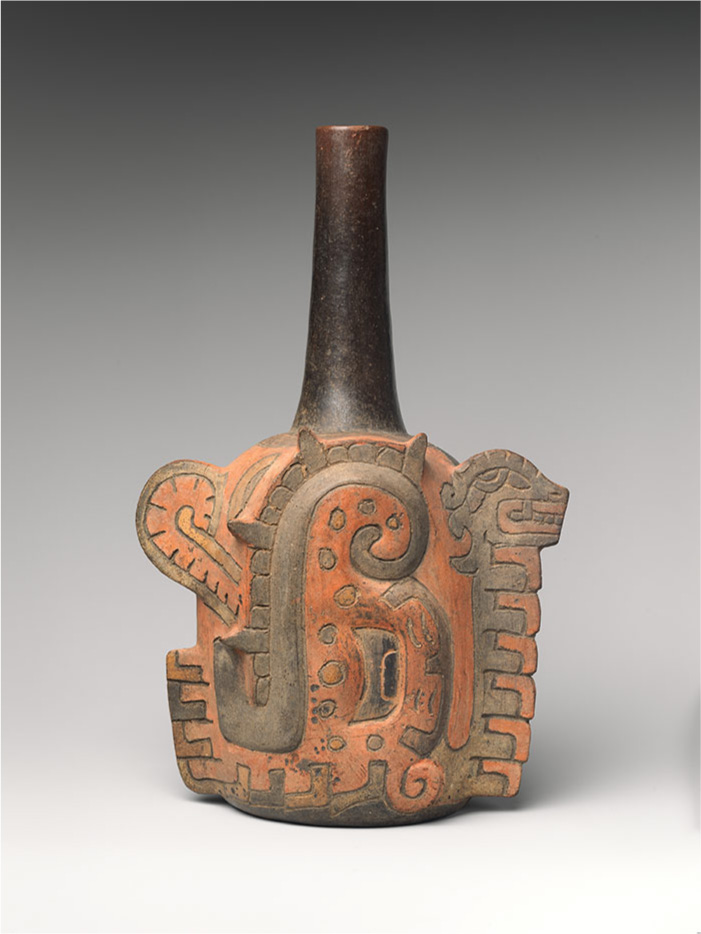
Around 900 BCE, the Andes region experienced a transformation when a single society, often called the Chavín culture, expanded across the entire area, opening what archaeologists call the Early Horizon, or Formative, period. The Chavín culture is known for its distinctive pottery style, which spread throughout the entire region and depicted numerous people, deities, and animals in a flowing and balanced manner (Figure 8.19).
英語のヒント
前900年ごろ、アンデス地域は大きく変化した。一般にチャビン文化と呼ばれる一つの社会が地域全体へ広がり、考古学者が初期ホライズン期、または形成期と呼ぶ時代が始まったのである。チャビン文化は、独特の土器の様式で知られる。この様式は地域全体に広がり、多数の人物、神々、動物を、流麗で均整の取れた形で描いていた(図8.19)。
Chavín Pottery.チャビンの土器
(credit: “Bottle with caiman” by The Michael C. Rockefeller Memorial Collection, Purchase, Nelson A. Rockefeller Gift, 1967/The Metropolitan Museum of Art, Public Domain) · Public Domain
Figure 8.19 The Chavín culture produced a distinctive pottery style. This ceramic piece (c. 1000–800 BCE) shows a stylized caiman, an alligator-like reptile species that inhabits parts of Mexico and South America. (credit: “Bottle with caiman” by The Michael C. Rockefeller Memorial Collection, Purchase, Nelson A. Rockefeller Gift, 1967/The Metropolitan Museum of Art, Public Domain)
図8.19 チャビン文化は独特の土器様式を生み出した。この土器(前1000〜前800年ごろ)には、メキシコや南アメリカの一部に生息する、アリゲーターに似た爬虫類カイマンが、様式化して描かれている。(出典:「Bottle with caiman」、The Michael C. Rockefeller Memorial Collection、1967年Nelson A. Rockefellerの寄贈による購入、メトロポリタン美術館、パブリックドメイン)
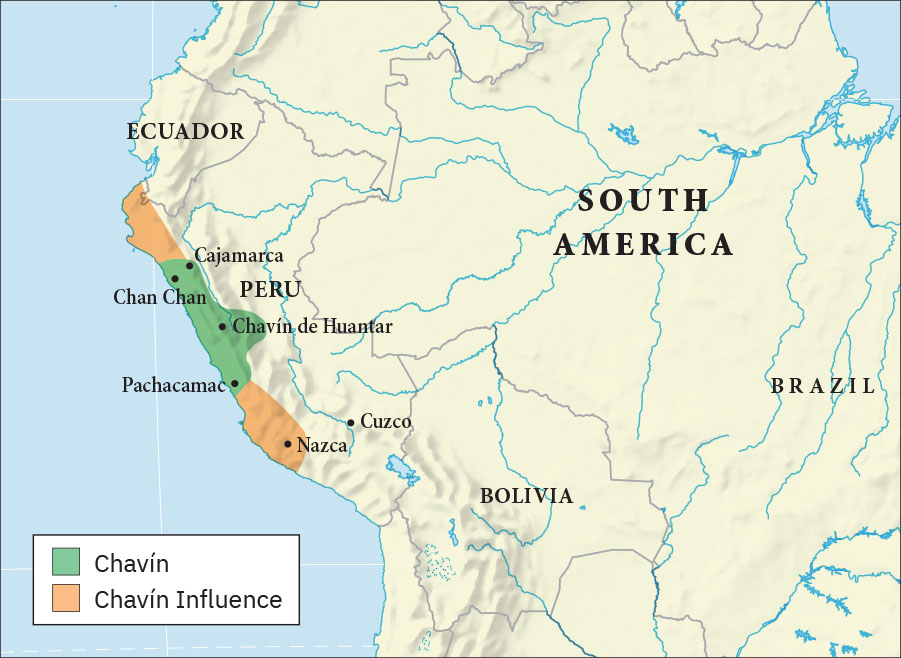
The name Chavín comes from Chavín de Huántar, possibly the culture’s most important religious center. This site is more than ten thousand feet high in the Andes Mountains, to the east of the older Norte Chico settlements. Its dominant architectural feature was its large temple complex, which faced the rising sun and included a maze of tunnels snaking through. Deep within the tunnels was a large sculpture of possibly this culture’s chief deity, called El Lanzón (“great lance”) because of its long lance-like shape. The image of El Lanzón mixes both human and animal features, with flared wide nostrils, bared teeth, long fangs on either side of the mouth, and claws protruding from fingertips and toes. The temple was also decorated with many other sculptures of animals, human heads, and deities bearing the features of both, all probably intended to awe residents and visitors alike.
英語のヒント
チャビンという名は、この文化でおそらく最も重要な宗教的中心地だった、チャビン・デ・ワンタルに由来する。この遺跡は、アンデス山中の標高1万フィートを超える場所にあり、より古いノルテ・チコの集落群の東に位置する。建築上の最も目立つ特徴は、昇る太陽に面した大きな神殿群で、内部には迷路のように曲がりくねる通路があった。通路の奥深くには、おそらくこの文化の主神を表す大きな彫像があった。細長い槍のような形から、エル・ランソン(「大きな槍」)と呼ばれる。広がった大きな鼻孔、むき出しの歯、口の両側の長い牙、手足の指先から突き出す爪など、人間と動物の特徴を組み合わせた姿である。神殿にはほかにも、動物、人間の頭、両方の特徴を持つ神々など、多数の彫刻が飾られていた。いずれも、住民にも訪問者にも、畏怖の念を抱かせる意図があったと考えられる。
The inhabitants of Chavín de Huántar numbered about twenty-five hundred by 200 BCE as it slipped into decline. The site’s importance lay in its role as a religious or ceremonial site, not as a population center. But by around 400 BCE, the Chavín religion and culture had spread far and wide across the Andes region. Whether these influences were transmitted by trade or warfare is unclear. Eventually, however, they replaced other architectural and artistic styles and burial practices. Innovations in textile production and metalworking in gold, silver, and copper also proliferated around the region. Craftspeople in towns and villages produced textiles and metal objects, and traders moved them from place to place along improved routes and with the aid of llamas as pack animals (Figure 8.20).
英語のヒント
チャビン・デ・ワンタルが衰退しつつあった前200年までに、住民は約2,500人となっていた。この場所の重要性は、人口の集中地であることよりも、宗教や儀礼の場としての役割にあった。前400年ごろまでには、チャビンの宗教と文化は、アンデス地域の広い範囲に伝わっていた。その影響が交易と戦争のどちらによって伝わったのかは、はっきりしない。しかし、やがて、ほかの建築・美術の様式や埋葬慣行に取って代わった。織物の生産や、金・銀・銅の金属加工の革新も、地域全体に広がった。町や村の職人が織物や金属製品を作り、商人たちは、整備された道を通り、荷役動物のリャマを使って、それらを各地へ運んだ(図8.20)。
Chavín Culture and Its Influence.チャビン文化とその影響
(attribution: Copyright Rice University, OpenStax, under CC BY 4.0 license) · CC BY 4.0
Figure 8.20 Between about 900 and 200 BCE, the Chavín culture exerted a strong influence over much of what is today coastal and Andean Peru. (attribution: Copyright Rice University, OpenStax, under CC BY 4.0 license)
図8.20 前900年ごろから前200年ごろまで、チャビン文化は、現在のペルーの海岸地帯とアンデス地域の広い範囲に、強い影響を及ぼした。(出典:© Rice University, OpenStax、CC BY 4.0)
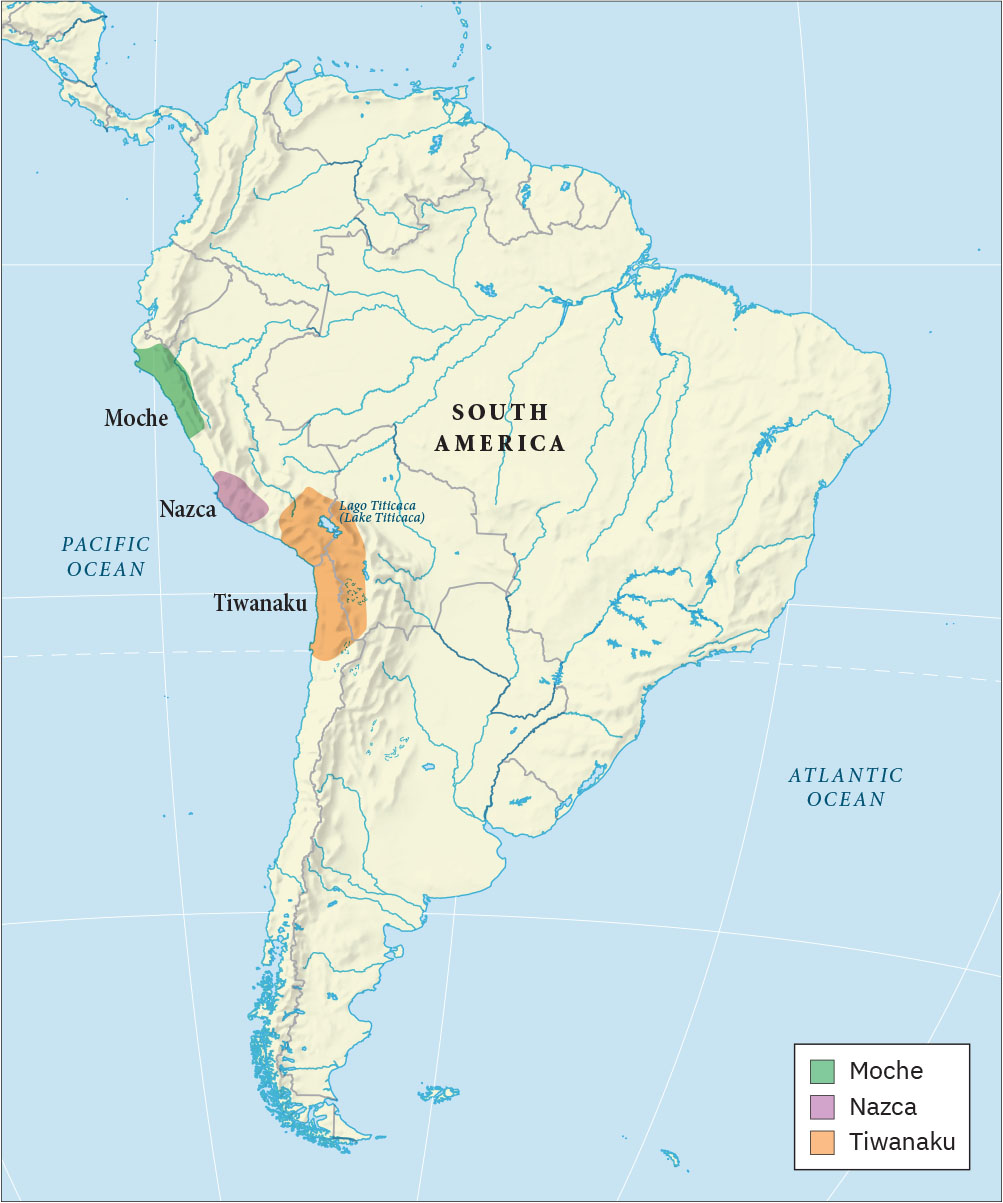
Beginning around 200 BCE, the influence of Chavín cultural styles and religious symbols began to wane. This came at a time of increased regional warfare among many groups, evidenced by the increasing use of defensive features like walls around settlements. The broader Chavín-influenced region then fragmented into a number of regional cultures that grew to full-fledged civilizations like the Moche, Nazca, and Tiwanaku (Figure 8.21).
英語のヒント
前200年ごろから、チャビンの文化様式や宗教的象徴の影響は衰え始めた。このころ、多くの集団の間で地域的な戦争が増えていた。集落を囲む壁など、防御施設が増えたことが、その証拠である。その後、チャビンの影響を受けていた広い地域は、いくつもの地域文化に分かれた。それらは、モチェ、ナスカ、ティワナクのような、本格的な文明へと成長した(図8.21)。
Moche, Nazca, and Tiwanaku Cultures.モチェ、ナスカ、ティワナクの文化
(attribution: Copyright Rice University, OpenStax, under CC BY 4.0 license) · CC BY 4.0
Figure 8.21 The Moche and Nazca civilizations both emerged around 200 BCE in different parts of what had formerly been Chavín areas of influence. The Tiwanaku civilization also traces its roots back to about 200 BCE, but its major building period started around 100 CE. (attribution: Copyright Rice University, OpenStax, under CC BY 4.0 license)
図8.21 モチェ文明とナスカ文明は、ともに前200年ごろ、かつてチャビンの影響下にあった別々の地域で生まれた。ティワナク文明の起源も前200年ごろにさかのぼるが、その大規模な建築の時代は100年ごろに始まった。(出典:© Rice University, OpenStax、CC BY 4.0)
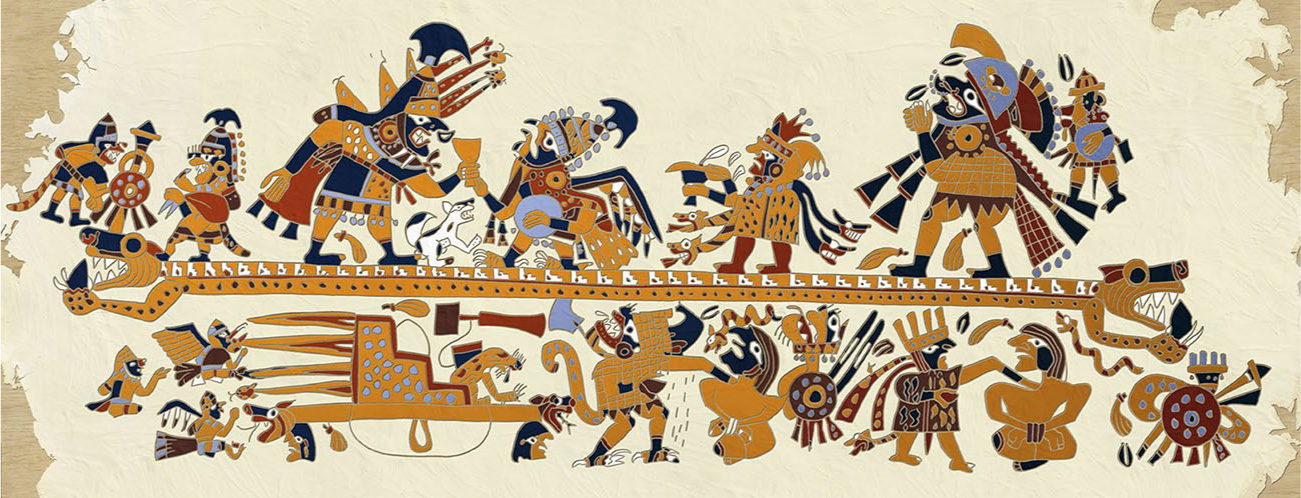
The Moche civilization emerged in northern Peru and made major settlements with large pyramid-style architecture at Sipán, Moche, and Cerro Blanco. Its people were agriculturalists with a keen knowledge of irrigation technology, which they used to grow squash, beans, maize, and peppers. They were also a highly militaristic society; their art depicts warriors in hand-to-hand combat, scenes of torture, and other forms of physical violence (Figure 8.22). The Moche formed a politically organized state with a sophisticated administration system. Their cities and burial practices reflect a hierarchical organization, with powerful divine kings and families of nobles ruling from atop large pyramids. Below these two tiers was a class of many bureaucrats who helped manage the state. Near the bottom of the social order were the large numbers of workers, agricultural and otherwise, who lived in the many agricultural villages controlled by the elite.
英語のヒント
モチェ文明はペルー北部に現れ、シパン、モチェ、セロ・ブランコに、大きなピラミッド状の建築を備えた主要な集落を築いた。人々は灌漑技術に優れた農耕民で、それを使って、カボチャ、豆、トウモロコシ、トウガラシを育てた。同時に、モチェは非常に軍事的な社会でもあった。美術には、白兵戦を行う戦士、拷問の場面、その他の身体的暴力が描かれる(図8.22)。モチェは、政治的に組織され、高度な行政制度を持つ国家を形成していた。都市や埋葬慣行には、社会の階層構造が表れている。強大な神聖王と貴族の家系が、大きなピラミッドの上から統治していた。その二つの階層の下には、国家運営を助ける多数の官僚の階層があった。社会の下層に近い位置には、農業をはじめとする多くの働き手がおり、支配層が統制する多数の農村で暮らしていた。
The Moche at War.戦争とモチェ
(credit: “Mural de la cultura Moche” by SCALA/Wikimedia Commons, CC0 1.0) · CC0 1.0
Figure 8.22 The Moche commanded a highly militaristic state that used war as well as ceremonial violence to subjugate surrounding populations. This colorful reproduction of a scene originally painted on a piece of Moche pottery (300–700 CE) shows a ceremony in which a Moche lord hands a cup to a high priest (top) as bound prisoners endure bloodletting at the hands of their captors (bottom). (credit: “Mural de la cultura Moche” by SCALA/Wikimedia Commons, CC0 1.0)
図8.22 モチェは、戦争と儀礼的な暴力を用いて周囲の住民を服従させる、非常に軍事的な国家を支配した。この色彩豊かな複製画は、もともとモチェの土器(300〜700年)に描かれた場面を再現したもの。上段ではモチェの君主が高位の神官に杯を渡し、下段では捕らえた者たちが、縛られた捕虜の血を流させている。(出典:SCALA「Mural de la cultura Moche」、Wikimedia Commons、CC0 1.0)
Far to the south of the Moche, along the dry coast of southern Peru, were the Nazca, whose culture also emerged around 200 BCE. While the terrain there is parched, with rainfall virtually unknown in some areas, the rivers that carry water from the mountains provided the Nazca with sufficient water for irrigation. Unlike the Moche in their large cities, the Nazca people lived mostly in small villages. However, they maintained important ceremonial sites like Cahuachi, where villagers made pilgrimages and witnessed elaborate fertility and other rituals.
英語のヒント
モチェからはるか南、ペルー南部の乾いた海岸地帯には、同じく前200年ごろに生まれたナスカ文化があった。一部の地域では、ほとんど雨が知られていないほど乾燥していたが、山地から流れ下る川が、灌漑に十分な水をもたらした。大きな都市に暮らしたモチェとは異なり、ナスカの人々は主に小さな村で暮らしていた。それでも、カワチのような重要な儀礼の場を維持しており、村人はそこへ巡礼し、豊穣を祈るものなど、手の込んだ儀礼を目にした。
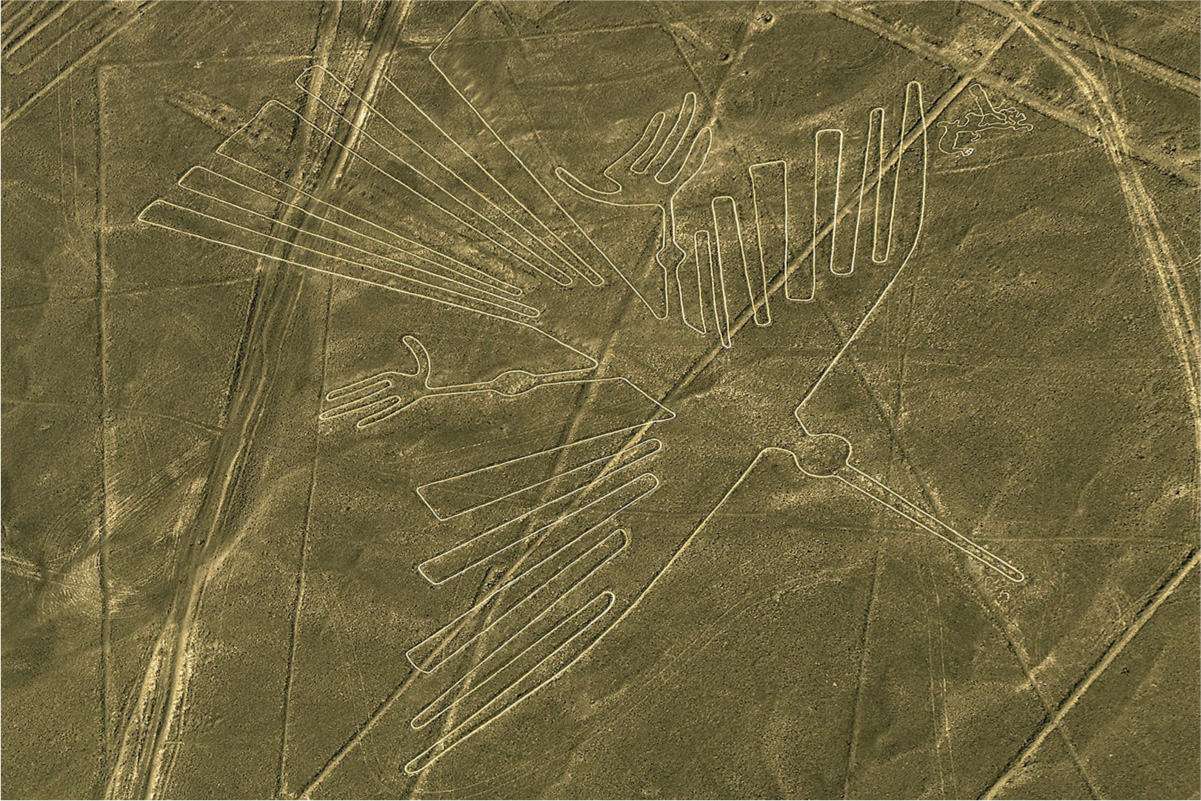
Politically, the Nazca may have adopted a type of confederation made up of a number of important families. Apart from many human-altered hills, called huacas, they also left behind hundreds of geoglyphs, large artistic representations imprinted in the dry desert ground. These are sometimes referred to as the Nazca Lines, and they can be either geometric patterns or images of animals like birds, fish, lizards, and cats (Figure 8.23). Some are as large as twelve hundred feet long and were created by clearing stones away from the desert floor to reveal the different-colored ground beneath.
英語のヒント
政治面では、ナスカは、いくつかの有力な家系から成る、連合のような仕組みを採用していた可能性がある。人の手で形を変えた、「ワカ」と呼ばれる多数の丘のほか、乾いた砂漠の地面に描いた、大きな図像である地上絵も何百と残した。これらは「ナスカの地上絵」と呼ばれ、幾何学模様の場合もあれば、鳥、魚、トカゲ、ネコなどの動物を描く場合もある(図8.23)。長さが1,200フィートに達するものもある。砂漠の表面の石を取り除き、その下にある色の異なる地面を露出させて作られた。
Nazca Lines.ナスカの地上絵
(credit: “The Condor” by Roger Canals/Wikimedia Commons, CC0 1.0) · CC0 1.0
Figure 8.23 Between 200 BCE and 600 CE, the Nazca in modern southern Peru created massive images of animals and other shapes like this bird by moving rocks to reveal the different-colored desert floor beneath. (credit: “The Condor” by Roger Canals/Wikimedia Commons, CC0 1.0)
図8.23 前200年から600年の間、現在のペルー南部に暮らしたナスカの人々は、岩を動かし、その下の色の異なる砂漠の地面を露出させることで、この鳥のような、動物などの巨大な図像を作った。(出典:Roger Canals「The Condor」、Wikimedia Commons、CC0 1.0)
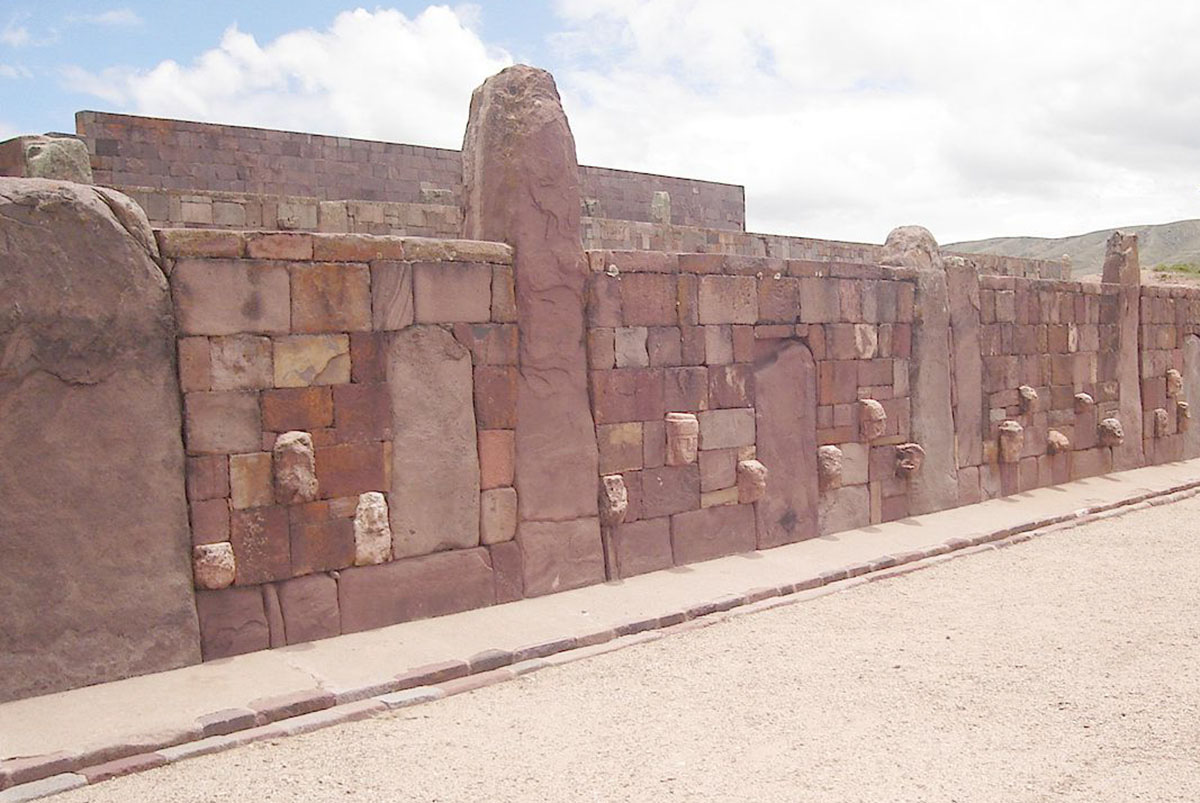
Whereas the Nazca lived in the arid coastal desert, the Tiwanaku civilization thrived high in the mountains near Lake Titicaca. Like the Moche and Nazca societies, this culture emerged in the wake of the collapse of Chavín culture around 200 BCE. Beginning around 100 CE, it entered a period of sustained building at its key city of Tiwanaku. There, residents built two large stone structures topped by additional buildings and carved stone artwork. A signature feature of the structures at Tiwanaku is the many “trophy heads” that poke out from among the stone blocks (Figure 8.24). Noting the different facial features on each head, some scholars have concluded that they represent important ancestors of the Tiwanaku elite or possibly the gods of various conquered groups.
英語のヒント
ナスカが乾燥した海岸の砂漠に暮らしたのに対して、ティワナク文明は、ティティカカ湖に近い高い山地で栄えた。モチェやナスカと同じく、この文化も、前200年ごろのチャビン文化の崩壊に続いて現れた。100年ごろからは、中心都市ティワナクで建設が継続的に行われる時代に入った。住民は二つの大きな石造建築を築き、その上にさらに建物や石の彫刻を置いた。ティワナクの建造物を特徴づけるのは、石のブロックの間から突き出す、多数の「戦利品の頭部」である(図8.24)。頭部ごとに顔立ちが違うことに注目した一部の研究者は、ティワナクの支配層の重要な祖先か、征服したさまざまな集団の神々を表しているのではないかと結論づけている。
Tiwanaku “Trophy Heads.”ティワナクの「戦利品の頭部」
(credit: modification of work “Tiwanaku23” by Alexson Scheppa Peisino (AlexSP)/Wikimedia Commons, Public Domain) · Public Domain
Figure 8.24 So-called trophy heads decorate the face of this wall built between the third and sixth centuries CE at Tiwanaku, near Lake Titicaca between Bolivia and Peru. (credit: modification of work “Tiwanaku23” by Alexson Scheppa Peisino (AlexSP)/Wikimedia Commons, Public Domain)
図8.24 ボリビアとペルーの間にあるティティカカ湖近くのティワナクで、3〜6世紀に築かれたこの壁の表面には、いわゆる「戦利品の頭部」が飾られている。(出典:Alexson Scheppa Peisino(AlexSP)「Tiwanaku23」を改変、Wikimedia Commons、パブリックドメイン)
At its height, the city supported perhaps as many as forty thousand people and oversaw at least four smaller cities in the surrounding area. It may even have been the center of a type of imperial system, with colonies on both the Pacific coast and the eastern side of the Andes. To support Tiwanaku and the other related cities, the people irrigated massive fields with a network of canals to grow potatoes. They also raised domesticated llamas and used them as pack animals for long-distance trade.
英語のヒント
最盛期には、この都市はおそらく4万人もの人口を支え、周囲の少なくとも四つの小都市を統括していた。太平洋岸とアンデスの東側の双方に植民地を持つ、帝国的な仕組みの中心だった可能性さえある。ティワナクと関連する都市を支えるため、人々は水路網で広大な農地を灌漑し、ジャガイモを栽培した。また、家畜化したリャマを育て、長距離交易で荷物を運ぶ動物として使った。
Tiwanaku survived until about 1000 CE and may have declined as the water level in Lake Titicaca rose to flood its farmland. The other civilizations of this period—the Moche and the Nazca—had disappeared long before, between 500 and 600 CE, for reasons that likely included environmental transformations. Other Andean civilizations emerged in their wake, including the Wari of the highlands of southeastern Peru and the Chimor of coastal Peru. These later groups built upon the earlier cultures’ innovations in agriculture, art, manufacturing, and trade. While Wari declined around 800 CE, Chimor survived into the fifteenth century. It was only in the 1400s that Chimor was conquered by a new and expanding imperial system, the Inca.
英語のヒント
ティワナクは1000年ごろまで存続したが、ティティカカ湖の水位が上がり、農地が水没したために衰退した可能性がある。この時代のほかの文明、モチェとナスカは、それよりはるか前の500〜600年の間に姿を消していた。その理由には、環境の変化が含まれていたと考えられる。その後、ペルー南東部の高地のワリや、海岸地帯のチムーなど、ほかのアンデス文明が現れた。これらの集団は、先行する文化が生み出した、農業、美術、製造、交易の革新を受け継いで発展した。ワリが800年ごろに衰退したのに対し、チムーは15世紀まで存続した。チムーが、新しく拡大を続ける帝国、インカに征服されたのは、1400年代に入ってからだった。