第8章古代の南北アメリカThe Americas in Ancient Times
North America in the Formative Period形成期の北アメリカ
The earliest complex societies in North America began to emerge in the Ohio River valley around 1000 BCE, at the start of the Formative period, when mound-building cultures with large populations in the Eastern Woodlands became more common.
英語のヒント
北アメリカ最初の複雑な社会は、形成期の始まる前1000年ごろ、オハイオ川流域に現れ始めた。このころ、東部森林地帯では、大きな人口を抱え、土塁や墳丘を築く文化が、広く見られるようになった。
Mound-Building Cultures in the Eastern Woodlands東部森林地帯のマウンド築造文化
The mound-building culture of the Ohio River valley area is often referred to as the Adena, after a mound excavated in 1901 in Ross County, Ohio. This and the hundreds of others discovered in the area were burial sites. They started small, with the burial of one or two important people, but grew over time as more were buried and more earth was used to cover them. Some of the mounds had a large circular ditch surrounding them and logs lining the interior. Evidence of postholes indicates that structures once stood there as well, suggesting the locations may have been meeting or ceremonial spots. The bodies of the dead themselves were often decorated with red ocher and other pigments. Grave objects included jewelry, weapons, stone tools, marine shells, and pipes for smoking kinnikinnick (a mixture of leaves and bark) and perhaps tobacco (Figure 8.25).
英語のヒント
オハイオ川流域のマウンド築造文化は、1901年にオハイオ州ロス郡で発掘された墳丘にちなみ、一般にアデナ文化と呼ばれる。この墳丘と、周辺で発見された何百もの墳丘は、埋葬の場だった。最初は重要な人物を1人か2人葬る小さな墓だったが、埋葬する人が増え、その上に土をかぶせるにつれて、大きくなっていった。墳丘の中には、大きな円形の溝で囲まれ、内側に丸太を並べたものもあった。柱穴の痕跡から、かつて建物もあったことがわかり、集会や儀礼の場所だった可能性がある。遺体そのものも、しばしば赤色顔料のオーカーなどで飾られた。副葬品には、装身具、武器、石器、海の貝殻、そして、キニキニック(葉と樹皮の混合物)や、おそらくタバコを吸うためのパイプがあった(図8.25)。
Owl-Effigy Pipe.フクロウ形パイプ。
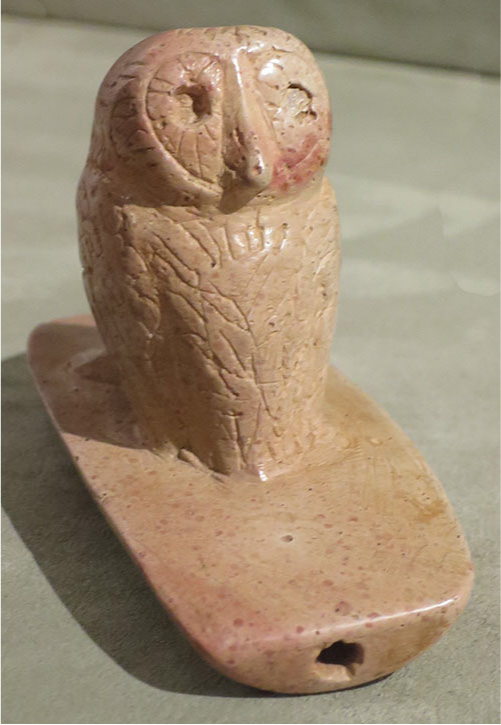
(credit: “Owl effigy pipe” by “Wmpearl”/Wikimedia Commons, CC0 1.0) · CC0 1.0
Figure 8.25 This stone owl-effigy pipe is held by the Dayton Art Institute, which dates it to about 900–1300 CE. (credit: “Owl effigy pipe” by “Wmpearl”/Wikimedia Commons, CC0 1.0)
図8.25 この石製のフクロウ形パイプはデイトン美術館の所蔵品で、同館は900〜1300年ごろの制作としている。(出典:「Wmpearl」「Owl effigy pipe」、Wikimedia Commons、CC0 1.0)
Communities of mound builders in the valley remained small at first, sometimes erecting no more than a couple of structures. The mounds themselves were also relatively small when compared with those of later cultures like the Hopewell tradition, a civilization that emerged around 200 BCE and eventually spread across the Eastern Woodlands through a common network of trade routes. Named for a large earthwork complex occupying 130 acres in today’s Ohio, the Hopewell tradition emerged around 200 BCE and is one of the most impressive of many of this period in the Woodlands. The site encloses thirty-eight different mounds within a large earthen D-shaped rectangle. The largest are three conjoined mounds; before centuries of erosion occurred, together they measured about five hundred feet wide and thirty feet high. Large platforms once supported wooden structures and were likely used for ritual purposes.
英語のヒント
流域でマウンドを築いた共同体は、初めのうちは小さく、建物を2棟ほどしか建てない場合もあった。墳丘そのものも、後のホープウェル文化などと比べると、比較的小さかった。ホープウェル文化は前200年ごろに現れ、共通の交易路網を通じて、やがて東部森林地帯全体に広がった。現在のオハイオ州にある、130エーカーに及ぶ大きな土塁群にちなんで名づけられたホープウェル文化は、前200年ごろに生まれた、この時代の森林地帯の文化の中でも、特に見事なものの一つである。この遺跡では、大きなD字形の土塁が、38基の異なる墳丘を囲んでいる。最大のものは、三つがつながった墳丘である。数世紀にわたる浸食が起きる前には、全体で幅約500フィート、高さ約30フィートあった。大きな基壇は、かつて木造の建物を支えており、儀礼に使われた可能性が高い。
Another Hopewell site located near Newark, Ohio, is equally impressive, with earthen enclosures, mounds, and an observation circle all organized to align with the movement of the moon and likely used to predict lunar eclipses and other seasonal events. Building such mounds with the available technology would have been a labor-intensive task and indicates the culture responsible was highly organized.
英語のヒント
オハイオ州ニューアークの近くにある、別のホープウェルの遺跡も、それに劣らず見事である。土の囲い、墳丘、円形の観測施設が、月の動きに合うように配置されており、おそらく月食や季節の出来事を予測するために使われた。当時使えた技術でこのようなマウンドを築くことは、多大な労働力を要する仕事だったはずである。それは、築造を担った文化が、高度に組織されていたことを示している。
The mound complexes were used for ceremonial purposes and do not appear to have been the site of urban settlements. Instead, most people of the Hopewell culture lived in small dispersed communities consisting of only a few extended families. They employed both hunter-gatherer strategies and the cultivation of domesticated plants like sunflowers and bottle gourds. Neighboring groups likely came together to participate in hunting, gathering, and religious events at their ceremonial sites. Religious traditions included the veneration of ancestors, such as those buried in the mounds.
英語のヒント
マウンド群は儀礼のために使われたもので、都市的な居住地だったようには見えない。むしろ、ホープウェル文化の大部分の人々は、少数の拡大家族から成る、分散した小共同体で暮らしていた。狩猟採集と、ヒマワリやヒョウタンなどの栽培植物の栽培を、両方行っていた。近隣の集団は、おそらく儀礼の場に集まり、狩猟、採集、宗教行事に参加した。宗教的伝統には、墳丘に葬られた人々など、祖先への崇敬が含まれていた。
Different communities from the wider area buried their dead leaders in the same mounds, likely as a way to establish symbolic connections across kin groups. Evidence from sites like the one at Newark suggests that ceremonies for burial and veneration were probably connected to seasonal changes and important astronomical observations. The items deposited in the mounds included a number of artistic depictions of animals like beavers, bears, dogs, cats, and even supernatural mixtures of these. These likely had symbolic importance for the individual kin groups and were connected to both their religious practices and specific ancestral ceremonies.
英語のヒント
広い地域の異なる共同体が、亡くなった指導者を同じ墳丘に葬っていた。おそらく、親族集団どうしの象徴的なつながりを築く方法だった。ニューアークなどの遺跡の証拠からは、埋葬や崇敬の儀礼が、季節の変化や重要な天文観測と結びついていたことがうかがえる。墳丘に納められた品には、ビーバー、クマ、イヌ、ネコ、さらにはそれらを混ぜ合わせた超自然的な存在などを描いた、多くの作品があった。これらは、おそらく各親族集団にとって象徴的な意味を持ち、宗教実践や、特定の祖先に関わる儀礼と結びついていた。
Politically, the settlements of the Hopewell tradition were decentralized and mostly egalitarian. The leadership structure of individual kin groups may have revolved around shamans or shamanistic practices, but there were no powerful rulers. There were, however, some divisions of labor based on specialization, including healers, clan leaders, and those who possessed certain spiritual qualities necessary for interpreting astronomical signs, preparing burials, and preserving important religious traditions. Ceremonial objects made of copper, bone, stone, and wood and shaped into bird claws and totem animals aided shamanistic figures in their duties and were often buried with them. Items within the mounds also provide evidence of extensive long-distance trading. Those discovered in the Ohio River valley include copper from Lake Superior, quartz from Arkansas, mica from the Appalachian region, marine shells from the Gulf coast, and obsidian from as far away as the Rocky Mountains. Trade in these objects was carried out by individuals moving along rivers or the networks of village paths.
英語のヒント
政治的には、ホープウェル文化の集落は分権的で、おおむね平等主義的だった。各親族集団の指導の仕組みは、シャーマンやシャーマニズムの実践を中心に成り立っていた可能性があるが、強力な支配者はいなかった。それでも、専門性による分業はあった。治療者、氏族の指導者、天文の徴候を読み取り、埋葬を準備し、重要な宗教的伝統を守るために必要な、特別な霊的資質を持つ人々などである。銅、骨、石、木で作り、鳥の爪やトーテム動物の形にした儀礼の品が、シャーマンの役割を果たす人々を助け、しばしば彼らとともに埋葬された。墳丘の中の品々は、広範囲の長距離交易の証拠でもある。オハイオ川流域で発見されたものには、スペリオル湖の銅、アーカンソーの水晶、アパラチア地方の雲母、メキシコ湾岸の海の貝殻、遠くロッキー山脈から来た黒曜石が含まれる。こうした品の交易は、川や、村々をつなぐ道の網を移動する個人によって行われた。
The Hopewell tradition settlements began to decline in the fourth century CE, evidenced by a waning of mound building and trade. The precise reason is not clear, but larger kin group alliances may have broken down as a result of underlying religious issues. Beginning around 600, groups in the Midwest built a number of so-called effigy mounds. These are earthen mounds formed in the image of animals like wolves, bears, snakes, and birds. Like many earlier mounds, the effigy mounds were also burial sites, but they usually contained only a few individuals. In comparison to the earlier Hopewell mounds, they were generally constructed with less labor and in a shorter amount of time, possibly by just a few dozen people working for a few days.
英語のヒント
ホープウェル文化の集落は4世紀に衰退し始めた。マウンドの築造や交易が減ったことが、その証拠である。正確な理由は明らかでないが、根底にある宗教的な問題によって、大きな親族集団の同盟が崩れた可能性がある。600年ごろから、中西部の集団はいくつもの「エフィジー・マウンド」を築いた。オオカミ、クマ、ヘビ、鳥などの姿をかたどった土の塚である。以前の多くのマウンドと同じく埋葬の場だったが、通常は少数の人しか納められていなかった。初期のホープウェルのマウンドに比べ、一般に少ない労力と短い期間で造られた。数十人が数日働くだけで築いた可能性もある。