第8章古代の南北アメリカThe Americas in Ancient Times
8.1 Populating and Settling the Americas8.1 南北アメリカへの移住と定住
Learning Objectives学習の目標
By the end of this section, you will be able to:
この節を学び終えると、次のことができるようになる。
Identify patterns of early migration to the Americas
南北アメリカへの初期の移住がどのように進んだかを説明する。
Describe the lifestyles of people living in Archaic America
南北アメリカのアルカイック期に暮らした人々の生活様式を述べる。
Explain how and when the Neolithic Revolution occurred in different regions of the Americas
南北アメリカの各地域で、新石器革命がいつ、どのように起きたかを説明する。
Ancestral humans like Homo erectus migrated out of Africa almost two million years ago and made their way around Asia, the Near East, and Europe. But so far, no solid evidence has placed them in the Americas. It was only with the rise of Homo sapiens that the populating of the Americas began. Exactly when this occurred is not clear, but it likely started around eighteen thousand years ago at the earliest. Within a few thousand years, modern humans had expanded in small numbers around North America, Central America, and South America. There they developed their own agricultural traditions, independent of those that emerged in the Near East, China, and Africa. They also established a range of unique cultural traditions and later a number of sophisticated civilizations characterized by refined religious practices, monumental architecture, large urban populations, and in some cases, writing systems.
英語のヒント
ホモ・エレクトスのような初期の人類は、約200万年前にアフリカを出て、アジア、近東、ヨーロッパへ移動した。しかし、これまでのところ、彼らが南北アメリカにいたことを示す確かな証拠はない。南北アメリカへの人類の移住が始まったのは、ホモ・サピエンスが現れてからだった。それが正確にいつだったのかは明らかではないが、早くとも約1万8,000年前に始まったと考えられる。数千年のうちに、現生人類は少人数ずつ北アメリカ、中央アメリカ、南アメリカ各地へ広がった。そこで、近東、中国、アフリカで生まれたものとは独立して、独自の農耕の伝統を発展させた。また、さまざまな独自の文化的伝統を築き、後には、洗練された宗教実践、記念碑的な建築、多数の都市住民、場合によっては文字体系を特徴とする、高度に発達した文明をいくつも成立させた。
Populating the Americas南北アメリカへの人類の移住
About eighteen thousand years ago, the last glaciation period was entering its peak stage, and sea levels globally were far lower than they are today. It was likely during this period that the first Homo sapiens reached the Americas, crossing the then-existing land bridge between modern Alaska and Russia known as Beringia. Beringia has since been consumed by rising waters and now lies under the Bering Strait. But then it was a low-lying land of sand dunes and spotty vegetation. It is possible that Homo sapiens had lived there for thousands of years before venturing into North America, but solid evidence for that theory has not yet been found.
英語のヒント
約1万8,000年前、最後の氷期は最も寒冷な段階を迎えつつあり、世界の海面は現在よりはるかに低かった。おそらくこの時期に、最初のホモ・サピエンスが南北アメリカに到達した。当時は現在のアラスカとロシアの間に、ベーリンジアと呼ばれる陸橋があり、人々はそれを渡った。その後、海面の上昇によってベーリンジアは水没し、現在はベーリング海峡の海底にある。しかし当時は、砂丘とまばらな植生の広がる低地だった。ホモ・サピエンスは北アメリカへ踏み出す前に、数千年にわたってそこで暮らしていた可能性もあるが、この説を裏づける確かな証拠はまだ見つかっていない。
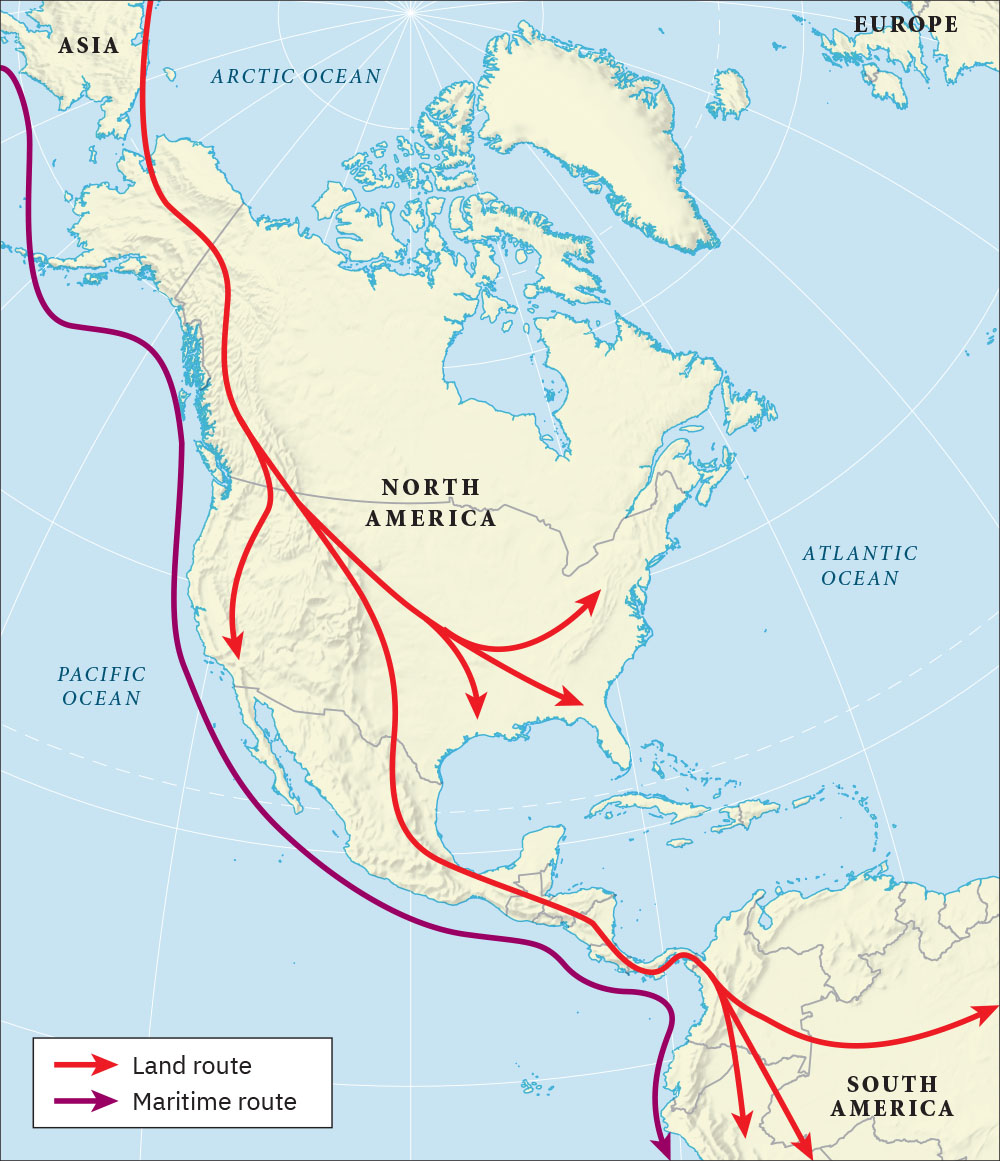
Regardless of how long humans lived in Beringia or when they crossed, they began spreading farther south into the Americas as the glacial ice retreated. They made their way through a corridor between two melting ice sheets and spread out in waves into what is now the continental United States. Some made their way to the western coast. Others migrated into the northeast and southeast regions. Still others made their way through the center of the continent into modern Mexico, Central America, and South America. By around fifteen thousand years ago at the earliest, human populations had reached as far as the tip of South America and were living throughout the Western Hemisphere (Figure 8.4).
英語のヒント
人類がベーリンジアでどれほど長く暮らし、いつ渡ってきたにせよ、氷河が後退するにつれて、人々は南北アメリカのさらに南へ広がり始めた。解けつつある二つの氷床の間の通路を進み、何度もの移動の波となって、現在のアメリカ合衆国本土にあたる地域へ分散していった。西海岸へ進んだ人々もいれば、北東部や南東部へ移った人々もいた。さらに別の人々は、大陸の中央部を通って、現在のメキシコ、中央アメリカ、南アメリカへ向かった。早ければ約1万5,000年前までに、人々は南アメリカの先端にまで到達し、西半球の各地で暮らしていた(図8.4)。
The Populating of the Americas.南北アメリカへの人類の移住
(attribution: Copyright Rice University, OpenStax, under CC BY 4.0 license) · CC BY 4.0
Figure 8.4 While the precise method of migration is unclear and still debated, it seems certain that by around fifteen thousand years ago, human populations had expanded throughout both North and South America. This map shows land and coastal routes they might have taken. (attribution: Copyright Rice University, OpenStax, under CC BY 4.0 license)
図8.4 正確な移住方法は明らかでなく、今も議論が続いているが、約1万5,000年前までに、人々が北アメリカと南アメリカの両方に広く分布していたことは確かと考えられる。この地図は、人々が通った可能性のある陸路と沿岸の経路を示している。(出典:ライス大学・OpenStax、CC BY 4.0)
There are aspects of the migration we may never fully understand but can be fairly certain happened. It is very likely, for example, that some populations moved down the west coast via a combination of land travel and coastal skirting by raft or canoe. Solid evidence has not yet been discovered, however, because at that time the coast extended a number of miles west of its current location. As sea levels rose following peak glaciation, the water covered these routes in the same way it covered Beringia. Yet we do have evidence for later coastal travel along similar routes. And these 10,000-year-old sites, discovered on high ground in coastal Alaska and Canada, have convinced many that similar and older evidence may now be beneath the sea.
英語のヒント
この移住には、完全には理解できないままに終わるかもしれないが、起きたこと自体はかなり確かだと考えられる面がある。例えば、一部の人々が、陸上での移動と、いかだやカヌーで海岸沿いを進む移動を組み合わせ、西海岸を南下した可能性は非常に高い。しかし、確かな証拠はまだ見つかっていない。当時の海岸線は、現在の位置より何マイルも西にあったからである。氷河の最盛期が過ぎて海面が上昇すると、ベーリンジアを水没させたのと同じように、これらの経路も水に覆われた。それでも、より後の時代に、似た経路で海岸沿いを移動した証拠はある。アラスカとカナダの沿岸の高台で見つかった1万年前の遺跡を根拠に、同じような、さらに古い証拠が今では海底にあるのかもしれないと、多くの人が考えるようになった。