第8章古代の南北アメリカThe Americas in Ancient Times
The Clovis Peopleクローヴィス文化の人々
As long as thirteen thousand years ago, groups of hunter-gatherers had spread across North America south of the remaining ice sheets. Named after the site in Clovis, New Mexico, where the first evidence of their existence was discovered, the Clovis culture consisted of mobile bands of hunter-gatherers who camped at resource-rich locations in modest-sized populations. Since the earliest discovery in the 1920s, archaeologists have found many other sites traceable to Clovis culture in Texas, Virginia, South Carolina, Oregon, and Pennsylvania. Recent DNA analysis conducted on remains discovered in Central and South America suggest that the Clovis culture also extended far to the south.
英語のヒント
1万3,000年も前には、狩猟採集民の集団が、残っていた氷床の南にある北アメリカ各地へ広がっていた。クローヴィス文化という名称は、その存在の最初の証拠が発見されたニューメキシコ州クローヴィスの遺跡に由来する。この文化を担ったのは、比較的小規模な人数で、資源の豊かな場所に野営する移動性の狩猟採集集団だった。1920年代の最初の発見以来、考古学者はテキサス、ヴァージニア、サウスカロライナ、オレゴン、ペンシルヴェニアでも、クローヴィス文化に結びつく遺跡を多数発見してきた。中央アメリカと南アメリカで見つかった遺骨の近年のDNA分析は、この文化がはるか南方にも広がっていたことを示唆している。
The most striking artifacts the Clovis people left behind are the many finely worked, fluted stone points they made. They created these so-called Clovis points by chipping and shaping various types of high-quality stone into sharp-sided projectiles, which they attached to shafts that were probably made of wood (Figure 8.5). Once assembled, the tools could serve as spears or other types of thrown hunting tools like darts. These weapons were part of a larger Clovis toolkit that included hand axes and implements made of bone. Items that were small and portable were a necessity for a people regularly on the move.
英語のヒント
クローヴィス文化の人々が残した遺物の中でも、特に目を引くのは、精巧に加工され、溝が付けられた数多くの石製尖頭器である。人々はさまざまな種類の良質な石を打ち欠き、形を整えて、鋭い刃を持つ投射具の先端を作った。これが、いわゆるクローヴィス尖頭器である。おそらく木製の柄に取り付けて使った(図8.5)。組み立てた道具は、槍や、投げ矢などの投擲用の狩猟具として役立った。これらの武器は、手斧や骨製の道具も含む、クローヴィス文化のより大きな道具体系の一部だった。日常的に移動する人々には、小さく持ち運びやすい道具が不可欠だった。
A Clovis Point.クローヴィス尖頭器
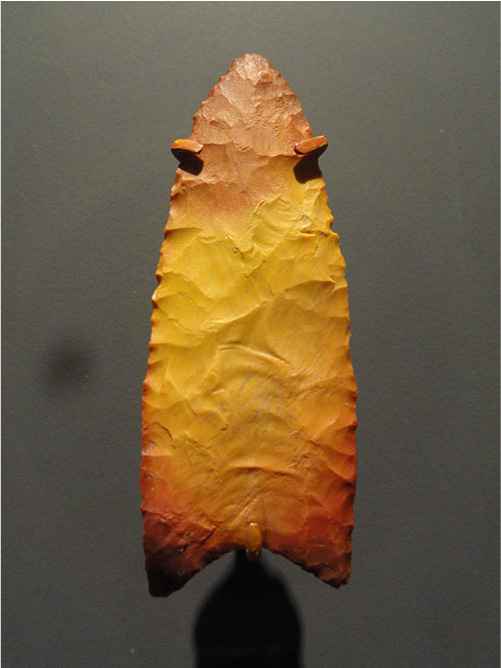
(credit: “Clovis point” by “Daderot”/Wikimedia Commons, CC0 1.0) · CC0 1.0
Figure 8.5 Clovis points discovered in North America have a distinctive appearance and were highly effective tools for hunting big game. This point found in modern Utah is between 11,000 and 13,000 years old. (credit: “Clovis point” by “Daderot”/Wikimedia Commons, CC0 1.0)
図8.5 北アメリカで発見されたクローヴィス尖頭器には独特の形があり、大型獣の狩猟に非常に有効だった。現在のユタ州で見つかったこの尖頭器は、1万1,000〜1万3,000年前のものである。(出典:「Daderot」「Clovis point」、Wikimedia Commons、CC0 1.0)
As they migrated, the Clovis people hunted mammoths, mastodons, giant bison, and many small animals. They likely also fished in coastal waters and in lakes and rivers. The places where they did settle for long periods typically had reliable access to fresh drinking water, animals for hunting and fishing, and rocks for making their signature points. Archaeologists have even discovered burial sites that appear to have been carefully designed and decorated with red ocher, a native earth containing iron oxide, suggesting a spiritual belief that required occasional ritual burial.
英語のヒント
クローヴィス文化の人々は移動しながら、マンモス、マストドン、巨大なバイソン、そして多くの小動物を狩った。沿岸の海や、湖、川でも、おそらく魚を捕っていた。比較的長くとどまった場所には、たいてい、飲み水になる淡水、狩猟や漁労の対象となる動物、そして特有の尖頭器を作るための石を安定して得られる条件があった。考古学者は、入念に造られ、赤色顔料のオーカーで飾られたと見られる埋葬地も発見している。オーカーは酸化鉄を含む天然の土である。この発見は、時折、儀礼的な埋葬を行うことを求める宗教的な信仰があった可能性を示している。
The world in which the Clovis people lived held a great variety of large animals like giant sloths, bears, tortoises, lions, wolves, beavers, armadillos, and various types of large bison. Then, about the same time people began migrating and hunting across North America, these giant species all went extinct. Some have argued that overhunting by the Clovis likely caused the extinction. An alternate hypothesis, however, suggests that rapid temperature rise at the end of the last ice age was the primary culprit. Both theories have weaknesses, and the debate continues. However, it seems at least plausible that both human intervention and climate change were factors.
英語のヒント
クローヴィス文化の人々が暮らした世界には、巨大なナマケモノ、クマ、リクガメ、ライオン、オオカミ、ビーバー、アルマジロ、さまざまな大型のバイソンなど、多種多様な大型動物がいた。ところが、人々が北アメリカ各地を移動して狩猟するようになったのとほぼ同じころ、これらの巨大な動物種はすべて絶滅した。クローヴィスの人々による過剰な狩猟が絶滅を引き起こした可能性が高い、と主張する人もいる。しかし別の仮説は、最後の氷期の終わりに起きた急激な気温上昇を主因としている。両説には弱点があり、議論は続いている。それでも、人間の関与と気候変動の両方が要因だったという見方には、少なくとも妥当性がありそうである。
The Clovis culture that spread across North America around thirteen thousand years ago vanished after only a few centuries. Its people settled in a number of different areas and produced new cultures as they responded to the environmental conditions in which they found themselves. These groups were then joined by other waves of migrants spreading across the Americas and settling in different areas. Between 9000 and 2000 BCE, during what is called the Archaic period, a great many different cultural traditions existed across North America and Mexico, Central America, and South America. They adapted to their many geographical settings: the Pacific Northwest, the Great Plains, the Eastern Woodlands, the Southwest, the jungles of southern Mexico and Central America, and the Andes region of South America.
英語のヒント
約1万3,000年前に北アメリカへ広がったクローヴィス文化は、わずか数世紀で姿を消した。その人々はさまざまな場所に定住し、それぞれが置かれた環境条件に対応しながら新たな文化を生み出した。さらに、南北アメリカ各地へ広がり、異なる場所に定住する、別の移住の波に属する人々が加わった。前9000年から前2000年までの、アルカイック期と呼ばれる時代には、北アメリカとメキシコ、中央アメリカ、南アメリカの各地に、非常に多くの異なる文化的伝統があった。人々は、太平洋岸北西部、大平原、東部森林地帯、南西部、メキシコ南部と中央アメリカの密林、南アメリカのアンデス地域といった、多様な地理的環境に適応した。
Peopling the Pacific Northwest太平洋岸北西部への定住
The groups that settled along the resource-rich Pacific Northwest developed into complex hunter-gatherer societies keenly adapted to the abundant marine life in the region. They likely migrated into the area by following caribou, which they hunted. Once they settled in the densely forested region, they learned to survive on beaver, elk, seals, birds, sea lions, and salmon and a great many other fish species.
英語のヒント
資源の豊かな太平洋岸北西部に定住した集団は、この地域の豊富な海の生物資源に巧みに適応した、複雑な狩猟採集社会へ発展した。彼らはおそらく、獲物にしていたカリブーを追ってこの地域に移住した。森林の密生する地域に定住すると、ビーバー、エルク、アザラシ、鳥、アシカ、サケ、そして多くの種類の魚を食べて暮らす方法を身につけた。
Salmon were an important resource. When they migrated upstream in the fall to spawn, they were so numerous they could be easily captured with traps, crude dams, or spears. They were then eaten immediately or dried to preserve the food for later. Halibut was another important fish species the peoples of the Pacific Northwest made into a staple of their diets.
英語のヒント
サケは重要な資源だった。秋、産卵のために川をさかのぼるときには非常に数が多く、わな、簡単な堰、槍で容易に捕ることができた。捕ったサケはすぐに食べるか、後で食べられるよう乾燥させて保存した。太平洋岸北西部の人々が食生活の主要な食べ物にした重要な魚には、オヒョウもあった。
The landscape also provided a great many resources for tools. From bone, the hunter-gatherer peoples designed harpoons useful for hunting large marine mammals like whales. They polished the rocks from the region into woodworking tools and used them to carve dugout canoes from the available trees. They also perfected a sophisticated woodcarving technique for producing art, created special bone and wood fishhooks, and used certain types of tree bark to create cloth and baskets.
英語のヒント
周囲の自然は、道具を作るための材料も豊富に供給した。狩猟採集民は骨から銛を作り、クジラのような大型の海生哺乳類を狩るのに役立てた。地域で採れる石を磨いて木工の道具にし、手に入る木から丸木舟を彫った。また、美術作品を作るための高度な木彫りの技術を完成させ、骨や木で特別な釣り針を作り、ある種の樹皮を使って布やかごも作った。
Because of the great abundance of resources along the Pacific Northwest coast, the groups that settled there could accumulate wealth far more easily than many other hunter-gatherer societies. We know they developed complex societies in which wealth and social status were connected. Evidence from the few discovered burial sites dating to around 2000 BCE supports the suggestion that wealth contributed to social differentiation even then. In the burial sites of the very wealthy, for example, archaeologists have found carved tools made of antler and other objects made from shells. As time went on, the graves of the wealthy came to include even more objects indicating their higher social status. There is also evidence of high population density in some areas, made possible by the large supply of food resources and the ability to accumulate and store them.
英語のヒント
太平洋岸北西部の海岸沿いには資源が非常に豊かだったため、そこに定住した集団は、ほかの多くの狩猟採集社会よりはるかに容易に富を蓄えられた。彼らが発展させた複雑な社会では、富と社会的地位が結びついていたことがわかっている。発見数は少ないが、前2000年ごろの埋葬地の証拠は、そのころすでに富が社会的な分化を促していたという見方を裏づけている。例えば、非常に裕福な人々の埋葬地では、角を彫って作った道具や、貝殻製の品々が見つかっている。時がたつにつれ、裕福な人の墓には、その高い社会的地位を示す物がさらに多く納められるようになった。一部の地域で人口密度が高かった証拠もある。それを可能にしたのは、豊かな食料資源と、食料を集めて蓄える能力だった。