第3章初期文明と都市社会Early Civilizations and Urban Societies
3.4 The Indus Valley Civilization3.4 インダス文明
Learning Objectives学習の目標
By the end of this section, you will be able to:
この節を学ぶと、次のことができるようになる。
Analyze the growth, development, and decline of the Indus valley culture
インダス川流域の文化の成長、発達、衰退を分析する。
Describe the cities of Mohenjo-Daro and Harappa
モヘンジョダロとハラッパの都市を説明する。
Identify key themes in Indus valley religion and culture
インダス川流域の宗教と文化の主要な特徴を挙げる。
More than fifteen hundred miles east of Mesopotamia, in the fertile valley of the Indus River, another early civilization developed in the early third millennium BCE as a peer of ancient Sumer. Early in the second millennium BCE, however, the cities of this Indus valley culture experienced decline. Lacking written records, historians have only cultural artifacts on which to base any speculation about the rise and fall of this spectacular culture, which undoubtedly influenced subsequent civilizations that arose in South Asia.
英語のヒント
メソポタミアの1500マイル以上東、肥沃なインダス川流域にも、紀元前3千年紀初め、古代シュメールと並ぶ初期文明が発達した。しかし紀元前2千年紀初め、その都市は衰退した。文字記録を読めないため、歴史家は文化的遺物だけを根拠に、この壮大な文化の興亡を推測しなければならない。この文明は、後に南アジアで生まれる文明に、間違いなく影響を与えた。
The Origins of the Indus Valley Civilizationインダス文明の起源
The Indus River flows from the Himalayan Mountains south into the Indian Ocean, depositing rich alluvial soil from the mountains along its banks. Its valley (in modern Pakistan and India) thus provided a hospitable environment for population growth for the emerging Indus valley civilization (c. 2800 BCE–1800 BCE).
英語のヒント
インダス川はヒマラヤ山脈から南のインド洋へ流れ、川岸に山地からの肥沃な沖積土を堆積させる。その流域、現在のパキスタンとインドは、成立しつつあったインダス文明(紀元前2800~1800年頃)の人口増加に適した環境だった。
Evidence for the domestication of plants and animals in this region dates to about 7000 BCE, but the process may have begun earlier. It is likely that agriculturalists in the region adopted barley and wheat cultivation techniques from the Near East, where people had been practicing agriculture for thousands of years by this point. However, it is also possible that the people of the Indus valley developed some of these techniques independently. Regardless, by about 5000 BCE, they were clearly in contact with the civilizations in Egypt and Sumer.
英語のヒント
この地域の植物の栽培化と動物の家畜化の証拠は、紀元前7000年頃にさかのぼるが、始まりはさらに古い可能性がある。農耕民は、すでに数千年の農耕経験を持つ近東から、オオムギやコムギの栽培技術を取り入れた可能性が高い。ただし、一部の技術は独自に発達させたかもしれない。いずれにせよ、紀元前5000年頃までには、エジプトやシュメールの文明と明らかに接触していた。
The farmers of the Indus valley cultivated wheat and barley as well as raised cattle and sheep, as did the farmers of Mesopotamia and western Asia. They also domesticated and cultivated bananas and cotton for cloth production, which were both unknown in ancient Mesopotamia. Thanks to the Neolithic Revolution, which secured a stable food source and stimulated population growth, people began living in settled communities along the Indus River valley as a new early civilization developed.
英語のヒント
インダス川流域の農民は、メソポタミアや西アジアの農民と同じく、コムギとオオムギを栽培し、ウシやヒツジを飼った。また、古代メソポタミアでは知られていなかったバナナや、布を作るためのワタも栽培化した。新石器革命が安定した食料源を確保し、人口増加を促したことで、人々はインダス流域の定住共同体で暮らし始め、新たな初期文明が発達した。
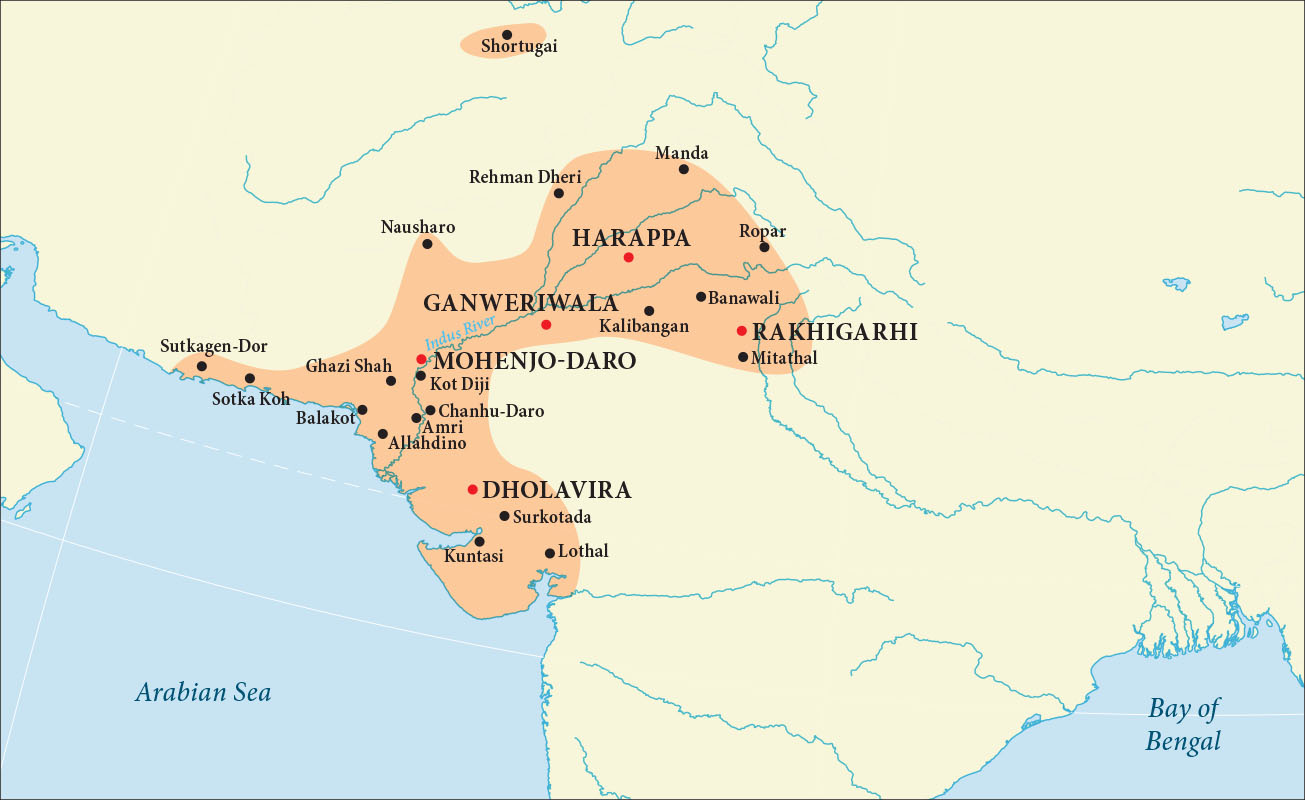
Beginning around 2800 BCE, the Indus valley entered a new phase in its development with the growth of a great number of urban centers. The two largest cities emerged at what are now the archaeological sites of Harappa in the northeast and Mohenjo-Daro to the southeast and downriver. Other large urban centers existed at Dholavira, Ganeriwala, and Rakhigarhi, along with many smaller but similarly organized cities scattered across the valley. By the time this civilization reached its height around 2000 BCE, more than one thousand urban centers of varying sizes were spread across the expansive region (Figure 3.24).
英語のヒント
紀元前2800年頃、多数の都市的中心地が成長し、インダス流域は新たな段階に入った。最大の2都市は、現在の考古遺跡ハラッパ(北東)と、下流のモヘンジョダロ(南東)である。ほかにもドーラーヴィーラ、ガンウェリワラ、ラキガリなどの大都市があり、同様に整備された小都市が流域に点在した。紀元前2000年頃に最盛期を迎えた時、この広い地域には、大小1000を超える都市的中心地があった(図3.24)。
The Indus Valley Culture.インダス川流域の文化。
(attribution: Copyright Rice University, OpenStax, under CC BY 4.0 license) · CC BY 4.0
Figure 3.24 The Indus valley civilization was spread over a very large area that today includes parts of Pakistan and India. By 2000 BCE it was highly urbanized, with several large cities and as many as a thousand smaller urban areas. (attribution: Copyright Rice University, OpenStax, under CC BY 4.0 license)
図3.24 インダス文明は、現在のパキスタンとインドの一部を含む、非常に広い地域に広がった。紀元前2000年までには都市化が進み、複数の大都市と、最大1000もの小都市的集落があった。(出典:Rice University、OpenStax、CC BY 4.0)
Despite the large size of this civilization, its existence was unknown to modern scholars until the early nineteenth century when British excavations revealed the ancient city of Harappa. Because Harappa was the first major site discovered by archaeologists, the term Harappan often appears as a synonym for Indus valley civilization.
英語のヒント
これほど大きな文明だったが、19世紀初め、イギリス人の発掘で古代都市ハラッパが明らかになるまで、近代の研究者はその存在を知らなかった。ハラッパが最初に発見された主要遺跡だったため、「ハラッパ文明」という呼び名も、インダス文明と同じ意味でよく使われる。
The archaeological sites of Harappa in the north and Mohenjo-Daro in the south have received the most study of all the Indus valley cities and remain the best known. At their height, they likely had populations of about thirty thousand people each. The political organization across the Indus valley remains imperfectly understood, but it may have consisted of a collection of independent city-states, such as existed in ancient Sumer. It is equally plausible, however, that the few large cities functioned as regional capitals ruling over the surrounding smaller ones. The fact that the sites all possessed a similar structural organization, with a sophisticated grid of well-laid-out city streets, lends credibility to theories that some form of central authority was operating.
英語のヒント
北のハラッパと南のモヘンジョダロは、インダスの都市の中で最もよく調べられ、最も知られている。最盛期には、それぞれ約3万人が住んだと考えられる。流域全体の政治組織は十分には分かっていないが、古代シュメールのような、独立都市国家の集合だった可能性がある。少数の大都市が地方の中心となり、周囲の小都市を支配した可能性も同じように考えられる。どの遺跡にも、整然とした道路の高度な格子状配置など、似た構成があることは、何らかの中央権力が働いていたという説を支える。
All the cities are divided into two sections: a lower city that was largely a residential area, and an upper city or citadel that was walled off from the rest of the settlement (Figure 3.25). This citadel may have served as a monumental ceremonial center for ritual activities and the residence of the ruling elite, like the palaces and temples of Egypt and Mesopotamia. At Harappa, the wall of mud-brick enclosing the citadel was forty-two feet thick at its base and nearly fifty feet high (about as tall as a five-story building today), with rectangular towers at regular intervals. Within the citadels stood platforms built of mud-brick where ritual activities such as animal sacrifices may have been performed; at Harappa, the platform was twenty-three feet high. At the site of Kalibangan, in northwestern India, archaeologists uncovered a pit on top of the platform containing burned cattle bones.
英語のヒント
各都市は、主に居住地の下町と、ほかの集落部分から壁で区切られた上町、すなわち城塞区の二つに分かれている(図3.25)。城塞区は、エジプトやメソポタミアの宮殿・神殿と同じように、大規模な儀礼の中心や支配層の住居だった可能性がある。ハラッパの城塞区を囲む日干しれんが壁は、基部の厚さ42フィート、高さ約50フィートで、現代の5階建てほどあり、長方形の塔が一定間隔に並んでいた。城塞区内には日干しれんがの基壇があり、動物の供犠などの儀礼が行われた可能性がある。ハラッパの基壇は高さ23フィートだった。インド北西部カリバンガンでは、基壇上の穴から焼けた牛の骨が見つかった。
The Citadel Mound at Mohenjo-Daro.モヘンジョダロの城塞丘。

(credit: "Stupa at Mohenjo-Daro" by Omair Anwer/Flickr, CC BY 2.0)] · CC BY 2.0
Figure 3.25 The stupa at Mohenjo-Daro, located in present-day Pakistan, was built circa 2500 BCE. The identification and dating of the stupa in 1923 by Indian archaeologist Rakhal Das Banerji led to the first major excavations at the site in the 1920s and 1930s. (credit: "Stupa at Mohenjo-Daro" by Omair Anwer/Flickr, CC BY 2.0)]
図3.25 現在のパキスタンにあるモヘンジョダロのストゥーパは、紀元前2500年頃に建てられた。インドの考古学者ラカール・ダース・バナジーが1923年にこれを同定し年代を推定したことが、1920~30年代の最初の大規模発掘につながった。(出典:Omair Anwer/Flickr「Stupa at Mohenjo-Daro」、CC BY 2.0)
The citadels also included public baths. At Mohenjo-Daro, the tank of the bath was forty feet long and twenty-three feet wide and entered by staircases on either side. A nearby well provided the water. Archaeologists have uncovered a large hall supported by pilasters composed of mud-brick at Mohenjo-Daro, as well as a multistory residence built around an open courtyard. This evidence suggests that ritual specialists, perhaps priests, lived and performed religious functions in the citadels that may have required them to bathe in the large public bath and congregate in the hall. An extensive granary for grain storage was found at Mohenjo-Daro. Farmers from outlying rural areas undoubtedly produced the surplus crops that were stored here to provide sustenance for the elite, religious specialists, and other city residents such as merchants and artisans, just as in Mesopotamia and Egypt.
英語のヒント
城塞区には公共浴場もあった。モヘンジョダロの浴槽は長さ40フィート、幅23フィートで、両側の階段から入れた。水は近くの井戸から供給された。同地では、日干しれんがの付け柱で支えられた大広間や、中庭を囲む複数階の住居も発見された。これらは、おそらく神官のような儀礼の専門家が城塞区に住み、大浴場での沐浴や広間への集合を伴う宗教活動をしていた可能性を示す。大きな穀物倉庫も見つかった。メソポタミアやエジプトと同じく、周辺農村の農民が余剰作物を生産し、支配層、宗教の専門家、商人、職人など都市の住民を養うために、ここへ蓄えたのだろう。
The lower sections of the Indus valley cities consisted of residential quarters and workshops. At Mohenjo-Daro and Kalibangan, the houses typically consisted of four to six rooms built around a central courtyard and were equipped with wells to provide running water to a bathroom. Larger homes in the cities were multistory with as many as thirty rooms. There is also evidence of devices attached to some of the roofs that pumped wind into homes and other large buildings to cool them.
英語のヒント
インダスの都市の低い部分には、住宅と工房があった。モヘンジョダロやカリバンガンでは、家は一般に中庭を囲む4~6室から成り、浴室へ水を供給する井戸を備えた。大きな家は複数階建てで、30室もあるものがあった。また、一部の屋根には、家や大きな建物へ風を送り込み、涼しくする装置が付いていた証拠もある。
The Indus valley cities also included an industrial area where workshops were located. At Harappa, this district included quarters for the laborers who worked there. The ancient city at the site of Lothal near the Indian Ocean included a dockyard and a warehouse for incoming trade goods. The inhabitants of these cities may have included the artisans and merchants who provided goods for the ruling elite. As in ancient Mesopotamia and Egypt, the majority of the population were probably farmers who lived in the outlying rural areas surrounding each city.
英語のヒント
インダスの都市には、工房の集まる生産地区もあった。ハラッパでは、その地区に労働者の住居も含まれた。インド洋近くのロータルには、船渠と、到着した交易品を納める倉庫があった。都市住民には、支配層へ物品を提供する職人や商人が含まれたのだろう。古代メソポタミアやエジプトと同じく、人口の大多数は、各都市を囲む周辺農村の農民だったと考えられる。