第3章初期文明と都市社会Early Civilizations and Urban Societies
The Age of Pyramid Buildingピラミッド建設の時代
By the 2600s BCE, the power of the pharaohs and the sophistication of the state in Egypt were such that the building of large-scale stone architecture became possible. Historians in the nineteenth century believed the significance of these developments was so great that it required a different name for the period. Today we call it the Old Kingdom (2613–2181 BCE), and it is best known for the massive stone pyramids that continue to awe visitors to Egypt today, many thousands of years after they were built (Table 3.1).
英語のヒント
紀元前2600年代までに、ファラオの権力と国家の組織の発達は、大規模な石造建築を可能にする水準に達した。19世紀の歴史家は、この変化が非常に重要であり、別の時代名が必要だと考えた。現在、それを古王国時代(紀元前2613~2181年)と呼ぶ。最もよく知られるのは巨大な石造ピラミッドで、建設から数千年たった今も、エジプトを訪れる人々を畏敬させる(表3.1)。
6000–3150 BCE 紀元前6000~3150年 |
Pre-Dynastic Egypt 先王朝時代 |
3150–2613 BCE 紀元前3150~2613年 |
Early Dynastic Egypt 初期王朝時代 |
2613–2181 BCE 紀元前2613~2181年 |
Old Kingdom Period 古王国時代 |
2181–2040 BCE 紀元前2181~2040年 |
First Intermediate Period 第1中間期 |
2040–1782 BCE 紀元前2040~1782年 |
Middle Kingdom Period 中王国時代 |
1782–1570 BCE 紀元前1782~1570年 |
Second Intermediate Period 第2中間期 |
1570–1069 BCE 紀元前1570~1069年 |
New Kingdom Period 新王国時代 |
1069–525 BCE 紀元前1069~525年 |
Third Intermediate Period 第3中間期 |
The pyramids were tombs for the pharaohs of Egypt, places where their bodies were stored and preserved after death. The preservation of the body was important and was directly related to Egyptian religious beliefs that a person was composed of a number of different elements. These included the Ka, Ba, Ahk, and others. A person’s Ka was their spiritual double. After the physical body died, the Ka remained but had to stay in the tomb with the body and be nourished with offerings. The Ba was also a type of spiritual essence, but it separated from the body after death, going out in the world during the day and returning to the body each night. The duty of the Ahk, yet another type of spirit, was to travel to the underworld and the afterlife. The belief in concepts like the Ka and Ba was what made the practice of mummification and the creation of tombs important in Egyptian religion. Both elements needed the physical body to survive.
英語のヒント
ピラミッドはエジプトのファラオの墓であり、死後の遺体を納め、保存する場所だった。遺体の保存は、人間が複数の要素から成るという宗教観と直接結び付いていた。その要素には、カー、バー、アクなどがあった。カーは霊的な分身である。肉体が死んでも残るが、墓の中で遺体とともにとどまり、供物によって養われる必要があった。バーも霊的な本質の一種だが、死後は肉体から離れ、昼には外界へ出て、夜ごとに肉体へ戻る。さらに別の霊であるアクは、冥界と死後の世界へ旅する役割を持った。カーやバーの信仰があるからこそ、ミイラ化や墓の造営が重要だった。この二つの要素は、存続するために肉体を必要とした。
Before the pyramids, tombs and other architectural features were built of mud-brick and called mastabas. But during the Early Dynastic reign of the pharaoh Djoser, just before the start of the Old Kingdom, a brilliant architect named Imhotep decided to build a marvelous stone tomb for his king. Originally, it was intended to be merely a stone mastaba. However, Imhotep went beyond this plan and constructed additional smaller stone mastabas, one on top of the other. The result was a multitiered step pyramid (Figure 3.20). Surrounding it, Imhotep built a large complex that included temples.
英語のヒント
ピラミッド以前の墓などは、日干しれんがで作られ、マスタバと呼ばれた。しかし、古王国の始まりの直前、初期王朝時代のファラオ、ジェセルの治世に、優れた建築家イムホテプが、王のために壮麗な石の墓を建てようとした。もとは石造マスタバにする予定だったが、その上に、より小さな石造マスタバを次々と重ねる計画へ発展した。こうして、多層の階段ピラミッドができた(図3.20)。周囲にも、神殿を含む大きな複合施設が築かれた。
The Pyramid of Djoser.ジェセルのピラミッド。
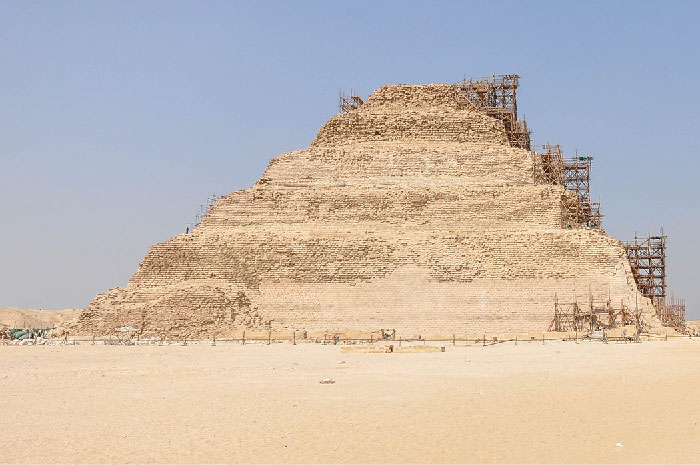
(credit: " Pyramid of Djoser (Step Pyramid)" by Jorge Láscar/Flickr, CC BY 2.0) · CC BY 2.0
Figure 3.20 The Pyramid of Djoser, sometimes called the step pyramid, is composed of six stone mastabas set atop each other, each slightly smaller than the one below. Built by the architect Imhotep during the reign of Pharaoh Djoser, it is the earliest large stone building in Egypt. (credit: " Pyramid of Djoser (Step Pyramid)" by Jorge Láscar/Flickr, CC BY 2.0)
図3.20 階段ピラミッドとも呼ばれるジェセルのピラミッドは、石造マスタバを6段重ね、上ほど少しずつ小さくした構造である。ファラオ、ジェセルの治世にイムホテプが建てた、エジプト最初の大規模石造建築である。(出典:Jorge Láscar/Flickr「Pyramid of Djoser (Step Pyramid)」、CC BY 2.0)
The step pyramid of Djoser was revolutionary, but the more familiar smooth-sided style appeared a few decades later in the reign of Snefru, when three pyramids were constructed. The most impressive has become known as the Red Pyramid, because of the reddish limestone revealed after the original white limestone surface fell away over the centuries. It had smooth sides and rose to a height of 344 feet over the surrounding landscape. Still an impressive sight, it pales in comparison to the famed Great Pyramid built by Snefru’s son Khufu at Giza near Cairo (Figure 3.21). The Great Pyramid at Giza was 756 feet long on each side and originally 481 feet high. Its base covers four city blocks and contains 2.3 million stone blocks, each weighing about 2.5 tons. Even more than the Pyramid of Djoser, the Great Pyramid is a testament to the organization and power of the Egyptian state.
英語のヒント
ジェセルの階段ピラミッドは画期的だったが、よく知られる滑らかな斜面の形は、数十年後のスネフェルの治世に現れた。この時、三つのピラミッドが建てられた。特に壮観なのは「赤いピラミッド」で、もとの白い石灰岩の外装が年月とともに失われ、赤みのある石灰岩が見えるため、そう呼ばれる。滑らかな斜面を持ち、周囲の地面から344フィートの高さに達した。今も印象的な建築だが、スネフェルの息子クフがカイロ近くのギザに建てた有名な大ピラミッドに比べると、かすんで見える(図3.21)。大ピラミッドは一辺756フィート、建設当初の高さ481フィートである。底面は市街地4区画分に広がり、約2.5トンの石材230万個を含む。ジェセルのピラミッド以上に、エジプト国家の組織力と権力の証しとなっている。
The Great Pyramid at Giza.ギザの大ピラミッド。
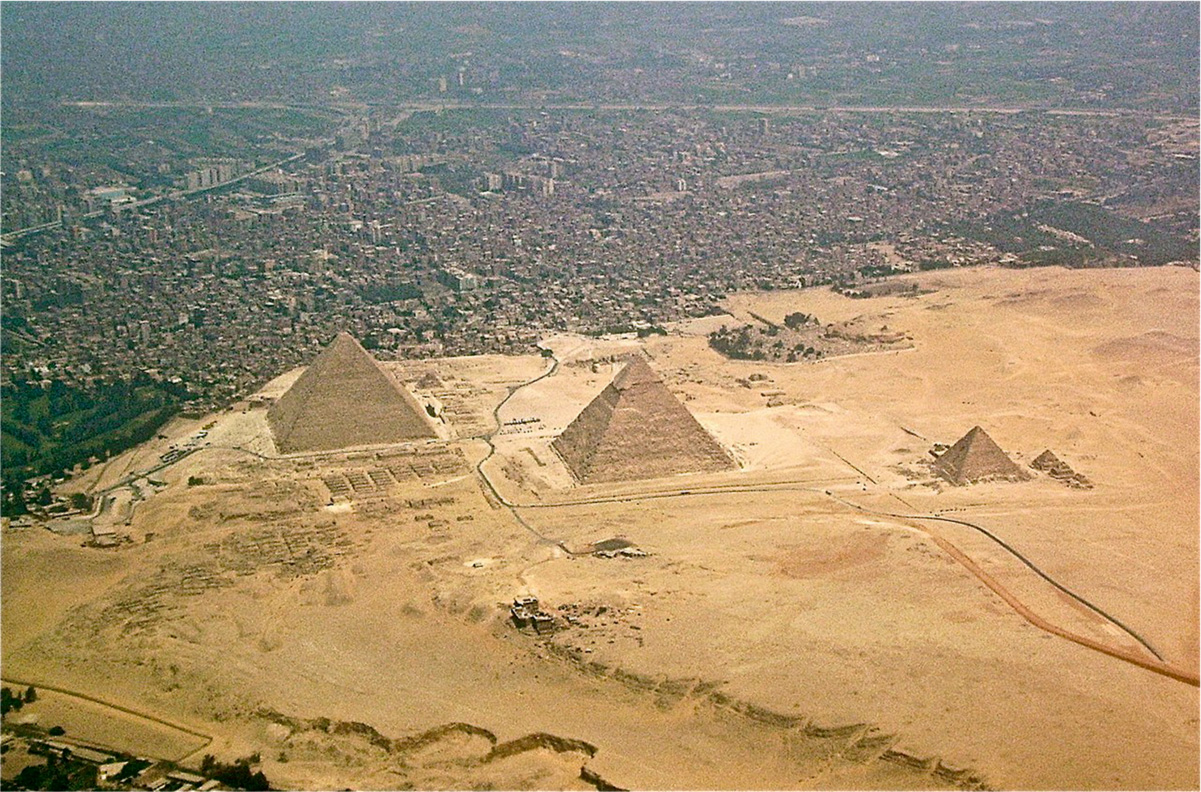
(credit: "The Giza-pyramids and Giza Necropolis, Egypt" by “Robster1983”/Wikimedia Commons, CC0 1.0) · CC0 1.0
Figure 3.21 The Giza pyramid complex, located just outside modern Cairo, includes three large pyramids and many other monuments and minor pyramids. From left to right, the large pyramids shown here are the Great Pyramid, the Pyramid of Khafre, and the Pyramid of Menkaure, all built between 2600 and 2500 BCE. (credit: "The Giza-pyramids and Giza Necropolis, Egypt" by “Robster1983”/Wikimedia Commons, CC0 1.0)
図3.21 現在のカイロのすぐ外にあるギザのピラミッド群には、大ピラミッド3基と、多くの記念建築や小ピラミッドがある。写真の大きな3基は左から、クフの大ピラミッド、カフラーのピラミッド、メンカウラーのピラミッドで、いずれも紀元前2600~2500年に建てられた。(出典:「Robster1983」/Wikimedia Commons「The Giza-pyramids and Giza Necropolis, Egypt」、CC0 1.0)
Later pharaohs of the Old Kingdom built two additional but slightly smaller pyramids at the same location. All align with the position of the Dog Star Sirius in the summer months, when the Nile floods each year. Each was also linked to a temple along the Nile dedicated to the relevant pharaoh.
英語のヒント
古王国の後のファラオたちは、同じ場所に、少し小さいピラミッドをさらに2基建てた。いずれも、毎年ナイルが氾濫する夏の、おおいぬ座の星シリウスの位置に合わせて配置されている。また、それぞれのファラオを祀るナイル沿いの神殿と結ばれていた。
Egyptian rulers invested heavily in time and resources to construct these tombs. In the mid-fifth century BCE, the ancient Greek historian Herodotus recorded that the pyramid of Khufu took 100,000 workers twenty years to construct. Herodotus lived two thousand years after this pyramid was built, however, so we might easily dismiss his report as exaggeration. Modern archaeologists suspect that a much smaller but still substantial workforce of around twenty thousand was likely employed. Excavations at the site reveal that these workers lived in cities built nearby that housed them as well as many others dedicated to feeding and caring for them. The workers were not enslaved, as is commonly assumed. Indeed, they likely enjoyed a higher standard of living than many other Egyptians at the time.
英語のヒント
エジプトの支配者は、こうした墓に膨大な時間と資源を投じた。紀元前5世紀半ば、ギリシアの歴史家ヘロドトスは、クフのピラミッド建設に10万人が20年かかったと記した。しかし、彼は建設の2000年後に生きていたため、この報告を誇張と考えることはできる。現代の考古学者は、ずっと少ないが、それでも相当な約2万人が働いた可能性が高いと考える。発掘によれば、労働者は近くに作られた町に住み、そこには食事や世話を担当する多くの人々もいた。よく想像されるような奴隷ではなかった。むしろ、当時の多くのエジプト人より高い生活水準を享受していたらしい。
As the pyramid and temple complexes became larger and more numerous during the Old Kingdom, so too did the number of priests and administrators in charge of managing them. This required that ever-increasing amounts of wealth be redirected toward these individuals from the central state. Over time, the management of the large Egyptian state also required more support from the regional governors or nomarchs and administrators of other types, which meant the pharaohs had to delegate more authority to them. By around 2200 BCE, priests and regional governors possessed a degree of wealth and power that rivaled and sometimes surpassed that of the nobility. For all these reasons and more, centralized power in Old Kingdom Egypt weakened greatly during this time, and scholars since the nineteenth century have referred to it as the First Intermediate Period.
英語のヒント
古王国時代にピラミッドと神殿が大きく、多くなると、それを管理する神官や役人の数も増えた。中央国家から彼らへ、ますます多くの富を振り向ける必要が生じた。広い国家の運営には、州侯と呼ばれる地方統治者や、ほかの行政官の支援もさらに必要となり、ファラオは彼らにより多くの権限を委ねた。紀元前2200年頃までに、神官と地方統治者の富と権力は、貴族に匹敵し、時には上回った。こうした理由などで、中央権力は大幅に弱まった。19世紀以来、研究者はこの時期を第1中間期と呼んでいる。
Scholars once claimed that this was a time of chaos and darkness. As evidence, they noted the decline in the building of large-scale monuments like the giant pyramids as well as a drop in the quality of artwork and historical records during these decades. Modern research, however, has demonstrated that this is a gross simplification. Power wasn’t necessarily lost so much as redistributed from central to regional control. From the perspective of the reigning noble families, this may have seemed like chaos and disorder. But it was not necessarily the dark age older generations of historians believed it to be.
英語のヒント
かつて研究者は、この時期を混沌と暗黒の時代とした。大ピラミッドのような大型建築の減少や、美術と歴史記録の質の低下を根拠にしたのである。しかし現代の研究は、それが大きな単純化だと示している。権力は、失われたというより、中央から地方へ分配し直された面がある。支配する王族や貴族の立場からは混乱に見えたかもしれないが、以前の歴史家が想像したような暗黒時代だったとは限らない。