第3章初期文明と都市社会Early Civilizations and Urban Societies
A Second Age of Egyptian Greatnessエジプトの第二の繁栄期
The First Intermediate Period came to an end around 2040 BCE as a series of powerful rulers, beginning with Mentuhotep II, was able to reestablish centralized control in Egypt. This led to the rise of what we now call the Middle Kingdom Period, which lasted nearly 260 years.
英語のヒント
紀元前2040年頃、メンチュヘテプ2世に始まる強力な支配者たちが、エジプトの中央集権を立て直し、第1中間期は終わった。こうして現在いう中王国時代が始まり、約260年間続いた。
In the year 1991 BCE, Amenemhat, a former vizier (adviser) to the line of kings who established the Middle Kingdom, assumed control and founded a line of pharaohs who ruled Egypt for two centuries. Under the leadership of these pharaohs, Egypt acquired its first standing army, restarted the large-scale building projects known in earlier times, made contacts with surrounding peoples and kingdoms in the Levant and in Kush (modern Sudan), and generally held itself together with a strong centralized power structure.
英語のヒント
紀元前1991年、中王国を築いた王家に宰相(助言者)として仕えたアメンエムハトが権力を握り、その後200年間エジプトを治める王朝を始めた。この王朝の下で、エジプトは初めて常備軍を持ち、以前のような大規模建設を再開し、レヴァントやクシュ(現在のスーダン)の人々や王国と接触した。全体として、強い中央権力の仕組みによって国がまとまっていた。
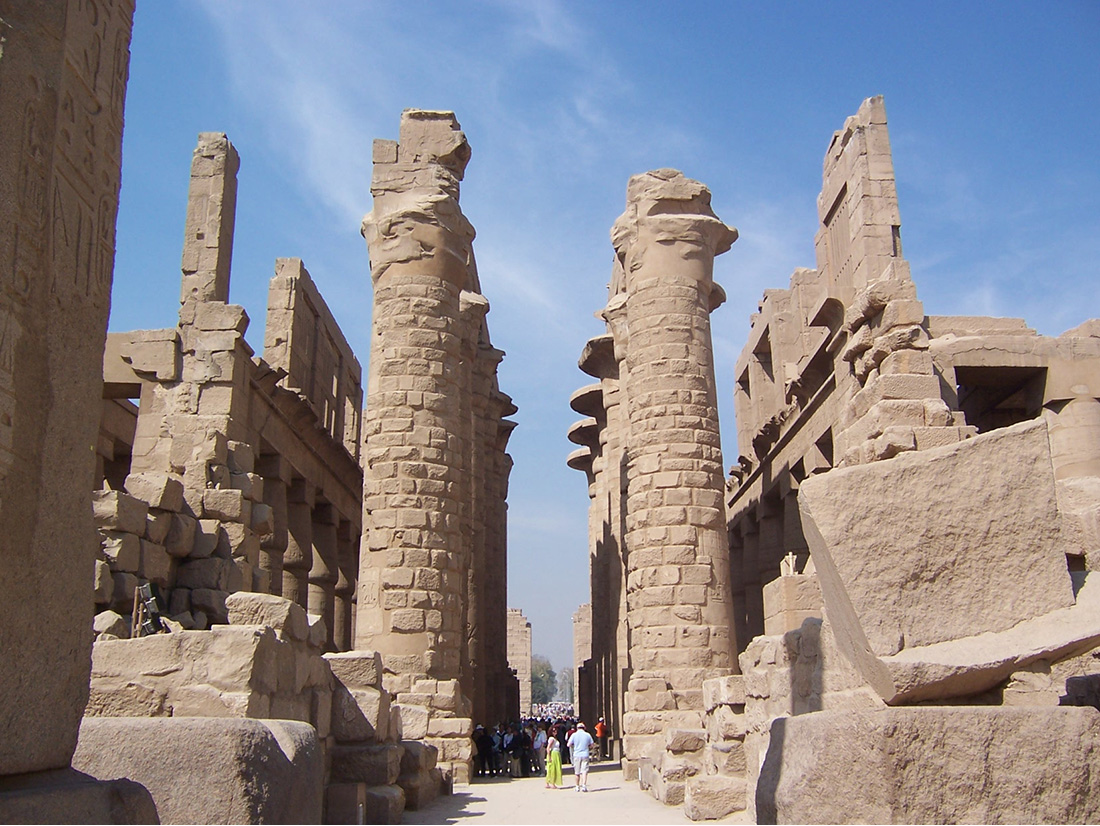
During the Middle Kingdom Period, pharaohs introduced the cult of the deity Amon-Re at Thebes. Amon-Re was a combination of the sun-god Re, the creator god worshipped in the north of Egypt, and Amon, a sky god revered in the south. He was portrayed as the king of the gods and the father of each reigning pharaoh. The pharaohs of the Middle Kingdom no longer constructed massive pyramids for their tombs. Instead, they focused on erecting massive temples to Amon-Re and his wife, the mother-goddess Mut, at Thebes (Figure 3.22). The ruins of these temples are located at Karnak in southern Egypt. Amon-Re’s temples featured immense halls in which multiple columns or colonnades supported the roof, courtyards, and ceremonial gates. They housed the sacred images of the deities, which on festival days were brought out in ritual processions.
英語のヒント
中王国時代、ファラオはテーベにアメン・ラーの崇拝を導入した。北で崇拝された創造神・太陽神ラーと、南で崇敬された天空神アメンを結び付けた神である。神々の王であり、在位する各ファラオの父とされた。中王国のファラオは、墓のための巨大ピラミッドを建てなくなり、代わりにテーベで、アメン・ラーとその妻で母神のムトの巨大な神殿造営に力を入れた(図3.22)。遺構はエジプト南部のカルナックにある。アメン・ラーの神殿には、多くの柱や列柱が屋根を支える大広間、中庭、儀式用の門があった。神々の聖像を納め、祭礼の日には行列にして外へ運び出した。
Temple of Amon-Re.アメン・ラー神殿。
(credit: modification of work "Karnak Temple Complex at Luxor, Egypt" by Daniel Csörföly/Wikimedia Commons, Public Domain) · Public Domain
Figure 3.22 The temple of Amon-Re, built around 2055 BCE, was plundered in ancient times for its stone. What remains are these ruins. The large ceremonial gates still stand, towering above the visitors who walk beneath them. (credit: modification of work "Karnak Temple Complex at Luxor, Egypt" by Daniel Csörföly/Wikimedia Commons, Public Domain)
図3.22 紀元前2055年頃に建てられたアメン・ラー神殿は、古代に石材を略奪された。残るのがこの遺構である。大きな儀式用の門は今も立ち、その下を歩く訪問者の上にそびえる。(出典:Daniel Csörföly/Wikimedia Commons「Karnak Temple Complex at Luxor, Egypt」を改変、パブリックドメイン)
Middle Kingdom Egypt reached its height in the 1870s and 1860s BCE during the reign of Senusret III, a powerful warrior pharaoh and capable administrator of the centralized state. He greatly expanded Egypt’s territorial control, leading armies up the Nile into Kush and into the Levant. These efforts not only strengthened Egypt’s ability to protect itself from invasion but also greatly increased the flow of trade from these regions. Kush was known for its rich gold deposits and capable warriors, and Senusret III’s several campaigns there brought Egypt access not only to the gold but also to mercenaries from Kush.
英語のヒント
中王国エジプトは、紀元前1870~1860年代、強力な戦士で有能な行政家でもあるファラオ、センウセレト3世の治世に最盛期を迎えた。彼は軍をナイル上流のクシュやレヴァントへ率い、支配領域を大きく広げた。これによって侵入への防衛力が増し、両地域との交易も大幅に拡大した。クシュは豊かな金鉱床と優れた戦士で知られ、センウセレト3世の遠征は、金だけでなくクシュの傭兵もエジプトにもたらした。
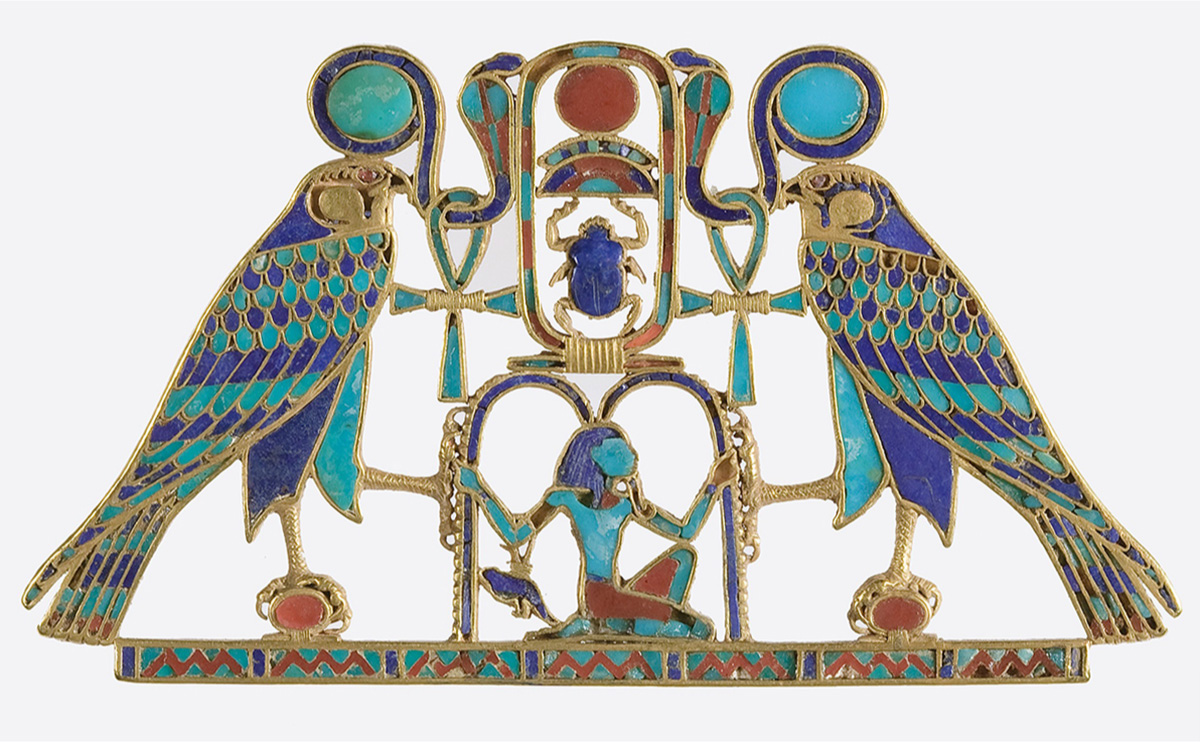
Senusret also dramatically increased the degree of centralized power held by the pharaoh, reducing the authority and even the number of the nomarchs. Overall, Egypt now grew wealthier, safer, more centralized, and more powerful than it had ever been. As a result, his reign was also a time of cultural flourishing when Egyptian art, architecture, and literature grew in refinement and sophistication (Figure 3.23).
英語のヒント
センウセレトは、州侯の権限、さらには人数を減らし、ファラオへの権力集中も大きく進めた。全体として、エジプトは以前にも増して豊かで、安全で、中央集権的で強力になった。その結果、彼の治世は文化の開花期ともなり、美術、建築、文学はいっそう洗練され、高度になった(図3.23)。
The Art of the Middle Kingdom.中王国の美術。
(credit: modification of work "Pectoral and Necklace of Sithathoryunet with the Name of Senwosret II" by Purchase, Rogers Fund and Henry Walters Gift, 1916/The Metropolitan Museum of Art, Public Domain) · Public Domain
Figure 3.23 This pectoral, a form of jewelry worn over the chest, is an excellent example of the fine artwork of the Egyptian Middle Kingdom Period. It once belonged to an Egyptian princess called Sithathoryunet and is made of gold and semiprecious stones. (credit: modification of work "Pectoral and Necklace of Sithathoryunet with the Name of Senwosret II" by Purchase, Rogers Fund and Henry Walters Gift, 1916/The Metropolitan Museum of Art, Public Domain)
図3.23 胸に着ける装身具、ペクトラル。エジプト中王国の精緻な美術をよく示す。シトハトホルユネトという王女の所有品で、金と半貴石で作られている。(出典:Rogers FundおよびHenry Waltersの寄贈による購入、1916年/メトロポリタン美術館「Pectoral and Necklace of Sithathoryunet with the Name of Senwosret II」を改変、パブリックドメイン)
The deaths of Senusret III and his son Amenemhat III led indirectly to a rare but not unprecedented transfer of royal power to an Egyptian woman. Possibly Amenemhat IV’s wife, sister, or both, Sobekneferu, the daughter of Amenemhat III, was the first woman to rule Egypt since before the Old Kingdom. She reigned for only a few years, and little is known of her accomplishments. But scholars have determined that she was the first pharaoh to associate herself with the Egyptian crocodile god Sobek. She may even have commissioned the construction of the city of Crocodilopolis to honor this important god. Because she died without having had children, she was the last in the long series of pharaohs in the line of Amenemhat I.
英語のヒント
センウセレト3世とその息子アメンエムハト3世の死は、間接的に、まれではあるが前例のないわけではない、女性への王権移行につながった。アメンエムハト3世の娘ソベクネフェルである。アメンエムハト4世の妻、姉妹、あるいはその両方だった可能性があり、古王国以前以来、初めてエジプトを治める女性となった。在位は数年にすぎず、業績の多くは不明である。しかし研究者によれば、自らをワニの神ソベクと結び付けた最初のファラオだった。この重要な神をたたえるため、クロコディロポリスの建設を命じた可能性さえある。子どもを持たずに死んだため、アメンエムハト1世に始まる長い王統の最後となった。
Even before the reign of Sobekneferu, Egypt was already experiencing some degree of decline. Over the next century, the pharaohs and their centralized control became steadily weaker. Increasing numbers of Semitic-speaking peoples from the Levant flowed into Egypt, possibly the result of increased trade between Egypt and the Levant at first. But by the late 1700s BCE, these Semitic-speaking groups had grown so numerous in the Nile delta region and centralized control of Egypt had grown so weak that some of their chieftains began to assert control in a few areas. The Egyptians called these Semitic-speaking chieftains Heqau-khasut (rulers of foreign lands). Today they are more commonly called Hyksos, a Greek corruption of this Egyptian name.
英語のヒント
ソベクネフェルの治世以前から、エジプトには衰退の兆しがあった。その後の100年、ファラオと中央集権は弱まり続けた。レヴァントからはセム語系の人々がますます流入した。当初は交易拡大が原因だった可能性がある。しかし紀元前1700年代末までには、ナイル・デルタの彼らの人口が非常に多くなり、中央統制が非常に弱まったため、その首長の一部が各地で支配を始めた。エジプト人は、これらの首長をヘカウ・カスウト(異国の支配者)と呼んだ。現在は、このエジプト語名がギリシア語で変化した「ヒクソス」の名で広く知られる。
By the time the Hyksos were asserting their control over parts of the Nile delta, Egypt was already well into what historians of the nineteenth century dubbed the Second Intermediate Period. Like the First Intermediate Period, the second was a time of reduced centralized control. Not only did the Egyptian nobles, ruling from their capital in Thebes, lose control of the delta, they also lost territory upriver to an increasingly powerful kingdom of Kush in the south. This meant that the territory once controlled by the powerful centralized state bureaucracy was effectively split into three regions: one ruled by Hyksos in the north, one by Kushite in the south, and one by the remnants of the Egyptian nobility in the center.
英語のヒント
ヒクソスがナイル・デルタの一部を支配する頃には、エジプトはすでに、19世紀の歴史家が第2中間期と名付けた時代に深く入っていた。第1中間期と同じく、中央統制の弱まった時期である。テーベを都とするエジプトの貴族層は、デルタだけでなく、上流の領域も、南で勢力を強めるクシュ王国に奪われた。かつて強力な中央官僚制が治めた領土は、事実上、北のヒクソス、南のクシュ、中央のエジプト貴族の残存勢力という三地域に分かれた。
Despite the fragmentation, for most of this period, the three regions of Egypt appear to have maintained peaceful relationships. That changed, however, beginning in the 1550s BCE when a string of Theban Egyptian rulers was able to go on the offensive against the Hyksos. After the Hyksos were defeated and the Nile delta recaptured, the emboldened Egyptians turned their attention south to Kush, eventually extending their control over these regions as well. These efforts ushered in a new period of Egyptian greatness called the New Kingdom, the highest high-water mark of Egyptian power and cultural influence in the ancient world.
英語のヒント
分裂してはいたが、この時期の大半、三地域は平和な関係を保っていたらしい。しかし紀元前1550年代から、テーベの支配者たちが次々とヒクソスへの攻勢に出て、状況は変わった。ヒクソスを倒しデルタを奪回すると、自信を得たエジプト人は南のクシュにも目を向け、やがてそこにも支配を広げた。こうして新王国と呼ばれる新たな繁栄期が始まり、古代世界でのエジプトの力と文化的影響は頂点に達した。