第3章初期文明と都市社会Early Civilizations and Urban Societies
3.2 Ancient Mesopotamia3.2 古代メソポタミア
Learning Objectives学習の目標
By the end of this section, you will be able to:
この節を学ぶと、次のことができるようになる。
Identify characteristics of civilization in Ancient Mesopotamia
古代メソポタミア文明の特徴を挙げる。
Discuss the political history of Mesopotamia from the early Sumerian city-states to the rise of Old Babylon
初期シュメール都市国家から古バビロニアの成立まで、メソポタミアの政治史を論じる。
Describe the economy, society, and religion of Ancient Mesopotamia
古代メソポタミアの経済、社会、宗教を説明する。
In the fourth millennium BCE, the world’s first great cities arose in southern Mesopotamia, or the land between the Tigris and Euphrates Rivers, then called Sumer. The ancient Sumerians were an inventive people responsible for a host of technological advances, most notably a sophisticated writing system. Even after the Sumerian language ceased to be spoken early in the second millennium BCE, Sumerian literary works survived throughout the whole of Mesopotamia and were often collected by later cities and stored in the first libraries.
英語のヒント
紀元前4千年紀、ティグリス川とユーフラテス川に挟まれたメソポタミアの南部、当時シュメールと呼ばれた地に、世界最初の大都市が生まれた。古代シュメール人は発明に富み、数多くの技術を進歩させた。特に重要なのが、高度な文字体系である。紀元前2千年紀の初めにシュメール語が話されなくなってからも、シュメール文学はメソポタミア全域に伝わり、後の都市で収集され、初期の図書館に保管された。
The Rise and Eclipse of Sumerシュメールの興隆と衰退
The term Mesopotamia, or “the land between the rivers” in Greek, likely originated with the Greek historian Herodotus in the fifth century BCE and has become the common name for the place between the Tigris and Euphrates Rivers in what is now Iraq. The rivers flow north to south, from the Taurus Mountains of eastern Turkey to the Persian Gulf, depositing fertile soil along their banks. Melting snow and rain from the mountains carry this topsoil to the river valleys below. In antiquity, the river flow was erratic, and flooding was frequent but unpredictable. The need to control it and manage the life-giving water led to the building of cooperative irrigation projects.
英語のヒント
「メソポタミア」はギリシア語で「川の間の地」を意味し、おそらく紀元前5世紀のギリシアの歴史家ヘロドトスに始まる呼び名で、現在のイラクにあるティグリス川とユーフラテス川の間の地域の一般的名称となった。両河川は、トルコ東部のタウルス山脈からペルシア湾へ、北から南へと流れ、川岸に肥沃な土を堆積させる。山の雪解け水や雨が、表土を下流の谷へ運ぶのである。古代には流量が不規則で、洪水が頻繁に、しかも予測できずに起きた。洪水を制御し、命を支える水を管理する必要から、共同で灌漑施設が建設された。
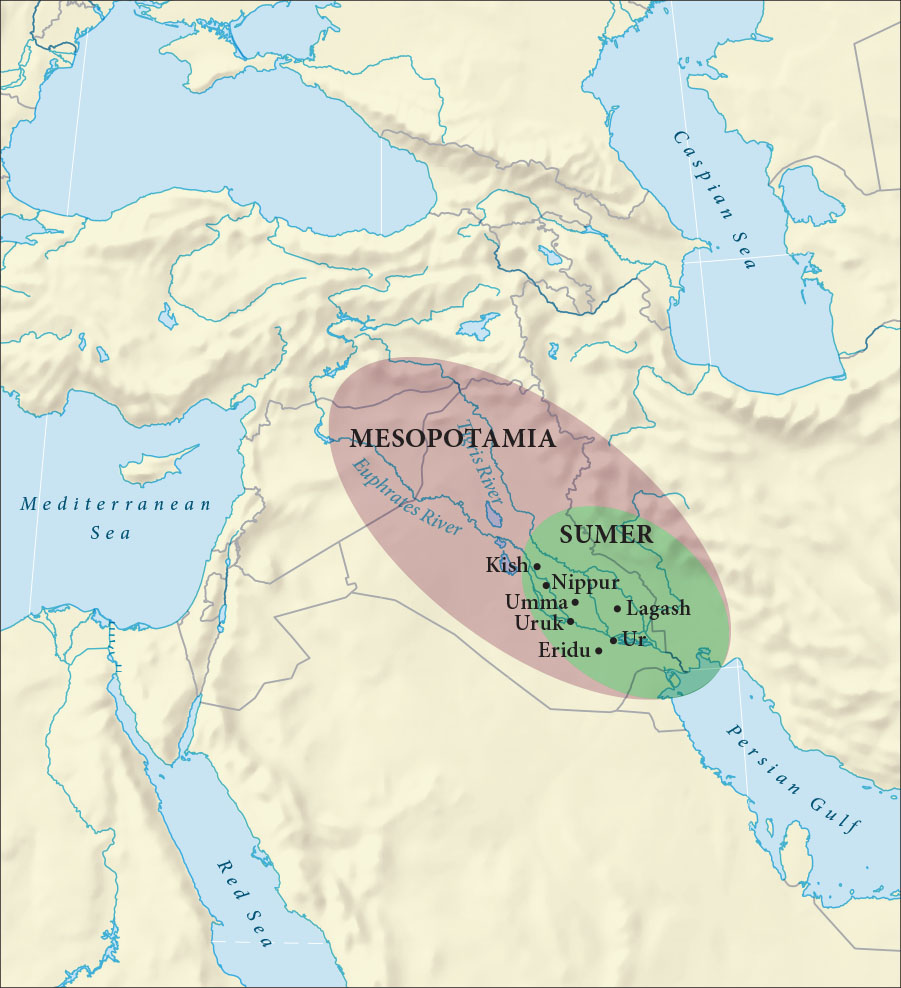
Agricultural practices reached Mesopotamia by around 8000 BCE, if not earlier. However, for about two millennia afterward, populations remained quite small, typically living in small villages of between one hundred and two hundred people. Beginning around 5500 BCE, some had begun to establish settlements in southern Mesopotamia, a wetter and more forbidding environment. It was here that the Sumerian civilization emerged (Figure 3.8). By around 4500 BCE, some of the once-small farming villages had become growing urban centers, some with thousands of residents. During the course of the fourth millennium BCE (3000s BCE), urbanization exploded in the region. By the end of the millennium, there were at least 124 villages with about one hundred residents each, twenty towns with as many as two thousand residents, another twenty small urban centers of about five thousand residents, and one large city, Uruk, with a population that may have been as high as fifty thousand. This growth helped make Sumer the earliest civilization to develop in Mesopotamia.
英語のヒント
遅くとも紀元前8000年頃までに、農耕はメソポタミアに伝わった。しかし、その後の約2000年間、人口は少なく、一般に100~200人の小村に暮らしていた。紀元前5500年頃から、より湿潤で厳しい環境であるメソポタミア南部にも、集落を作る人々が現れた。シュメール文明が生まれたのは、ここだった(図3.8)。紀元前4500年頃までには、小さな農村の一部が成長する都市的中心地となり、数千人の住民を抱えるものもあった。紀元前4千年紀、すなわち紀元前3000年代には、都市化が急激に進んだ。その末までには、約100人の村が少なくとも124、最大2000人の町が20、約5000人の小都市がさらに20、そして人口が5万人に達した可能性のある大都市ウルクがあった。この成長によって、シュメールはメソポタミアで最初に発達した文明となった。
Early Sumer.初期のシュメール。
(attribution: Copyright Rice University, OpenStax, under CC BY 4.0 license) · CC BY 4.0
The fourth millennium BCE in Sumer was also a period of technological innovation. One important invention made after 4000 BCE was the process for manufacturing bronze, an alloy of tin and copper, which marked the beginning of the Bronze Age in Mesopotamia. In this period, bronze replaced stone as the premier material for tools and weapons and remained so for nearly three thousand years. The ancient Sumerians also developed the plow, the wheel, and irrigation techniques that used small channels and canals with dikes for diverting river water into fields. All these developments allowed for population growth and the continued rise of cities by expanding agricultural production and the distribution of agricultural goods. In the area of science, the Sumerians developed a sophisticated mathematical system based on the numbers sixty, ten, and one.
英語のヒント
シュメールの紀元前4千年紀は、技術革新の時代でもあった。紀元前4000年以後の重要な発明に、スズと銅の合金である青銅の製造法がある。これがメソポタミアの青銅器時代の始まりを示す。青銅は石に代わって道具や武器の主要材料となり、その地位を約3000年保った。古代シュメール人は、犂や車輪も発達させ、堤防を伴う小水路や運河で川の水を畑へ引く灌漑技術も生み出した。これらは農業生産と農産物の流通を広げ、人口増加と都市の成長を可能にした。科学の分野では、60、10、1を基礎とする高度な数学体系を発達させた。
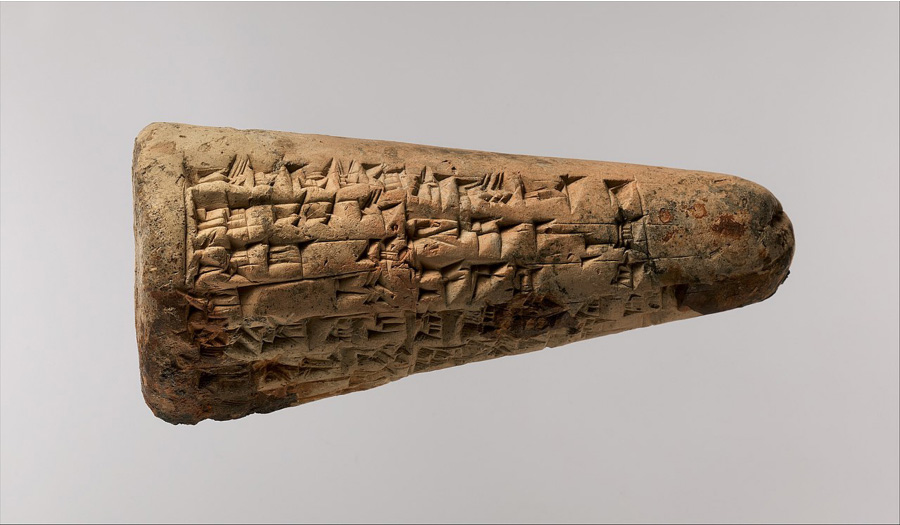
One of the greatest inventions of this period was writing. The Sumerians developed cuneiform, a script characterized by wedge-shaped symbols that evolved into a phonetic script, that is, one based on sounds, in which each symbol stood for a syllable (Figure 3.9). They wrote their laws, religious tracts, and property transactions on clay tablets, which became very durable once baked, just like the clay bricks the Sumerians used to construct their buildings. The clay tablets held records of commercial exchanges, including contracts and receipts as well as taxes and payrolls. Cuneiform also allowed rulers to record their laws and priests to preserve their rituals and sacred stories. In these ways, it helped facilitate both economic growth and the formation of states.
英語のヒント
この時代の最大の発明の一つが文字だった。シュメール人は、くさび形の記号を特徴とする楔形文字を発達させた。それは音を表す文字体系へと発展し、一つの記号が一音節を表すようになった(図3.9)。法律、宗教文書、財産取引は粘土板に記された。粘土板は焼くと、建物に使う粘土れんがと同じように、非常に丈夫になった。粘土板には契約や領収書、税、賃金支払いなど、商取引の記録が残された。楔形文字は、支配者が法を記し、神官が儀礼や聖なる物語を保存することも可能にした。このように、文字は経済成長と国家形成の両方を促した。
Sumerian Cuneiform.シュメールの楔形文字。
(credit: "Votive cone with cuneiform inscription of Lipit-Eshtar" by Anonymous Gift, 1971/The Metropolitan Museum of Art, Public Domain) · Public Domain
Figure 3.9 Cuneiform, from the Latin cuneus (meaning “wedge”), was created by pressing a stylus of reed into wet clay to create a meaningful arrangement of wedge shapes. This clay cone from circa 1934–1924 BCE includes a dedication to the ruler of the city of Isin in southern Mesopotamia. (credit: "Votive cone with cuneiform inscription of Lipit-Eshtar" by Anonymous Gift, 1971/The Metropolitan Museum of Art, Public Domain)
図3.9 楔形文字を表す英語cuneiformは、「くさび」を意味するラテン語cuneusに由来する。葦の筆を湿った粘土に押し付け、くさび形を意味のある配置にして記した。この紀元前1934~1924年頃の粘土円錐には、メソポタミア南部イシンの支配者への奉献文がある。(出典:匿名寄贈、1971年/メトロポリタン美術館「Votive cone with cuneiform inscription of Lipit-Eshtar」、パブリックドメイン)
Cuneiform was a very complex writing system, and literacy remained the monopoly of an elite group of highly trained writing specialists, the scribes. But the script was also highly flexible and could be used to symbolize a great number of sounds, allowing subsequent Mesopotamian cultures such as the Akkadians, Babylonians, and many more to adapt it to their own languages. Since historians deciphered cuneiform in the nineteenth century, they have read the thousands of clay tablets that survived over the centuries and learned much about the history, society, economy, and beliefs of the ancient Sumerians and other peoples of Mesopotamia.
英語のヒント
楔形文字は非常に複雑で、読み書きは、専門的な訓練を受けた書記という少数の集団に独占されていた。しかし、この文字は柔軟でもあり、非常に多くの音を表せた。そのため、後のアッカド人やバビロニア人など、メソポタミアのさまざまな人々が自らの言語に応用できた。歴史家が19世紀に楔形文字を解読して以来、長い年月を生き延びた何千枚もの粘土板が読まれ、古代シュメール人やメソポタミアのほかの人々の歴史、社会、経済、信仰について、多くのことが分かってきた。
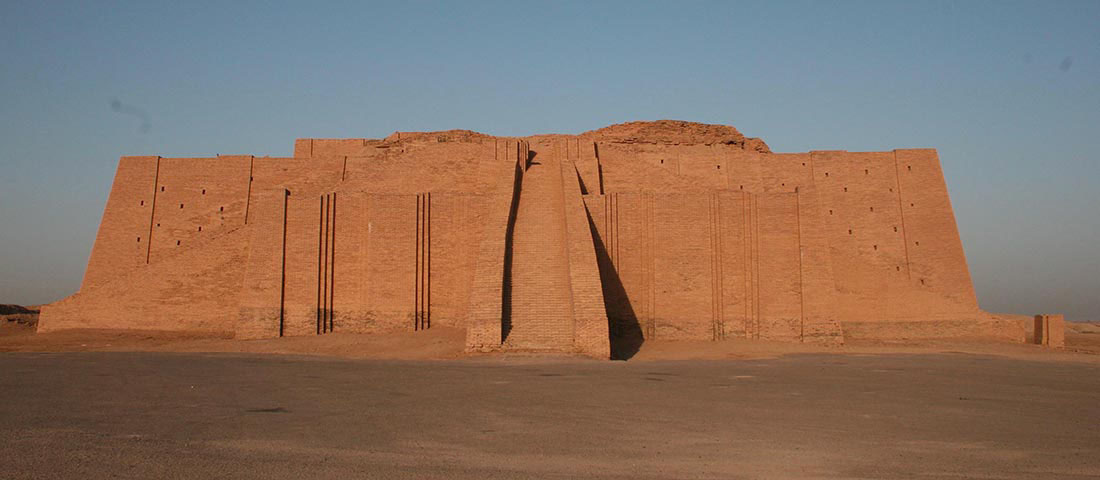
The Sumerians were polytheists, people who revered many gods. Each Sumerian city had its own patron god, however, one with whom the city felt a special connection and whom it honored above the others. For example, the patron god of Uruk was Inanna, the goddess of fertility; the city of Nippur revered the weather god Enlil; and Ur claimed the moon god Sin. Each city possessed an immense temple complex for its special deity, which included a site where the deity was worshipped and religious rituals were performed. This site, the ziggurat, was a stepped tower built of mud-brick with a flat top (Figure 3.11). At its summit stood a roofed structure that housed the sacred idol or image of the temple’s deity. The temple complex also included the homes of the priests, workshops for artisans who made goods for the temple, and storage facilities to meet the needs of the temple workers.
英語のヒント
シュメール人は、多くの神々を崇敬する多神教徒だった。ただし、各都市には特別な結び付きを感じ、ほかの神々より重んじる守護神があった。ウルクでは豊穣の女神イナンナ、ニップルでは天候の神エンリル、ウルでは月神シンが守護神だった。各都市は、その神のために巨大な神殿複合体を持ち、神を礼拝して儀礼を行う場所も備えていた。それがジッグラトであり、日干しれんがで築かれた、頂上が平らな階段状の塔だった(図3.11)。頂上には屋根付きの建物があり、神の聖なる像が納められた。神殿複合体には、神官の住居、神殿の物品を作る職人の工房、神殿労働者に必要な物資の倉庫もあった。
The Ziggurat of Ur.ウルのジッグラト。
(credit: "Ziggarat of Ur" by “Tla2006”/Wikimedia Commons, Public Domain) · Public Domain
Figure 3.11 The partially reconstructed remains of the once-great ziggurat of Ur (near the modern city of Nasiriyah in Iraq) demonstrate the size of these huge temples and the enormous human resources spent on their construction. When it was completed in the twenty-first century BCE, this structure had additional tiers upon the large base shown and was about one hundred feet high. (credit: "Ziggarat of Ur" by “Tla2006”/Wikimedia Commons, Public Domain)
図3.11 現在のイラク、ナーシリーヤ付近にあるウルのジッグラトは、一部が復元されている。遺構は、この巨大な神殿の規模と、建設に費やされた膨大な人手を物語る。紀元前21世紀に完成した時には、写真の大きな基壇の上にさらに段があり、高さは約100フィートだった。(出典:「Tla2006」/Wikimedia Commons「Ziggarat of Ur」、パブリックドメイン)
Sumerians were clearly eager to please their gods by placing them at the center of their society. These gods could be fickle, faithless, and easily stirred to anger. If displeased with the people, they might bring famine or conquest. Making sure the gods were praised and honored was thus a way of ensuring prosperity. Praising them, however, implied different things for different social tiers in Sumer. For common people, it meant living a virtuous life and giving to the poor. For priests and priestesses, it consisted of performing the various rituals at the temple complexes. And for rulers honoring the gods, it meant ensuring that the temples were properly funded, maintained, and regularly beautified and enlarged if possible.
英語のヒント
シュメール人は、神々を社会の中心に置くことで、その心を喜ばせようとした。神々は気まぐれで、約束を守らず、すぐに怒ることもあった。人々を気に入らなければ、飢饉や征服をもたらしかねなかった。したがって、神々を確実にたたえ、敬うことは、繁栄を確保する方法だった。しかし、神々をたたえる行為は、社会階層によって異なった。一般の人々には、徳のある生活を送り、貧者へ施すことを意味した。男女の神官には、神殿複合体でさまざまな儀礼を行うことだった。支配者には、神殿に十分な資金を与え、維持し、定期的に美しく整え、可能なら拡張することだった。
By the Early Dynastic Period (c. 2650 BCE–2400 BCE), powerful dynasties of kings called lugals had established themselves as rulers of the cities. In each city, the lugals rose to power primarily as warlords, since the Sumerian cities often waged war against each other for control of farmland and access to water as well as other natural resources. Lugals legitimized their authority through the control of the religious institutions of the city. For example, at Ur, the daughter of the reigning lugal always served as the high priestess of the moon god Sin, the chief deity at Ur.
英語のヒント
初期王朝時代(紀元前2650~2400年頃)までには、「ルガル」と呼ばれる王たちの強力な王朝が、都市の支配者となっていた。シュメールの都市は、農地、水、その他の天然資源をめぐって頻繁に戦ったため、各都市のルガルは、主に軍事指導者として台頭した。彼らは都市の宗教組織を支配することで、権威を正当化した。たとえばウルでは、在位中のルガルの娘が常に、守護神である月神シンの最高位の女性神官を務めた。
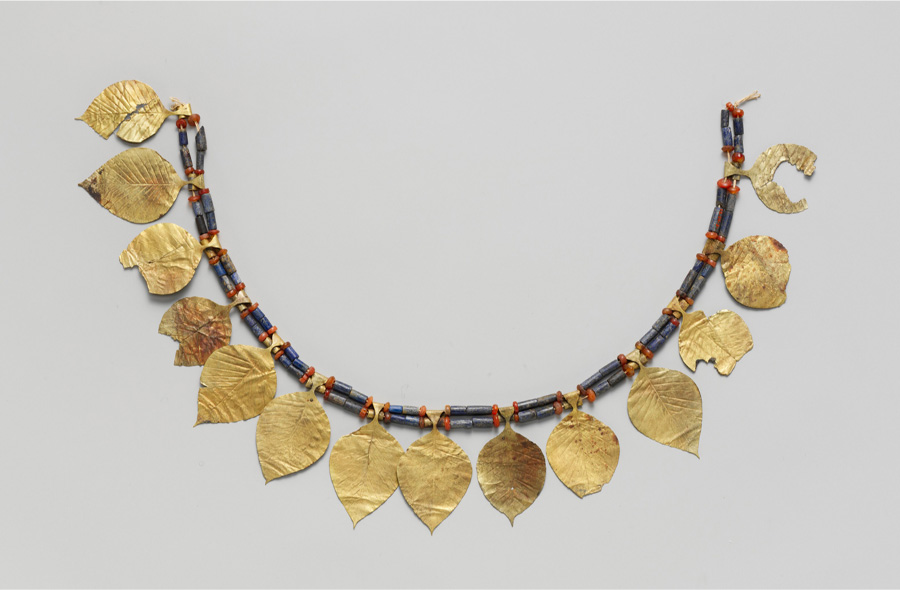
The lugals at Ur during this period, the so-called First Dynasty of Ur, were especially wealthy, as reflected in the magnificent beehive-shaped tombs in which they were buried. In these tombs, precious goods such as jewelry and musical instruments were stored, along with the bodies of servants who were killed and placed in the tomb to accompany the rulers to the Land of the Dead. One of the more spectacular tombs belonged to a woman of Ur called Pu-Abi, who was buried wearing an elaborate headdress and might have been a queen (Figure 3.12). The most famous lugal in all Sumer in this early period was Gilgamesh of Uruk, whose legendary exploits were recounted later in fantastical form in the Epic of Gilgamesh.
英語のヒント
この時代のウルのルガル、いわゆるウル第1王朝の王たちは、とりわけ富裕だった。それは、彼らが葬られた豪華な蜂の巣形の墓に表れている。墓には宝飾品や楽器などの高価な品とともに、支配者に付き従って死者の国へ行くため、殺されて埋葬された従者の遺体も納められた。特に壮麗な墓の一つは、プアビというウルの女性のものだった。彼女は精巧な頭飾りを着けて埋葬され、王妃だった可能性がある(図3.12)。この初期のシュメールで最も有名なルガルはウルクのギルガメシュであり、その伝説的な功績は、後に『ギルガメシュ叙事詩』で幻想的に語り直された。
Sumerian Gold Headdress.シュメールの金の頭飾り。
(credit: modification of work "Headdress" by Dodge Fund, 1933/The Metropolitan Museum of Art, Public Domain) · Public Domain
Figure 3.12 The striking beauty and quality of this gold and lapis lazuli headdress from circa 2600 BCE have convinced some that the woman wearing it in the Ur tomb where it was found might have been a queen. Others believe she was simply an attendant, though an elaborately dressed one. (credit: modification of work "Headdress" by Dodge Fund, 1933/The Metropolitan Museum of Art, Public Domain)
図3.12 紀元前2600年頃の金とラピスラズリの頭飾り。その際立つ美しさと質から、ウルの墓でこれを着けていた女性を王妃と考える人もいる。豪華な身なりではあっても、単なる従者だったと考える人もいる。(出典:Dodge Fund、1933年/メトロポリタン美術館「Headdress」を改変、パブリックドメイン)