第3章初期文明と都市社会Early Civilizations and Urban Societies
The Pharaohファラオ
The king of the united Egypt, the pharaoh, governed a kingdom much larger than any contemporary realm. Historians estimate that the population of the Egyptian state, when first united in about 3150 BCE, numbered as many as two million people, whereas a typical Sumerian lugal ruled about thirty thousand subjects. The temple/palace system in Egypt therefore operated on a much vaster scale than anywhere in Mesopotamia.
英語のヒント
統一エジプトの王ファラオは、同時代のどの国家よりも大きな王国を治めた。歴史家の推定では、紀元前3150年頃に初めて統一されたエジプトの人口は、最大200万人だった。典型的なシュメールのルガルが治めた臣民は、約3万人である。このため、エジプトの神殿・宮殿の仕組みは、メソポタミアのどこよりもはるかに大規模だった。
The term pharaoh in ancient Egyptian is translated as “big house,” likely a reference to the size of the palaces along the Nile valley where the pharaoh resided and administered the lands. As in ancient Mesopotamia, the palace included large facilities for storing taxes in kind, as well as workshops for artisans who produced goods for the palace. Also, as in Mesopotamia, a large portion of the population were peasant farmers. They paid taxes in kind to support the artisans and others working in the pharaoh’s palaces and temples and living nearby, inside the city. The ruling elite included scribes, priests, and the pharaoh’s officials.
英語のヒント
古代エジプト語の「ファラオ」は「大きな家」と訳される。ファラオが住んで国を治めた、ナイル流域の宮殿の大きさを指すのだろう。古代メソポタミアと同様、宮殿には現物税を保管する大倉庫と、宮殿向けの物品を作る職人の工房があった。また、人口の大部分は農民だった。彼らは現物で税を納め、ファラオの宮殿や神殿で働き、近くの都市内に暮らす職人やその他の人々を支えた。支配層には、書記、神官、ファラオの役人が含まれた。
The pharaoh was not merely a political figure but also served as the high priest and was revered as a god. In the role of high priest, the pharaoh united the lands by performing religious rituals to honor the different gods worshipped up and down the Nile River valley. As a deity, the pharaoh was the human form or incarnation of Horus, the god of justice and truth. Egyptians believed the divine presence of the pharaoh as Horus maintained justice throughout the land, which, in turn, maintained peace and prosperity, as evidenced by the welcome annual flooding of the Nile.
英語のヒント
ファラオは政治的支配者であるだけでなく、最高神官を務め、神として崇敬された。最高神官として、ナイル川の上流から下流まで各地で崇拝される神々を敬う儀礼を行い、国土を結び付けた。神としては、正義と真実の神ホルスの人間の姿、すなわち化身だった。エジプト人は、ホルスとしてのファラオの神的存在が全土の正義を保ち、それが平和と繁栄を保つと信じた。毎年の恵みのナイルの氾濫が、その証しとされた。
Egyptian Religionエジプトの宗教
Like the people of Mesopotamia, Ancient Egyptians were polytheists and worshipped many deities who controlled the forces of nature. For example, Re was the god of the sun, and Isis was the earth goddess of fertility. Osiris was associated with the Nile. The annual flooding of the river, the central event of the Egyptian year, was explained through the myth of Osiris, who was murdered by his brother Seth, the god of the desert wind, but then resurrected by his devoted wife Isis. The Nile (Osiris) was at its lowest in the summer when the hot desert wind was blowing (Seth), but then it was “resurrected” when it flooded its banks and brought life-giving water to the earth (Isis). Horus (the pharaoh) was the child of Isis and Osiris. Since Osiris was a god who had died, he was also the lord of the underworld and the judge of the dead. Ancient Egyptians believed Osiris would reward people who had lived a righteous life with a blessed afterlife in the underworld, whereas he would punish wicked evildoers.
英語のヒント
メソポタミア人と同じく、古代エジプト人は、自然の力を司る多くの神々を崇拝する多神教徒だった。たとえばラーは太陽神、イシスは豊穣をもたらす大地の女神であり、オシリスはナイル川と結び付いていた。エジプトの一年の中心となる毎年の氾濫は、オシリス神話で説明された。オシリスは、砂漠の風の神である弟セトに殺されるが、献身的な妻イシスに蘇生させられる。熱い砂漠の風(セト)が吹く夏に、ナイル(オシリス)は最も水位を下げ、その後に氾濫して大地(イシス)へ命の水をもたらすことで「復活」する。ホルス(ファラオ)は、イシスとオシリスの子だった。オシリスは一度死んだ神なので、冥界の主であり死者の裁判官でもあった。正しく生きた人には冥界で祝福された死後の生を与え、邪悪な者には罰を与える、と古代エジプト人は信じた。
As these gods and myths indicate, the Nile played an important role in the development of Egyptian religion. Whereas the unpredictable flooding of the Tigris and Euphrates Rivers in southern Mesopotamia commonly brought destruction along with fresh alluvial deposits, the Nile’s summer flooding, predictable as clockwork, brought only welcome deposits of rich sediment. It provided Egyptians with a sense that the world was harmonious and organized around cycles. In later centuries, this notion developed into the concept of Ma’at (also personified as a goddess), which combined the ideas of order, truth, justice, and balance. In contrast to the apparently pessimistic people in Mesopotamia, Egyptians drew from their environment a feeling that their world was orderly, balanced, and geared toward a sense of cosmic justice. It was an Egyptian’s responsibility to live in harmony with this order.
英語のヒント
こうした神々と神話が示すように、ナイルはエジプト宗教の発達に重要な役割を果たした。メソポタミア南部のティグリス・ユーフラテスの予測しにくい洪水は、新しい沖積土とともに破壊をもたらすことが多かった。それに対しナイルの夏の氾濫は、時計のように規則正しく、豊かな堆積物という恵みをもたらした。そのためエジプト人は、世界は調和し、周期に沿って組み立てられていると感じた。後の時代、この考えは、秩序、真実、正義、均衡を結び付ける「マアト」の概念へ発展した。マアトは女神としても表された。悲観的に見えるメソポタミア人とは対照的に、エジプト人は環境から、世界には秩序と均衡があり、宇宙的な正義へ向かうという感覚を得た。この秩序と調和して暮らすことが、エジプト人の責務だった。
Egyptian Writingエジプトの文字
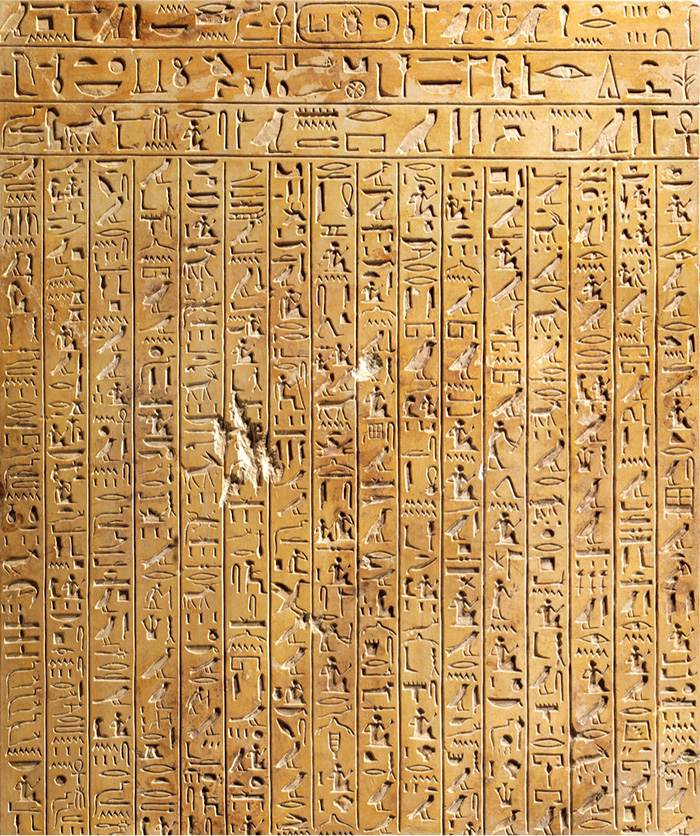
Egyptians developed their own unique writing system, known today by the Greek word hieroglyphics (meaning “sacred writings”), though the Egyptians called it medu-netjer (“the god’s words”). The roots of hieroglyphic writing can be traced to the time before the Early Dynastic Period when the first written symbols emerged. But by at least 3000 BCE, the use of these symbols had developed into a sophisticated script. It used a combination of alphabetic signs, syllabic signs, word signs, and pictures of objects. In this complicated system, then known only to highly trained professional scribes, written symbols represented both sounds and ideas (Figure 3.19). The Egyptians also developed a simplified version of this hieroglyphic script known as hieratic, which they often employed for more mundane purposes such as recordkeeping and issuing receipts in commercial transactions.
英語のヒント
エジプト人は独自の文字体系を発達させた。現在はギリシア語の「ヒエログリフ」(「聖なる文字」の意)で知られるが、エジプト人自身はメドゥ・ネチェル(「神の言葉」)と呼んだ。その起源は、最初の文字記号が現れた初期王朝時代以前にさかのぼる。遅くとも紀元前3000年までには、記号の使用は高度な文字体系となっていた。アルファベット的な記号、音節記号、語を表す記号、物の絵を組み合わせた複雑な仕組みで、当時は専門的に訓練された書記だけが使えた。記号は音と概念の両方を表した(図3.19)。エジプト人はまた、ヒエラティック(神官文字)と呼ばれる簡略形も作り、記録や商取引の領収書など、日常的な用途でよく使った。
Egyptian Hieroglyphics.エジプトのヒエログリフ。
(credit: modification of work "Stela of the Steward Mentuwoser" by Gift of Edward S. Harkness, 1912/The Metropolitan Museum of Art, Public Domain) · Public Domain
Figure 3.19 The hieroglyphics in this Egyptian stele from circa 1944 BCE are far more stylized than the Egyptian writing produced a thousand years earlier. It took many centuries for the Egyptian script to evolve into the style of writing seen here. (credit: modification of work "Stela of the Steward Mentuwoser" by Gift of Edward S. Harkness, 1912/The Metropolitan Museum of Art, Public Domain)
図3.19 紀元前1944年頃のこのエジプト石碑のヒエログリフは、1000年前の文字よりはるかに様式化されている。この文字様式になるまでには、何世紀もかかった。(出典:Edward S. Harkness寄贈、1912年/メトロポリタン美術館「Stela of the Steward Mentuwoser」を改変、パブリックドメイン)
Egyptian scribes recorded their ideas in stone inscriptions on the walls of temples and painted them on the walls of tombs, but they also used the fibers from a reed plant growing along the banks of the Nile to produce papyrus, a writing material like paper that could be rolled into scrolls and stored as records. Some of these papyrus rolls have survived for thousands of years because of the way the dry heat preserved them, and they proved very useful for modern historians and archaeologists after hieroglyphics were deciphered in the nineteenth century. They preserved Egyptian myths and poetry, popular stories, and lists of pharaohs, along with records of the daily life of ancient Egyptians.
英語のヒント
エジプトの書記は、神殿の石壁に文字を刻み、墓の壁に描いて考えを記録した。さらに、ナイル川岸に生える葦状の植物の繊維から、紙に似た筆記材パピルスも作った。巻物にして記録を保管できた。乾燥した熱い環境のおかげで、数千年間残った巻物もある。19世紀にヒエログリフが解読されると、それらは現代の歴史家や考古学者にとって非常に役立つものとなった。神話や詩、広く親しまれた物語、ファラオの一覧、さらに古代エジプト人の日常生活の記録が保存されていたのである。