第3章初期文明と都市社会Early Civilizations and Urban Societies
Trade, Writing, and Religion交易、文字、宗教
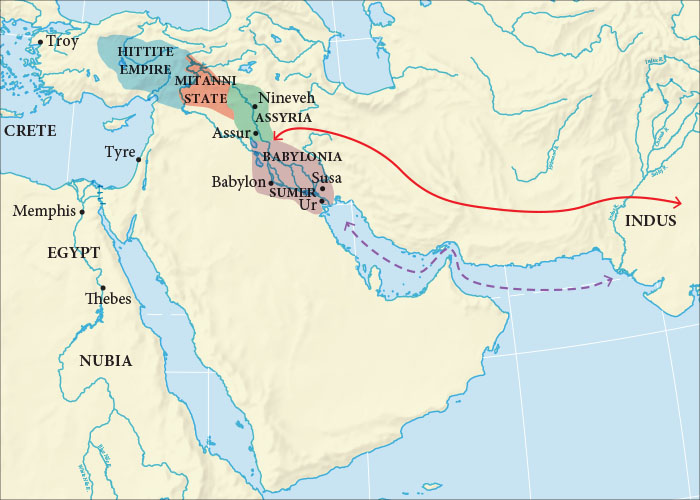
Archaeological work has revealed that a considerable amount of trade flowed between Mesopotamia and the Indus valley. Cuneiform tablets from Mesopotamia refer to the Indus valley as Meluhha and document that precious stones such as lapis lazuli and carnelian, as well as marine shells from the Indian Ocean, were imported from there. Merchants traveled by sea across the Indian Ocean and by land over the Iranian plateau (Figure 3.26).
英語のヒント
考古学研究によって、メソポタミアとインダス流域の間に、大量の交易があったことが分かっている。メソポタミアの楔形文字粘土板は、インダス流域をメルッハと呼び、そこからラピスラズリ、紅玉髄などの貴石や、インド洋の貝殻を輸入したことを記す。商人はインド洋を海路で、イラン高原を陸路で往来した(図3.26)。
Indus Valley Trade with Mesopotamia.インダス流域とメソポタミアの交易。
(attribution: Copyright Rice University, OpenStax, under CC BY 4.0 license) · CC BY 4.0
Figure 3.26 From the work of archaeologists, we know that significant trade took place between the inhabitants of the Indus River valley and their contemporaries in Mesopotamia. (attribution: Copyright Rice University, OpenStax, under CC BY 4.0 license)
図3.26 考古学者の研究から、インダス川流域の住民と、同時代のメソポタミア人の間に、重要な交易があったことが分かる。(出典:Rice University、OpenStax、CC BY 4.0)
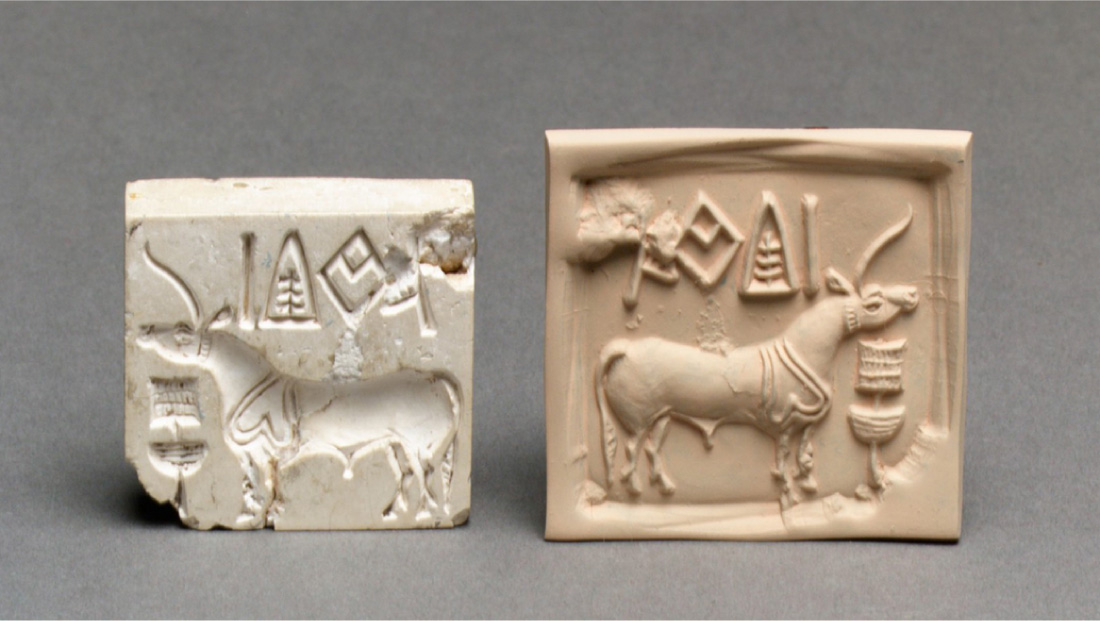
The influence of Mesopotamia on the Indus valley culture is evident in the use of seals. The Indus valley seals were inscribed with depictions of human figures and animals such as bulls and goats, likely totems for families or lineages, and brief inscriptions that likely indicate names, titles, or occupations. Merchants marked ownership of goods by making an impression of the seal on the soft clay that covered the mouth of the jar or other vessel that held the objects, or on clay tags attached to sacks of grain (Figure 3.27). A similar practice occurred in contemporary Mesopotamia, where the seal was in the shape of a cylinder that could be rolled to leave an impression. Archaeologists have found seals from the Indus valley in ancient Sumerian cities such as Ur.
英語のヒント
印章の使用には、メソポタミアがインダス文化に与えた影響が見られる。インダスの印章には人物、雄牛やヤギなどの動物が刻まれ、おそらく家族や家系の象徴だった。短い銘文は、名前、称号、職業を示すのだろう。商人は、品物を入れた壺や容器の口を覆う柔らかい粘土、あるいは穀物袋に付けた粘土札へ印章を押し、所有権を示した(図3.27)。同時代のメソポタミアにも似た慣行があり、円筒形の印章を転がして印影を残した。ウルなど古代シュメールの都市でも、インダスの印章が発見されている。
An Indus Valley Seal.インダスの印章。
(credit: modification of work "Stamp seal and modern impression: unicorn and incense burner (?)" by Dodge Fund, 1949/The Metropolitan Museum of Art, Public Domain) · Public Domain
Figure 3.27 On the left is a seal from the Indus valley civilization, and on the right is a modern clay impression made from it. Such seals typically showed animals and a script that remains to be deciphered. (credit: modification of work "Stamp seal and modern impression: unicorn and incense burner (?)" by Dodge Fund, 1949/The Metropolitan Museum of Art, Public Domain)
図3.27 左はインダス文明の印章、右はそこから現代に作った粘土の印影。こうした印章には、通常、動物と、まだ解読されていない文字が描かれる。(出典:Dodge Fund、1949年/メトロポリタン美術館「Stamp seal and modern impression: unicorn and incense burner (?)」を改変、パブリックドメイン)
The script that appears on many of the seals is unique to the people of the Indus valley civilization, and scholars have yet to decipher it. It seems to consist of phonograms, signs for the sounds of syllables, and there appear to be about four hundred such signs. Many speculate that the language written in this script may be related to the Dravidian languages still spoken across southern India today. It may also be similar to the script invented by the Elamites of southwestern Iran. Unlike the case in Mesopotamia and Egypt, archaeologists have not uncovered clay tablets or papyrus rolls in the Indus valley.
英語のヒント
多くの印章にある文字は、インダス文明独自のもので、今も解読されていない。音節の音を示す表音記号から成るように見え、その数は約400とされる。記された言語は、現在もインド南部で話されるドラヴィダ諸語と関係するかもしれない、と考える人が多い。イラン南西部のエラム人の文字と似ている可能性もある。メソポタミアやエジプトとは異なり、インダス流域では粘土板やパピルス巻物は発見されていない。
Bronze technology probably also entered the Indus River valley by the third millennium BCE through trade with Mesopotamia. Merchants from the Indus valley may even have exported tin from Afghanistan to Mesopotamia, since this metal was in demand for the manufacture of bronze.
英語のヒント
青銅技術も、おそらく紀元前3千年紀までに、メソポタミアとの交易を通じてインダス流域へ入った。インダスの商人は、アフガニスタンからメソポタミアへスズを輸出した可能性さえある。青銅製造に必要とされた金属だったからである。
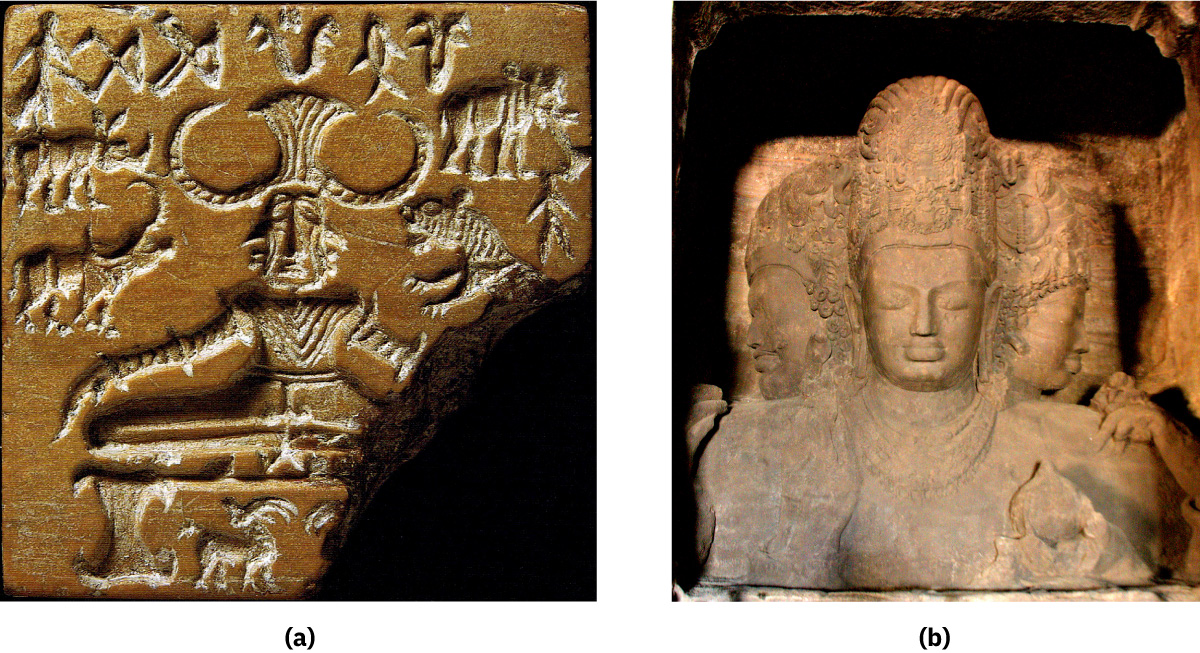
Notwithstanding the many obvious Mesopotamian influences and trading connections, the people of the Indus valley civilization developed their own unique culture. Their distinctive religion may have shaped later cultures in India. For example, clay figurines from the Indus valley that are believed to depict deities are often interpreted as portraying a goddess whose female attributes are similar to those of the Hindu goddess Durga, consort of the god Shiva. Some seals depict a horned three-faced figure surrounded by animals, which closely resembles the Hindu deity Shiva when represented as the Lord of the Animals (Figure 3.28). Archaeologists have also found stones molded into shapes that resemble lingams and yonis, which are representations of male and female sexual organs associated with the worship of Shiva. The people of the Indus valley buried their dead with modest grave goods such as clay pots, which suggests a belief in an afterlife. However, there is no evidence of temples or monumental tombs such as the Egyptian pyramids or the royal tombs of Ur in Mesopotamia.
英語のヒント
メソポタミアの影響や交易関係は多く見られるが、インダス文明の人々は独自の文化も作った。その宗教は、後のインド文化に影響した可能性がある。たとえば、神を表すとされる粘土小像は、シヴァ神の配偶神であるヒンドゥー教の女神ドゥルガーに似た女性的特徴を持つ、女神像と解釈されることが多い。一部の印章には、角と三つの顔を持ち、動物に囲まれた人物がある。「動物の主」としてのシヴァの表現によく似る(図3.28)。また、シヴァ崇拝に関わる男性・女性の性器の表現、リンガとヨーニに似た形の石も見つかっている。死者は土器などの控えめな副葬品とともに葬られ、死後の世界への信仰を示唆する。しかし、エジプトのピラミッドやメソポタミアのウル王墓のような、神殿や巨大な墓の証拠はない。
Possible Influence of Indus Valley Religious Imagery.インダスの宗教図像が及ぼした可能性のある影響。
(credit a: modification of work "Shiva Pashupati" by Unknown/Wikimedia Commons, Public Domain; credit b: modification of work "Elephanta Caves" by Christian Haugen/Flickr, CC BY 2.0) · Public Domain + CC BY 2.0
Figure 3.28 Historians speculate that the religion of the Indus valley might have influenced later Indian cultures. For example, a seal from 2600–1900 BCE discovered at Mohenjo-Daro (a) shows a seated figure with three faces surrounded by animals. A much later sixth-century CE portrayal of Shiva from the Elephanta Caves in western India (b) shows the Hindu god seated, also with three faces and surrounded by animals. (credit a: modification of work "Shiva Pashupati" by Unknown/Wikimedia Commons, Public Domain; credit b: modification of work "Elephanta Caves" by Christian Haugen/Flickr, CC BY 2.0)
図3.28 歴史家は、インダスの宗教が後のインド文化に影響した可能性を考えている。たとえばモヘンジョダロ出土の紀元前2600~1900年の印章(a)には、三つの顔を持ち、動物に囲まれて座る人物がある。はるか後の紀元6世紀、インド西部エレファンタ石窟のシヴァ像(b)も、三つの顔を持ち、動物に囲まれて座るヒンドゥー教の神を示す。(出典a:作者不詳/Wikimedia Commons「Shiva Pashupati」を改変、パブリックドメイン。出典b:Christian Haugen/Flickr「Elephanta Caves」を改変、CC BY 2.0)
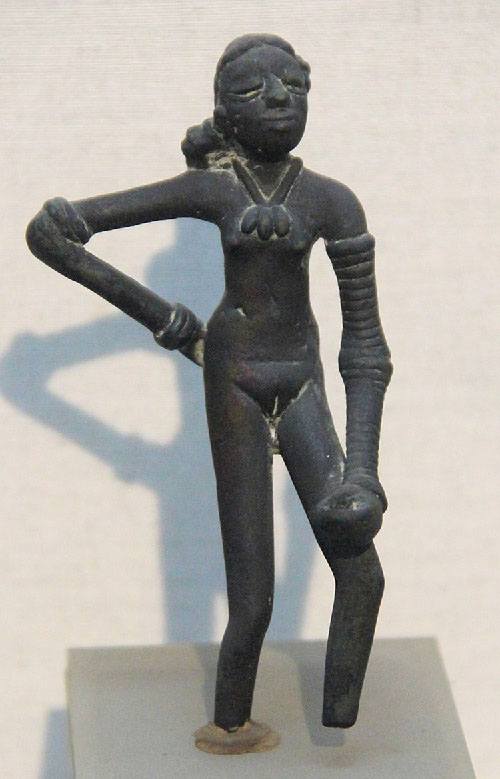
The artisans of the Indus valley created unique sculptures in clay, stone, and bronze. One of the more spectacular stone works from Mohenjo-Daro depicts a serene bearded man who may be a priest or leader in the community. A tiny bronze figure appears to represent a young woman dancing (Figure 3.29). Her bracelets and necklaces indicate that the people of this culture employed artisans to manufacture such adornment, which may have indicated high social status. Artisans of the Indus valley were also very busy manufacturing pottery and seals. Their artistic designs influenced artisans in neighboring cultures over a wide area, from the upper Ganges River valley in what is today northwestern India to Baluchistan in western Pakistan and southeastern Iran.
英語のヒント
インダスの職人は、粘土、石、青銅による独自の彫刻を作った。モヘンジョダロの優れた石像の一つは、穏やかな表情のひげの男性で、神官や共同体の指導者かもしれない。小さな青銅像は、踊る若い女性を表すように見える(図3.29)。腕輪や首飾りから、この文化には装身具を作る職人がいたことが分かり、その装飾は高い地位を示した可能性がある。職人は土器や印章も盛んに作った。その意匠は、現在のインド北西部のガンジス川上流域から、パキスタン西部・イラン南東部のバルーチスターンまで、周辺の広い地域の職人に影響した。
The Mohenjo-Daro Dancer.モヘンジョダロの踊り子。
(credit: modification of work "Bronze ‘Dancing Girl,’ Mohenjo-daro, c. 2500 BC" by Gary Todd/Flickr, Public Domain) · Public Domain
Figure 3.29 This four-inch-tall bronze statue of a young woman discovered at Mohenjo-Daro and dated to circa 2300–1750 BCE could depict a goddess or a woman of the elite class who is dancing. If she is dancing, we can also conclude that music and dance may have been incorporated into social and religious rituals. (credit: modification of work "Bronze ‘Dancing Girl,’ Mohenjo-daro, c. 2500 BC" by Gary Todd/Flickr, Public Domain)
図3.29 モヘンジョダロで見つかった、高さ4インチの若い女性の青銅像。紀元前2300~1750年頃とされ、女神や、踊っている上層階級の女性かもしれない。踊りを表すなら、音楽や舞踊が社会・宗教儀礼に取り入れられた可能性も考えられる。(出典:Gary Todd/Flickr「Bronze ‘Dancing Girl,’ Mohenjo-daro, c. 2500 BC」を改変、パブリックドメイン)
Merchants from the Indus valley were undoubtedly active in exchanging such wares in these regions. In the absence of coinage, they used a common system of stone cubical weights to assess goods in commercial exchanges that required barter. The cities of the Indus valley could have also used these weights to assess taxes in kind that they collected for their granaries.
英語のヒント
インダスの商人は、こうした品を各地で盛んに交換したのだろう。硬貨がないため、物々交換を伴う取引では、共通の立方体形の石製分銅を使って品物を評価した。各都市は、穀物倉庫へ集める現物税を査定する際にも、この分銅を使った可能性がある。