第3章初期文明と都市社会Early Civilizations and Urban Societies
3.3 Ancient Egypt3.3 古代エジプト
Learning Objectives学習の目標
By the end of this section, you will be able to:
この節を学ぶと、次のことができるようになる。
Discuss the unification of Ancient Egypt and the development of a distinct culture there
古代エジプトの統一と、独自の文化の発達を論じる。
Analyze the accomplishments of the pharaohs under the Old Kingdom
古王国時代のファラオの業績を分析する。
Describe the changes in government and society in Egypt during the Middle Kingdom
中王国時代のエジプトで、統治と社会がどう変わったかを説明する。
The rich agricultural valleys historians refer to as the “Fertile Crescent,” due to the shape of this region on the map, witnessed the development of an early civilization as long ago as the fourth millennium BCE. Adjacent to this region was another fertile river valley formed by the Nile in northeast Africa. Here arose another civilization that was quite unique. Unlike the city-states of Sumer, which were not organized into an empire until the time of Sargon of Akkad, the peoples of the Nile River valley were brought together under a single ruler around 3150 BCE. Although brief intervals of disunity occurred, Egypt remained a united and powerful kingdom, the great superpower of the ancient Near East, until the end of the Bronze Age in about 1100 BCE.
英語のヒント
地図上の形から歴史家が「肥沃な三日月地帯」と呼ぶ豊かな農耕地域では、早くも紀元前4千年紀に初期文明が発達した。その隣のアフリカ北東部にも、ナイル川の作る肥沃な流域があった。そこには、非常に独自性の強い文明が生まれた。アッカドのサルゴンの時代まで帝国に統合されなかったシュメールの都市国家とは異なり、ナイル川流域の人々は、紀元前3150年頃、一人の支配者の下にまとまった。短い分裂期はあったが、エジプトは紀元前1100年頃の青銅器時代の終わりまで、統一された強大な王国、古代近東の大国であり続けた。
The Origins of Ancient Egypt古代エジプトの起源
Aside from the Nile, Egypt and the areas around it are today part of the expansive and very arid Sahara. But around 10,000 BCE, as the Neolithic Revolution was getting underway in parts of southwestern Asia, much of North Africa including Egypt was lush, wet, and dotted with lakes. The region was highly hospitable to the many Paleolithic peoples living there and surviving on its abundant resources.
英語のヒント
現在、ナイル川沿いを除くエジプトと周辺地域は、広大で乾燥の激しいサハラの一部である。しかし、西南アジアの一部で新石器革命が始まった紀元前1万年頃、エジプトを含む北アフリカの多くは、緑豊かで湿潤であり、湖が点在していた。そこに住む多くの旧石器時代の人々にとって、豊富な資源に支えられた暮らしやすい土地だった。
However, beginning around 6000 BCE the grasslands and lakes began to give way to sand as the once green environment was transformed into the Sahara we recognize today. As the environment became more difficult for humans to survive in, they retreated to oases and rivers on the fringes. One of these areas was the Nile River valley, a long thin area of fertility running through the deserts of eastern North Africa and made possible by the regular flooding of the Nile. The Nile is the longest river in Africa, and the second-longest in the world after the Amazon. It originates deep in central Africa and flows thousands of miles north through Egypt before it spills into the Mediterranean Sea.
英語のヒント
ところが紀元前6000年頃から、草原や湖は砂に置き換わり始め、かつての緑地は、現在知られるサハラへと変わった。環境が厳しくなると、人々は周縁のオアシスや川へ退いた。その一つがナイル川流域だった。北アフリカ東部の砂漠を貫く細長い肥沃な帯であり、ナイルの定期的な氾濫によって成り立っていた。ナイル川はアフリカで最長、世界ではアマゾンに次いで2番目に長い川である。アフリカ中央部の奥地に源を発し、エジプトを通って何千マイルも北へ流れ、地中海へ注ぐ。
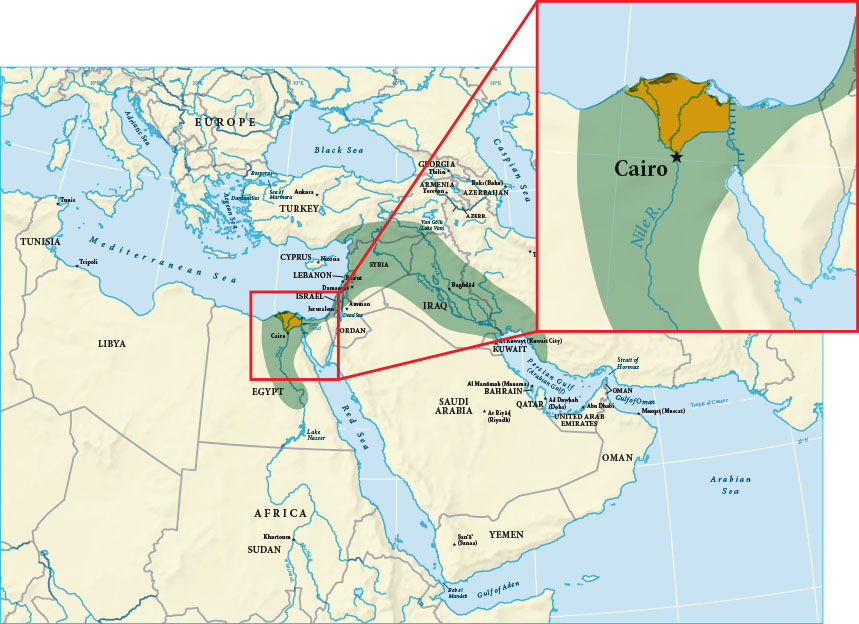
It was around this same time, about 7000 to 6000 BCE, that agricultural technology and knowledge about the domestication of wheat, barley, sheep, goats, and cattle were introduced into the Nile River valley, likely through contact with the Levant. The earliest evidence for the emergence of Egyptian culture dates from this era as well. Two related but different Neolithic cultures arose: one in the Nile delta, where the river runs into the Mediterranean, and the other upriver and to the south of this location. The people of these cultures lived in crude huts, survived on fishing and agriculture, developed distinctive pottery styles, and even practiced burial rituals. Over thousands of years, they developed into two separate kingdoms, Lower Egypt or the delta region, and Upper Egypt or the area upriver (Figure 3.17).
英語のヒント
ほぼ同じ紀元前7000~6000年頃、おそらくレヴァントとの接触を通じて、農業技術と、コムギ、オオムギの栽培化、ヒツジ、ヤギ、ウシの家畜化の知識が、ナイル川流域へ伝わった。エジプト文化の成立を示す最古の証拠も、この時代のものである。関連しながら異なる二つの新石器文化が生まれた。一つは川が地中海へ注ぐナイル・デルタ、もう一つはその南の上流地域である。人々は粗末な小屋に住み、漁労と農耕で暮らし、独特の土器様式や埋葬儀礼を発達させた。数千年のうちに、デルタの下エジプトと上流の上エジプトという、別々の王国になった(図3.17)。
The Upper and Lower Kingdoms of Egypt.エジプトの上王国と下王国。
(attribution: Copyright Rice University, OpenStax, under CC BY 4.0 license) · CC BY 4.0
Figure 3.17 The fertile Nile River valley became home to two different but related early Egyptian cultures, the Lower Kingdom in the north and the Upper Kingdom in the south. (attribution: Copyright Rice University, OpenStax, under CC BY 4.0 license)
図3.17 肥沃なナイル川流域には、互いに関係しながら異なる二つの初期エジプト文化が生まれた。北の下王国と南の上王国である。(出典:Rice University、OpenStax、CC BY 4.0)
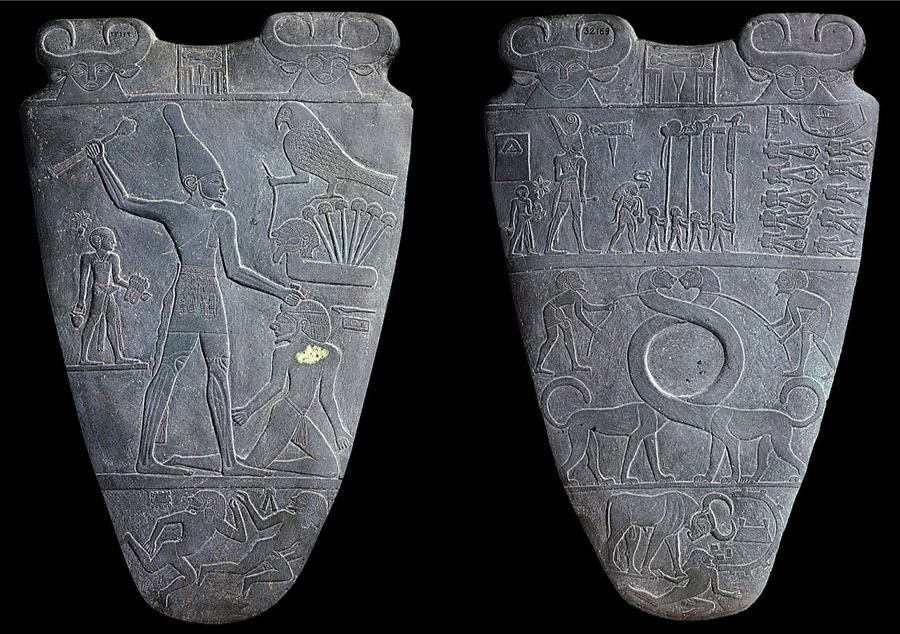
A major political and cultural shift occurred in about 3150 BCE when Upper and Lower Egypt were unified into a single powerful kingdom. Some evidence suggests this achievement belongs to a king named Narmer. More recent records attribute it to a king called Menes, but many scholars now believe Menes and Narmer are one and the same (Figure 3.18).
英語のヒント
紀元前3150年頃、上下エジプトが一つの強力な王国に統一され、政治と文化の大きな転換が起こった。これを成し遂げたのはナルメルという王だと示唆する証拠がある。後世の記録はメネスという王に帰しているが、現在では両者を同一人物と考える研究者が多い(図3.18)。
The Narmer Palette.ナルメルのパレット。
(credit: "La palette de Narmer" by “Jean88”/Wikimedia Commons, CC0 1.0) · CC0 1.0
Figure 3.18 Often called the Narmer palette, this two-foot-high siltstone Egyptian artifact appears to depict Egypt’s unification, which would place it from around 3150–3000 BCE. The large figure on one side (left image) is believed to be King Narmer wearing the white crown of Upper Egypt and striking a prisoner, and the tall, left-most figure in the upper row on the other side (right image) is likely Narmer wearing the red crown of Lower Egypt in a procession. Two mythical creatures stand below, their necks artfully entwined. (credit: "La palette de Narmer" by “Jean88”/Wikimedia Commons, CC0 1.0)
図3.18 「ナルメルのパレット」と呼ばれる高さ2フィートのシルト岩製品。エジプト統一を描いたものと見られ、その場合は紀元前3150~3000年頃の制作となる。片面(左)の大きな人物は、上エジプトの白冠をかぶり捕虜を打つナルメル王と考えられる。反対面(右)の上段左寄りの背の高い人物は、下エジプトの赤冠をかぶって行列に加わるナルメルらしい。その下では、2頭の神話上の獣が巧みに首を絡ませている。(出典:「Jean88」/Wikimedia Commons「La palette de Narmer」、CC0 1.0)
Unification gave rise to what scholars refer to as the Early Dynasty Period (about 3150 to 2613 BCE), or the era of the earliest dynasties to rule a unified Egypt. The powerful kings of these dynasties established a bureaucratic system, possibly influenced by the palace/temple redistributive economic system in place in ancient Sumer. But unlike Mesopotamia, ancient Egypt in the Bronze Age was now a single state instead of a number of warring rivals. Also unlike Mesopotamia, which was subject to periodic invasion, Egypt was protected by its geography. On both east and west, the Nile River valley was surrounded by large deserts that were difficult to cross and that made the kingdom into a kind of island in a hot, dry sea. During this time, many of the best-known cultural characteristics of ancient Egypt emerged in their earliest forms. They include the institution of the pharaoh, distinctive religious practices, and the Egyptian writing system.
英語のヒント
統一によって、研究者が初期王朝時代(紀元前3150~2613年頃)と呼ぶ時代、すなわち統一エジプトを最初の王朝が治める時代が始まった。強力な王たちは官僚制を築いた。古代シュメールの宮殿・神殿による再分配経済の影響を受けた可能性がある。しかし、メソポタミアとは異なり、青銅器時代の古代エジプトは、戦い合う多数の勢力ではなく一つの国家となっていた。また、侵入を繰り返し受けたメソポタミアと異なり、エジプトは地理に守られていた。ナイル川流域の東西は横断の難しい大砂漠に囲まれ、王国は、暑く乾いた海に浮かぶ島のようだった。この時代に、ファラオの制度、独自の宗教慣行、文字体系など、古代エジプトを代表する多くの文化的特徴が、最初の形を現した。