第3章初期文明と都市社会Early Civilizations and Urban Societies
The Rise of the World’s First Empire世界最初の帝国の成立
Around 2300 BCE, the era of the independent Sumerian city-state, a political entity consisting of a city and surrounding territory that it controls, came to an end. Sumer and indeed all of Mesopotamia was conquered by Sargon of Akkad, who created the first-known empire, in this case, a number of regional powers under the control of one person. The word “Akkad” in his name was a reference to the Akkadians, a group that settled in central Mesopotamia, north of Sumer, around the ancient city of Kish. Over time, the Akkadians adopted Sumerian culture and adapted cuneiform to their own language, a language of the Semitic family that includes the Arabic and Hebrew spoken today. They also identified their own gods with the gods of the Sumerians and adopted Sumerian myths. For example, the Akkadians identified the fertility goddess Inanna with their own goddess Ishtar.
英語のヒント
紀元前2300年頃、独立したシュメール都市国家の時代は終わった。都市国家とは、都市と、それが支配する周辺領域から成る政治組織である。アッカドのサルゴンがシュメール、さらにメソポタミア全体を征服し、知られている最初の帝国を作った。ここで帝国とは、複数の地域勢力を一人が支配する仕組みを指す。彼の名に付く「アッカド」は、シュメールの北、メソポタミア中央部の古代都市キシュ周辺に定住したアッカド人に由来する。彼らは次第にシュメール文化を取り入れ、楔形文字を自分たちの言語へ応用した。アッカド語は、現在のアラビア語やヘブライ語も属するセム語族の言語である。彼らはまた、自らの神々をシュメールの神々と同一視し、その神話も取り入れた。たとえば豊穣の女神イナンナを、自らの女神イシュタルと同一視した。
Sargon conquered not only Sumer but also what is today northern Iraq, Syria, and southwestern Iran. While the precise details of his origin and rise to power are not known, scholars believe the story Sargon told about himself, at least, has likely been accurately preserved in the Legend of Sargon, written two centuries after his death as a purported autobiography. It is a familiar story of a scrappy young hero born in humble circumstances and rising on his own merits to become a great leader. The Legend relates how, when Sargon was a baby, his unwed mother put him in a basket and cast it on the Euphrates River. A farmer found and raised him, and Ishtar loved Sargon and elevated him from a commoner to a great king and conqueror.
英語のヒント
サルゴンはシュメールだけでなく、現在のイラク北部、シリア、イラン南西部も征服した。出自や台頭の詳しい事情は不明だが、少なくとも本人が語った物語は、死後200年に自伝と称して書かれた『サルゴン伝説』に、おそらく正確に伝わっていると研究者は考える。低い身分に生まれたたくましい若者が、自らの力で偉大な指導者になるという、よくある物語である。伝説によれば、サルゴンが赤ん坊の時、未婚の母は彼を籠に入れ、ユーフラテス川へ流した。農民が見つけて育て、イシュタルがサルゴンを愛し、平民から偉大な王、征服者へと引き上げた。
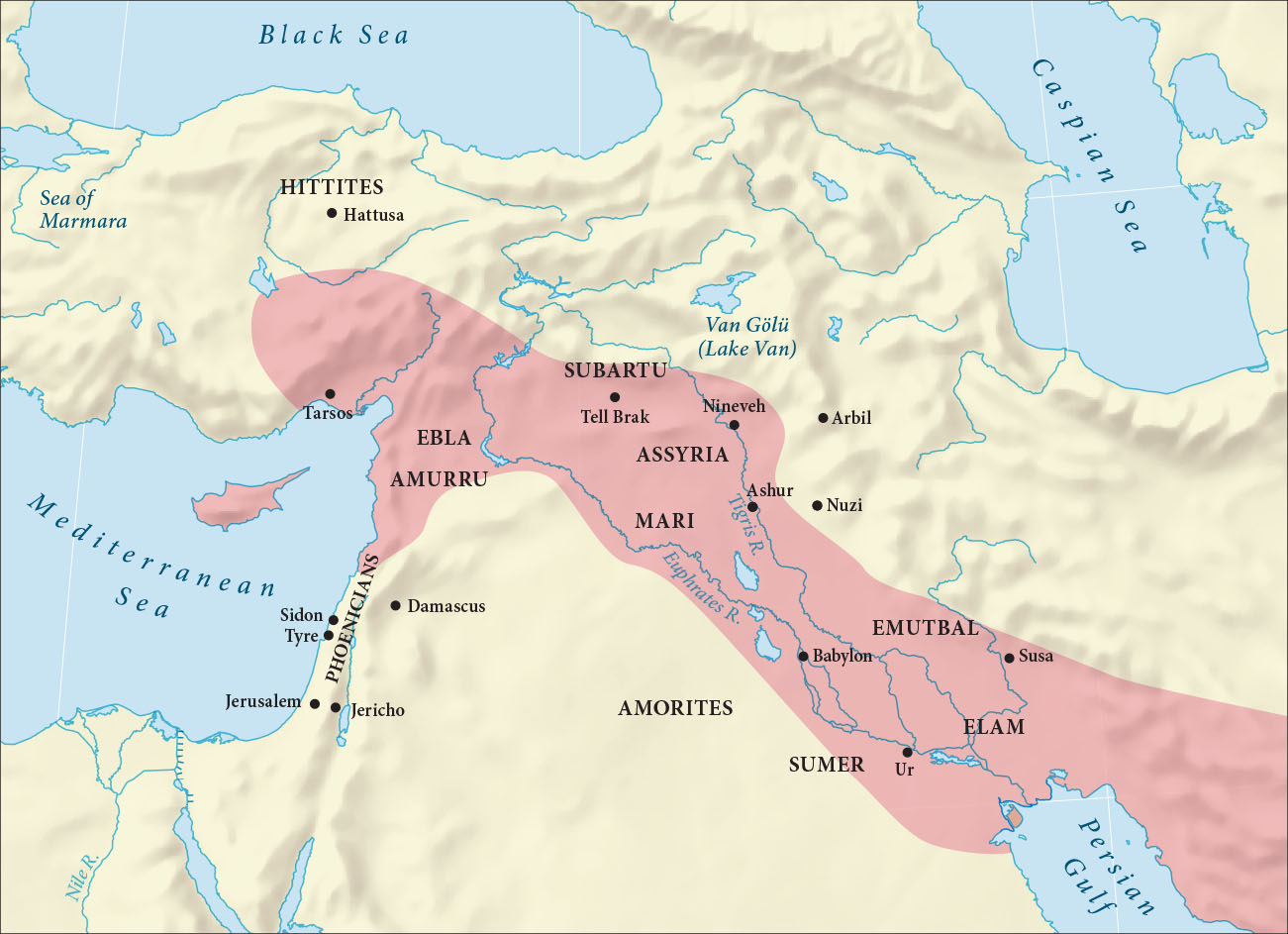
This interesting tale would have certainly been a powerful piece of propaganda justifying Sargon’s rule and endearing him to the common people, and some of it may even be true. But from what historians can tell, Sargon’s rise to power likely occurred during a period of turmoil as his kingdom of Kish, of which he had likely seized control, came under attack by another king named Lugalzagesi. Sargon’s eventual defeat of Lugalzagesi and conquest of all of Sumer proved to be the beginning of a larger conquest of Mesopotamia. The Akkadian Empire that Sargon created lasted for about a century and a half, officially coming to an end in the year 2193 BCE (Figure 3.13).
英語のヒント
この興味深い物語は、サルゴンの支配を正当化し、庶民に親しみを抱かせる、強力な宣伝だったに違いない。一部には事実も含まれるかもしれない。しかし、歴史家の知りうる限りでは、彼の台頭は混乱期に起こったらしい。サルゴンがおそらく支配権を奪っていたキシュ王国が、ルガルザゲシという別の王の攻撃を受けたのである。サルゴンはやがてルガルザゲシを倒し、シュメール全土を征服した。それは、さらに広いメソポタミア征服の始まりだった。彼の建てたアッカド帝国は約150年存続し、正式には紀元前2193年に終わった(図3.13)。
The World’s First Empire.世界最初の帝国。
(attribution: Copyright Rice University, OpenStax, under CC BY 4.0 license) · CC BY 4.0
Figure 3.13 The Akkadian Empire reached its greatest geographic extent under its first emperor, Sargon of Akkad. At Sargon’s death in 2279 BCE, it included all of Mesopotamia, and his armies were marching into Syria and Anatolia. (attribution: Copyright Rice University, OpenStax, under CC BY 4.0 license)
図3.13 アッカド帝国は、最初の皇帝サルゴンの下で領土が最大となった。紀元前2279年に彼が死んだ時、帝国はメソポタミア全域を含み、その軍勢はシリアとアナトリアへ進出していた。(出典:Rice University、OpenStax、CC BY 4.0)
One of the rivals of the Akkadian Empire was the city-state of Ebla, located in northwestern Syria. At some point, its people had adapted Sumerian cuneiform to their own language, which, like Akkadian, belonged to the Semitic family of languages, and archaeologists have discovered thousands of cuneiform tablets at the site. These tablets reveal that Ebla especially worshipped the storm god Adad, who was honored with the title “Ba‘al” or lord. More than one thousand years later in the Iron Age, people in this region still worshipped Baal, who was the main rival of Yahweh for the affections of the ancient Israelites.
英語のヒント
アッカド帝国の競争相手の一つが、シリア北西部の都市国家エブラだった。その住民は、ある時期にシュメールの楔形文字を自らの言語へ応用した。エブラ語もアッカド語と同じくセム語族に属する。遺跡では、何千枚もの楔形文字粘土板が発見された。そこから、エブラでは嵐の神アダドが特に崇拝され、「主」を意味する「バアル」の称号で敬われたことが分かる。1000年以上後の鉄器時代にも、この地域ではバアルが崇拝され、古代イスラエル人の信仰をめぐるヤハウェの主要な対抗神となった。
Other rivals of the Akkadians were the Elamites, who inhabited the region to the immediate southeast of Mesopotamia in southwest Iran and whose city of Susa arose around 4000 BCE. The art and architecture of the Elamites suggest a strong Sumerian influence. They developed their own writing system around 3000 BCE, even though they adapted Sumerian cuneiform to their language later in the third millennium BCE. The Elamites also worshipped their own distinct deities, such as Insushinak, the Lord of the Dead. Both Elam and Ebla eventually suffered defeat at the hands of the Akkadians.
英語のヒント
アッカド人の別の競争相手がエラム人だった。彼らは、メソポタミアのすぐ南東、イラン南西部に住み、その都市スサは紀元前4000年頃に生まれた。美術や建築には、シュメールの強い影響がうかがえる。エラム人は紀元前3000年頃、独自の文字体系を発達させたが、紀元前3千年紀の後半には、シュメールの楔形文字も自らの言語に応用した。死者の主インシュシナクなど、独自の神々も崇拝した。エラムとエブラは、いずれも最終的にアッカド人に敗れた。
In the year 2193 BCE, however, the Akkadian Empire collapsed. The precise reason is not entirely clear. However, some ancient accounts point to the incursions of the nomadic Guti tribes, whose original homes were located in the Zagros Mountains of northwestern Iran, northwest of Mesopotamia. These Guti were originally pastoralists, who lived off their herds of livestock and moved from place to place to find pasture for their animals. While the Guti tribes certainly did move into the Akkadian Empire toward its end, modern scholarship suggests that the empire was likely experiencing internal decline and famine before this. The Guti appear to have exploited this weakness rather than triggering it. Regardless, for around a century, the Guti ruled over Sumer and adopted its culture as their own. Around 2120 BCE, however, the Sumerians came together under the leadership of the cities of Uruk and Ur and expelled the Guti from their homeland.
英語のヒント
しかし紀元前2193年、アッカド帝国は崩壊した。正確な理由は明らかではない。古代の記録の一部は、もともとイラン北西部、メソポタミアの北西にあるザグロス山脈に住んだ、遊牧民グティ人の侵入を挙げる。彼らは家畜の群れで生計を立て、牧草地を求めて移動する牧畜民だった。帝国末期にグティ人が侵入したことは確かだが、現代の研究では、それ以前から帝国は内部の衰退と飢饉に苦しんでいた可能性が高い。グティ人は弱体化を引き起こしたというより、それを利用したらしい。いずれにせよ、彼らは約100年にわたりシュメールを支配し、その文化を取り入れた。しかし紀元前2120年頃、シュメール人はウルクとウルを中心に結集し、故郷からグティ人を追放した。
Later Empires in Mesopotamiaメソポタミアの後続の帝国
While Sargon’s empire lasted only a few generations, his conquests dramatically transformed politics in Mesopotamia. The era of independent city-states waned, and over the next few centuries, a string of powerful Mesopotamian rulers were able to build their own empires, often using the administrative techniques developed by Sargon as a model. For example, beginning about 2112 BCE, all Sumer was again united under the Third Dynasty of Ur as the Guti were driven out. The rulers of this dynasty held the title of lugal of all Sumer and Akkad, and they were also honored as gods. They built temples in the Sumerian city of Nippur, which was sacred to the storm god Enlil, the ruler of the gods in the Sumerian pantheon. The most famous lugal of this dynasty was Ur-Nammu (c. 2150 BCE), renowned for his works of poetry as well as for the law code he published.
英語のヒント
サルゴンの帝国は数世代しか続かなかったが、その征服はメソポタミアの政治を大きく変えた。独立都市国家の時代は衰え、その後数世紀には、強力な支配者が次々と帝国を築いた。多くはサルゴンの統治手法を手本とした。たとえば紀元前2112年頃から、グティ人が追い出されるとともに、シュメール全土はウル第3王朝の下で再統一された。その支配者は「全シュメールとアッカドのルガル」を称し、神としても敬われた。彼らは、シュメールの神々の支配者である嵐の神エンリルの聖地、ニップルに神殿を建てた。この王朝で最も有名なルガルはウル・ナンム(紀元前2150年頃)で、詩作と、公布した法典で知られる。
At its height, the Third Dynasty extended its control over both southern and northern Mesopotamia. But by the end of the third millennium, change was on the horizon. Foreign invaders from the north, east, and west put tremendous pressure on the empire, and its rulers increased their military preparedness and even constructed a 170-mile fortification wall to keep them out. While these strategies were somewhat effective, they appear to have only postponed the inevitable as Amorites, Elamites, and other groups eventually poured in and raided cities across the land. By about 2004 BCE, Sumer had crumbled, and even Ur was violently sacked by the invaders.
英語のヒント
最盛期の第3王朝は、メソポタミア南部と北部の両方を支配した。しかし紀元前3千年紀末には、変化の兆しが見えた。北・東・西からの侵入者が帝国に強い圧力をかけたため、支配者は軍備を増強し、侵入を防ぐ全長170マイルの防壁まで築いた。これらの対策はある程度有効だったが、避けられない事態を先延ばしにしたにすぎなかったらしい。アムル人、エラム人などが流入し、各地の都市を襲った。紀元前2004年頃までにシュメールは崩れ、ウルさえも激しく略奪された。
In the centuries after 2004 BCE, the migration of Amorites into Mesopotamia resulted in the gradual disappearance of Sumerian as a spoken language. People in the region came to speak Amorite, which belonged to the family of Semitic languages. Nonetheless, scribes continued to preserve and write works in Sumerian and Akkadian cuneiform. Sumerian and Akkadian became the languages of religious rituals, hymns, and prayers, as well as classic literary works such as the Epic of Gilgamesh. Consequently, the literary output of these earlier cultures was preserved and transmitted to the new settlers. When nomadic Amorite tribes settled in Mesopotamia, they eventually established new cities such as Mari, Asshur, and Babylon, and they adopted much of the culture they encountered. The ancient Sumerian cities of Larsa and Isin of this era also preserved these cultural traditions, even as they came under the rule of Amorite kings.
英語のヒント
紀元前2004年以後の数世紀、アムル人のメソポタミアへの移住によって、話し言葉としてのシュメール語は次第に姿を消した。この地域の人々は、セム語族のアムル語を話すようになった。それでも、書記たちはシュメール語やアッカド語の楔形文字で、作品を保存し、書き続けた。これらの言語は、宗教儀礼、賛歌、祈り、『ギルガメシュ叙事詩』のような古典文学の言語となった。こうして、以前の文化の文学的成果が保存され、新たな住民へ伝えられた。遊牧民だったアムル人がメソポタミアに定住すると、やがてマリ、アッシュル、バビロンなどの新都市を築き、そこで出会った文化の多くを取り入れた。この時代の古いシュメール都市ラルサやイシンも、アムル系の王の支配下に入りながら、文化的伝統を守った。
Hammurabi, the energetic ruler of Babylon during the first half of the eighteenth century BCE, defeated the kings of the rival cities of Mari and Larsa and created an empire that encompassed nearly all of Mesopotamia. To unify this new empire, Hammurabi initiated the construction of irrigation projects, built new temples at Nippur, and published his legal edicts throughout his realm. Hammurabi had these edicts inscribed on stone pillars erected in different places in the empire to inform his subjects about proper behavior and the laws of the land. Being especially clear, the Code of Hammurabi far outlived the king who created it. It also provides us with a fascinating window into how Mesopotamian society functioned at this time.
英語のヒント
紀元前18世紀前半、バビロンの精力的な支配者ハンムラビは、競合するマリとラルサの王を倒し、メソポタミアのほぼ全域を含む帝国を築いた。彼は統一のため、灌漑事業を始め、ニップルに新たな神殿を建て、各地に法令を公布した。帝国内のさまざまな場所に立てた石柱に法令を刻ませ、臣民に適切な行動と国の法を知らせたのである。ハンムラビ法典は特に明確だったため、制定者である王の死後も長く生き続けた。それは、この時代のメソポタミア社会の仕組みを知る、興味深い手がかりでもある。
While Hammurabi’s empire lasted a century and a half, much of the territory he conquered began falling away from Babylon’s control shortly after he died. The empire continued to dwindle in size until 1595 BCE, when an army of Hittites from central Anatolia in the north (modern Turkey) sacked the city of Babylon. Shortly thereafter, Kassites from the Zagros Mountains of northwestern Iran conquered Babylon and southern Mesopotamia and settled there, unlike the Hittites who had returned to their Anatolian home. The Kassites established a dynasty that ruled over Babylon for nearly five hundred years, to the very end of the Bronze Age. Like the Guti and the Amorites before them, over time, the Kassite rulers adopted the culture of their Mesopotamian subjects.
英語のヒント
ハンムラビの帝国は150年ほど続いたが、征服した領土の多くは、彼の死後まもなくバビロンの支配を離れ始めた。帝国は縮小を続け、紀元前1595年、北のアナトリア中央部(現在のトルコ)から来たヒッタイト軍が、バビロンを略奪した。その直後、イラン北西部のザグロス山脈から来たカッシート人が、バビロンとメソポタミア南部を征服して定住した。故郷アナトリアへ帰ったヒッタイト人とは異なる。カッシート人は、青銅器時代の終わりまで約500年にわたりバビロンを支配する王朝を築いた。先行するグティ人やアムル人と同じく、カッシートの支配者も、次第にメソポタミアの臣民の文化を取り入れた。