第3章初期文明と都市社会Early Civilizations and Urban Societies
The First Urban Societies最初の都市社会
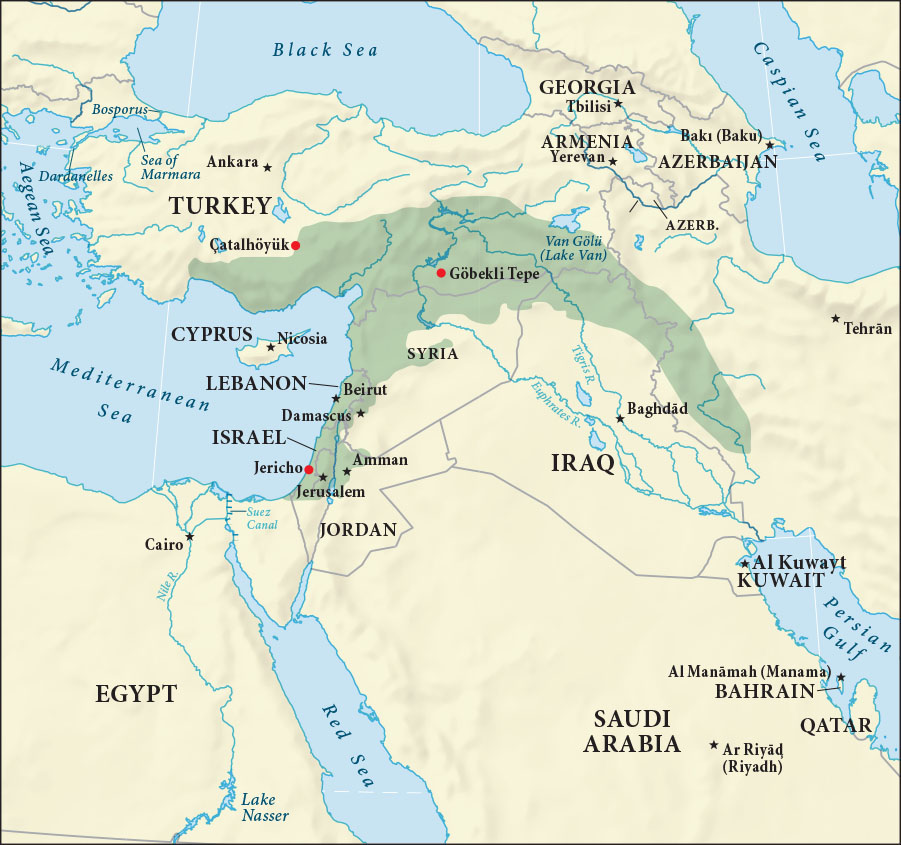
Around 10,000 BCE, wheat was first domesticated in what is today northern Iraq, southeastern Turkey, and western Iran, and also in Syria and Israel. This region is commonly called the Fertile Crescent (because of its shape). It includes Mesopotamia (modern Iraq), southern Anatolia (modern Turkey), and the Levant (modern Syria, Lebanon, Israel, and Palestine) and has yielded the earliest evidence of agriculture (Figure 3.4). This same region saw the rise of the first urban areas in the Neolithic Age, often called Neolithic cities. Examples include Jericho (8300–6500 BCE) along the Jordan River in what is today the Palestinian Territories, and Çatalhöyük (7200–6000 BCE) in southeastern Turkey. Archaeologists have established that these early urban areas had populations as high as six thousand.
英語のヒント
紀元前1万年頃、現在のイラク北部、トルコ南東部、イラン西部、さらにシリアやイスラエルで、コムギが初めて栽培化された。この地域は、その形から一般に「肥沃な三日月地帯」と呼ばれる。メソポタミア(現在のイラク)、アナトリア南部(現在のトルコ)、レヴァント(現在のシリア、レバノン、イスラエル、パレスチナ)を含み、最古の農耕の証拠が見つかっている(図3.4)。この地域には、新石器時代に最初の都市的な集落も生まれた。新石器時代の都市と呼ばれることも多い。例として、現在のパレスチナ自治区のヨルダン川沿いにあるイェリコ(紀元前8300~6500年)や、トルコ南東部のチャタル・ヒュユク(紀元前7200~6000年)が挙げられる。考古学者によれば、これら初期の都市的集落の人口は、最大6000人にも達した。
The Fertile Crescent.肥沃な三日月地帯。
(attribution: Copyright Rice University, OpenStax, under CC BY 4.0 license) · CC BY 4.0
Figure 3.4 This broad swath of land (shown in green) in what is now Iraq, Syria, Israel, Palestine, and Turkey was home to the world’s first cities, including Çatalhöyük and Jericho. (attribution: Copyright Rice University, OpenStax, under CC BY 4.0 license)
図3.4 現在のイラク、シリア、イスラエル、パレスチナ、トルコに広がるこの地域(緑色)には、チャタル・ヒュユクやイェリコなど、世界最初の都市が生まれた。(出典:Rice University、OpenStax、CC BY 4.0)
Neolithic settlements depended upon the transition to agricultural production to sustain their populations. Such developments were also accompanied by increasing complexity in other areas of life, such as religion. An agricultural surplus enabled religious specialists to devote time to performing bull sacrifices at Çatalhöyük, for example, and freed artisans to hone their skills to create the frescoes that decorated the interior space where these sacrifices occurred. Some form of government must have organized the labor and materials necessary to construct the walls and tower at Jericho, which may have served as an observatory to mark the passage of the solar year. In both Jericho and Çatalhöyük, a shared belief system, or unity behind a leader, must have inspired the inhabitants to labor in the fields and distribute their agricultural surplus. At Jericho, the community may have been united by its veneration of ancestors, whose skulls were decorated and revered as idols. The people of Çatalhöyük may have offered their bull sacrifices to a mother-deity, possibly represented by small figurines of a woman that archaeologists have discovered there.
英語のヒント
新石器時代の集落は、住民を養うため、農業生産への移行に依存していた。こうした発達に伴い、宗教など生活のほかの面も複雑になった。たとえばチャタル・ヒュユクでは、農業の余剰によって、宗教の専門家が牛の供犠に時間を割き、職人が技を磨いて、供犠が行われる室内を飾るフレスコ画を作ることが可能になった。イェリコの壁や塔を築く労働力と資材は、何らかの統治組織がまとめたに違いない。塔は、太陽年の経過を測る観測施設だった可能性もある。イェリコでもチャタル・ヒュユクでも、共有された信仰、あるいは指導者の下での結束が、人々を畑仕事と農業余剰の分配へ向かわせたのだろう。イェリコでは、頭蓋骨を飾って偶像として崇める祖先崇拝が、共同体を結び付けたのかもしれない。チャタル・ヒュユクの牛の供犠は、母なる神に捧げられた可能性がある。現地で発見された女性の小像は、その神を表したのかもしれない。
The Neolithic cities of Jericho and Çatalhöyük were some of the earliest to emerge. But they are not the only such sites. As early as 7000 BCE, a Neolithic settlement appeared in modern Pakistan, at a site today known as Mehrgarh, whose inhabitants engaged in long-distance trade, grew barley, and raised goats and sheep. Comparable Neolithic settlements in China emerged around 8000 BCE along the Yellow and Yangtze Rivers, where people cultivated millet and rice. A few thousand years later in the Americas, Neolithic settlements sprang up in both Mesoamerica and the Andes Mountains region.
英語のヒント
イェリコやチャタル・ヒュユクは、最初期に現れた新石器時代の都市の一部であり、同種の遺跡はほかにもある。早くも紀元前7000年、現在のパキスタンのメヘルガルにも集落が現れ、住民は遠距離交易を行い、オオムギを育て、ヤギやヒツジを飼っていた。中国では、紀元前8000年頃、黄河と長江の流域に同様の集落が現れ、キビ類やイネを栽培した。その数千年後には、アメリカ大陸のメソアメリカとアンデス山脈地域にも、新石器時代の集落が生まれた。
Not all the Neolithic settlements endured. Çatalhöyük, for example, was ultimately abandoned around 6000 BCE and never reoccupied. Jericho, on the other hand, was abandoned and resettled a few times and is still a functioning city today. What is important about these Neolithic settlements is what they can tell us about the long transition between the emergence of agriculture and the eventual rise of early civilizations thousands of years later in places like Mesopotamia, Egypt, and the Indus River valley.
英語のヒント
新石器時代の集落が、すべて存続したわけではない。たとえばチャタル・ヒュユクは、紀元前6000年頃に最終的に放棄され、その後は再び人が住まなかった。イェリコは、放棄と再定住を何度か繰り返し、現在も都市として存続している。これらの集落が重要なのは、農耕の出現から、数千年後にメソポタミア、エジプト、インダス川流域などで初期文明が成立するまでの、長い移行過程を教えてくれるからである。