第10章信仰と帝国Empires of Faith
10.2 The Byzantine Empire and Persia10.2 ビザンツ帝国とペルシア
Learning Objectives学習の目標
By the end of this section, you will be able to:
この節を読み終えると、次のことができるようになる。
Explain the evolution of the Byzantine Empire in Late Antiquity
古代末期におけるビザンツ帝国の変化を説明する。
Describe Sasanian culture and society in Late Antiquity
古代末期のサーサーン朝の文化と社会を描写する。
Analyze the relationship between the Roman Empire and Sasanian Persia in Late Antiquity
古代末期のローマ帝国とサーサーン朝ペルシアの関係を分析する。
The period of Late Antiquity witnessed the height of two great competing empires. The Roman Empire morphed into the Byzantine Empire, possessing a culture that looked to both its Roman past and its Christian present. This duality was exemplified in the reign of the emperor Justinian, who sought to reconquer the old empire. Meanwhile, in the East, the Sasanian Empire emerged with its own vibrant culture and vied with the Byzantines for supremacy. This situation set the stage for the emergence in the following period of smaller but still disruptive states.
英語のヒント
古代末期には、競い合う二つの大帝国が最盛期を迎えた。ローマ帝国はビザンツ帝国へ姿を変え、ローマという過去とキリスト教という現在の両方に目を向ける文化を持った。旧帝国の再征服を目指した皇帝ユスティニアヌスの治世は、この二面性をよく表していた。東方では、サーサーン朝が独自の活力ある文化とともに登場し、ビザンツと覇権を競った。この状況は、次の時代に、より小さくとも既存の秩序を揺るがす国家が現れる舞台を整えた。
Late Antique Rome古代末期のローマ
Historians have carved out roughly 150 to 750 CE as the period of Late Antiquity and view it as a time of vibrant transformation in the Mediterranean, rather than simply Rome’s decline and fall. The cultural focus on the eastern Mediterranean, the rise of Christianity, and new forms of Roman governance indicate some ways in which people from this period thought of themselves as being different from what was seen in the ancient world.
英語のヒント
歴史家は、おおよそ紀元後150〜750年を古代末期という時代として区切り、単なるローマの衰亡ではなく、地中海世界が活発に変化した時期と捉えている。文化の重心が東地中海へ移り、キリスト教が台頭し、ローマの統治に新しい形が生まれた。これらは、この時代の人々が、自らを、それ以前の古代世界とは異なるものとして認識したことを示している。
Yet the Roman state continued to function, at least in the East, and many still saw themselves as a part of the classical Mediterranean order. The later Roman Empire was in many ways an extension of the earlier period, replicating and repeating similar trends in governance, culture, and even religion. This interplay between continuity with the ancient world and stark differences from it makes Late Antiquity a unique historical period.
英語のヒント
それでもローマ国家は、少なくとも東方では機能し続け、多くの人々は自分たちを、依然として古典古代の地中海秩序の一部と見ていた。後期ローマ帝国は多くの点で以前の時代の延長にあり、統治、文化、さらには宗教にも、似た傾向が再現され、繰り返されていた。古代世界との連続性と、そこからの際立った相違が絡み合っていることが、古代末期を独特な歴史の時代にしている。
In the late 400s and early 500s, the culture of the empire was changing profoundly as Christianity grew in influence. The centralization of imperial power was coupled with intense growth of the empire’s bureaucratic system, in which the wealthy classes were able to control government at the expense of the poor. The Roman senatorial class in particular had changed. While in earlier centuries the Senate had played an important administrative role for the entire state, it now acted largely as a type of aristocratic “city council” for the city of Rome itself, making few meaningful decisions beyond city management and with many members choosing not even to attend. Urban growth continued in some places, despite various setbacks due to war on the eastern frontier, while public spaces in some cities fell into disrepair. In contrast, the Christian Church thrived as a social and economic force in the cities of the eastern Mediterranean, and the construction of monasteries and churches overseen by bishops continued.
英語のヒント
400年代後半から500年代初め、キリスト教の影響力が増すにつれ、帝国の文化は大きく変化していた。皇帝権力の集中には、官僚制度の急速な拡大が伴った。この制度の中で、富裕層は貧しい人々を犠牲にして、政府を掌握できた。とりわけ、ローマの元老院階層は変化していた。以前の世紀には、元老院は国家全体の行政で重要な役割を担っていた。だが今や、主としてローマ市自体の貴族的な「市議会」のようになり、都市の運営を超える重要な決定はほとんどせず、出席すらしない議員も多かった。東の国境での戦争によるさまざまな後退があっても、都市の成長が続く場所はあった。しかし、一部の都市の公共空間は荒廃した。対照的に、キリスト教会は東地中海の都市で、社会的・経済的な勢力として繁栄し、司教の監督による修道院や教会の建設は続いた。
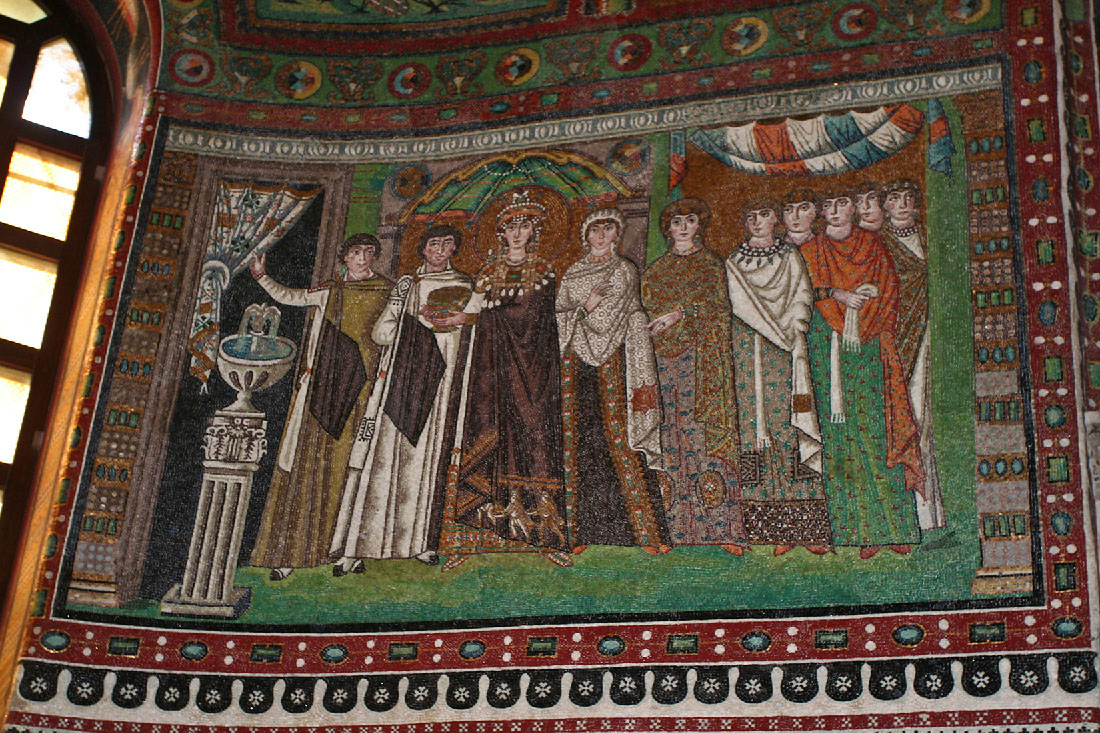
Art and architecture produced during this period underwent a similar transformation. Much of the new construction across the empire consisted of the building of churches, many erected with material salvaged from dismantled pagan temples. Churches generally followed the plan of a Roman basilica, with a central nave (aisle) and an apse (small chapel) at one end of the building. Art was also produced in the Christian mode, with icons that depicted holy people or places. Paintings, mosaics, and in later periods stained-glass windows functioned as aids to worship and also as a means of teaching the mostly illiterate people about the Bible stories central to their faith. Mosaics, a hallmark of Roman art, became more elaborate during this period, and artists were able to play with light and color in their designs (Figure 10.11). In much the same way, the classical past influenced Late Antique literature as writers continued to produce histories and works in genres that had enjoyed prominence in earlier times. But literature from this period also represented the Christian present because it was dominated by conversations about theology.
英語のヒント
この時代の美術と建築にも、同じような変化が起きた。帝国各地の新築建造物の多くは教会であり、解体された異教の神殿から回収した資材で建てる例も多かった。教会は通常、ローマのバシリカの平面形式に従い、中央に身廊、すなわち通路があり、建物の一端にアプス、すなわち小礼拝堂があった。美術も、聖なる人物や場所を描くイコンなど、キリスト教的な様式で制作された。絵画、モザイク、後の時代のステンドグラスは、礼拝を助けるとともに、ほとんどが読み書きできない人々へ、信仰の中心にある聖書の物語を教える手段だった。ローマ美術を特徴づけるモザイクは、この時代にさらに精巧になり、作り手は光と色を生かした表現を試せるようになった(図10.11)。古典古代の過去は、文学にもほぼ同じ形で影響した。書き手たちは、歴史書や、以前に重要だったジャンルの作品を作り続けた。しかし、この時代の文学では神学の議論が主流を占め、キリスト教の現在も表現されていた。
Empress Theodora.皇后テオドラ
(credit: “Mosaic of Empress Theodora, Basilica of San Vitale, Ravenna” by Sharon Mollerus/Flickr, CC BY 2.0) · CC BY 2.0
Figure 10.11 This mid-sixth-century mosaic from the Basilica of San Vitale in Ravenna, Italy, depicts the empress Theodora, wife of the emperor Justinian, presenting a chalice as a symbol of her charity. Theodora’s image and the nearby panels depicting her husband emphasized their high status and Christian devotion. (credit: “Mosaic of Empress Theodora, Basilica of San Vitale, Ravenna” by Sharon Mollerus/Flickr, CC BY 2.0)
図10.11 イタリアのラヴェンナにあるサン・ヴィターレ聖堂の、6世紀半ばのモザイク。皇帝ユスティニアヌスの妻テオドラが、施しの象徴として杯をささげる姿を描く。この像と、近くにある夫のパネルは、皇帝夫妻の高い地位とキリスト教への帰依を強調した。(クレジット:「Mosaic of Empress Theodora, Basilica of San Vitale, Ravenna」、Sharon Mollerus/Flickr、CC BY 2.0)
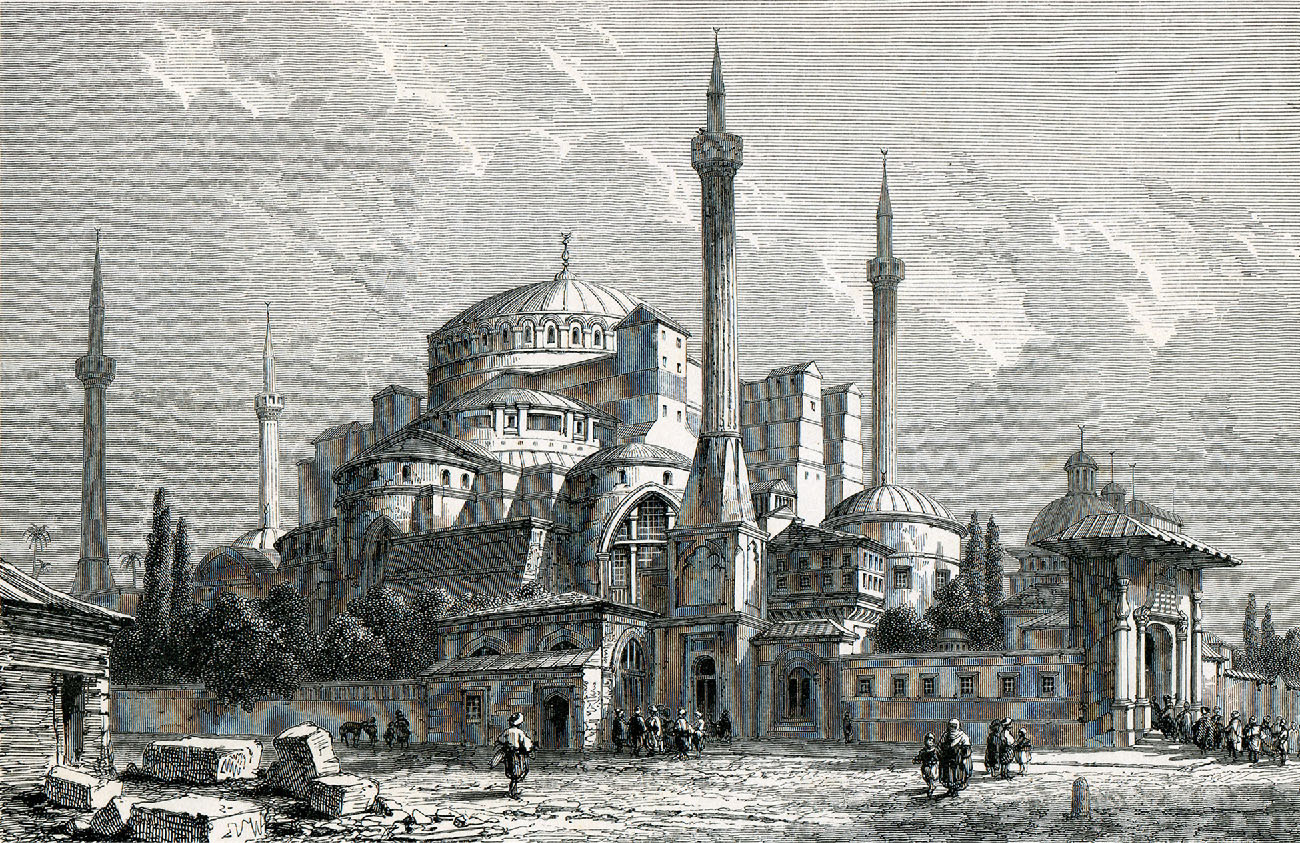
These cultural and societal trends were prominent in the reign of Justinian I, who was the Eastern Roman emperor from 527 to 565. A devout Christian, Justinian expressed his piety by drafting laws that specifically addressed religious matters. He showed a special interest in religious debates and theology, publishing a series of theological discourses during his reign. In addition, he funded the construction of numerous churches in Constantinople. The most impressive was certainly the Hagia Sophia, or the Church of Holy Wisdom. This church was located next to the imperial residence and hippodrome (a stadium for horse and chariot racing) and was a central point in the city where the emperor could carry out his duties (Figure 10.12).
英語のヒント
文化や社会のこうした傾向は、527〜565年に東ローマ皇帝だったユスティニアヌス1世の治世に、はっきり現れた。敬虔なキリスト教徒だった皇帝は、宗教問題に特に対応する法律を起草し、信仰心を示した。宗教論争と神学に強い関心を寄せ、治世を通じて一連の神学的論考を公にした。また、コンスタンティノープルの多くの教会の建設に資金を出した。最も印象的なのは、ハギア・ソフィア、すなわち「聖なる叡智の教会」だろう。教会は、皇帝の住居と、競馬や戦車競走の競技場であるヒッポドロームの隣にあり、皇帝が職務を果たせる都市の中心的な場所だった(図10.12)。
Hagia Sophia.ハギア・ソフィア
(credit: modification of work “Lithography of the Hagia Sophia, Istanbul, 1857” by Dmitry Makeev/Wikimedia Commons, Public Domain) · Public Domain
Figure 10.12 Hagia Sophia, the Church of Holy Wisdom in Constantinople, combines a basilican central space with a great dome and semi-domes. Its main dome is about 31 meters in diameter. This lithograph shows the exterior in 1857; mosaics decorated its richly furnished interior. (credit: modification of work “Lithography of the Hagia Sophia, Istanbul, 1857” by Dmitry Makeev/Wikimedia Commons, Public Domain)
図10.12 コンスタンティノープルのハギア・ソフィア(聖なる知恵の教会)は、バシリカの中央空間に、大ドームと半ドームを組み合わせた建物である。中央ドームの直径は約31メートル。この石版画は1857年の外観を示す。豪華な内部にはモザイクが施されていた。(クレジット:「Lithography of the Hagia Sophia, Istanbul, 1857」、Dmitry Makeev/Wikimedia Commonsを改変、パブリックドメイン)
Justinian also focused on maintaining the empire’s connection to its past. Among the legal reforms he instituted to preserve its laws, the Code of Justinian aimed to compile the laws issued since the early second century. Unlike the Theodosian Code, however, the Code of Justinian regulated imperial edicts by addressing any inconsistencies among them. Though laws were increasingly being issued in Greek by this time, the Code of Justinian also preserved past laws in their original Latin. Thus, while Greek was the dominant language spoken in the empire, Latin continued as the language of legislation and formed part of upper-class education. It also functioned as a means to link the empire to its past. Though the language slowly fell out of use, fluency in Latin was still a status symbol among the wealthy, educated class. In addition to his compilation of edicts, Justinian carried out other legal projects that brought together the written opinions of jurists, legal professionals in the Roman Empire.
英語のヒント
ユスティニアヌスは、帝国とその過去とのつながりを保つことにも力を入れた。法を保存するための法改革の一つ、ユスティニアヌス法典は、2世紀初め以後に出された法を編纂することを目指した。ただし、テオドシウス法典とは異なり、勅令間の矛盾を整理して、帝国の法令を体系づけた。このころ、法はギリシア語で出されることが増えていたが、ユスティニアヌス法典は、過去の法を元のラテン語でも保存した。そのため、帝国で主に話される言語はギリシア語であっても、ラテン語は立法の言語であり続け、上層階級の教育の一部をなした。帝国を過去へつなぐ手段としても機能した。ラテン語は次第に使われなくなったものの、流暢に使えることは、裕福で教育のある階層にとって、依然として地位の象徴だった。ユスティニアヌスは、勅令の編纂に加え、ローマ帝国の法律専門家である法学者たちの書かれた見解を集めるなど、ほかの法事業も行った。
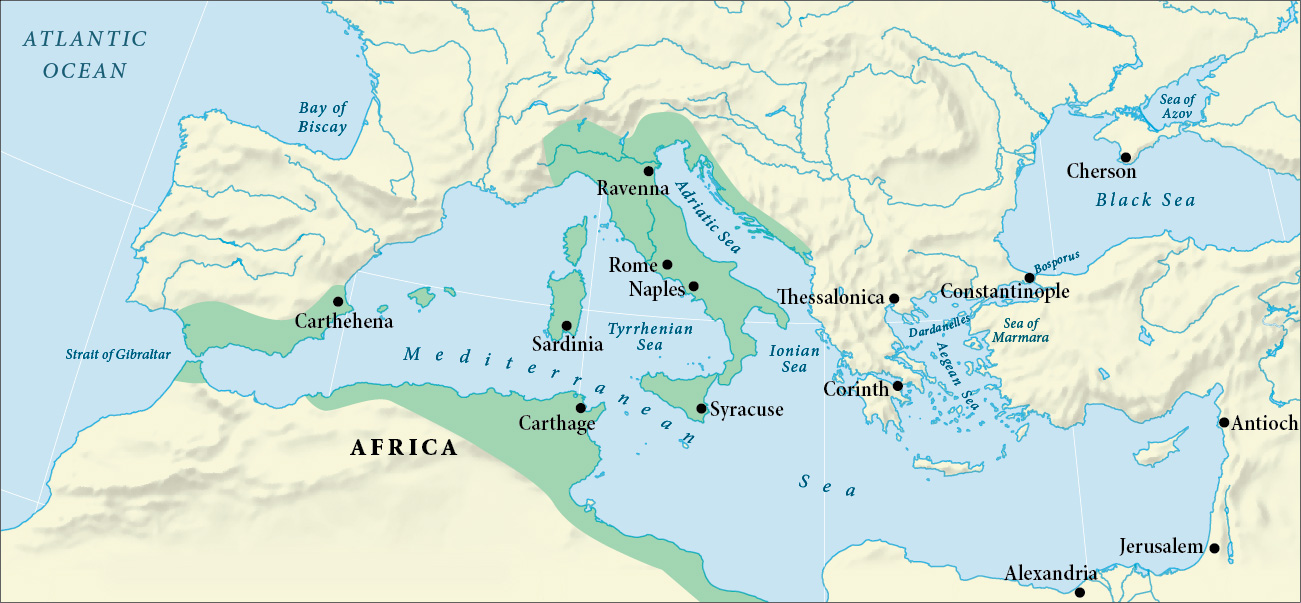
Justinian’s ambitions also extended to reconquering the West. Though by this time the Byzantine Empire was focused on the eastern Mediterranean, regaining Italy, the earlier seat of the empire, held strong appeal. Following the successful capture of Carthage in Vandal-controlled North Africa, the emperor planned to invade Italy, by that time controlled by the Ostrogoths. He sent his trusted general Belisarius to Italy, and despite having a relatively small force, Belisarius occupied Rome in 536. He made headway in recapturing the cities of Italy, including Milan and Ravenna, and he continued his campaign until 540 when he was recalled to the east to command the troops against the Persians. Justinian completed the conquest of Italy in the 550s, also making inroads against the Visigoths in southern Spain (Figure 10.13).
英語のヒント
ユスティニアヌスの野望は、西方の再征服にも及んだ。このころ、ビザンツ帝国の中心は東地中海にあったが、かつて帝国の中心だったイタリアを取り戻すことには、強い魅力があった。ヴァンダル人が支配する北アフリカで、カルタゴの攻略に成功した後、皇帝は当時東ゴート人に支配されていたイタリアへの侵攻を計画した。信頼する将軍ベリサリウスを送り、ベリサリウスは比較的小さい兵力にもかかわらず、536年にローマを占領した。ミラノやラヴェンナなど、イタリアの都市の再奪取を進め、540年まで遠征を続けた。この年、ペルシア軍に対抗する部隊を指揮するため、東方へ呼び戻された。ユスティニアヌスは550年代にイタリア征服を完了し、スペイン南部でも、西ゴート人の支配地へ食い込んだ(図10.13)。
The Reconquests of Justinian.ユスティニアヌスの再征服
(attribution: Copyright Rice University, OpenStax, under CC BY 4.0 license) · CC BY 4.0
Figure 10.13 Justinian’s plan to reconquer the western empire (the areas in green) proved effective with a relatively small force, but it ultimately strained his realm, which had to deal with growing problems with the Persians in the East. (attribution: Copyright Rice University, OpenStax, under CC BY 4.0 license)
図10.13 ユスティニアヌスの西帝国再征服計画、地図の緑色の地域への遠征は、比較的小さな兵力で成果を上げた。しかし、東方でペルシアとの問題が増す中、最終的には帝国へ負担をかけた。(著作権表記:Rice University, OpenStax、CC BY 4.0)