第10章信仰と帝国Empires of Faith
From Parthian to Sasanian Persiaパルティアからサーサーン朝ペルシアへ
Following Alexander the Great’s conquest of the Persians in the fourth century BCE and the breakup of his empire, the Seleucid dynasty governed much of his eastern kingdom. In the third century BCE, a local tribe along the east coast of the Caspian Sea came into conflict with the Seleucids, gaining more power in the region over the next two centuries. The Parthians, as they came to be called, were ruled by a king but had a decentralized government, relying on a network of semiautonomous rulers called satrapies to govern the administrative districts of the empire. They managed an extensive trade network, maintaining the roads built during the Seleucid period and establishing water routes by way of the Caspian Sea. With their skilled cavalry, the Parthians won multiple military conflicts with the Roman Empire. Yet by the second century CE, the Romans had conquered much of the Parthian territory including the fertile lands of Mesopotamia, won by the emperor Trajan.
英語のヒント
前4世紀にアレクサンドロス大王がペルシアを征服し、その帝国が分裂すると、東方の領土の多くはセレウコス朝に支配された。前3世紀、カスピ海東岸の一地方部族がセレウコス朝と争い始め、続く2世紀の間に、地域での勢力を増した。やがてパルティア人と呼ばれるようになったこの人々は、王に支配されていたが、政府は分権的だった。サトラピーと呼ばれる半自治的な支配者のネットワークに頼り、帝国の行政区を治めた。広い交易網を運営し、セレウコス朝時代の道路を維持し、カスピ海を経由する水上交易路も設けた。熟練した騎兵を持つパルティア人は、ローマ帝国との戦争で何度も勝利した。しかし紀元後2世紀までに、ローマ人はパルティア領の多くを征服した。その中には、皇帝トラヤヌスが獲得したメソポタミアの肥沃な土地もあった。
This turmoil spurred the Parthians to found a new empire in 224. Ardashir was the first king of the Sasanians, a name derived from the ruler’s family name, Sasan. Throughout their history, the Sasanians were in perpetual conflict with the Romans as well as other groups as they attempted to maintain the borders of their empire. Notable events included Shapur I’s capture of the Roman emperor Valerian in 260 and, in the fourth century, Shapur II’s fortification of the western and eastern borders against encroachment, especially by nomadic groups like the Huns. By the fifth century, priests had largely taken over the administration of the empire after a series of weak kings.
英語のヒント
この混乱に促され、パルティア人は224年に新しい帝国を建てた。サーサーン朝の最初の王はアルダシールで、王朝の名は支配者の家名サーサーンに由来する。サーサーン朝は、その歴史を通じ、帝国の国境を維持しようとする中で、ローマ人やほかの集団と絶えず争った。重要な出来事には、260年にシャープール1世がローマ皇帝ウァレリアヌスを捕らえたこと、4世紀にシャープール2世が、特にフン人のような遊牧集団の侵入に備えて、東西の国境を強化したことがある。5世紀までには、弱い王が続いた後、祭司たちが帝国の行政の大部分を掌握していた。
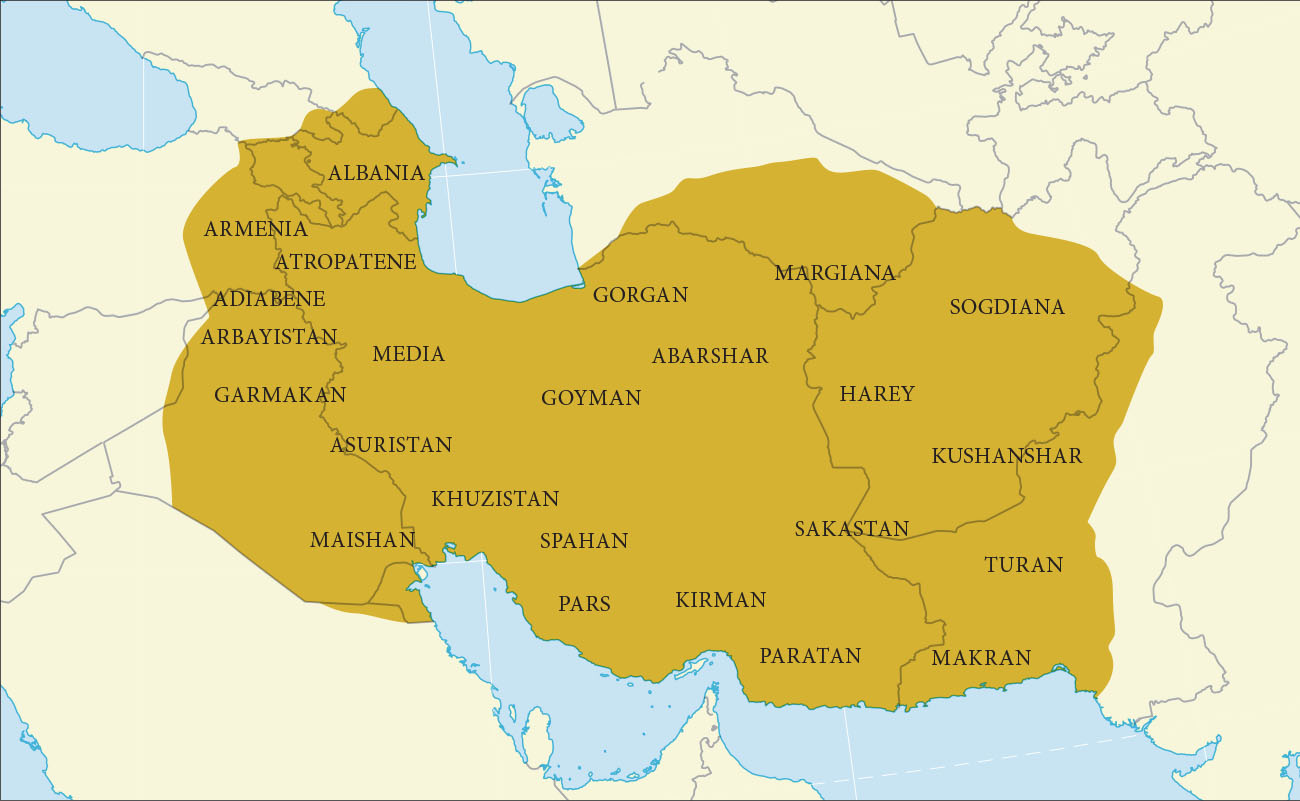
Dubbed the “King of Kings,” the Sasanian ruler maintained a centralized state in which local officials reported directly to him. The Sasanians ruled the area of the former classical Persian Empire, including the modern-day country of Iran. The empire extended beyond this region, however, stretching from the modern-day country of Georgia in the west to the Indus River in the east (Figure 10.14). It contained both heavily urbanized centers and various nomadic tribes, especially on the Iranian plateau. The Sasanians were able to leverage their location between the Roman Empire and China to facilitate trade. Their empire’s trade network extended far beyond its borders, and it was the Silk Roads that gave the Sasanians the greatest advantage because these land routes linked the empire with numerous regional trading partners.
英語のヒント
「諸王の王」と称されたサーサーン朝の支配者は、地方官が直接自分に報告する中央集権国家を維持した。支配したのは、現在のイランを含む、かつての古典古代のペルシア帝国の地域だった。領土はそれを越えて広がり、西は現在のジョージアから、東はインダス川まで及んだ(図10.14)。帝国には、高度に都市化した拠点と、とりわけイラン高原のさまざまな遊牧部族の両方が含まれていた。サーサーン朝は、ローマ帝国と中国の間に位置する立地を生かして、交易を促進できた。交易網は国境のはるか外まで広がった。中でも最大の利点をもたらしたのはシルクロードだった。これらの陸上路によって、帝国は多くの地域の交易相手と結ばれたからである。
Sasanian Persia.サーサーン朝ペルシア
(credit: modification of work “Map of the Sassanid Empire just before the Arab conquest of Iran” by “DieBuche”/Wikimedia Commons, Public Domain) · Public Domain
Figure 10.14 The Sasanian Empire stretched from modern-day Armenia and Georgia in the west to the Indus River in the east. At its greatest extent in the seventh century, it encroached into once-Byzantine territory through a series of conflicts. (credit: modification of work “Map of the Sassanid Empire just before the Arab conquest of Iran” by “DieBuche”/Wikimedia Commons, Public Domain)
図10.14 サーサーン朝の領域は、西の現在のアルメニアやジョージアから、東のインダス川まで広がった。7世紀の最大領域では、一連の戦争を通じ、かつてビザンツ帝国が支配していた地域へ進出した。(クレジット:「Map of the Sassanid Empire just before the Arab conquest of Iran」、DieBuche/Wikimedia Commonsを改変、パブリックドメイン)
Because of its massive size, the empire was linguistically and culturally diverse. While the west was characterized by interactions with the Byzantines, in the east evidence from inscriptions suggests a diversity of languages and cultures. For example, the use of Greek continued as a remnant of Alexander the Great’s empire, and Bactrian was an Iranian language from what is now Afghanistan. In cities throughout the empire, a hierarchical class structure prevailed, with the educated priestly class on top, followed by those who served in the military, agriculturalists, artisans, and finally enslaved people.
英語のヒント
帝国は巨大だったため、言語と文化は多様だった。西方はビザンツとの交流に特徴づけられたが、東方では、碑文から多様な言語や文化があったことがうかがえる。たとえば、アレクサンドロス大王の帝国の名残としてギリシア語が使われ続け、現在のアフガニスタンに由来するイラン系の言語、バクトリア語もあった。帝国各地の都市には、階層的な身分秩序が広く存在した。頂点は教育を受けた祭司階級で、その下に軍務に就く人々、農業従事者、職人が続き、最後に奴隷とされた人々が位置した。
As in the Roman and Byzantine worlds, women’s legal status was very low, and many laws controlled their behavior. However, women could inherit property from their family and conduct low-level business. Punishments were a way to control Sasanian society and were often tied to sins as defined by the state religion. Incestuous relationships and even marriages were known, particularly among the religious elite, although descriptions of incest as commonplace may be an attempt by successors to belittle the Sasanians in later centuries. There were no opportunities for women to become involved in Sasanian politics, with the single exception of Queen Boran’s brief rise just before the collapse of the Sasanian state in the seventh century. The daughter of the previous ruler Khosrow II, she was hailed as ruler despite being a woman because of her connection to Khosrow rather than because of her capability or her status as a woman. While she attempted to build a positive relationship with the Byzantines and to stabilize the Sasanian state, she was ultimately unsuccessful in her efforts before being murdered by her own people, a demonstration of the instability that followed the Sasanian loss in the war.
英語のヒント
ローマやビザンツの世界と同じく、女性の法的地位は非常に低く、多くの法律が行動を規制した。それでも女性は、一族から財産を相続し、小規模な商業活動を行えた。刑罰はサーサーン朝の社会を統制する手段であり、国教が定義する罪と結びつくことが多かった。近親間の性的関係や結婚さえ、特に宗教的な上層層では知られている。ただし、近親婚が一般的だったという描写は、後の世紀の後継者がサーサーン朝をおとしめようとしたものかもしれない。女性がサーサーン朝の政治に参加する機会はなく、唯一の例外は、7世紀の国家崩壊の直前に、女王ボーラーンが短期間権力を得たことだった。前の王ホスロー2世の娘だった彼女は、女性でありながら支配者として推戴された。それは能力や女性としての地位によるというより、ホスローとのつながりによるものだった。ビザンツとの良好な関係を築き、国家を安定させようとしたが、成功には至らず、自国の人々に殺された。このことは、戦争での敗北後のサーサーン朝の不安定さを示している。
Ardashir, the first king, instituted Zoroastrianism, the religion of the ancient Persians, as the state religion, encouraging loyalty to the government and to the royal family through religious practice. Zoroastrianism is a universal faith with both monotheistic and dualistic elements, and with rituals and beliefs based on the teachings of the prophet Zoroaster, who lived sometime in the first millennium BCE. Adherents to the faith focus their daily lives on carrying out good deeds, holding good thoughts, and practicing rituals of purification in preparation for their judgment and resurrection after death. Zoroastrian iconography is based on images of fire and water in devotion to the creator god Ahura Mazda. The faith also supposes a perpetual struggle between the dual elements of good and evil. According to Zoroastrian teachings, this struggle will ultimately end in the assured triumph of the good.
英語のヒント
初代王アルダシールは、古代ペルシア人の宗教であるゾロアスター教を国教とし、宗教的実践を通じて政府と王家への忠誠を奨励した。ゾロアスター教は、一神教的な要素と二元論的な要素の両方を持つ普遍的な信仰で、前1千年紀のいずれかの時期に生きた預言者ゾロアスターの教えに基づく儀礼と信念を持つ。信徒は、死後の審判と復活に備え、善い行い、善い思い、浄化の儀礼を日々の生活の中心に置く。ゾロアスター教の図像は、創造神アフラ・マズダーへの崇敬を表す、火や水のイメージを基礎とする。この信仰は、善と悪という二つの要素の間に、絶え間ない闘争があるとも考える。その教えでは、この闘争は最終的に、確実な善の勝利に終わる。
The Sasanian kings were intimately involved in the religious affairs of the empire, instituting religious policy and maintaining fire temples across the empire. Yet the population also included Jews and Christians, who could be maligned for their lack of devotion to the state religion. The Sasanian government viewed residents of the western empire as difficult to manage in terms of religion; they may have been seen as particularly susceptible to Byzantine influence because Byzantine rulers claimed dominion over all Christians, including those outside their empire’s borders.
英語のヒント
サーサーン朝の王たちは、宗教政策を定め、帝国各地の拝火神殿を維持するなど、宗教問題に深く関与した。しかし、住民にはユダヤ人やキリスト教徒もおり、国教を信奉しないため、悪く言われることがあった。政府は帝国西部の住民について、宗教の面で統制が難しいと考えた。特にビザンツの影響を受けやすいと見られたのかもしれない。ビザンツの支配者たちが、自国の国境の外にいる人々も含め、すべてのキリスト教徒に対する支配権を主張していたからである。