第10章信仰と帝国Empires of Faith
10.1 The Eastward Shift10.1 東方への重心移動
Learning Objectives学習の目標
By the end of this section, you will be able to:
この節を読み終えると、次のことができるようになる。
Explain how and why the political focus of the Roman Empire shifted eastward during Late Antiquity
古代末期に、ローマ帝国の政治の重心が、どのように、なぜ東へ移ったかを説明する。
Discuss how the adoption of Christianity as the official religion of the Roman Empire altered Mediterranean society
ローマ帝国がキリスト教を公認の国家宗教としたことで、地中海社会がどう変わったかを論じる。
Explain the collapse of Roman authority in the West, including the role of Germanic migrations and invasions
ゲルマン系諸集団の移動と侵入の役割も含め、西方でローマの権威が崩壊した過程を説明する。
From the third through the seventh centuries CE, the culture of the Roman Empire transformed itself profoundly and in fundamental ways. The rise of Christianity marked a seminal moment, and from the time of the emperor Constantine in the fourth century, the government advocated monotheism, the worship of one God to the exclusion of others. With a Christian government and a new capital at Constantinople in the eastern Mediterranean, the Byzantine Empire grew from the old Roman state. At the same time, the fracturing of the Roman Empire’s government led to various new regional alliances and rivalries. Germanic kingdoms flourished in the West, while the Byzantines attempted to maintain order among the burgeoning Christian population within their borders.
英語のヒント
紀元後3〜7世紀に、ローマ帝国の文化は深く、根本的に変わった。キリスト教の台頭は重要な転機となり、4世紀のコンスタンティヌス帝の時代から、政府は他の神々を排して一柱の神を崇拝する、一神教を支持した。キリスト教徒の政府と、東地中海のコンスタンティノープルという新首都を持つビザンツ帝国が、古いローマ国家から成長していった。同時に、ローマ帝国の政府の分裂は、地域ごとに新たな同盟と対立を生んだ。西方ではゲルマン諸王国が栄え、ビザンツ側は、領内で急増するキリスト教徒の間に秩序を保とうとした。
The Roman Empire’s eastward shift epitomized the major cultural changes occurring during this period. Because of these shifts, Late Antiquity has been characterized as a transitional period between the ancient and medieval worlds that occurred from roughly 150 to 750 CE. On the one hand, Late Antique culture remained influenced by the classical past, with the maintenance of certain ancient institutional values. While still calling themselves “Romans,” the Byzantines simultaneously attempted to maintain Christian orthodoxy. On the other hand, the appearance of new religious identities and the breakdown of the Roman state led to conflicts among different regional and cultural groups. The empire’s borders were in constant flux, and its territory slowly diminished as numerous powers vied for regional dominance.
英語のヒント
ローマ帝国の東方への重心移動は、この時代に起きた大きな文化的変化を象徴していた。こうした変化があるため、古代末期は、おおよそ紀元後150〜750年に当たる、古代世界と中世世界の過渡期とされてきた。古代末期の文化には、古典古代の制度的な価値観の一部が保たれ、過去の影響が残っていた。ビザンツの人々は、依然として自らを「ローマ人」と呼ぶと同時に、キリスト教の正統信仰を維持しようとした。他方、新たな宗教的帰属意識の出現と、ローマ国家の解体は、地域や文化の異なる集団間に争いを生んだ。帝国の国境は絶えず変動し、多数の勢力が地域の覇権を争う中で、その領土はゆっくりと縮小した。
Constantinople and the Roman Eastコンスタンティノープルとローマの東方
The third century was a period of upheaval and change for the Roman government, often referred to as the Crisis of the Third Century. From 235 to 284, a span of only forty-nine years, the empire was ruled by upward of twenty-six different claimants to the imperial throne. New emperors were often declared and supported by Roman soldiers. As a result, civil wars—as well as wars on the eastern frontier—were nearly constant. Economic problems became more apparent after the devaluation of currency, in which coins issued by the government became increasingly less valuable, led to a rapid rise in the price of goods. The high turnover of leadership led to periods of reform and attempts to bring stability to the government and economy, but progress toward securing the empire was limited.
英語のヒント
3世紀は、ローマ政府にとって激動と変化の時代であり、「3世紀の危機」とも呼ばれる。235〜284年のわずか49年間に、26人を超える皇帝位の請求者が帝国を統治した。新皇帝は、しばしばローマ軍の兵士によって擁立され、支えられた。その結果、東の国境での戦争に加え、内戦もほぼ絶えなかった。貨幣の価値が下がり、政府発行の硬貨の価値がますます低くなったことで、物価が急上昇すると、経済問題はいっそう目立つようになった。指導者が次々に交代する中で改革が繰り返され、政府と経済を安定させる試みがなされたが、帝国を安泰にするための前進は限られていた。
In 284, however, Diocletian, a military official from Illyria in the Balkans, was declared emperor by his troops. His reforms, unlike those of his predecessors, had a lasting impact on the empire and its eventual eastward shift. Diocletian divided his rule with a co-emperor, who like him bore the title augustus, and with two junior emperors given the title caesar. This shared rule between the four emperors was called a tetrarchy. While there was no formal geographic division of leadership, each emperor or tetrarch had his own sphere of influence. Each also had a regional capital city located near the empire’s borders from which he governed and organized military defense. There were familial and legal ties among the tetrarchs, who utilized imagery to send a message of strength (Figure 10.4). Diocletian also aimed to fix the empire’s economy, issuing several edicts to curb inflation and promote trade within the empire. For example, in 301, he issued the Edict on Maximum Prices, which had two goals. First, to curb inflation, the edict placed an upper limit on the price at which certain goods could be sold. Second, to combat currency devaluation, it set specific values for coinage issued by the government.
英語のヒント
しかし284年、バルカンのイリュリア出身の軍人ディオクレティアヌスが、部隊によって皇帝に擁立された。彼の改革は、先帝たちの改革とは異なり、帝国と、その後の東方への重心移動に長く影響を残した。ディオクレティアヌスは、自分と同じアウグストゥスの称号を持つもう一人の正帝と、カエサルの称号を与えられた二人の副帝とで、統治を分担した。四人の皇帝による共同統治は、テトラルキア、すなわち四帝分治制と呼ばれる。統治者ごとの正式な地理的区分はなかったが、それぞれに勢力範囲があった。各皇帝は、帝国の国境近くに地方の首都を持ち、そこから統治し、防衛を組織した。皇帝たちは親族関係と法的関係で結ばれ、図像によって強固な結束を訴えた(図10.4)。ディオクレティアヌスは経済の立て直しも目指し、インフレを抑え、帝国内の交易を促す勅令をいくつも出した。例えば301年の最高価格令には二つの目的があった。第一に、インフレ抑制のため、一定の商品に販売価格の上限を設けた。第二に、貨幣価値の低下に対処するため、政府発行の貨幣の価値を具体的に定めた。
The Four Tetrarchs.四人の皇帝
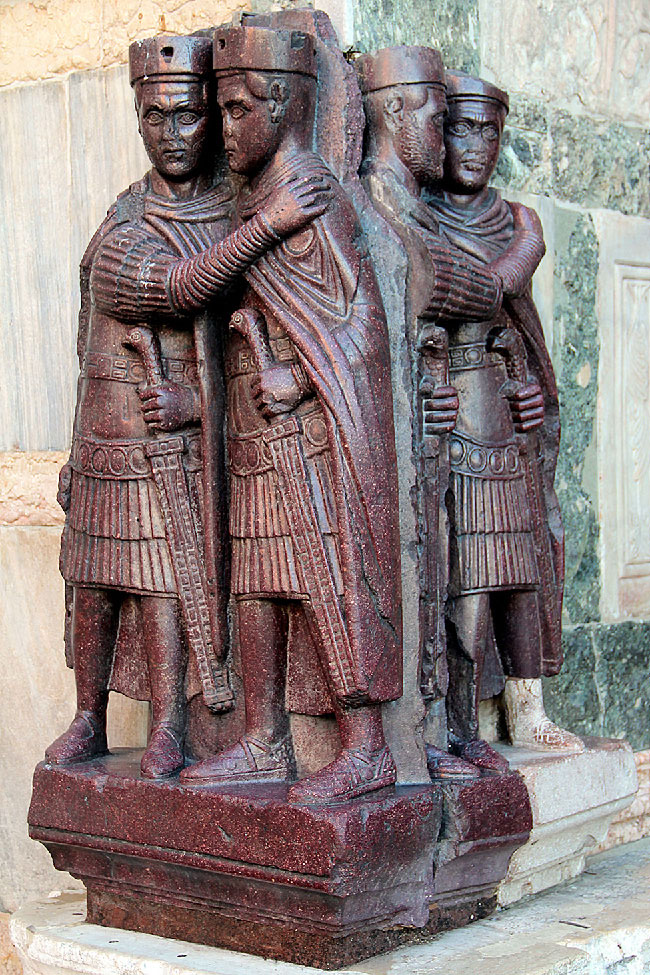
(credit: “Portrait of the Four Tetrarchs” by Jean-Pol Grandmont/Wikimedia Commons, CC BY 4.0) · CC BY 4.0
Figure 10.4 This sculptural portrait of the Roman tetrarchs from St. Mark’s Basilica in Venice shows the cooperation the four co-rulers hoped to achieve. The figures, carved in about 300 CE, are for the most part indistinguishable, and their rigid features contrast with the idealism of the classical style that had been prevalent in early Roman society. (credit: “Portrait of the Four Tetrarchs” by Jean-Pol Grandmont/Wikimedia Commons, CC BY 4.0)
図10.4 ヴェネツィアのサン・マルコ大聖堂にある、ローマの四帝を表す彫像。四人の共同統治者が目指した協力を示す。紀元後300年ごろの像は、互いにほとんど見分けがつかない。硬い表情は、初期のローマ社会に広まっていた古典様式の理想主義と対照的である。(クレジット:「Portrait of the Four Tetrarchs」、Jean-Pol Grandmont/Wikimedia Commons、CC BY 4.0)
It is unclear if when Diocletian established his tetrarchy, he expected to eventually abdicate as a means of making the succession of future emperors more uniform. In any case, after he and his co-emperor Maximian formally left office in 305, the remaining two tetrarchs took their place alongside two new junior emperors. Civil wars soon engulfed the empire as infighting among the emperors resulted in the advancement of Constantine, son of the emperor Constantius Chlorus. Upon his father’s death, Constantine claimed the imperial throne in 306. Making his way from the city of York in Britannia, he first gained control of the western provinces before arriving in Italy in 312. In the city of Rome, he defeated Maxentius, his final rival to the throne, at the Battle of Milvian Bridge.
英語のヒント
ディオクレティアヌスが四帝分治制を設けたとき、将来の皇帝継承をより規則的にするため、自らもいずれ退位するつもりだったかどうかは明らかではない。いずれにせよ、305年に彼ともう一人の正帝マクシミアヌスが正式に退くと、残る二帝がその地位を引き継ぎ、新たに二人の副帝が加わった。皇帝たちの内紛はコンスタンティヌスの台頭につながり、まもなく内戦が帝国を覆った。彼はコンスタンティウス・クロルス帝の息子で、306年の父の死後、皇帝位を主張した。ブリタンニアのヨークから進み出て、まず西方の諸属州を支配下に置き、312年にイタリアへ入った。ローマ市で、皇帝位を争う最後の敵マクセンティウスを、ミルウィウス橋の戦いで破った。
During his reign, Constantine attributed his victory over Maxentius to the Christian God. According to the emperor’s official biographer Eusebius, Constantine had seen an image of the labarum, the Greek symbols of “Chi” and “Rho” that make up the first letters of “Christ,” in the sky that commanded him, “By this sign, conquer.” Whether this was a message specifically designed to appeal to the empire’s Christian populace is disputed, but Constantine showed clear Christian sympathies. From early in his reign, however, he sent out a carefully balanced message aimed to please Christians and traditional polytheists alike. For example, the design and inscription of the Arch of Constantine in Rome express a new synthesis of Roman tradition with Christianity that balanced the emperor’s competing interests. The arch contains images from existing Roman monuments, while the inscription regarding a divine being is deliberately ambiguous (Figure 10.5).
英語のヒント
コンスタンティヌスは在位中、マクセンティウスに勝利したのはキリスト教の神のおかげだとした。皇帝の公式伝記作者エウセビオスによれば、彼は空にラバルムの像を見たという。これは「キリスト」の最初の文字となるギリシア文字キーとローの組み合わせであり、その像は「この印によって征服せよ」と命じた。この話が、帝国内のキリスト教徒に訴えることを特に意図したものだったかどうかには議論がある。しかし、コンスタンティヌスがキリスト教への明確な好意を示したことは確かである。在位の初期から彼は、キリスト教徒と従来の多神教徒の両方を満足させるよう、慎重に釣り合いを取ったメッセージを発していた。例えば、ローマのコンスタンティヌス凱旋門の意匠と碑文は、ローマの伝統とキリスト教を新たに組み合わせ、皇帝が配慮すべき相反する利益の均衡を図ったものだった。門には既存のローマの記念建造物から取った図像が使われ、神的な存在への碑文の言及は、意図的に曖昧にされている(図10.5)。
The Arch of Constantine.コンスタンティヌスの凱旋門
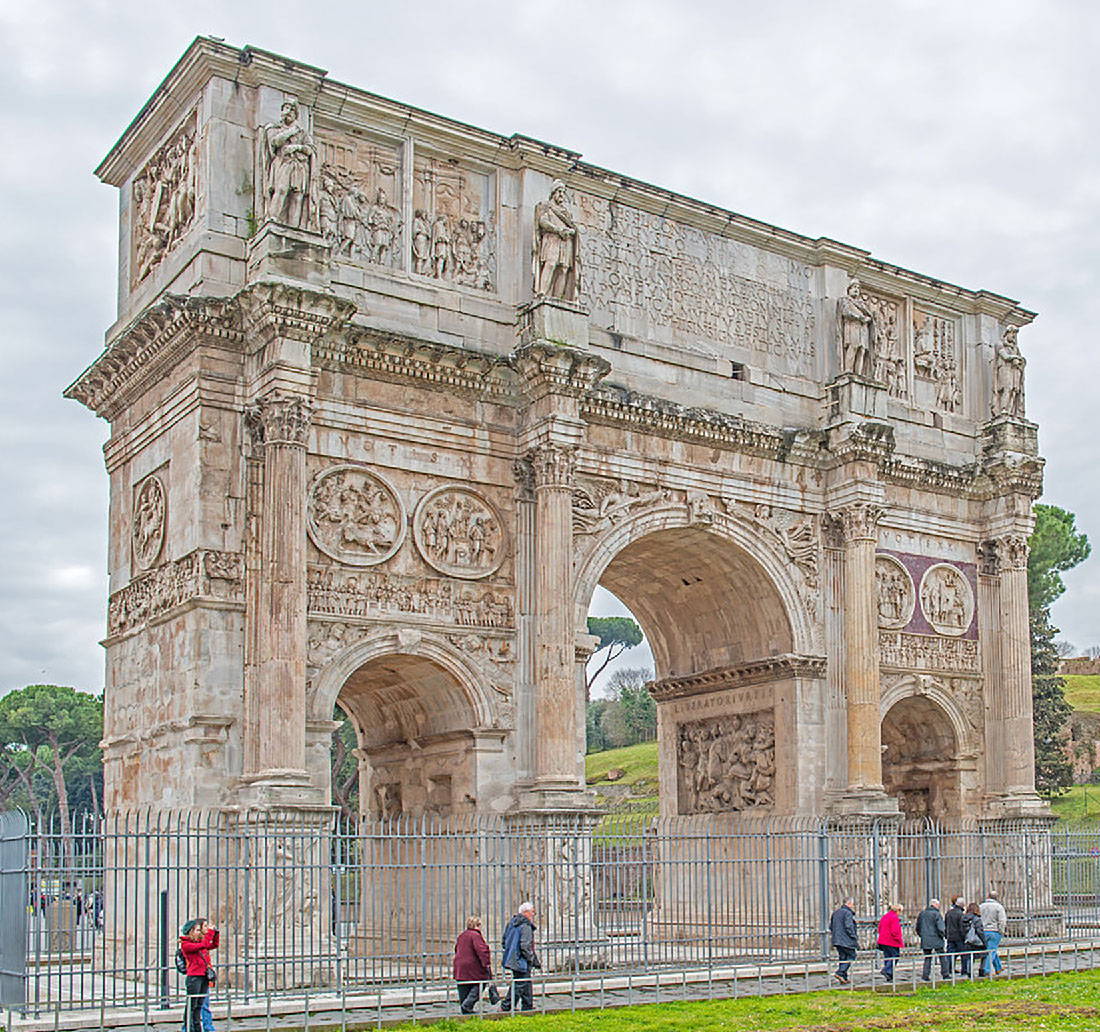
(credit: modification of work “"DSC_0787; Arco di Constantino Rome Italy February 2013” by Bengt Nyman/Flickr, CC BY 2.0) · CC BY 2.0
Figure 10.5 The Arch of Constantine in Rome was dedicated in 315 CE. Its incorporation of material from earlier monuments shows Constantine’s desire to place himself at the pinnacle of Roman history, while the deliberately ambiguous inscription caters to a religiously diverse audience by attributing the emperor’s victory to “divine inspiration” and not to a specific deity. (credit: modification of work “"DSC_0787; Arco di Constantino Rome Italy February 2013” by Bengt Nyman/Flickr, CC BY 2.0)
図10.5 ローマのコンスタンティヌスの凱旋門は、紀元後315年に奉献された。古い記念建造物の部材を取り込むことは、自分をローマの歴史の頂点に置こうとする皇帝の意図を示す。意図的に曖昧にされた銘文は、勝利を特定の神ではなく「神的な霊感」に帰すことで、さまざまな宗教の人々に訴えている。(クレジット:「"DSC_0787; Arco di Constantino Rome Italy February 2013」、Bengt Nyman/Flickrを改変、CC BY 2.0)
To further celebrate his rule, Constantine refounded the city of Byzantium (modern-day Istanbul) as Constantinople in 330 CE, and it eventually became the new imperial capital. The city’s location on the empire’s eastern frontier was advantageous for its proximity to trade routes and to the sites of many Roman military campaigns (Figure 10.6).
英語のヒント
自らの治世をさらに顕彰するため、コンスタンティヌスは紀元後330年、ビュザンティオン、現在のイスタンブルを、コンスタンティノープルとして再建した。この都市はやがて帝国の新首都となった。帝国の東の国境に近い位置は、交易路や、ローマがたびたび遠征を行う地域に近いという利点があった(図10.6)。
The Roman Empire Moves East.東へ移るローマ帝国
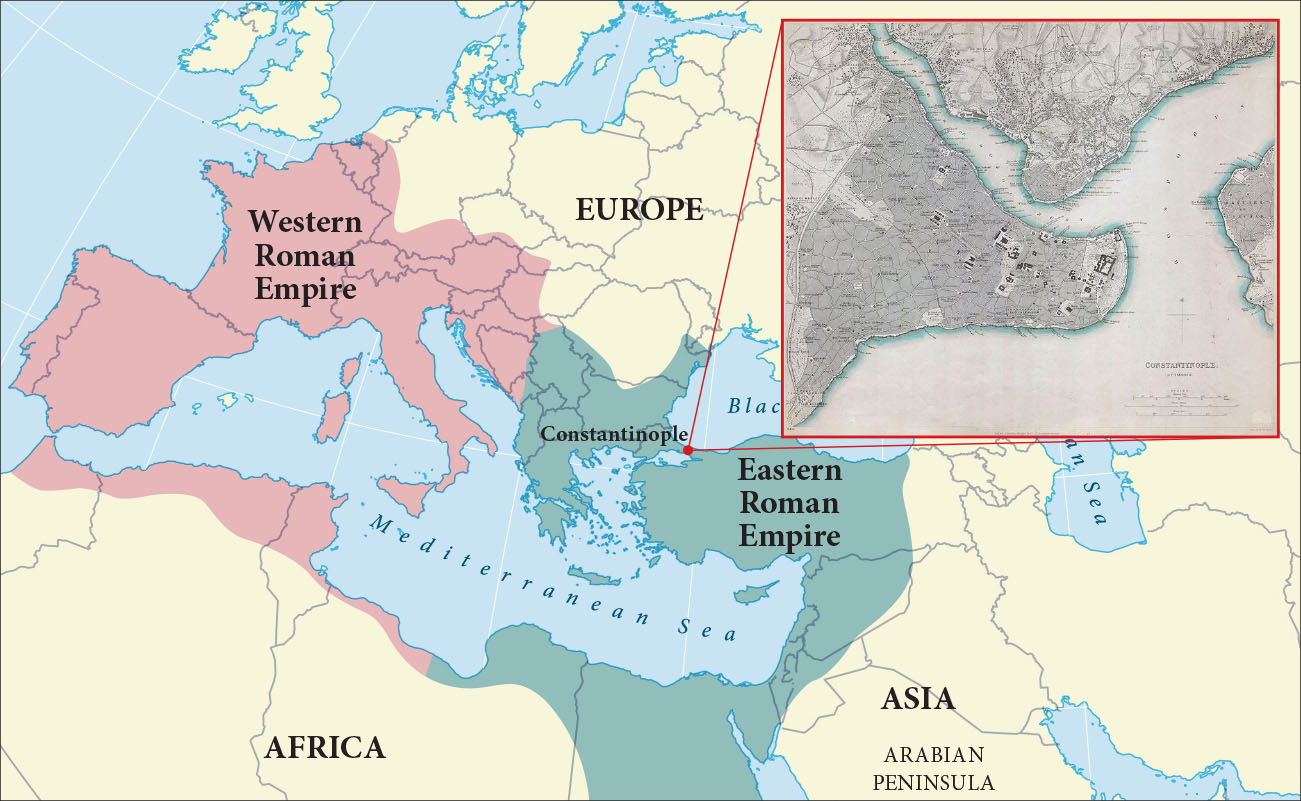
(credit: modification of work “Political Europe” by CIA/The World Factbook, Public Domain; credit inset: modification of work “Constantinople. Stambool” by Maps of the Society for the Diffusion of Useful Knowledge/Wikimedia Commons, Public Domain) · Public Domain
Figure 10.6 Constantinople’s location shifted the empire’s geographic focus eastward. The city was near the sites of frequent Roman military campaigns in the lower Danube and significantly closer than Rome to the frontiers along the Euphrates (in modern Iraq). It was also a hub of trade and travel because it was connected to western Europe, the Near East, and the Balkans. (credit: modification of work “Political Europe” by CIA/The World Factbook, Public Domain; credit inset: modification of work “Constantinople. Stambool” by Maps of the Society for the Diffusion of Useful Knowledge/Wikimedia Commons, Public Domain)
図10.6 コンスタンティノープルの立地は、帝国の地理的な重心を東へ移した。ローマが頻繁に軍事行動を行ったドナウ川下流に近く、ユーフラテス川沿い、現在のイラクの国境地域へも、ローマ市よりはるかに近かった。また、西ヨーロッパ、近東、バルカンと結ばれ、交易と交通の結節点でもあった。(クレジット:「Political Europe」、CIA/The World Factbookを改変、パブリックドメイン。挿入図:「Constantinople. Stambool」、Maps of the Society for the Diffusion of Useful Knowledge/Wikimedia Commonsを改変、パブリックドメイン)
Constantine ruled until his death in 337, and his legacy was cemented during the reigns of his sons who succeeded him. They waged military campaigns to maintain the frontiers of the empire, promoted Christianity, and enacted laws against pagan practice. Only Julian, a nephew of Constantine, attempted a brief resurgence of paganism in the Roman government during his rule, from 361 to 363. He enacted a series of reforms, wrote a number of philosophical works, and carried out a military campaign against the Sasanians. But after reaching the Persian capital of Ctesiphon, Julian’s army was effectively in retreat when the emperor suffered a mortal wound from a spear. Any vision for a renewed polytheist empire ended with his death. Thus, Constantine had effectively ushered in a new era of Christian governance. Rulers for the rest of the empire’s history were explicitly Christian, acting as de facto heads of the church and controlling church policy.
英語のヒント
コンスタンティヌスは337年に亡くなるまで統治し、その遺産は、後を継いだ息子たちの治世に確かなものとなった。息子たちは、帝国の国境を維持するため遠征を行い、キリスト教を奨励し、異教の慣行を禁じる法律を制定した。コンスタンティヌスの甥ユリアヌスだけが、361〜363年の短い治世に、ローマ政府での異教復興を試みた。改革を進め、哲学書をいくつも書き、サーサーン朝への遠征を行った。しかし、ペルシアの首都クテシフォンに達した後、軍が事実上の撤退に入ったところで、皇帝は槍によって致命傷を負った。多神教の帝国を再び築く構想は、その死とともに終わった。このように、コンスタンティヌスは実質的に、キリスト教徒が統治する新時代を開いた。その後の帝国の支配者は、明確にキリスト教徒であり、教会の事実上の長として振る舞い、教会の方針を統制した。