第10章信仰と帝国Empires of Faith
The Fall of the Roman West西ローマの崩壊
Theodosius I was the last emperor who reigned over a united empire. After his death in 395, power passed to his two sons; Arcadius ruled the eastern half of the empire from Constantinople, while Honorius controlled the western half from Ravenna in northern Italy. The geography of each region dictated its fate. With a shorter stretch of the Danube River to guard against foreign invaders, the East was able to thrive by paying off these groups with its wealth and discouraging them from entering their territory. The West suffered various setbacks along its more extensive and chaotic frontier that brought both political and social disruption. There were simply more foreign groups to contend with, and the traditional barrier of the Rhine and Danube Rivers was long and continuously crossed by Germanic groups during this period. The West was also less urbanized than the East, resulting in less social cohesion in parts of this region. This allowed different, outsider cultures to infiltrate and transform it (Figure 10.10).
英語のヒント
テオドシウス1世は、統一された帝国を統治した最後の皇帝だった。395年に死去すると、権力は二人の息子に渡った。アルカディウスはコンスタンティノープルから東半分を治め、ホノリウスは北イタリアのラヴェンナから西半分を支配した。両地域の地理が、その運命を左右した。外からの侵入に備えて守るべきドナウ川の範囲が比較的短かった東方は、富を使って外部集団に金を払い、領内への侵入を思いとどまらせることで、繁栄できた。西方では、より長く混乱した国境に沿って挫折が重なり、政治的・社会的な混乱を招いた。対処すべき外部集団の数も多く、伝統的な防壁であるライン川とドナウ川は長く、この時代にはゲルマン系諸集団が絶えず渡ってきた。西方は東方ほど都市化しておらず、一部地域では社会的な結束も弱かった。そのため、外部の異なる文化が入り込み、地域を変容させることができた(図10.10)。
Germanic Kingdoms.ゲルマン諸王国
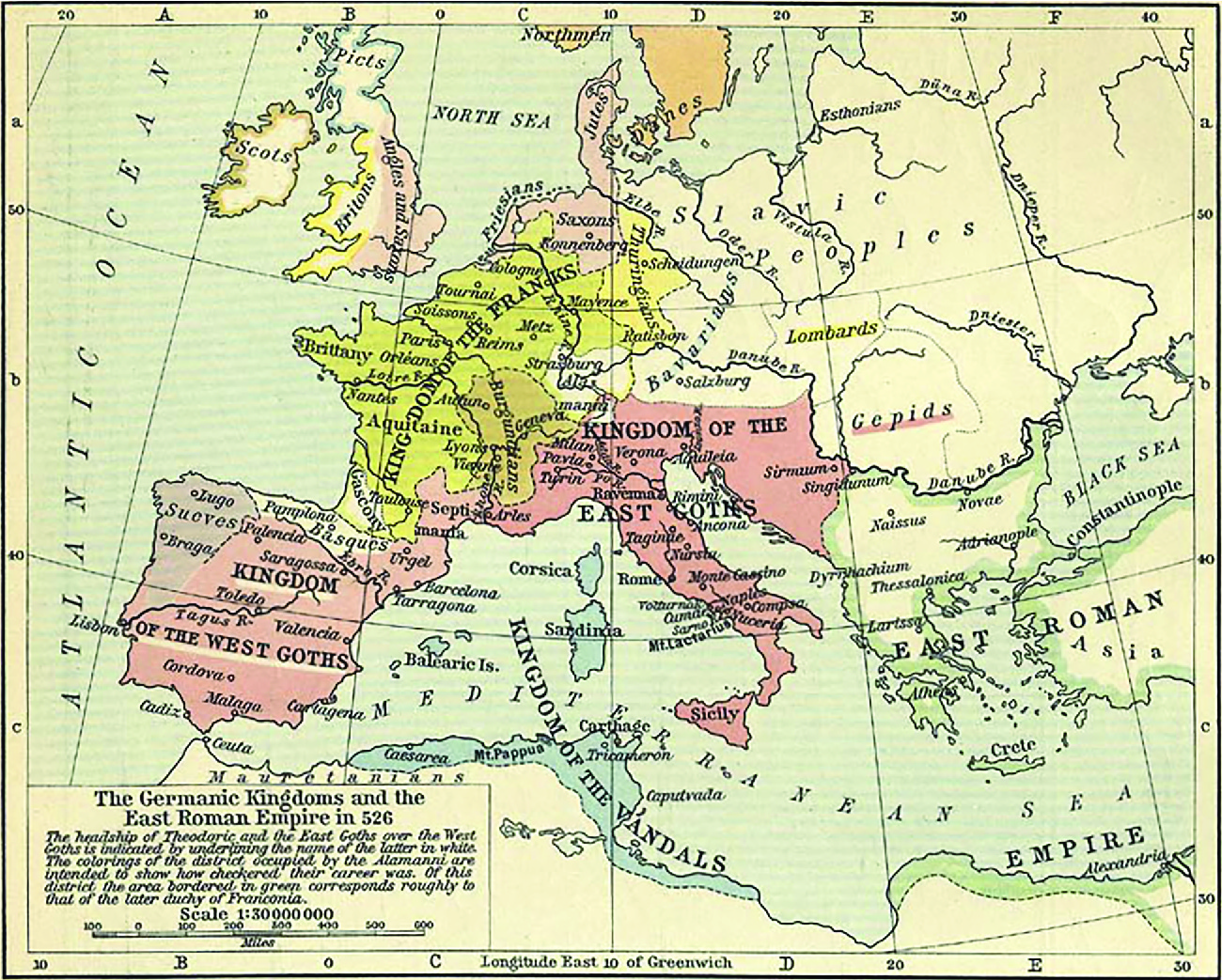
(credit: “Germanic kingdoms 526CE “ by Historical Atlas by William R. Shepherd/Wikimedia Commons, Public Domain) · Public Domain
Figure 10.10 The increasing influx of Germanic peoples into the western empire brought about a fracturing of Roman power as a series of independent kingdoms took control of the Italian peninsula, Gaul (modern-day France and Belgium), the Iberian Peninsula, and North Africa. This map from cartographer William R. Shepherd’s Historical Atlas (1923) shows the Germanic kingdoms as they were in 526 CE. (credit: “Germanic kingdoms 526CE “ by Historical Atlas by William R. Shepherd/Wikimedia Commons, Public Domain)
図10.10 西帝国へ流入するゲルマン系諸民族が増えるにつれ、独立した王国が次々とイタリア半島、ガリア、現在のフランスとベルギー、イベリア半島、北アフリカを支配し、ローマの権力は分裂した。地図製作者ウィリアム・R・シェパードの『歴史地図帳』(1923年)に収められたこの図は、紀元後526年のゲルマン諸王国を示す。(クレジット:「Germanic kingdoms 526CE」、William R. Shepherd著 Historical Atlas/Wikimedia Commons、パブリックドメイン)
As the western empire came into increasing contact with these outsider groups, the state dealt with them in various ways. It deemed many Germanic groups foederati, meaning they were bound by a treaty that allowed them semiautonomy in exchange for their military service on behalf of the Roman Empire. Mercenaries thus came from the various tribes and foreign states allied with the empire, serving alongside Romans in an increasingly diverse military. After completing their military service, foreign soldiers were given the opportunity to participate in Roman civic life, to live in Roman territory, and to integrate into Roman society. Some Germans were also able to settle in Roman territory, leading to periods of peaceful coexistence and cooperation, while others were not so fortunate because they were captured in conflict and forced into Roman households as enslaved people. As Germans were brought into the Roman cultural fold through various means, rivalries among ambitious and newly integrated outsiders often disrupted Roman society.
英語のヒント
西帝国がこれらの外部集団と接触する機会を増す中、国家はさまざまな方法で対処した。多くのゲルマン系集団をフォエデラティと位置づけた。これは条約で結ばれ、ローマ帝国のために軍事奉仕を行う代わりに、部分的な自治を認められた集団を意味する。こうして、帝国と同盟した多様な部族や外国から傭兵が集まり、ますます多様化する軍の中で、ローマ人とともに従軍した。兵役を終えた外国人兵士には、ローマの市民生活に参加し、領内に住み、社会へ溶け込む機会が与えられた。ゲルマン人の中には、ローマ領へ定住し、平和的な共存と協力を経験した人々もいた。しかし、戦争で捕らえられ、奴隷としてローマの家に組み込まれた人々は、それほど幸運ではなかった。さまざまな手段でローマ文化の中に取り込まれた外来者のうち、野心を持つ者同士の争いが、ローマ社会をしばしば混乱させた。
In the early 400s, Germanic groups made their way into Gaul and Italy, negotiating and fighting with the Romans. Originating in central Europe around modern-day Poland, the Vandals crossed the Rhine in 406, settling in Gaul before being pushed into Spain and finally forming a kingdom in North Africa. A notable Roman military commander of Vandal origin was Stilicho, who was appointed guardian of the young emperor Honorius. Stilicho had aims to control the western empire himself, having married into the imperial family and attained some popularity due to his military victories.
英語のヒント
400年代初め、ゲルマン系諸集団は、ローマ人と交渉し、戦いながら、ガリアとイタリアへ入った。現在のポーランド周辺の中央ヨーロッパを起源とするヴァンダル人は、406年にライン川を越えてガリアへ定住した。その後、スペインへ押し出され、最終的には北アフリカに王国を築いた。ヴァンダル系出身の著名なローマの軍司令官に、幼い皇帝ホノリウスの後見人となったスティリコがいる。皇室の女性と結婚し、軍事的勝利によってある程度の人気を得たスティリコは、自ら西帝国を支配しようという野望を持っていた。
Stilicho fell out of favor, however, because of his mismanagement of another outsider group, the Visigoths, one of several Gothic groups from eastern Europe. The Visigoths had come into increasing contact with the Romans after crossing the Danube River in the fourth century, ultimately defeating Rome at the Battle of Adrianople in 378. By the early 400s, the Visigoth leader Alaric had negotiated various agreements with the Roman government to settle his people in Roman territory. Stilicho urged the Roman Senate to honor the agreements and pay Alaric to pacify him, which the Senate did despite preferring a military solution against the Visigoths. As the situation disintegrated, Stilicho was blamed for the unfavorable outcome, and his increasingly strained relationship with the Senate eventually resulted in his execution. Alaric then invaded Italy, attacking Rome over the course of three days in 410. Remembered as a seminal moment in the empire’s decline, this “sacking” of the city of Rome itself produced little physical damage but plundered a good deal of the city’s wealth and further damaged the prestige of the grand old city. After Alaric’s death soon thereafter, the Visigoths ultimately settled in Gaul as foederati of the Roman Empire.
英語のヒント
しかしスティリコは、外部集団への対応に失敗して、信任を失った。その集団とは、東ヨーロッパ出身の複数のゴート系集団の一つ、西ゴート人である。西ゴート人は4世紀にドナウ川を渡った後、ローマとの接触を深め、378年のアドリアノープルの戦いでは、ついにローマを破った。400年代初めまでに、西ゴートの指導者アラリックは、自分の民をローマ領内へ定住させるため、政府とさまざまな協定を結んでいた。スティリコは元老院に、協定を守り、アラリックに金を払って鎮めるよう求めた。元老院は西ゴート人に対する軍事的解決を好んだが、それでも支払いに応じた。状況が崩れると、不利な結果の責任はスティリコに負わされ、元老院との関係がますます緊張し、ついには処刑された。続いてアラリックはイタリアへ侵入し、410年、三日間にわたってローマを攻撃した。帝国衰退の重要な転機として記憶されるこの「略奪」では、都市そのものの物理的な損害は小さかった。しかし、多くの富が奪われ、偉大な古都の威信はさらに傷ついた。間もなくアラリックが死去した後、西ゴート人は最終的に、ローマ帝国のフォエデラティとしてガリアへ定住した。
Many of the migrations of Germanic peoples during this period were a result of the influx of the Huns. A nomadic group originating in the Eurasian Steppe, the Huns made their way west from central Asia toward Europe around 450. As they reached the edge of Europe, they conquered and occupied the frontiers of the Roman Empire, placing pressure on groups already there to move into the continent’s interior. These migrations eventually pushed Germanic groups and others into Roman territory. The Huns were led by their ruler Atilla, who gained a reputation among the Romans for being ruthless as he plundered much of Europe. Atilla oversaw a vast empire, conquering and integrating various peoples as the Huns moved westward. Reaching as far as Gaul, the Hun Empire ultimately collapsed due to Atilla’s death in 454.
英語のヒント
この時代のゲルマン系諸民族の移動の多くは、フン人の流入によって生じた。ユーラシアのステップを起源とする遊牧集団フン人は、450年ごろ、中央アジアから西へ、ヨーロッパに向かった。ヨーロッパの縁に達すると、ローマ帝国の国境地域を征服して占領し、そこにいた集団へ、大陸の内部へ移るよう圧力をかけた。こうした移動は、やがてゲルマン系集団などをローマ領内へ押し出した。フン人を率いた支配者アッティラは、ヨーロッパの広い範囲を略奪し、ローマ人の間で無慈悲な人物として知られた。フン人が西へ進む中、さまざまな人々を征服して取り込み、広大な帝国を統べた。その帝国はガリアにまで達したが、454年のアッティラの死によって、最終的に崩壊した。
Other migratory groups during this period settled in Gaul, including the Franks. A one-time ally of the Roman Empire, the Frankish kingdom eventually expelled the Romans and ruled the region in some form until the ninth century. Roman troops were likewise pushed out of Britain for the final time by the invasion of Germanic peoples who included the Angles and the Saxons. Coming from modern-day southern Denmark and northern Germany, they occupied southern Britain in the late fifth century. Originally two distinct groups, they are more commonly known as Anglo-Saxons, a name applied to them in the eighth century to distinguish them from similarly named Germanic groups on the European continent.
英語のヒント
この時代にガリアへ定住した、ほかの移動集団にはフランク人がいる。かつてローマ帝国の同盟者だったフランク王国は、やがてローマ人を追放し、9世紀まで、形を変えながらこの地域を支配した。ブリテンでも同じく、アングル人とサクソン人を含むゲルマン系諸民族の侵入によって、ローマ軍が最後には押し出された。現在のデンマーク南部とドイツ北部から来た彼らは、5世紀後半にブリテン南部を占領した。もともとは別々の二集団だったが、一般にはアングロ・サクソン人として知られる。この名は、ヨーロッパ大陸の似た名のゲルマン系集団と区別するため、8世紀に彼らに使われるようになった。