第4章離散確率変数
4.3 Binomial Distribution4.3 二項分布
There are three characteristics of a binomial experiment.
二項実験には三つの特徴がある。
- There are a fixed number of trials. Think of trials as repetitions of an experiment. The letter n denotes the number of trials.試行回数が固定されている。試行は実験の繰り返しと考えればよい。試行回数をnで表す。
- There are only two possible outcomes, called "success" and "failure," for each trial. The letter p denotes the probability of a success on one trial, and q denotes the probability of a failure on one trial. p + q = 1.各試行の結果は「成功」と「失敗」と呼ばれる二通りだけである。1回の試行で成功する確率をp、失敗する確率をqで表す。p + q = 1である。
- The n trials are independent and are repeated using identical conditions. Because the n trials are independent, the outcome of one trial does not help in predicting the outcome of another trial. Another way of saying this is that for each individual trial, the probability, p, of a success and probability, q, of a failure remain the same. For example, randomly guessing at a true-false statistics question has only two outcomes. If a success is guessing correctly, then a failure is guessing incorrectly. Suppose Joe always guesses correctly on any statistics true-false question with probability p = 0.6. Then, q = 0.4. This means that for every true-false statistics question Joe answers, his probability of success (p = 0.6) and his probability of failure (q = 0.4) remain the same.n回の試行は独立で、同じ条件の下で繰り返される。独立なので、ある試行の結果を知っても、別の試行の結果を予測する助けにはならない。言い換えると、個々の試行で成功の確率pと失敗の確率qは変わらない。たとえば、統計学の正誤問題の答えを無作為に推測する場合、結果は二通りだけである。正しく推測することを成功とすれば、誤って推測することが失敗となる。ジョーが統計学のどの正誤問題でも正解を推測する確率はp = 0.6だとする。このとき、q = 0.4である。これは、ジョーが答えるどの統計学の正誤問題でも、成功確率p = 0.6と失敗確率q = 0.4が変わらないことを意味する。
The outcomes of a binomial experiment fit a binomial probability distribution. The random variable X = the number of successes obtained in the n independent trials.
二項実験の結果は二項確率分布に従う。確率変数X = n回の独立な試行で得られる成功の回数である。
The mean, μ, and variance, σ2, for the binomial probability distribution are μ = np and σ2 = npq. The standard deviation, σ, is then σ = .
二項確率分布の平均μと分散σ2は、μ = np、σ2 = npqである。したがって、標準偏差σはσ = となる。
Any experiment that has characteristics two and three and where n = 1 is called a Bernoulli Trial (named after Jacob Bernoulli who, in the late 1600s, studied them extensively). A binomial experiment takes place when the number of successes is counted in one or more Bernoulli Trials.
英語のヒント
特徴2と3を満たし、n = 1である実験をベルヌーイ試行と呼ぶ(1600年代後半にこれを広く研究したヤコブ・ベルヌーイに由来する)。1回以上のベルヌーイ試行における成功回数を数えるとき、二項実験となる。
Example 4.9例題 4.9
At ABC College, the withdrawal rate from an elementary physics course is 30% for any given term. This implies that, for any given term, 70% of the students stay in the class for the entire term. A "success" could be defined as an individual who withdrew. The random variable X = the number of students who withdraw from the randomly selected elementary physics class.
英語のヒント
ABCカレッジでは、どの学期でも初等物理学の履修取り消し率が30%である。つまり、どの学期でも学生の70%が学期末までクラスに残る。「成功」を、ある学生が履修を取り消すことと定義してもよい。確率変数X = 無作為に選んだ初等物理学のクラスで履修を取り消す学生の人数である。
Example 4.10例題 4.10
Suppose you play a game that you can only either win or lose. The probability that you win any game is 55%, and the probability that you lose is 45%. Each game you play is independent. If you play the game 20 times, write the function that describes the probability that you win 15 of the 20 times. Here, if you define X as the number of wins, then X takes on the values 0, 1, 2, 3, ..., 20. The probability of a success is p = 0.55. The probability of a failure is q = 0.45. The number of trials is n = 20. The probability question can be stated mathematically as P(x = 15).
勝ちか負けのどちらかしかないゲームをするとする。どの回でも勝つ確率は55%、負ける確率は45%である。各回は独立している。20回行うとき、そのうち15回勝つ確率を表す関数を書け。ここでXを勝利回数と定義すると、Xは0、1、2、3、…、20の値を取る。成功確率はp = 0.55、失敗確率はq = 0.45、試行回数はn = 20である。求める確率は、数学的にP(x = 15)と表せる。
Example 4.11例題 4.11
A coin has been altered to weight the outcome from 0.5 to 0.25 and flipped 5 times. Each flip is independent. What is the probability of getting more than 3 heads? Let X = the number of heads in 5 flips of the fair coin. X takes on the values 0, 1, 2, 3, 4, 5. Since the coin is altered to result in p = 0.25, q is 0.75. The number of trials is n = 5. State the probability question mathematically.
英語のヒント
表の出る確率が0.5から0.25になるように加工した硬貨を5回投げる。各回は独立している。表が3回より多く出る確率はいくらか。X = 公平な硬貨を5回投げたときに表が出る回数とする。Xは0、1、2、3、4、5の値を取る。硬貨をp = 0.25となるように加工してあるので、qは0.75である。試行回数はn = 5である。この確率の問いを数学的に表せ。
First develop fully the probability density function and graph the probability density function. With the fully developed probability density function we can simply read the solution to the question heads. We have added the two individual probabilities because of the addition rule from Probability Topics.
まず、確率密度関数をすべて求め、そのグラフを描く。確率密度関数をすべて求めておけば、表の回数についての問いの答えをそのまま読み取れる。 「確率の話題」で扱った加法則に従い、二つの個別の確率を足した。
Figure 4.2 also allows us to see the link between the probability density function and probability and area. We also see in Figure 4.2 the skew of the binomial distribution when p is not equal to 0.5. In Figure 4.2 the distribution is skewed right as a result of because .
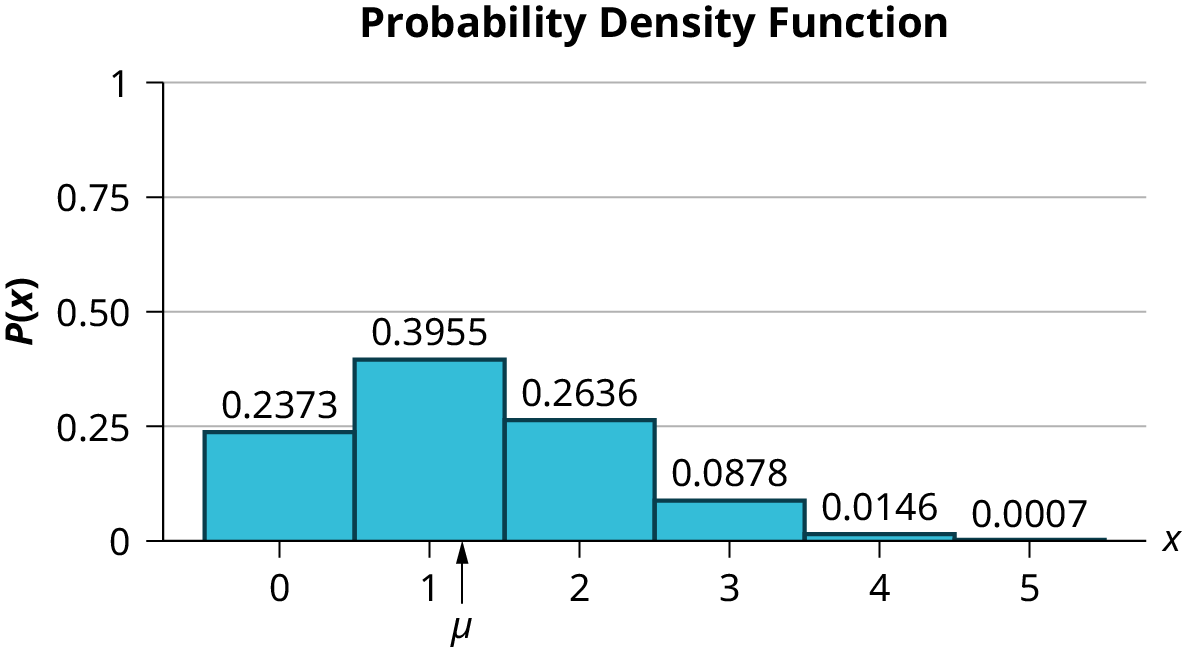

Figure 4.2図 4.2
Example 4.12例題 4.12
Approximately 70% of statistics students do their homework in time for it to be collected and graded. Each student does homework independently. In a statistics class of 50 students, what is the probability that at least 40 will do their homework on time? Students are selected randomly.
統計学の学生の約70%は、回収・採点に間に合うように宿題を終える。各学生は独立に宿題を行う。50人の統計学のクラスで、少なくとも40人が期限内に宿題を終える確率はいくらか。学生は無作為に選ばれている。
a. This is a binomial problem because there is only a success or a __________, there are a fixed number of trials, and the probability of a success is 0.70 for each trial.
a. 結果は成功か__________だけで、試行回数が固定され、各試行の成功確率が0.70なので、これは二項分布の問題である。
b. If we are interested in the number of students who do their homework on time, then how do we define X?
b. 期限内に宿題を終える学生の人数に関心があるとき、Xをどのように定義するか。
c. What values does x take on?
c. xはどのような値を取るか。
d. What is a "failure," in words?
d. 「失敗」とは何か、言葉で述べよ。
e. If p + q = 1, then what is q?
e. p + q = 1なら、qはいくらか。
f. The words "at least" translate as what kind of inequality for the probability question P(x ____ 40).
f. 確率の問いP(x ____ 40)で、「少なくとも」はどのような不等号で表されるか。
Solution解き方
a. failure
a. 失敗
b. X = the number of statistics students who do their homework on time
b. X = 期限内に宿題を終える統計学の学生の人数
c. 0, 1, 2, …, 50
d. Failure is defined as a student who does not complete their homework on time.
d. 失敗は、ある学生が期限内に宿題を終えないことと定義する。
The probability of a success is p = 0.70. The number of trials is n = 50.
成功確率はp = 0.70で、試行回数はn = 50である。
e. q = 0.30
f. greater than or equal to (≥)
The probability question is P(x ≥ 40).
The probability question is P(x ≥ 40).
f. 以上(≥)。確率の問いはP(x ≥ 40)となる。