第14章ストレス、生活習慣、健康
Stress Reduction Techniquesストレス低減の技法
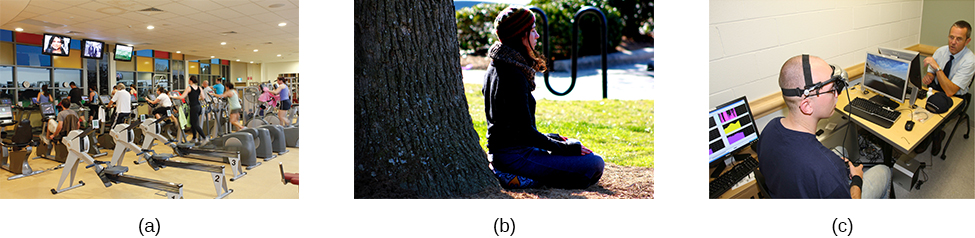
Beyond having a sense of control and establishing social support networks, there are numerous other means by which we can manage stress (Figure 14.24). A common technique people use to combat stress is exercise (Salmon, 2001). It is well-established that exercise, both of long (aerobic) and short (anaerobic) duration, is beneficial for both physical and mental health (Everly & Lating, 2002). There is considerable evidence that physically fit individuals are more resistant to the adverse effects of stress and recover more quickly from stress than less physically fit individuals (Cotton, 1990). In a study of more than 500 Swiss police officers and emergency service personnel, increased physical fitness was associated with reduced stress, and regular exercise was reported to protect against stress-related health problems (Gerber, Kellman, Hartman, & Pühse, 2010).
英語のヒント
コントロール感をもつことやソーシャル・サポートのネットワークを築くこと以外にも、ストレスを管理する手段はほかに数多くある(図14.24)。ストレスに対抗するために人々がよく用いる技法は運動である(Salmon, 2001)。運動は、長時間のもの(有酸素運動)であれ短時間のもの(無酸素運動)であれ、身体的健康と精神的健康の両方に有益であることが確立されている(Everly & Lating, 2002)。体力のある人は、体力の劣る人に比べて、ストレスの悪影響に対する抵抗力が強く、ストレスからより早く回復するという相当な証拠がある(Cotton, 1990)。スイスの警察官と救急隊員500人以上を対象とした研究では、体力の向上がストレスの低下と関連しており、定期的な運動がストレスに関連した健康問題を防ぐことが報告された(Gerber, Kellman, Hartman, & Pühse, 2010)。
OpenStax, Rice University; Psychology 2e. (credit a: modification of work by “UNE Photos”/Flickr; credit b: modification of work by Caleb Roenigk; credit c: modification of work by Dr. Carmen Russoniello) · CC BY 4.0 · Source出典

Figure 14.24図 14.24
Stress reduction techniques may include (a) exercise, (b) meditation and relaxation, or (c) biofeedback. (credit a: modification of work by “UNE Photos”/Flickr; credit b: modification of work by Caleb Roenigk; credit c: modification of work by Dr. Carmen Russoniello)
ストレス低減の技法には、(a)運動、(b)瞑想とリラクセーション、(c)バイオフィードバックなどがある。(出典a:“UNE Photos”/Flickrの作品を改変、出典b:Caleb Roenigkの作品を改変、出典c:Dr. Carmen Russonielloの作品を改変)
One reason exercise may be beneficial is because it might buffer some of the deleterious physiological mechanisms of stress. One study found rats that exercised for six weeks showed a decrease in hypothalamic-pituitary-adrenal responsiveness to mild stressors (Campeau et al., 2010). In high-stress humans, exercise has been shown to prevent telomere shortening, which may explain the common observation of a youthful appearance among those who exercise regularly (Puterman et al., 2010). Further, exercise in later adulthood appears to minimize the detrimental effects of stress on the hippocampus and memory (Head, Singh, & Bugg, 2012). Among cancer survivors, exercise has been shown to reduce anxiety (Speck, Courneya, Masse, Duval, & Schmitz, 2010) and depressive symptoms (Craft, VanIterson, Helenowski, Rademaker, & Courneya, 2012). Clearly, exercise is a highly effective tool for regulating stress.
英語のヒント
運動が有益でありうる理由の一つは、ストレスの有害な生理的メカニズムの一部を和らげる可能性があることである。ある研究では、6週間運動したラットは、軽いストレッサーに対する視床下部−下垂体−副腎軸(HPA軸)の反応性が低下していた(Campeau et al., 2010)。ストレスの大きい人間では、運動がテロメアの短縮を防ぐことが示されており、このことは、定期的に運動する人が若々しく見えるというよく知られた観察を説明するかもしれない(Puterman et al., 2010)。さらに、成人期後期の運動は、ストレスが海馬と記憶に及ぼす有害な影響を最小限に抑えるようである(Head, Singh, & Bugg, 2012)。がんサバイバーでは、運動が不安(Speck, Courneya, Masse, Duval, & Schmitz, 2010)と抑うつ症状(Craft, VanIterson, Helenowski, Rademaker, & Courneya, 2012)を軽減することが示されている。明らかに、運動はストレスを調整するためのきわめて効果的な手段である。
In the 1970s, Herbert Benson, a cardiologist, developed a stress reduction method called the relaxation response technique (Greenberg, 2006). The relaxation response technique combines relaxation with transcendental meditation, and consists of four components (Stein, 2001):
英語のヒント
1970年代に、心臓専門医のハーバート・ベンソンは、リラクセーション反応法と呼ばれるストレス低減法を開発した(Greenberg, 2006)。リラクセーション反応法はリラクセーションと超越瞑想を組み合わせたもので、次の四つの要素から成る(Stein, 2001)。
- sitting upright on a comfortable chair with feet on the ground and body in a relaxed position,足を床につけ、身体をリラックスした姿勢にして、座り心地のよい椅子に背筋を伸ばして座ること
- being in a quiet environment with eyes closed,目を閉じて、静かな環境に身を置くこと
- repeating a word or a phrase—a mantra—to oneself, such as “alert mind, calm body,”「さえた心、穏やかな身体」のような言葉や句、すなわちマントラを、自分に向けて繰り返し唱えること
- passively allowing the mind to focus on pleasant thoughts, such as nature or the warmth of your blood nourishing your body.自然のことや、身体に栄養を行き渡らせる血液の温かさなど、心地よい考えに心が向かうのを、受け身のまま任せること
The relaxation response approach is conceptualized as a general approach to stress reduction that reduces sympathetic arousal, and it has been used effectively to treat people with high blood pressure (Benson & Proctor, 1994).
英語のヒント
リラクセーション反応のアプローチは、交感神経系の覚醒を低下させる、ストレス低減への一般的なアプローチとして概念化されており、高血圧の人の治療に効果的に用いられてきた(Benson & Proctor, 1994)。
Another technique to combat stress, biofeedback, was developed by Gary Schwartz at Harvard University in the early 1970s. Biofeedback is a technique that uses electronic equipment to accurately measure a person’s neuromuscular and autonomic activity—feedback is provided in the form of visual or auditory signals. The main assumption of this approach is that providing somebody biofeedback will enable the individual to develop strategies that help gain some level of voluntary control over what are normally involuntary bodily processes (Schwartz & Schwartz, 1995). A number of different bodily measures have been used in biofeedback research, including facial muscle movement, brain activity, and skin temperature, and it has been applied successfully with individuals experiencing tension headaches, high blood pressure, asthma, and phobias (Stein, 2001).
英語のヒント
ストレスに対抗するもう一つの技法であるバイオフィードバックは、1970年代初めにハーバード大学のゲイリー・シュワルツによって開発された。バイオフィードバックは、電子機器を使って人の神経筋の活動と自律神経の活動を正確に測定する技法であり、フィードバックは視覚的または聴覚的な信号の形で与えられる。このアプローチの主な前提は、人にバイオフィードバックを与えれば、その人は、ふだんは不随意である身体の過程に対して、ある程度の随意的なコントロールを得る助けとなる方略を身につけられるようになる、というものである(Schwartz & Schwartz, 1995)。バイオフィードバックの研究では、顔の筋肉の動き、脳の活動、皮膚温など、さまざまな身体の指標が用いられてきた。また、バイオフィードバックは、緊張型頭痛、高血圧、喘息、恐怖症を経験している人々に適用されて成果を上げている(Stein, 2001)。
Summaryまとめ
When faced with stress, people must attempt to manage or cope with it. In general, there are two basic forms of coping: problem-focused coping and emotion-focused coping. Those who use problem-focused coping strategies tend to cope better with stress because these strategies address the source of stress rather than the resulting symptoms. To a large extent, perceived control greatly impacts reaction to stressors and is associated with greater physical and mental well-being. Social support has been demonstrated to be a highly effective buffer against the adverse effects of stress. Extensive research has shown that social support has beneficial physiological effects for people, and it seems to influence immune functioning. However, the beneficial effects of social support may be related to its influence on promoting healthy behaviors.
ストレスに直面したとき、人はそれを管理したり、それに対処したりしようとしなければならない。一般に、コーピングには問題焦点型コーピングと感情焦点型コーピングという二つの基本的な形がある。問題焦点型のコーピング方略を用いる人は、ストレスにうまく対処する傾向がある。こうした方略は、結果として生じる症状ではなく、ストレスの原因に取り組むからである。知覚されたコントロールは、ストレッサーへの反応を大きく左右し、より良好な身体的・精神的ウェルビーイングと関連している。ソーシャル・サポートは、ストレスの悪影響に対するきわめて効果的な緩衝材であることが実証されている。多くの研究によって、ソーシャル・サポートが人々に有益な生理的効果をもたらすことが示されており、ソーシャル・サポートは免疫機能にも影響を与えるようである。しかし、ソーシャル・サポートの有益な効果は、健康的な行動を促すというその影響と関係しているのかもしれない。