第14章ストレス、生活習慣、健康
Depression and the Heart抑うつと心臓
For centuries, poets and folklore have asserted that there is a connection between moods and the heart (Glassman & Shapiro, 1998). You are no doubt familiar with the notion of a broken heart following a disappointing or depressing event and have encountered that notion in songs, films, and literature.
英語のヒント
何世紀にもわたって、詩人や民間伝承は、気分と心臓のあいだにはつながりがあると主張してきた(Glassman & Shapiro, 1998)。失望させられる出来事や気のめいる出来事の後に心が「張り裂ける」という考えには、きっとなじみがあるだろう。歌や映画、文学の中でその考えに出会ったこともあるはずだ。
Perhaps the first to recognize the link between depression and heart disease was Benjamin Malzberg (1937), who found that the death rate among institutionalized patients with melancholia (an archaic term for depression) was six times higher than that of the population. A classic study in the late 1970s looked at over 8,000 people diagnosed with manic-depressive disorder (now classified as bipolar disorder) in Denmark, finding a nearly 50% increase in deaths from heart disease among these patients compared with the general Danish population (Weeke, 1979). By the early 1990s, evidence began to accumulate showing that depressed individuals who were followed for long periods of time were at increased risk for heart disease and cardiac death (Glassman, 2007). In one investigation of over 700 Denmark residents, those with the highest depression scores were 71% more likely to have experienced a heart attack than were those with lower depression scores (Barefoot & Schroll, 1996). Figure 14.20 illustrates the gradation in risk of heart attacks for both men and women.
英語のヒント
抑うつと心臓病の関連に最初に気づいたのは、おそらくベンジャミン・マルツバーグ(1937)だろう。マルツバーグは、メランコリー(抑うつを指す古い用語)で施設に収容されている患者の死亡率が、一般の人々の死亡率の6倍であることを見いだした。1970年代後半の古典的な研究は、デンマークで躁うつ性障害(現在は双極性障害に分類される)と診断された8000人以上を調べ、これらの患者では、デンマークの一般の人々と比べて、心臓病による死亡が50%近く多いことを見いだした(Weeke, 1979)。1990年代初めまでには、長期間にわたって追跡された抑うつのある人は、心臓病や心臓死のリスクが高いことを示す証拠が蓄積しはじめた(Glassman, 2007)。デンマークの住民700人以上を対象としたある調査では、抑うつ得点が最も高かった人は、抑うつ得点が低かった人に比べて、心臓発作を経験していた可能性が71%高かった(Barefoot & Schroll, 1996)。図14.20は、男性と女性の両方について、心臓発作のリスクが段階的に変わる様子を示している。
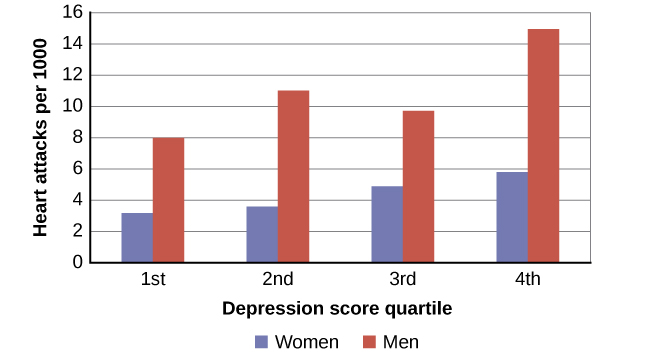

Figure 14.20図 14.20
This graph shows the incidence of heart attacks among men and women by depression score quartile (adapted from Barefoot & Schroll, 1996).
このグラフは、抑うつ得点の四分位ごとに、男性と女性の心臓発作の発生率を示している(Barefoot & Schroll, 1996を改変)。
After more than two decades of research, it is now clear that a relationship exists: Patients with heart disease have more depression than the general population, and people with depression are more likely to eventually develop heart disease and experience higher mortality than those who do not have depression (Hare, Toukhsati, Johansson, & Jaarsma, 2013); the more severe the depression, the higher the risk (Glassman, 2007). Consider the following:
英語のヒント
20年以上にわたる研究を経て、関係が存在することは今や明らかである。心臓病の患者は一般の人々よりも抑うつが多く、抑うつのある人は、抑うつのない人に比べて、最終的に心臓病を発症し、より高い死亡率を経験する可能性が高い(Hare, Toukhsati, Johansson, & Jaarsma, 2013)。そして、抑うつが重いほど、リスクは高くなる(Glassman, 2007)。次の例を考えてみよう。
- In one study, death rates from cardiovascular problems were substantially higher in depressed people; depressed men were 50% more likely to have died from cardiovascular problems, and depressed women were 70% more likely (Ösby, Brandt, Correia, Ekbom, & Sparén, 2001).
英語のヒント
ある研究では、心血管の問題による死亡率は、抑うつのある人で大幅に高かった。抑うつのある男性は心血管の問題で死亡していた可能性が50%高く、抑うつのある女性では70%高かった(Ösby, Brandt, Correia, Ekbom, & Sparén, 2001)。 - A statistical review of 10 longitudinal studies involving initially healthy individuals revealed that those with elevated depressive symptoms have, on average, a 64% greater risk of developing heart disease than do those with fewer symptoms (Wulsin & Singal, 2003).
英語のヒント
当初は健康だった人々を対象とした10件の縦断的研究を統計的に検討したところ、抑うつ症状が強い人は、症状の少ない人に比べて、心臓病を発症するリスクが平均して64%高いことが明らかになった(Wulsin & Singal, 2003)。 - A study of over 63,000 registered nurses found that those with more depressed symptoms when the study began were 49% more likely to experience fatal heart disease over a 12-year period (Whang et al., 2009).
英語のヒント
6万3000人以上の正看護師を対象とした研究では、研究開始時に抑うつ症状が多かった人は、12年間のうちに致死的な心臓病を経験する可能性が49%高かった(Whang et al., 2009)。
The American Heart Association, fully aware of the established importance of depression in cardiovascular diseases, several years ago recommended routine depression screening for all heart disease patients (Lichtman et al., 2008). Recently, they have recommended including depression as a risk factor for heart disease patients (AHA, 2014).
英語のヒント
アメリカ心臓協会は、心血管疾患において抑うつが重要であることがすでに確立されていると十分に認識したうえで、数年前、すべての心臓病患者に対して抑うつのスクリーニングを日常的に行うよう勧告した(Lichtman et al., 2008)。最近では、心臓病患者の危険因子として抑うつを含めることを勧告している(AHA, 2014)。
Although the exact mechanisms through which depression might produce heart problems have not been fully clarified, a recent investigation examining this connection in early life has shed some light. In an ongoing study of childhood depression, adolescents who had been diagnosed with depression as children were more likely to be obese, smoke, and be physically inactive than were those who had not received this diagnosis (Rottenberg et al., 2014). One implication of this study is that depression, especially if it occurs early in life, may increase the likelihood of living an unhealthy lifestyle, thereby predisposing people to an unfavorable cardiovascular disease risk profile.
英語のヒント
抑うつが心臓の問題を生じさせうる正確な仕組みは、まだ十分には解明されていないが、この関連を人生の早い時期について調べた最近の調査が、いくらか光を当てている。子どもの抑うつについて現在進行中の研究では、子どものころにうつ病と診断されていた青年は、この診断を受けていなかった青年に比べて、肥満であったり、喫煙したり、運動不足であったりする可能性が高かった(Rottenberg et al., 2014)。この研究が示唆することの一つは、抑うつが、とくに人生の早い時期に生じた場合に、不健康な生活様式を送る可能性を高めるかもしれず、それによって、人を心血管疾患のリスクの面で好ましくない状態に陥りやすくする、ということである。
It is important to point out that depression may be just one piece of the emotional puzzle in elevating the risk for heart disease, and that chronically experiencing several negative emotional states may be especially important. A longitudinal investigation of Vietnam War veterans found that depression, anxiety, hostility, and trait anger each independently predicted the onset of heart disease (Boyle, Michalek, & Suarez, 2006). However, when each of these negative psychological attributes was combined into a single variable, this new variable (which researchers called psychological risk factor) predicted heart disease more strongly than any of the individual variables. Thus, rather than examining the predictive power of isolated psychological risk factors, it seems crucial for future researchers to examine the effects of combined and more general negative emotional and psychological traits in the development of cardiovascular illnesses.
英語のヒント
抑うつは、心臓病のリスクを高める感情のパズルの一片にすぎないかもしれないこと、そして、いくつかの否定的な感情状態を慢性的に経験することがとくに重要かもしれないことを、指摘しておくことが重要である。ベトナム戦争の退役軍人を対象とした縦断的な調査では、抑うつ、不安、敵意、特性怒りのそれぞれが、独立に心臓病の発症を予測することが分かった(Boyle, Michalek, & Suarez, 2006)。しかし、これらの否定的な心理的属性のそれぞれを一つの変数にまとめると、この新しい変数(研究者たちはこれを心理的危険因子と呼んだ)は、個々のどの変数よりも強く心臓病を予測した。したがって、今後の研究者にとっては、切り離された心理的危険因子の予測力を調べるのではなく、組み合わされた、より一般的な否定的感情特性・心理的特性が心血管疾患の発症に及ぼす影響を調べることが、決定的に重要であるように思われる。