第14章ストレス、生活習慣、健康
Cardiovascular Disorders心血管疾患
The cardiovascular system is composed of the heart and blood circulation system. For many years, disorders that involve the cardiovascular system—known as cardiovascular disorders—have been a major focal point in the study of psychophysiological disorders because of the cardiovascular system’s centrality in the stress response (Everly & Lating, 2002). Heart disease is one such condition. Each year, heart disease causes approximately one in three deaths in the United States, and it is the leading cause of death in the developed world (Centers for Disease Control and Prevention [CDC], 2011; Shapiro, 2005).
英語のヒント
心血管系は、心臓と血液循環系から構成されている。長年にわたり、心血管系にかかわる疾患――心血管疾患として知られる――は、ストレス反応において心血管系が中心的な位置を占めることから、心身症の研究の主要な焦点となってきた(Everly & Lating, 2002)。心臓病は、そうした疾患の一つである。アメリカでは毎年、心臓病が死亡のおよそ3件に1件の原因となっており、先進国における死因の第1位でもある(Centers for Disease Control and Prevention [CDC], 2011; Shapiro, 2005)。
The symptoms of heart disease vary somewhat depending on the specific kind of heart disease one has, but they generally involve angina—chest pains or discomfort that occur when the heart does not receive enough blood (Office on Women’s Health, 2009). The pain often feels like the chest is being pressed or squeezed; burning sensations in the chest and shortness of breath are also commonly reported. Such pain and discomfort can spread to the arms, neck, jaws, stomach (as nausea), and back (American Heart Association [AHA], 2012a) (Figure 14.17).
英語のヒント
心臓病の症状は、その人がかかっている心臓病の具体的な種類によっていくらか異なるが、一般に狭心症を伴う。狭心症とは、心臓に十分な血液が届かないときに起こる胸の痛みや不快感である(Office on Women’s Health, 2009)。その痛みは、胸が押されたり締めつけられたりしているように感じられることが多い。胸の焼けるような感覚や息切れもよく報告される。こうした痛みや不快感は、腕、首、あご、胃(吐き気として)、背中に広がることがある(American Heart Association [AHA], 2012a)(図14.17)。
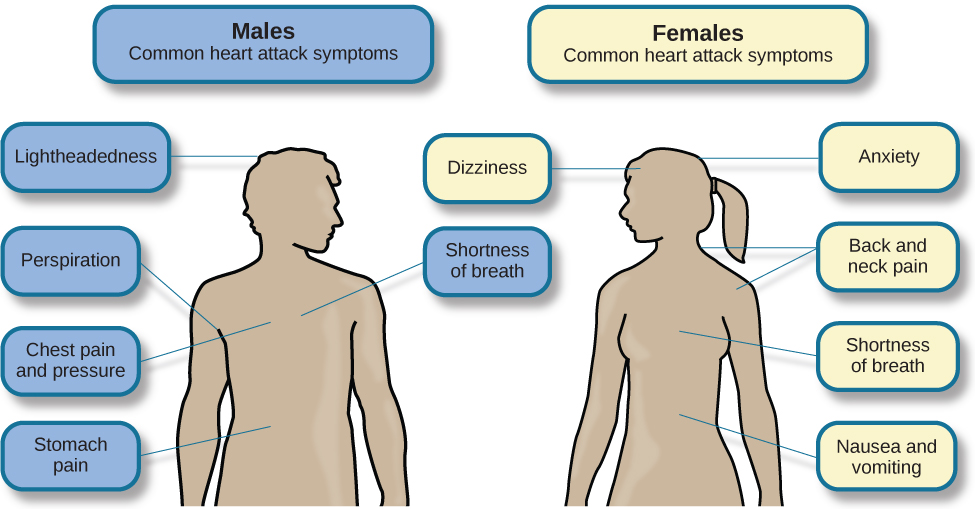
Figure 14.17図 14.17
Males and females often experience different symptoms of a heart attack.
男性と女性では、心臓発作の症状が異なることが多い。
A major risk factor for heart disease is hypertension, which is high blood pressure. Hypertension forces a person’s heart to pump harder, thus putting more physical strain on the heart. If left unchecked, hypertension can lead to a heart attack, stroke, or heart failure; it can also lead to kidney failure and blindness. Hypertension is a serious cardiovascular disorder, and it is sometimes called the silent killer because it has no symptoms—one who has high blood pressure may not even be aware of it (AHA, 2012b).
英語のヒント
心臓病の主要な危険因子の一つは高血圧、すなわち血圧が高いことである。高血圧は、心臓により強く血液を送り出すことを強い、そのため心臓にかかる身体的な負担が大きくなる。放置すれば、高血圧は心臓発作、脳卒中、心不全につながりうる。腎不全や失明につながることもある。高血圧は深刻な心血管疾患であり、症状がないことから「沈黙の殺し屋」と呼ばれることもある。血圧が高い人は、そのことに気づいてさえいないかもしれないのである(AHA, 2012b)。
Many risk factors contributing to cardiovascular disorders have been identified. These risk factors include social determinants such as aging, income, education, and employment status, as well as behavioral risk factors that include unhealthy diet, tobacco use, physical inactivity, and excessive alcohol consumption; obesity and diabetes are additional risk factors (World Health Organization [WHO], 2013).
英語のヒント
心血管疾患の一因となる危険因子は、数多く特定されている。そうした危険因子には、加齢、所得、教育、雇用状態といった社会的決定要因のほか、不健康な食事、たばこの使用、運動不足、過度の飲酒などの行動上の危険因子が含まれる。肥満や糖尿病も危険因子である(World Health Organization [WHO], 2013)。
Over the past few decades, there has been much greater recognition and awareness of the importance of stress and other psychological factors in cardiovascular health (Nusair, Al-dadah, & Kumar, 2012). Indeed, exposure to stressors of many kinds has also been linked to cardiovascular problems; in the case of hypertension, some of these stressors include job strain (Trudel, Brisson, & Milot, 2010), natural disasters (Saito, Kim, Maekawa, Ikeda, & Yokoyama, 1997), marital conflict (Nealey-Moore, Smith, Uchino, Hawkins, & Olson-Cerny, 2007), and exposure to high traffic noise levels at one’s home (de Kluizenaar, Gansevoort, Miedema, & de Jong, 2007). Perceived discrimination appears to be associated with hypertension among African Americans (Sims et al., 2012). In addition, laboratory-based stress tasks, such as performing mental arithmetic under time pressure, immersing one’s hand into ice water (known as the cold pressor test), mirror tracing, and public speaking have all been shown to elevate blood pressure (Phillips, 2011).
英語のヒント
ここ数十年のあいだに、心血管の健康にとってのストレスやその他の心理的要因の重要性が、はるかに広く認識され、知られるようになった(Nusair, Al-dadah, & Kumar, 2012)。実際、さまざまな種類のストレッサーにさらされることも、心血管の問題と関連づけられてきた。高血圧の場合、そうしたストレッサーには、職務ストレイン(Trudel, Brisson, & Milot, 2010)、自然災害(Saito, Kim, Maekawa, Ikeda, & Yokoyama, 1997)、夫婦間の対立(Nealey-Moore, Smith, Uchino, Hawkins, & Olson-Cerny, 2007)、自宅で高い交通騒音レベルにさらされること(de Kluizenaar, Gansevoort, Miedema, & de Jong, 2007)などがある。知覚された差別は、アフリカ系アメリカ人のあいだで高血圧と関連しているようである(Sims et al., 2012)。さらに、実験室でのストレス課題、たとえば時間的なプレッシャーのもとで暗算をすること、手を氷水に浸すこと(寒冷昇圧試験として知られる)、鏡映描写、人前でのスピーチなどは、いずれも血圧を上昇させることが示されている(Phillips, 2011)。
Are You Type A or Type B?あなたはタイプAか、タイプBか
Sometimes research ideas and theories emerge from seemingly trivial observations. In the 1950s, cardiologist Meyer Friedman was looking over his waiting room furniture, which consisted of upholstered chairs with armrests. Friedman decided to have these chairs reupholstered. When the man doing the reupholstering came to the office to do the work, he commented on how the chairs were worn in a unique manner—the front edges of the cushions were worn down, as were the front tips of the arm rests. It seemed like the cardiology patients were tapping or squeezing the front of the armrests, as well as literally sitting on the edge of their seats (Friedman & Rosenman, 1974). Were cardiology patients somehow different than other types of patients? If so, how?
英語のヒント
研究のアイデアや理論は、ときに一見ささいな観察から生まれる。1950年代、心臓専門医のマイヤー・フリードマンは、待合室の家具を点検していた。その家具は、ひじ掛けのついた布張りの椅子だった。フリードマンは、これらの椅子を張り替えてもらうことにした。張り替えを担当する男性が作業のために診療所に来たとき、彼は椅子が独特なすり減り方をしていることを指摘した。クッションの前の縁がすり減っており、ひじ掛けの前の先端も同じようにすり減っていたのである。心臓病の患者たちは、ひじ掛けの前の部分を指でたたいたり握りしめたりしていたうえ、文字どおり椅子の縁に腰かけていたようだった(Friedman & Rosenman, 1974)。心臓病の患者は、ほかの種類の患者と何か違っていたのだろうか。もしそうなら、どのように違っていたのだろうか。
After researching this matter, Friedman and his colleague, Ray Rosenman, came to understand that people who are prone to heart disease tend to think, feel, and act differently than those who are not. These individuals tend to be intensively driven workaholics who are preoccupied with deadlines and always seem to be in a rush. According to Friedman and Rosenman, these individuals exhibit Type A behavior pattern; those who are more relaxed and laid-back were characterized as Type B (Figure 14.18). In a sample of Type As and Type Bs, Friedman and Rosenman were startled to discover that heart disease was over seven times more frequent among the Type As than the Type Bs (Friedman & Rosenman, 1959).
英語のヒント
この問題を調べた結果、フリードマンと同僚のレイ・ローゼンマンは、心臓病になりやすい人は、そうでない人とは考え方、感じ方、行動の仕方が異なる傾向があると理解するようになった。こうした人々は、締め切りに気をとられ、いつも急いでいるように見える、強い意欲に駆り立てられた仕事中毒の人である傾向がある。フリードマンとローゼンマンによれば、こうした人々はタイプA行動パターンを示す。これに対し、よりリラックスしてのんびりした人々はタイプBとされた(図14.18)。タイプAとタイプBの人々からなる標本で、フリードマンとローゼンマンは、心臓病がタイプBよりタイプAのあいだで7倍以上も多いことを発見して驚いた(Friedman & Rosenman, 1959)。
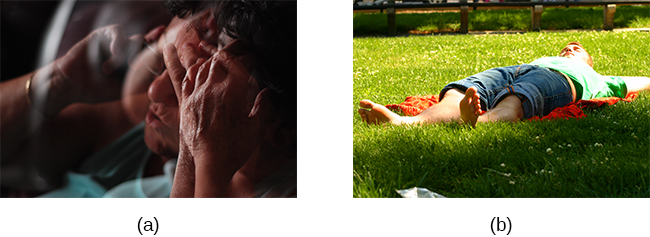
OpenStax, Rice University; Psychology 2e. (credit a: modification of work by Greg Hernandez; credit b: modification of work by Elvert Barnes) · CC BY 4.0 · Source出典
Figure 14.18図 14.18
(a) Type A individuals are characterized as intensely driven, (b) while Type B people are characterized as laid-back and relaxed. (credit a: modification of work by Greg Hernandez; credit b: modification of work by Elvert Barnes)
(a)タイプAの人は、強い意欲に駆り立てられているのが特徴とされ、(b)タイプBの人は、のんびりしていてリラックスしているのが特徴とされる。(出典a:Greg Hernandezの作品を改変、出典b:Elvert Barnesの作品を改変)
The major components of the Type A pattern include an aggressive and chronic struggle to achieve more and more in less and less time (Friedman & Rosenman, 1974). Specific characteristics of the Type A pattern include an excessive competitive drive, chronic sense of time urgency, impatience, and hostility toward others (particularly those who get in the person’s way).
英語のヒント
タイプAパターンの主な構成要素には、ますます少ない時間でますます多くのことを成し遂げようとする、攻撃的で慢性的な奮闘が含まれる(Friedman & Rosenman, 1974)。タイプAパターンの具体的な特徴としては、過度の競争心、慢性的な時間的切迫感、せっかちさ、他者(とりわけ自分の邪魔をする人)に対する敵意などがある。
An example of a person who exhibits Type A behavior pattern is Jeffrey. Even as a child, Jeffrey was intense and driven. He excelled at school, was captain of the swim team, and graduated with honors from an Ivy League college. Jeffrey never seems able to relax; he is always working on something, even on the weekends. However, Jeffrey always seems to feel as though there are not enough hours in the day to accomplish all he feels he should. He volunteers to take on extra tasks at work and often brings his work home with him; he often goes to bed frustrated late at night because he feels that he has not done enough. Jeffrey is quick tempered with his coworkers; he often becomes noticeably agitated when dealing with those coworkers he feels work too slowly or whose work does not meet his standards. He typically reacts with hostility when interrupted at work. He has experienced problems in his marriage over his lack of time spent with family. When caught in traffic during his commute to and from work, Jeffrey incessantly pounds on his horn and swears loudly at other drivers. When Jeffrey was 52, he suffered his first heart attack.
英語のヒント
タイプA行動パターンを示す人の例として、ジェフリーを挙げよう。子どものころから、ジェフリーは何事にも激しく打ち込み、意欲に駆り立てられていた。学業に秀で、水泳部の主将を務め、アイビーリーグの大学を優秀な成績で卒業した。ジェフリーは決してくつろげないようで、週末でさえ、いつも何かに取り組んでいる。それでもジェフリーはいつも、自分がやるべきだと思うことをすべて成し遂げるには、1日の時間が足りないと感じているようだ。職場では自分から進んで余分な仕事を引き受け、よく仕事を家に持ち帰る。十分にやり終えていないと感じるので、夜遅く、いらいらしたまま床につくことも多い。ジェフリーは同僚に対して短気である。仕事が遅すぎると感じる同僚や、仕事が自分の基準に達しない同僚とかかわるときには、目に見えていら立つことが多い。仕事中に邪魔が入ると、たいてい敵意をもって反応する。家族と過ごす時間が少ないことをめぐって、結婚生活でも問題を抱えてきた。通勤の行き帰りに渋滞に巻き込まれると、ジェフリーはひっきりなしにクラクションを鳴らし、ほかの運転者に大声で悪態をつく。52歳のとき、ジェフリーは最初の心臓発作を起こした。
By the 1970s, a majority of practicing cardiologists believed that Type A behavior pattern was a significant risk factor for heart disease (Friedman, 1977). Indeed, a number of early longitudinal investigations demonstrated a link between Type A behavior pattern and later development of heart disease (Rosenman et al., 1975; Haynes, Feinleib, & Kannel, 1980).
英語のヒント
1970年代までには、臨床に携わる心臓専門医の大多数が、タイプA行動パターンは心臓病の重大な危険因子であると考えるようになっていた(Friedman, 1977)。実際、初期の縦断的な調査のいくつかは、タイプA行動パターンとその後の心臓病の発症との関連を実証していた(Rosenman et al., 1975; Haynes, Feinleib, & Kannel, 1980)。
Subsequent research examining the association between Type A and heart disease, however, failed to replicate these earlier findings (Glassman, 2007; Myrtek, 2001). Because Type A theory did not pan out as well as they had hoped, researchers shifted their attention toward determining if any of the specific elements of Type A predict heart disease.
英語のヒント
しかし、タイプAと心臓病の関連を調べたその後の研究は、これらの初期の知見を追試で再現できなかった(Glassman, 2007; Myrtek, 2001)。タイプA理論が期待したほどうまくいかなかったため、研究者たちは、タイプAの特定の要素のどれかが心臓病を予測するかどうかを明らかにすることへと、関心を移した。
Extensive research clearly suggests that the anger/hostility dimension of Type A behavior pattern may be one of the most important factors in the development of heart disease. This relationship was initially described in the Haynes et al. (1980) study mentioned above: Suppressed hostility was found to substantially elevate the risk of heart disease for both men and women. Also, one investigation followed over 1,000 male medical students from 32 to 48 years. At the beginning of the study, these men completed a questionnaire assessing how they react to pressure; some indicated that they respond with high levels of anger, whereas others indicated that they respond with less anger. Decades later, researchers found that those who earlier had indicated the highest levels of anger were over 6 times more likely than those who indicated less anger to have had a heart attack by age 55, and they were 3.5 times more likely to have experienced heart disease by the same age (Chang, Ford, Meoni, Wang, & Klag, 2002). From a health standpoint, it clearly does not pay to be an angry person.
英語のヒント
数多くの研究が、タイプA行動パターンの怒り/敵意の次元が、心臓病の発症における最も重要な要因の一つかもしれないことを、はっきりと示唆している。この関係が最初に記述されたのは、先に触れたヘインズら(1980)の研究である。この研究では、抑え込まれた敵意が、男性でも女性でも心臓病のリスクを大幅に高めることが分かった。また、ある調査では、1000人を超える男子医学生を32〜48年間にわたって追跡した。研究の開始時に、これらの男性は、プレッシャーにどう反応するかを評価する質問紙に回答した。強い怒りで反応すると答えた人もいれば、それほど怒らずに反応すると答えた人もいた。数十年後、研究者たちは、以前に最も強い怒りを示していた人は、怒りの少なかった人に比べて、55歳までに心臓発作を起こしていた可能性が6倍以上高く、同じ年齢までに心臓病を経験していた可能性も3.5倍高いことを見いだした(Chang, Ford, Meoni, Wang, & Klag, 2002)。健康という観点から見れば、怒りっぽい人であることは明らかに割に合わない。
After reviewing and statistically summarizing 35 studies from 1983 to 2006, Chida and Steptoe (2009) concluded that the bulk of the evidence suggests that anger and hostility constitute serious long-term risk factors for adverse cardiovascular outcomes among both healthy individuals and those already suffering from heart disease. One reason angry and hostile moods might contribute to cardiovascular diseases is that such moods can create social strain, mainly in the form of antagonistic social encounters with others. This strain could then lay the foundation for disease-promoting cardiovascular responses among hostile individuals (Vella, Kamarck, Flory, & Manuck, 2012). In this transactional model, hostility and social strain form a cycle (Figure 14.19).
英語のヒント
1983年から2006年までの35件の研究を検討し、統計的に要約した結果、チダとステプトー(2009)は、証拠の大部分が次のことを示唆していると結論づけた。すなわち、怒りと敵意は、健康な人にとっても、すでに心臓病を患っている人にとっても、心血管系の悪い転帰をもたらす深刻な長期的危険因子となっている、ということである。怒りや敵意に満ちた気分が心血管疾患の一因となりうる理由の一つは、そうした気分が、社会的な緊張、主に他者との敵対的な社会的やりとりという形の緊張を生み出しうることである。そして、この緊張が、敵意の強い人において、病気を促進するような心血管系の反応の土台を築く可能性がある(Vella, Kamarck, Flory, & Manuck, 2012)。この相互作用モデルでは、敵意と社会的な緊張が循環を形づくる(図14.19)。
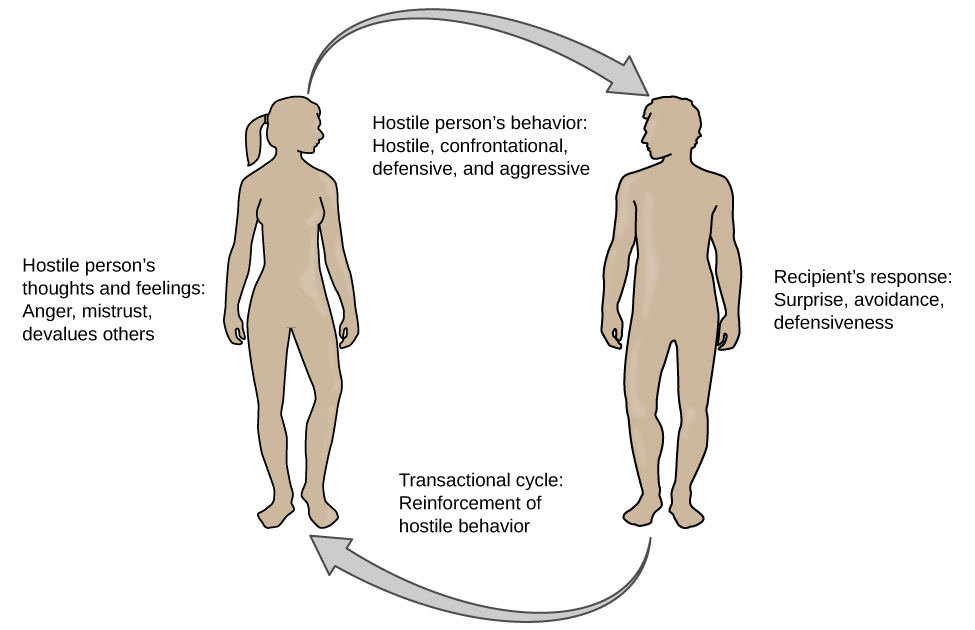


Figure 14.19図 14.19
According to the transactional model of hostility for predicting social interactions (Vella et al., 2012), the thoughts and feelings of a hostile person promote antagonistic behavior toward others, which in turn reinforces complimentary reactions from others, thereby intensifying ones’ hostile disposition and intensifying the cyclical nature of this relationship.
社会的なやりとりを予測する敵意の相互作用モデル(Vella et al., 2012)によれば、敵意の強い人の思考と感情は、他者に対する敵対的な行動を促す。それが今度は、他者からのそれに応じた反応を強め、その結果、本人の敵意ある性向が強まり、この関係の循環的な性質も強まる。
For example, suppose Kaitlin has a hostile disposition; she has a cynical, distrustful attitude toward others and often thinks that other people are out to get her. She is very defensive around people, even those she has known for years, and she is always looking for signs that others are either disrespecting or belittling her. In the shower each morning before work, she often mentally rehearses what she would say to someone who said or did something that angered her, such as making a political statement that was counter to her own ideology. As Kaitlin goes through these mental rehearsals, she often grins and thinks about the retaliation on anyone who will irk her that day.
英語のヒント
たとえば、ケイトリンが敵意の強い性向を持っているとしよう。ケイトリンは他者に対して皮肉で不信に満ちた態度をとり、ほかの人たちが自分を陥れようとしているとしばしば考える。人といるときには、何年も前から知っている相手に対してさえ、とても防衛的になり、他者が自分を軽んじたり見くびったりしているしるしを、いつも探している。毎朝、出勤前にシャワーを浴びながら、自分を怒らせるようなことを言ったりしたりした人――たとえば、自分の信条に反する政治的な発言をした人――に何と言ってやるかを、頭の中でよくリハーサルする。こうした頭の中のリハーサルをしながら、ケイトリンはよくにやりと笑い、その日に自分をいら立たせる者が誰であれ、その相手への仕返しのことを考える。
Socially, she is confrontational and tends to use a harsh tone with people, which often leads to very disagreeable and sometimes argumentative social interactions. As you might imagine, Kaitlin is not especially popular with others, including coworkers, neighbors, and even members of her own family. They either avoid her at all costs or snap back at her, which causes Kaitlin to become even more cynical and distrustful of others, making her disposition even more hostile. Kaitlin’s hostility—through her own doing—has created an antagonistic environment that cyclically causes her to become even more hostile and angry, thereby potentially setting the stage for cardiovascular problems.
英語のヒント
人づきあいの面では、ケイトリンは対立的で、人に対してきつい口調を使いがちである。そのため、やりとりは非常に不愉快なものになることが多く、ときには口論にもなる。想像がつくように、ケイトリンは、同僚や近所の人、さらには自分の家族も含めて、ほかの人たちからとくに好かれてはいない。人々は、何としても彼女を避けるか、彼女に言い返すかのどちらかであり、そのことでケイトリンは、他者に対してますます皮肉な見方をし、不信感を強め、その性向はさらに敵意に満ちたものになる。ケイトリンの敵意は――彼女自身の振る舞いによって――敵対的な環境をつくり出してしまった。その環境が循環的に彼女をいっそう敵意に満ちた、怒りっぽい人にし、それによって心血管の問題の下地をつくる可能性がある。
In addition to anger and hostility, a number of other negative emotional states have been linked with heart disease, including negative affectivity and depression (Suls & Bunde, 2005). Negative affectivity is a tendency to experience distressed emotional states involving anger, contempt, disgust, guilt, fear, and nervousness (Watson, Clark, & Tellegen, 1988). It has been linked with the development of both hypertension and heart disease. For example, over 3,000 initially healthy participants in one study were tracked longitudinally, up to 22 years. Those with higher levels of negative affectivity at the time the study began were substantially more likely to develop and be treated for hypertension during the ensuing years than were those with lower levels of negative affectivity (Jonas & Lando, 2000). In addition, a study of over 10,000 middle-aged London-based civil servants who were followed an average of 12.5 years revealed that those who earlier had scored in the upper third on a test of negative affectivity were 32% more likely to have experienced heart disease, heart attack, or angina over a period of years than were those who scored in the lowest third (Nabi, Kivimaki, De Vogli, Marmot, & Singh-Manoux, 2008). Hence, negative affectivity appears to be a potentially vital risk factor for the development of cardiovascular disorders.
英語のヒント
怒りと敵意のほかにも、否定的感情性や抑うつをはじめ、いくつかの否定的な感情状態が心臓病と関連づけられてきた(Suls & Bunde, 2005)。否定的感情性とは、怒り、軽蔑、嫌悪、罪悪感、恐れ、神経過敏を含む、苦痛に満ちた感情状態を経験しやすい傾向である(Watson, Clark, & Tellegen, 1988)。否定的感情性は、高血圧と心臓病の両方の発症と関連づけられてきた。たとえば、ある研究では、当初は健康だった3000人以上の参加者を、最長22年にわたって縦断的に追跡した。研究開始時に否定的感情性の水準が高かった人は、低かった人に比べて、その後の年月のあいだに高血圧を発症し、その治療を受ける可能性が大幅に高かった(Jonas & Lando, 2000)。さらに、ロンドンを拠点とする中年の公務員1万人以上を平均12.5年追跡した研究では、以前に否定的感情性の検査で上位3分の1の得点だった人は、最下位3分の1の得点だった人に比べて、数年のあいだに心臓病、心臓発作、狭心症を経験していた可能性が32%高かった(Nabi, Kivimaki, De Vogli, Marmot, & Singh-Manoux, 2008)。したがって、否定的感情性は、心血管疾患の発症にとって、きわめて重要な危険因子となりうるもののようである。