第14章ストレス、生活習慣、健康
Stress and the Immune Systemストレスと免疫系
In a sense, the immune system is the body’s surveillance system. It consists of a variety of structures, cells, and mechanisms that serve to protect the body from invading microorganisms that can harm or damage the body’s tissues and organs. When the immune system is working as it should, it keeps us healthy and disease free by eliminating harmful bacteria, viruses, and other foreign substances that have entered the body (Everly & Lating, 2002).
英語のヒント
ある意味で、免疫系は身体の監視システムである。免疫系は、さまざまな構造、細胞、仕組みから成り、それらは、身体の組織や器官を害したり傷つけたりしうる、侵入してくる微生物から身体を守る働きをしている。免疫系が本来のとおりに働いているときには、体内に入り込んだ有害な細菌やウイルス、その他の異物を取り除くことで、私たちを健康で病気のない状態に保っている(Everly & Lating, 2002)。
Immune System Errors免疫系の誤作動
Sometimes, the immune system will function erroneously. For example, sometimes it can go awry by mistaking your body’s own healthy cells for invaders and repeatedly attacking them. When this happens, the person is said to have an autoimmune disease, which can affect almost any part of the body. How an autoimmune disease affects a person depends on what part of the body is targeted. For instance, rheumatoid arthritis, an autoimmune disease that affects the joints, results in joint pain, stiffness, and loss of function. Systemic lupus erythematosus (lupus), an autoimmune disease, causes a person’s body to attack its own tissues and can inflict permanent damage on multiple organs, including the heart, lungs, and kidneys. Hashimoto's hypothyroiditis, an autoimmune disease that affects the thyroid gland, can result in depression, fatigue, muscle cramps, and heart problems (American Association of Clinical Endocrinologists and American Thyroid Association, 2012).
英語のヒント
免疫系は、ときに誤って働くことがある。たとえば、自分の身体の健康な細胞を侵入者と取り違え、それを繰り返し攻撃することで、おかしくなってしまうことがある。こうしたことが起こると、その人は自己免疫疾患にかかっているといわれる。自己免疫疾患は、身体のほぼどの部分にも影響しうる。自己免疫疾患が人にどのような影響を与えるかは、身体のどの部分が標的になるかによって決まる。たとえば、関節を侵す自己免疫疾患である関節リウマチは、関節の痛み、こわばり、機能の喪失をもたらす。自己免疫疾患の一つである全身性エリテマトーデス(ループス)は、自分の身体に自分自身の組織を攻撃させ、心臓、肺、腎臓をはじめとする複数の器官に永続的な損傷を与えることがある。甲状腺を侵す自己免疫疾患である橋本甲状腺炎は、抑うつ、疲労、筋肉のけいれん、心臓の問題をもたらしうる(American Association of Clinical Endocrinologists and American Thyroid Association, 2012)。
In addition, the immune system may sometimes break down and be unable to do its job. This situation is referred to as immunosuppression, the decreased effectiveness of the immune system. When people experience immunosuppression, they become susceptible to any number of infections, illness, and diseases. For example, acquired immune deficiency syndrome (AIDS) is a serious and lethal disease that is caused by human immunodeficiency virus (HIV), which greatly weakens the immune system by infecting and destroying antibody-producing cells, thus rendering an untreated person vulnerable to any of a number of opportunistic infections (Powell, 1996).
英語のヒント
また、免疫系はときに機能しなくなり、その役目を果たせなくなることがある。この状態は免疫抑制、すなわち免疫系の有効性が低下した状態と呼ばれる。免疫抑制が起こると、人はさまざまな感染症や病気、疾患にかかりやすくなる。たとえば、後天性免疫不全症候群(AIDS)は、ヒト免疫不全ウイルス(HIV)によって引き起こされる、深刻で命にかかわる病気である。HIVは、抗体を産生する細胞に感染してそれを破壊することで免疫系を大きく弱め、その結果、治療を受けていない人は、さまざまな日和見感染症にかかりやすくなる(Powell, 1996)。
Stressors and Immune Functionストレッサーと免疫機能
The question of whether stress and negative emotional states can influence immune function has captivated researchers for over three decades, and discoveries made over that time have dramatically changed the face of health psychology (Kiecolt-Glaser, 2009). Psychoneuroimmunology is the field that studies how psychological factors such as stress influence the immune system and immune functioning. The term psychoneuroimmunology was first coined in 1981, when it appeared as the title of a book that reviewed available evidence for associations between the brain, endocrine system, and immune system (Zacharie, 2009). To a large extent, this field evolved from the discovery that there is a connection between the central nervous system and the immune system.
英語のヒント
ストレスや否定的な感情状態が免疫機能に影響しうるのかという問いは、30年以上にわたって研究者たちを引きつけてきた。そして、その間になされた発見は、健康心理学の姿を劇的に変えてきた(Kiecolt-Glaser, 2009)。精神神経免疫学とは、ストレスなどの心理的要因が免疫系と免疫機能にどのように影響するかを研究する分野である。精神神経免疫学という用語は1981年に初めてつくられた。この年、この語は、脳、内分泌系、免疫系のあいだの関連について、入手できる証拠を概観した本の題名として登場したのである(Zacharie, 2009)。この分野は、中枢神経系と免疫系のあいだにつながりがあるという発見から、大部分が発展してきた。
Some of the most compelling evidence for a connection between the brain and the immune system comes from studies in which researchers demonstrated that immune responses in animals could be classically conditioned (Everly & Lating, 2002). For example, Ader and Cohen (1975) paired flavored water (the conditioned stimulus) with the presentation of an immunosuppressive drug (the unconditioned stimulus), causing sickness (an unconditioned response). Not surprisingly, rats exposed to this pairing developed a conditioned aversion to the flavored water. However, the taste of the water itself later produced immunosuppression (a conditioned response), indicating that the immune system itself had been conditioned. Many subsequent studies over the years have further demonstrated that immune responses can be classically conditioned in both animals and humans (Ader & Cohen, 2001). Thus, if classical conditioning can alter immunity, other psychological factors should be capable of altering it as well.
英語のヒント
脳と免疫系のつながりを示す最も説得力のある証拠のいくつかは、動物の免疫反応が古典的に条件づけられうることを研究者たちが実証した研究から得られている(Everly & Lating, 2002)。たとえば、エイダーとコーエン(1975)は、味をつけた水(条件刺激)を、体調不良(無条件反応)を引き起こす免疫抑制薬の投与(無条件刺激)と対にして提示した。当然ながら、この対提示にさらされたネズミは、味つきの水に対する条件づけられた嫌悪を身につけた。ところが、のちには水の味そのものが免疫抑制(条件反応)を生じさせた。これは、免疫系そのものが条件づけられていたことを示している。その後の長年にわたる多くの研究によって、免疫反応が動物でもヒトでも古典的に条件づけられうることが、さらに実証されてきた(Ader & Cohen, 2001)。したがって、古典的条件づけが免疫を変えうるのであれば、ほかの心理的要因もまた免疫を変えうるはずである。
Hundreds of studies involving tens of thousands of participants have tested many kinds of brief and chronic stressors and their effects on the immune system (e.g., public speaking, medical school examinations, unemployment, marital discord, divorce, death of spouse, burnout and job strain, caring for a relative with Alzheimer’s disease, and exposure to the harsh climate of Antarctica). It has been repeatedly demonstrated that many kinds of stressors are associated with poor or weakened immune functioning (Glaser & Kiecolt-Glaser, 2005; Kiecolt-Glaser, McGuire, Robles, & Glaser, 2002; Segerstrom & Miller, 2004).
英語のヒント
数万人の参加者がかかわる数百件の研究が、短期的・慢性的なさまざまな種類のストレッサーと、それらが免疫系に与える影響を検証してきた(たとえば、人前でのスピーチ、医学部の試験、失業、夫婦の不和、離婚、配偶者の死、バーンアウトと職務ストレイン、アルツハイマー病の親族の介護、南極の過酷な気候にさらされることなど)。多くの種類のストレッサーが、免疫機能の低さや弱まりと関連していることが、繰り返し実証されている(Glaser & Kiecolt-Glaser, 2005; Kiecolt-Glaser, McGuire, Robles, & Glaser, 2002; Segerstrom & Miller, 2004)。
When evaluating these findings, it is important to remember that there is a tangible physiological connection between the brain and the immune system. For example, the sympathetic nervous system innervates immune organs such as the thymus, bone marrow, spleen, and even lymph nodes (Maier, Watkins, & Fleshner, 1994). Also, we noted earlier that stress hormones released during hypothalamic-pituitary-adrenal (HPA) axis activation can adversely impact immune function. One way they do this is by inhibiting the production of lymphocytes, white blood cells that circulate in the body’s fluids that are important in the immune response (Everly & Lating, 2002).
英語のヒント
こうした知見を評価する際には、脳と免疫系のあいだに具体的な生理的つながりがあることを覚えておくことが重要である。たとえば、交感神経系は、胸腺、骨髄、脾臓、さらにはリンパ節といった免疫器官に神経を分布させている(Maier, Watkins, & Fleshner, 1994)。また、先に述べたように、視床下部−下垂体−副腎軸(HPA軸)の活性化の際に放出されるストレスホルモンは、免疫機能に悪影響を及ぼしうる。その仕組みの一つは、リンパ球の産生を抑制することである。リンパ球とは、体液の中を循環する白血球で、免疫反応において重要なものである(Everly & Lating, 2002)。
Some of the more dramatic examples demonstrating the link between stress and impaired immune function involve studies in which volunteers were exposed to viruses. The rationale behind this research is that because stress weakens the immune system, people with high stress levels should be more likely to develop an illness compared to those under little stress. In one memorable experiment using this method, researchers interviewed 276 healthy volunteers about recent stressful experiences (Cohen et al., 1998). Following the interview, these participants were given nasal drops containing the cold virus (in case you are wondering why anybody would ever want to participate in a study in which they are subjected to such treatment, the participants were paid $800 for their trouble). When examined later, participants who reported experiencing chronic stressors for more than one month—especially enduring difficulties involving work or relationships—were considerably more likely to have developed colds than were participants who reported no chronic stressors (Figure 14.15).
英語のヒント
ストレスと免疫機能の低下の関連を示す、より劇的な例のいくつかは、ボランティアをウイルスにさらした研究である。この研究の背後にある論理は、ストレスは免疫系を弱めるのだから、ストレスの水準が高い人は、ストレスのほとんどない人に比べて病気を発症する可能性が高いはずだ、というものである。この方法を用いた印象的な実験の一つで、研究者たちは健康なボランティア276人に、最近のストレスの多い経験について面接を行った(Cohen et al., 1998)。面接の後、参加者たちには風邪のウイルスを含む点鼻薬が投与された(そのような処置を受ける研究に、いったい誰が参加したいと思うのかと不思議に思うかもしれないが、参加者には手間賃として800ドルが支払われた)。のちに調べたところ、1か月を超えて続く慢性的なストレッサー(とりわけ、仕事や人間関係にかかわる長引く困難)を経験したと報告した参加者は、慢性的なストレッサーがなかったと報告した参加者に比べて、風邪をひいていた可能性がかなり高かった(図14.15)。
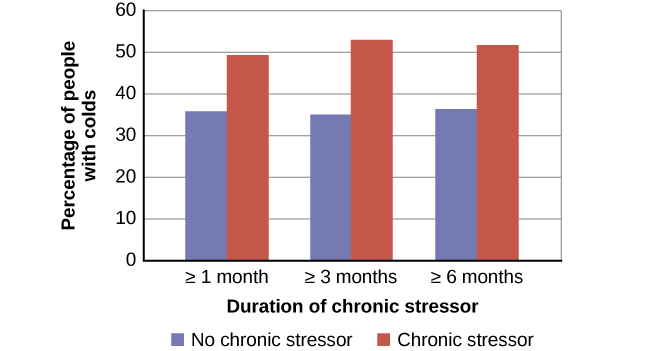

Figure 14.15図 14.15
This graph shows the percentages of participants who developed colds (after receiving the cold virus) after reporting having experienced chronic stressors lasting at least one month, three months, and six months (adapted from Cohen et al., 1998).
このグラフは、少なくとも1か月、3か月、6か月続く慢性的なストレッサーを経験したと報告した後に、(風邪のウイルスを投与されて)風邪をひいた参加者の割合を示している(Cohen et al., 1998を改変)。
In another study, older volunteers were given an influenza virus vaccination. Compared to controls, those who were caring for a spouse with Alzheimer’s disease (and thus were under chronic stress) showed poorer antibody response following the vaccination (Kiecolt-Glaser, Glaser, Gravenstein, Malarkey, & Sheridan, 1996).
英語のヒント
別の研究では、高齢のボランティアにインフルエンザウイルスのワクチンが接種された。統制群と比べて、アルツハイマー病の配偶者を介護していた人々(したがって慢性的なストレスのもとにあった人々)は、ワクチン接種後の抗体反応が弱かった(Kiecolt-Glaser, Glaser, Gravenstein, Malarkey, & Sheridan, 1996)。
Other studies have demonstrated that stress slows down wound healing by impairing immune responses important to wound repair (Glaser & Kiecolt-Glaser, 2005). In one study, for example, skin blisters were induced on the forearm. Subjects who reported higher levels of stress produced lower levels of immune proteins necessary for wound healing (Glaser et al., 1999). Stress, then, is not so much the sword that kills the knight, so to speak; rather, it’s the sword that breaks the knight’s shield, and your immune system is that shield.
英語のヒント
ほかの研究では、ストレスが、傷の修復に重要な免疫反応を損なうことによって、傷の治りを遅らせることが実証されている(Glaser & Kiecolt-Glaser, 2005)。たとえばある研究では、前腕に皮膚の水ぶくれをつくった。より高い水準のストレスを報告した対象者は、傷の治癒に必要な免疫タンパク質の産生量が少なかった(Glaser et al., 1999)。つまりストレスは、いわば騎士を殺す剣というよりも、騎士の盾を壊す剣なのである。そして、あなたの免疫系こそがその盾である。