第14章ストレス、生活習慣、健康
14.1 What Is Stress?14.1 ストレスとは何か
Learning Objectives学習目標
By the end of this section, you will be able to:
この節を学び終えると、次のことができるようになる。
- Differentiate between stimulus-based and response-based definitions of stressストレスの、刺激に基づく定義と反応に基づく定義を区別する
- Define stress as a processストレスを一つの過程として定義する
- Differentiate between good stress and bad stress良いストレスと悪いストレスを区別する
- Describe the early contributions of Walter Cannon and Hans Selye to the stress research fieldストレス研究の分野に対するウォルター・キャノンとハンス・セリエの初期の貢献を説明する
- Understand the physiological basis of stress and describe the general adaptation syndromeストレスの生理的基盤を理解し、汎適応症候群を説明する
The term stress as it relates to the human condition first emerged in scientific literature in the 1930s, but it did not enter the popular vernacular until the 1970s (Lyon, 2012). Today, we often use the term loosely in describing a variety of unpleasant feeling states; for example, we often say we are stressed out when we feel frustrated, angry, conflicted, overwhelmed, or fatigued. Despite the widespread use of the term, stress is a fairly vague concept that is difficult to define with precision.
英語のヒント
人間のありように関係する意味での「ストレス」という語が科学文献に初めて現れたのは1930年代だが、一般の日常語に入ったのは1970年代になってからである(Lyon, 2012)。今日、私たちはこの語を、さまざまな不快な気分の状態を表すのに大ざっぱに使うことが多い。たとえば、いらいらしたり、腹が立ったり、葛藤を感じたり、手に負えないと感じたり、疲れ切ったりしたときに、「ストレスがたまっている」とよく言う。この語は広く使われているものの、ストレスはかなりあいまいな概念であり、正確に定義するのは難しい。
Researchers have had a difficult time agreeing on an acceptable definition of stress. Some have conceptualized stress as a demanding or threatening event or situation (e.g., a high-stress job, overcrowding, and long commutes to work). Such conceptualizations are known as stimulus-based definitions because they characterize stress as a stimulus that causes certain reactions. Stimulus-based definitions of stress are problematic, however, because they fail to recognize that people differ in how they view and react to challenging life events and situations. For example, a conscientious student who has studied diligently all semester would likely experience less stress during final exams week than would a less responsible, unprepared student.
英語のヒント
研究者たちは、誰もが受け入れられるストレスの定義について合意するのに苦労してきた。ストレスを、負担の大きい、あるいは脅威となる出来事や状況(たとえば、ストレスの多い仕事、過密、長い通勤)として概念化した研究者もいる。こうした概念化は、ストレスを、ある種の反応を引き起こす刺激として特徴づけるので、刺激に基づく定義として知られている。しかし、ストレスの刺激に基づく定義には問題がある。人生の困難な出来事や状況をどうとらえ、それにどう反応するかが人によって異なることを、見落としているからである。たとえば、学期中ずっと熱心に勉強してきた勤勉な学生は、責任感が乏しく準備のできていない学生に比べて、期末試験の週に経験するストレスがおそらく少ないだろう。
Others have conceptualized stress in ways that emphasize the physiological responses that occur when faced with demanding or threatening situations (e.g., increased arousal). These conceptualizations are referred to as response-based definitions because they describe stress as a response to environmental conditions. For example, the endocrinologist Hans Selye, a famous stress researcher, once defined stress as the “response of the body to any demand, whether it is caused by, or results in, pleasant or unpleasant conditions” (Selye, 1976, p. 74). Selye’s definition of stress is response-based in that it conceptualizes stress chiefly in terms of the body’s physiological reaction to any demand that is placed on it. Neither stimulus-based nor response-based definitions provide a complete definition of stress. Many of the physiological reactions that occur when faced with demanding situations (e.g., accelerated heart rate) can also occur in response to things that most people would not consider to be genuinely stressful, such as receiving unanticipated good news: an unexpected promotion or raise.
英語のヒント
一方、負担の大きい、あるいは脅威となる状況に直面したときに生じる生理的反応(たとえば覚醒の高まり)を重視するかたちで、ストレスを概念化した研究者もいる。こうした概念化は、ストレスを環境条件に対する反応として記述するので、反応に基づく定義と呼ばれる。たとえば、著名なストレス研究者である内分泌学者ハンス・セリエは、かつてストレスを「あらゆる要求に対する体の反応であり、それが快い状態と不快な状態のどちらによって引き起こされるか、あるいはどちらをもたらすかは問わない」と定義した(Selye, 1976, p. 74)。セリエの定義は、ストレスを主として、体に課されるあらゆる要求に対する体の生理的反応という観点からとらえている点で、反応に基づく定義である。刺激に基づく定義も、反応に基づく定義も、ストレスの完全な定義にはなっていない。負担の大きい状況に直面したときに生じる生理的反応の多く(たとえば心拍数の上昇)は、たいていの人が本当の意味でストレスになるとは考えないような事柄、たとえば予期しない良い知らせ、つまり思いがけない昇進や昇給を受け取ることへの反応としても起こりうる。
A useful way to conceptualize stress is to view it as a process whereby an individual perceives and responds to events that they appraise as overwhelming or threatening to their well-being (Lazarus & Folkman, 1984). A critical element of this definition is that it emphasizes the importance of how we appraise—that is, judge—demanding or threatening events (often referred to as stressors); these appraisals, in turn, influence our reactions to such events. Two kinds of appraisals of a stressor are especially important in this regard: primary and secondary appraisals. A primary appraisal involves judgment about the degree of potential harm or threat to well-being that a stressor might entail. A stressor would likely be appraised as a threat if one anticipates that it could lead to some kind of harm, loss, or other negative consequence; conversely, a stressor would likely be appraised as a challenge if one believes that it carries the potential for gain or personal growth. For example, an employee who is promoted to a leadership position would likely perceive the promotion as a much greater threat if they believed the promotion would lead to excessive work demands than if they viewed it as an opportunity to gain new skills and grow professionally. Similarly, a college student on the cusp of graduation may face the change as a threat or a challenge (Figure 14.2).
英語のヒント
ストレスをとらえる有用な方法は、ストレスを、人が、自分の幸福にとって手に負えない、あるいは脅威となると評価する出来事を知覚し、それに反応する過程とみなすことである(Lazarus & Folkman, 1984)。この定義の決定的に重要な点は、負担の大きい、あるいは脅威となる出来事(しばしばストレッサーと呼ばれる)を私たちがどう評価するか、つまりどう判断するかの重要性を強調していることである。そして今度は、その評価が、そうした出来事への私たちの反応に影響する。この点で特に重要なのが、ストレッサーについての二種類の評価、すなわち一次評価と二次評価である。一次評価とは、ストレッサーがもたらしうる潜在的な害や幸福への脅威が、どの程度のものかについての判断である。ストレッサーが何らかの害や損失、そのほかの否定的な結果につながりうると予想すれば、人はおそらくそれを脅威と評価するだろう。逆に、ストレッサーが利益や個人的な成長の可能性をはらんでいると信じれば、おそらくそれを挑戦と評価するだろう。たとえば、管理職に昇進した社員は、昇進が過大な仕事の負担につながると思う場合のほうが、新しい技能を身につけて職業人として成長する機会とみなす場合よりも、その昇進をはるかに大きな脅威と受け止めるだろう。同じように、卒業を目前にした大学生は、その変化を脅威として迎えることも、挑戦として迎えることもあるだろう(図14.2)。

Figure 14.2図 14.2
Graduating from college and entering the workforce can be viewed as either a threat (loss of financial support) or a challenge (opportunity for independence and growth). (credit: Timothy Zanker)
大学を卒業して働きはじめることは、脅威(経済的な支えを失うこと)とも、挑戦(自立と成長の機会)ともとらえうる。(出典:Timothy Zanker)
The perception of a threat triggers a secondary appraisal: judgment of the options available to cope with a stressor, as well as perceptions of how effective such options will be (Lyon, 2012) (Figure 14.3). As you may recall from what you learned about self-efficacy, an individual’s belief in their ability to complete a task is important (Bandura, 1994). A threat tends to be viewed as less catastrophic if one believes something can be done about it (Lazarus & Folkman, 1984). Imagine that two middle-aged people, Robin and Madhuri, perform breast self-examinations one morning and each notices a lump on the lower region of their left breast. Although both view the breast lump as a potential threat (primary appraisal), their secondary appraisals differ considerably. In considering the breast lump, some of the thoughts racing through Robin’s mind are, “Oh my God, I could have breast cancer! What if the cancer has spread to the rest of my body and I cannot recover? What if I have to go through chemotherapy? I’ve heard that experience is awful! What if I have to quit my job? My partner and I won’t have enough money to pay the mortgage. Oh, this is just horrible…I can’t deal with it!” On the other hand, Madhuri thinks, “Hmm, this may not be good. Although most times these things turn out to be benign, I need to have it checked out. If it turns out to be breast cancer, there are doctors who can take care of it because the medical technology today is quite advanced. I’ll have a lot of different options, and I’ll be just fine.” Clearly, Robin and Madhuri have different outlooks on what might turn out to be a very serious situation: Robin seems to think that little could be done about it, whereas Madhuri believes that, worst case scenario, a number of options that are likely to be effective would be available. As such, Robin would clearly experience greater stress than would Madhuri.
英語のヒント
脅威が知覚されると、二次評価が引き起こされる。二次評価とは、ストレッサーに対処するために使える選択肢についての判断であり、あわせて、そうした選択肢がどれほど効果的かについての認識でもある(Lyon, 2012)(図14.3)。自己効力感について学んだことから覚えているかもしれないが、課題をやり遂げる自分の能力に対する個人の信念は重要である(Bandura, 1994)。何か手の打ちようがあると信じていれば、脅威はそれほど破滅的なものとはみなされない傾向がある(Lazarus & Folkman, 1984)。中年のロビンとマドゥリという二人が、ある朝、乳房の自己検診をして、それぞれ左の乳房の下のほうにしこりがあるのに気づいたと想像してほしい。二人ともそのしこりを潜在的な脅威とみなしている(一次評価)が、二人の二次評価はかなり異なる。しこりについて考えるロビンの頭を駆けめぐっている考えには、たとえば次のようなものがある。「どうしよう、乳がんかもしれない! がんが体のほかの部分に広がっていて、治らなかったらどうしよう? 化学療法を受けなければならなくなったら? あれはひどくつらい経験だと聞いたことがある! 仕事を辞めなければならなくなったらどうしよう? パートナーと私では、住宅ローンを払うだけのお金が足りなくなる。ああ、本当にひどい……とても耐えられない!」一方、マドゥリはこう考える。「うーん、これはよくないかもしれない。こういうものはたいてい良性だと分かるけれど、検査してもらう必要がある。もし乳がんだと分かっても、今の医療技術はかなり進んでいるから、治療してくれる医者がいる。いろいろな選択肢があるだろうし、きっと大丈夫。」明らかに、ロビンとマドゥリは、非常に深刻な事態になるかもしれない状況について、異なる見通しを持っている。ロビンは、それについてほとんど何も打つ手がないと考えているようだが、マドゥリは、最悪の場合でも、効果的である可能性の高い選択肢がいくつもあるだろうと信じている。したがって、ロビンは明らかにマドゥリよりも大きなストレスを経験するだろう。
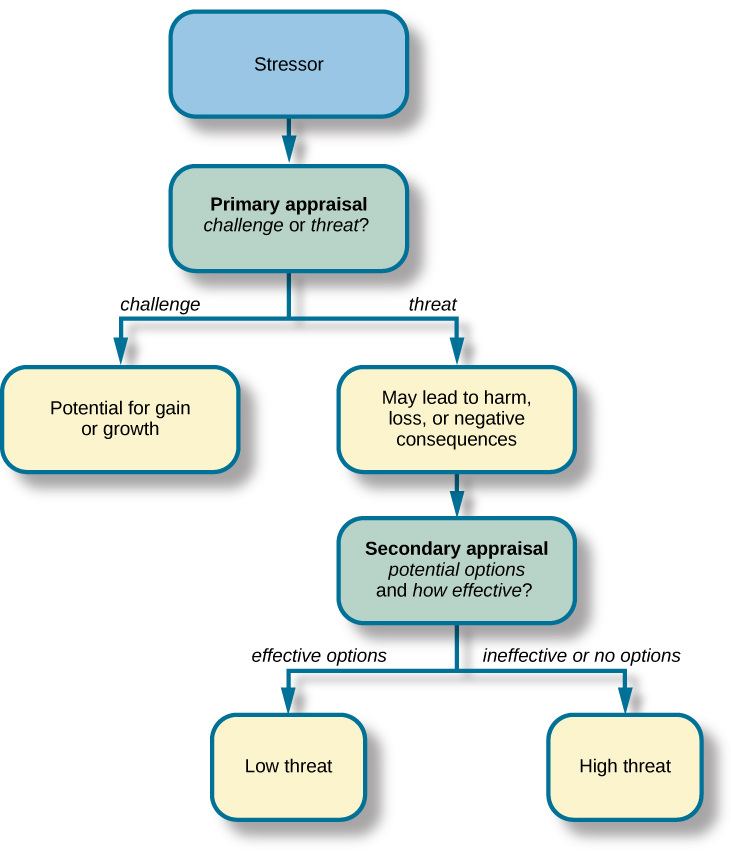


Figure 14.3図 14.3
When encountering a stressor, a person judges its potential threat (primary appraisal) and then determines if effective options are available to manage the situation. Stress is likely to result if a stressor is perceived as extremely threatening or threatening with few or no effective coping options available.
ストレッサーに出会うと、人はその潜在的な脅威を判断し(一次評価)、次に、その状況に対処するための効果的な選択肢があるかどうかを見定める。ストレッサーが極度の脅威と知覚される場合や、脅威と知覚されたうえで効果的な対処の選択肢がほとんど、あるいはまったくない場合に、ストレスが生じる可能性が高い。
To be sure, some stressors are inherently more stressful than others in that they are more threatening and leave less potential for variation in cognitive appraisals (e.g., objective threats to one’s health or safety). Nevertheless, appraisal will still play a role in augmenting or diminishing our reactions to such events (Everly & Lating, 2002).
英語のヒント
確かに、ストレッサーの中には、ほかのものより本質的にストレスの大きいものもある。より脅威が大きく、認知的評価が人によって変わる余地が小さいという点で、そうなのである(たとえば、自分の健康や安全への客観的な脅威)。それでも、そうした出来事への反応を強めたり弱めたりするうえで、評価はやはり一定の役割を果たすだろう(Everly & Lating, 2002)。
If a person appraises an event as harmful and believes that the demands imposed by the event exceed the available resources to manage or adapt to it, the person will subjectively experience a state of stress. In contrast, if one does not appraise the same event as harmful or threatening, she is unlikely to experience stress. According to this definition, environmental events trigger stress reactions by the way they are interpreted and the meanings they are assigned. In short, stress is largely in the eye of the beholder: it’s not so much what happens to you as it is how you respond (Selye, 1976).
英語のヒント
ある人が、ある出来事を有害なものと評価し、その出来事が課す要求が、それに対処したり適応したりするために使える資源を上回ると信じるなら、その人は主観的にストレスの状態を経験するだろう。これに対して、同じ出来事を有害とも脅威とも評価しなければ、その人がストレスを経験する可能性は低い。この定義によれば、環境の出来事がストレス反応を引き起こすのは、それがどう解釈され、どのような意味を与えられるかを通じてである。要するに、ストレスは大部分が受け止める人しだいである。大事なのは、自分に何が起こるかというよりも、それにどう反応するかなのである(Selye, 1976)。